

An inbound call center is the nerve center of your customer experience, the place where all incoming customer calls land. Unlike outbound centers that are all about making calls, an inbound call center is built to react and respond to what customers need right now—whether that’s help with a support ticket, placing an order, or just getting a question answered.
What Is an Inbound Call Center

Think of an inbound call center as your company's front door for every customer conversation. It’s a dedicated team or service designed exclusively to field calls that your customers initiate. This single function is the absolute backbone of great customer service, turning what could be a simple problem-solving chore into a strategic asset for building rock-solid loyalty and trust.
The key difference comes down to who makes the first move. In an inbound setup, the customer is the one reaching out. This simple fact completely changes the dynamic of the conversation. The customer already has a specific need—a problem to solve, a question to ask, or a purchase to make—and your team’s job is to meet that need effectively and without friction. It's a world away from outbound centers, where agents are proactively calling prospects for sales or surveys.
The Strategic Value of Inbound Operations
A high-performing inbound call center does a lot more than just answer the phone; it acts as a critical listening post for your entire business. Every single call is a goldmine of insights into customer pain points, product feedback, and what the market is actually demanding. When managed well, it stops being a cost center and becomes a powerful engine for keeping customers happy and driving revenue.
For example, a customer calling for tech support isn't just a ticket to be closed. It’s a golden opportunity to deliver an experience that reinforces their decision to choose your brand in the first place. Likewise, a sales inquiry is a red-hot lead that, if handled correctly, can be converted on the spot.
An inbound call center is a direct reflection of your company's commitment to its customers. The quality of this single touchpoint can define the entire customer relationship, impacting everything from satisfaction scores to long-term loyalty.
The economic importance of this function is impossible to ignore. The global market for outsourced inbound services was valued at US$57,932.2 million in a recent year and is projected to skyrocket to US$93,810.7 million by 2030, growing at a rapid 9% CAGR. This explosive growth shows just how seriously businesses are taking professional inbound call management. You can dive deeper into the market growth for inbound services on Grand View Research.
Core Functions and Responsibilities
While the overarching goal is always to help customers, the day-to-day operations of an inbound call center are surprisingly diverse. Agents are trained to juggle a wide range of tasks, each requiring its own unique set of skills. Let's break down the core responsibilities that keep a modern inbound center humming.
Core Functions of a Modern Inbound Call Center
This table outlines the primary roles within a high-performing inbound call center, helping you quickly understand its key responsibilities.
| Function | Description | Primary Goal |
|---|---|---|
| Technical Support | Assisting customers with troubleshooting product issues, software problems, or service interruptions. | Resolve technical problems efficiently to restore customer satisfaction and product usability. |
| Customer Service | Answering general inquiries, updating account information, and resolving billing disputes. | Provide helpful, accurate information and resolve non-technical issues to build positive relationships. |
| Order Processing | Taking orders over the phone, processing payments, and managing sales transactions. | Facilitate a smooth and secure purchasing experience, driving direct revenue for the business. |
| Appointment Setting | Scheduling consultations, service calls, or meetings for other departments. | Convert interest into actionable appointments, feeding the sales or service pipeline. |
Ultimately, every single function within an inbound call center is geared toward one thing: creating a positive, seamless, and genuinely helpful customer experience.
Tracking the Metrics That Actually Matter

Running an inbound call center without tracking the right data is like flying a plane blind. You might be moving, but you have no idea if you're headed for your destination or straight into a storm. Data is everything, but it's easy to drown in vanity metrics that look good on a chart but don’t actually move the needle.
The secret is to focus on Key Performance Indicators (KPIs) that tell you a clear story about your two main goals: operational efficiency and customer satisfaction. These numbers cut through the noise, showing you what’s working, what’s not, and where you need to improve. They turn guesswork into a real strategy.
Measuring Efficiency and Productivity
Efficiency metrics are all about how well your team is using its resources—mostly, your agents' time. Nailing these numbers means you can handle more calls without burning out your team or blowing your budget. Think of these as the engine-room stats that keep the whole operation running.
One of the most foundational KPIs is Average Handle Time (AHT). This measures the entire customer interaction, from "hello" to the moment an agent finishes their post-call notes. If your AHT is creeping up, it could be a sign that agents need more training or your internal processes have too many steps.
But speed alone is a trap. It has to be balanced with First Call Resolution (FCR), which tracks the percentage of calls where the customer's problem is solved in one go. No callbacks needed.
A high FCR is a massive win. It’s one of the clearest signs of a top-tier inbound call center because it means your agents are knowledgeable, empowered, and have the tools to fix things on the spot. That's a direct line to happier customers.
For example, an insurance agency with a low FCR rate is just creating a cycle of frustrated callbacks, driving up costs and chipping away at client trust. On the other hand, a home services company that nails scheduling issues on the first try leaves customers feeling confident and taken care of.
Gauging the Customer Experience
Efficiency is critical, but it’s worthless if your customers hang up feeling ignored or frustrated. Customer-centric KPIs measure the quality of the interaction from the caller's point of view. This is your report card, and it tells you if your push for speed is hurting your service.
The most direct measure here is your Customer Satisfaction (CSAT) score. This usually comes from a quick post-call survey asking customers to rate their experience. It gives you immediate, honest feedback on both individual agents and your overall service quality.
Another big one is the Net Promoter Score (NPS), which gets at long-term loyalty. It’s based on a single question: "On a scale of 0-10, how likely are you to recommend us to a friend?" High scores mean you're creating brand fans; low scores are a warning sign that customers might be heading for the door.
Let’s look at a few other essential metrics:
- Abandonment Rate: The percentage of people who hang up before ever reaching an agent. A high rate is a huge red flag, often pointing to painful wait times or a confusing phone menu.
- Service Level: This tracks how quickly you answer the phone—for example, answering 80% of calls within 20 seconds. It’s a direct reflection of how accessible your team is.
By keeping a close eye on these core KPIs, your inbound call center stops being just a reactive cost center and becomes a proactive, data-driven engine for growth. You get the clarity you need to make smarter decisions, train your team effectively, and build an experience that keeps customers coming back.
The Shift to an AI-Powered Inbound Strategy

The traditional inbound call center model, for all its reliability over the years, is starting to show its age in a world that never logs off. Its effectiveness has always been chained to human availability. This means high labor costs, rigid operating hours, and a constant struggle to keep up when call volumes spike.
When your team is slammed or simply off the clock, potential customers and urgent support requests get funneled into a voicemail box. Let's be honest—that voicemail often feels like a black hole.
This is exactly where a new approach comes in. The modern inbound center isn’t about choosing between human agents or automation anymore. Instead, it’s about creating a powerful partnership between them. AI voice agents are now acting as a true force multiplier, helping you build a more responsive, efficient, and cost-effective operation.
Imagine a "digital receptionist" that never sleeps, eats, or takes a break. This AI assistant can instantly answer every single call, qualify leads, gather key information, and book appointments right into your calendar, 24/7. This isn’t about replacing your team; it’s about finally letting them do their best work.
Redefining Roles and Responsibilities
Bringing AI into the mix fundamentally changes the day-to-day workflow. All the repetitive, predictable tasks that used to eat up an agent's day are now handled automatically.
This frees your human experts to focus only on what they do best: navigating complex negotiations, solving nuanced customer problems, and building the genuine relationships that create loyalty and drive sales.
Your business can now operate with an efficiency that just wasn't possible before. Your team is no longer bogged down with routine intake questions or basic scheduling. Instead, they’re connecting with callers who are already qualified and ready for a high-value conversation.
The economic shift is already happening. The global AI market in call centers was recently valued at USD 3.98 billion and is expected to hit USD 4.89 billion next year. Companies embracing AI-driven tools are seeing a 14% increase in issues resolved per hour and a 9% reduction in average call handling time.
With 50% of businesses already using AI tools and another 34% planning to, the trend is clear. You can dig into these impactful call center statistics to see the data for yourself.
Traditional vs. AI-Powered: A Practical Comparison
To really see the difference, it helps to put the two models side-by-side. The gap in availability, cost, and raw capability is striking. An AI-augmented inbound center isn't just a small upgrade; it's a completely different operating model built for the speed of modern business.
Here’s a breakdown of the key distinctions.
Traditional Call Center vs Modern AI-Powered Center
This table highlights the core differences between the old way and the new, AI-powered approach.
| Feature | Traditional Call Center | AI-Powered Call Center |
|---|---|---|
| Availability | Limited to business hours and staffing levels. | Operates 24/7/365, ensuring no call is ever missed. |
| Cost Structure | High fixed and variable costs (salaries, benefits, overhead). | Lower, predictable costs based on usage, not headcount. |
| Scalability | Slow and expensive to scale; requires hiring and training. | Instantly scalable to handle any call volume without delay. |
| Data Capture | Relies on manual agent entry, prone to human error. | Automatically captures and logs call data with near-perfect accuracy. |
| Agent Focus | Agents juggle routine tasks with complex issues. | Agents focus solely on high-value, revenue-generating conversations. |
As you can see, the AI-powered model is built for agility and efficiency, directly addressing the core limitations of the traditional setup.
The goal of an AI-powered inbound strategy is not to eliminate the human element but to elevate it. By automating the predictable, you empower your team to excel at the exceptional.
This smart division of labor creates a system that is both incredibly efficient and deeply human. Routine calls get handled instantly and accurately by AI, while customers who need real empathy and creative problem-solving are connected seamlessly to a well-prepared human agent.
This dual approach guarantees every caller gets the best possible experience for their specific need, turning your inbound call center from a cost center into a powerful engine for growth.
Putting AI to Work in Your Industry
The idea of an AI-powered call center can feel a bit abstract. It’s easy to get lost in the tech talk until you see it solving real-world problems—the kinds of nagging, everyday headaches that cost you time and money.
We’re not talking about some far-off futuristic concept. This is about putting a tool to work on the ground, right now, to fix things like missed calls after 5 PM or leads that go cold because your team couldn't follow up fast enough.
Let's look at a few concrete scenarios where an AI voice agent isn't just a nice-to-have, but a core part of the team. Each example tackles a common business challenge and shows how this kind of automation delivers a direct, measurable fix.
For the Auto Insurance Agency
In the cutthroat world of auto insurance, speed is the name of the game. When a potential client calls for a quote, you can bet they're also calling two or three of your competitors. If that call goes to voicemail because it’s after hours or your agents are tied up, you’ve probably lost that lead for good.
This is a perfect job for an AI agent.
- The Challenge: You need to capture and qualify every single lead, 24/7, without hiring a massive overnight team.
- The AI Solution: An AI voice agent answers every call on the first ring, day or night. It jumps right into the important qualifying questions, like, "What's the year, make, and model of your vehicle?" or "Have you had any accidents in the last three years?"
- The Outcome: The AI gathers all the essential info for a quote. It can then schedule a callback with a licensed agent for the next morning or, if it’s during business hours, transfer the warm, pre-qualified lead directly to an available human. No lead ever hits a voicemail box, and your team gets to spend their time actually building quotes and closing deals, not just collecting basic data.
By automating that first conversation, an insurance agency can achieve 100% lead capture. Suddenly, your inbound line is no longer a bottleneck; it's a reliable, around-the-clock lead generation machine.
For the Home Services Company
If you run an HVAC, plumbing, or electrical business, your phone is your lifeline. A homeowner with a burst pipe isn’t going to wait around. They need help now. The biggest operational nightmare is often juggling a complex schedule, trying to book appointments without double-booking a technician or making a frantic customer wait on hold.
An AI-powered system becomes the perfect dispatcher.
- The Challenge: You have to check technician availability and book jobs accurately on the spot, without putting customers on hold or promising a callback that might come too late.
- The AI Solution: The AI agent plugs directly into your company’s scheduling software—whether it's a dedicated platform or a simple shared calendar. When a customer calls to book a service, the AI asks for their zip code, understands they need a "furnace repair," and checks the calendar in real time.
- The Outcome: The AI can instantly offer up real, available time slots. “I’ve got an opening tomorrow between 10 AM and noon, or one in the afternoon between 2 and 4. Which works better for you?” It books the appointment right then and there. This lifts the administrative weight off your techs and office staff, slashes booking errors, and gives customers the immediate resolution they crave.
For the Law Firm
Legal intake is a delicate dance. Firms have to gather sensitive information while quickly figuring out if a potential client actually has a viable case. This means asking the right questions, every single time—a process that eats up the valuable time of paralegals and attorneys who are already buried in casework.
This is where AI steps in as a precise and tireless intake specialist.
- The Challenge: You need a way to filter a high volume of calls to find the qualified clients, all without wasting billable hours on inquiries that are going nowhere.
- The AI Solution: Following a script designed by the firm, the AI agent conducts the initial screening. It asks the critical questions upfront, like, "Can you briefly describe your legal issue?" or for a personal injury case, "Was a police report filed at the scene of the incident?"
- The Outcome: The AI gathers and neatly documents all the preliminary case details, separating the promising leads from the calls that don't fit the firm's practice areas. This frees up the legal team to pour their energy into consultations with pre-vetted, high-potential clients, making the entire firm more efficient and boosting its conversion rates.
How to Implement Your AI Inbound Solution
Making the jump to an AI-powered inbound system is a lot more straightforward than most business owners think. It's not about a massive, complex overhaul. The secret is breaking the process down into simple, manageable steps.
This roadmap will walk you through everything, from the initial "what-if" planning stage to having a fully operational AI agent working for you 24/7.
The first step is always the same: define your number one goal. What's the single biggest headache you're trying to solve with this? Are you bleeding leads after 5 PM? Is your team drowning in repetitive, mind-numbing qualification calls? Getting crystal clear on this one thing will guide every other decision you make.
For example, a home services company might be desperate to stop missing emergency calls overnight. A law firm, on the other hand, might just want a faster, better way to pre-qualify potential clients.
Nail down your objective and make it measurable. Something like "capture 100% of after-hours calls" or "cut our lead qualification time by 50%" gives you a clear target to aim for and a benchmark for success.
Designing Your Ideal Call Flow
Once you know why you're doing this, you can figure out how the conversation should go. A call flow is just the step-by-step journey your AI agent will guide a caller through. Think of it as a smart, interactive script that knows how to pivot based on what the caller says.
This is where you map out the must-ask questions for your business. What info is absolutely essential to qualify a lead or book a solid appointment? The goal here is to gather what you need without making the call feel like a robotic interrogation.
A well-designed flow for an insurance agency, for instance, might look something like this:
- Greeting: A warm, professional welcome that clearly identifies the agency.
- Initial Triage: "Are you calling for a new quote, to check on an existing claim, or for something else?"
- Data Collection: Gathering key details like the caller's vehicle information or property address.
- Action: Booking a callback with a licensed agent or, if it's urgent, transferring the caller immediately.
This infographic shows exactly how that kind of streamlined process turns a simple phone call into a booked appointment on the calendar.
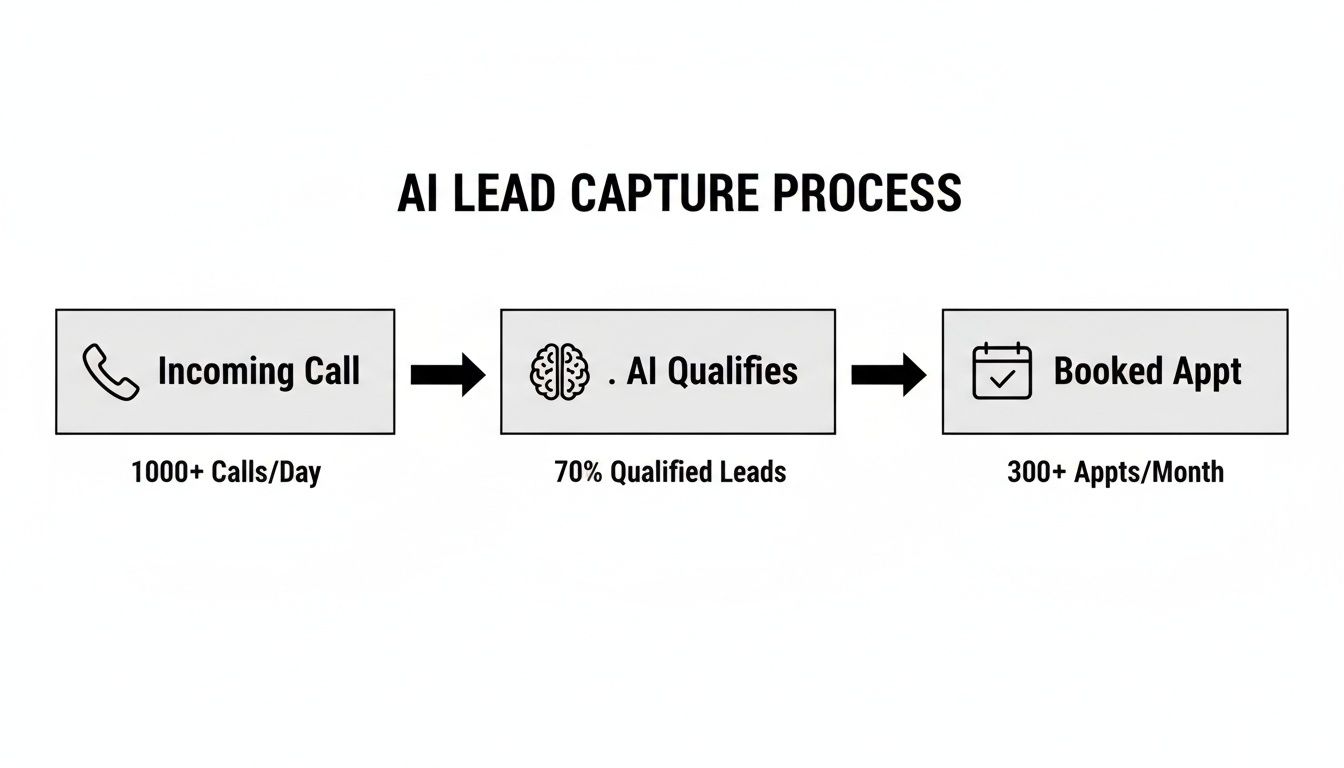
This visual really gets to the core of what the AI does: it turns raw interest into real business opportunities with as little friction as possible.
Integrating and Training Your AI Agent
An AI agent is only as good as its connections. The most powerful ones slot right into the tools you're already using every day. Modern platforms like Voicedial.ai are built from the ground up to integrate easily with your CRM, scheduling software, and other business systems.
This connection is what automates all the tedious work. When the AI books an appointment, it pops up directly in your team’s calendar. When it qualifies a new lead, a contact record is created in your CRM automatically. No more manual data entry, and no more delays. Your team gets the info they need, instantly.
Training the AI is all about feeding it the call flows and responses you've already designed. The system learns your company's specific lingo, business rules, and any compliance requirements you have. This ensures it represents your brand just as professionally and accurately as your best human agent. It’s what makes the AI feel like a genuine extension of your team.
Calculating ROI and Ensuring Compliance
So, how do you know if it's working and how do you stay on the right side of the law? Calculating your Return on Investment (ROI) is actually pretty simple. You just compare the cost of the AI solution to the value it's creating.
That value comes from two places: the direct savings on labor costs and the new revenue you're generating from leads that you otherwise would have lost for good.
The true ROI of an AI inbound solution isn't just about cost savings. It's about unlocking new growth by ensuring every single sales opportunity that calls your business is captured and acted upon, 24/7.
Compliance is the other critical piece of the puzzle, especially if you're in a regulated industry. Reputable AI providers bake compliance features right into their platforms. This means using pre-approved scripts that include necessary legal disclosures and ensuring all data is handled securely to meet industry standards. That built-in security is what lets you automate with complete peace of mind.
As your business grows, these kinds of cloud-based solutions become non-negotiable. The market for cloud contact centers is on track to hit USD 82.43 billion by 2030, a trend driven by the need for flexible, scalable systems. With the average call center handling thousands of calls a month, AI provides the backbone to manage that volume without breaking a sweat. You can find out more about the latest call center statistics and trends on Sprinklr.
Got Questions About AI Call Centers?
Making the move to an AI-powered inbound call center feels like a big step. It’s totally normal to have questions about how it all works, what it means for your customers, and whether the investment is actually going to pay off. This is a real operational shift, and you need real answers.
Let's cut through the noise and tackle the most common questions business leaders ask when thinking about adding an AI voice agent to their team. The idea is to give you the clarity you need to make a decision you feel good about.
"Will an AI Voice Agent Just Frustrate My Customers?"
This is always the first question, and for good reason. We’ve all been trapped in those clunky, robotic phone menus from a decade ago. The good news? Technology has come a long, long way. Today's AI agents are built with natural-sounding voices, realistic pacing, and human-like intonation.
The goal isn’t to trick someone into thinking they're talking to a person. It's to give them a surprisingly fast, professional, and helpful first point of contact for routine stuff. In fact, research shows that when customers feel an agent isn't just reading from a script, their satisfaction can hit as high as 78%. A well-programmed AI agent delivers that kind of consistency without sounding like a robot.
The best AI inbound systems don't try to do everything. They operate on a hybrid model where the AI handles the predictable, fact-finding parts of a call. Then, for anything complex, sensitive, or emotional, it seamlessly hands off to a human. This gives customers the best of both worlds: speed for simple tasks and real empathy when it truly counts.
With this setup, your team is always there for the conversations that need a human touch, while the AI makes sure no call ever goes unanswered.
"How Does This AI Even Connect With My Current Software?"
A tool that doesn't talk to your other systems just creates more work. That's why smooth integration is a non-negotiable for any AI call center solution worth its salt. Modern platforms are designed from the ground up to plug right into the software you already use every day.
This connection usually happens through something called an Application Programming Interface (API), which is basically a secure bridge that lets different software programs share information automatically.
For instance, a good AI agent can:
- Talk to your CRM to create new lead profiles, log call notes, and update customer records the second a conversation ends.
- Sync with scheduling software like Calendly or Acuity to check real-time availability and book appointments directly into your team's calendars.
- Tap into your internal knowledge base to pull up-to-date answers for common questions, guaranteeing customers always get the right information.
This is what turns the AI from a simple answering machine into a core part of your workflow. It gets rid of soul-crushing manual data entry, slashes the risk of human error, and creates a clean, unbroken line from the first ring to the final follow-up.
"What’s the Real ROI of an AI Inbound System?"
The return on investment you get from an AI-powered inbound system isn't just some vague promise of "efficiency." It shows up in three very real, measurable ways.
First, you get an immediate and direct reduction in operational costs. An AI voice agent can handle a virtually unlimited number of calls, 24/7, for a fraction of what it costs to hire, train, and manage enough human staff to provide the same coverage. You stop paying for idle time and only pay for active call handling.
Second, you see a major increase in revenue opportunities. Think about it: every call that hits voicemail is a potential sale you just handed to a competitor who answered their phone. By giving every single caller an instant response, you capture leads that would have otherwise disappeared. The AI then qualifies them on the spot, so your sales team only spends their valuable time on high-potential prospects who are actually ready to talk.
Finally, you get a massive boost in overall team productivity. When your skilled people are freed from the repetitive grind of answering basic questions and scheduling appointments, they can focus their full energy on the high-value work that actually moves the needle—closing tough deals, solving tricky customer problems, and building relationships that last.
"How Do I Make Sure My AI Agent Is Compliant?"
If you're in a regulated industry like finance, healthcare, or legal services, compliance isn't just a good idea—it's the law. Any top-tier AI provider gets this and builds security and compliance features directly into their platform from day one.
It starts with the call scripts. The system has to let you build carefully structured call flows that include all the necessary legal disclosures and consent language required by regulations like TCPA, HIPAA, or GDPR. This makes sure every conversation meets the legal standard from the very first word.
On top of that, a compliant system ensures all sensitive data—from call recordings to customer info—is encrypted and stored securely. This protects both your business and your clients from data breaches and privacy violations. When you're looking at different AI providers, you absolutely must ask about their experience in your specific industry and double-check their security protocols. Doing that homework lets you automate your inbound calling with confidence, knowing you can grow your operations without compromising on legal integrity.
Ready to see how an AI-powered inbound call center can transform your business? Voicedial.ai delivers human-like AI voice agents that capture every lead and book appointments 24/7. Discover how our platform can help you reduce costs, increase conversions, and free up your team to focus on what they do best by visiting https://voicedial.ai.