

Predictive dialing isn't just about calling numbers faster; it’s an intelligent system designed to do one thing exceptionally well: connect your agents with live prospects, one after another, with almost no downtime in between. The entire goal is to make sure that the second an agent finishes a call, another live person is already on the line waiting for them.
This technology is the workhorse of high-volume sales teams because it automatically filters out all the time-wasters—busy signals, voicemails, disconnected numbers, and fax machines. The result is a massive jump in call volume and a team that spends its time selling, not dialing.
How Predictive Dialing Actually Works
Think of a predictive dialer as a highly efficient traffic controller for your sales floor. Its sole purpose is to eliminate the stop-and-go nature of manual dialing. Instead of agents picking up the phone, dialing, waiting, and often hitting a dead end, the system does all that legwork in the background. It’s not just dialing more numbers; it's dialing them smarter.
The real "magic" behind it is a sophisticated pacing algorithm. This isn't just a simple script; it's a dynamic engine that constantly learns from what's happening in real-time.
The Brains of the Operation: The Pacing Algorithm
This algorithm is what separates a predictive dialer from simpler automated systems. It crunches several key data points—both historical and live—to decide exactly how many numbers to dial at any given moment.
Here's what it's constantly analyzing:
- Average Call Duration: It knows how long your agents typically spend on a successful conversation.
- Live Answer Rate: It keeps a running tally of what percentage of calls are actually picked up by a real person.
- Agent Availability: It has a live headcount of how many agents are busy versus how many are free or about to be.
- Wrap-Up Time: It factors in the crucial seconds or minutes an agent needs after a call to log notes or schedule the next step.
Based on all this, the algorithm predicts when an agent is about to become available and starts dialing numbers before that happens. It intentionally over-dials, dialing more numbers than you have free agents, because it's betting that some calls won't connect, some will go to voicemail, and at least one will be answered by a live person at the perfect moment.
This flow diagram breaks down the process, showing how the system takes a list of numbers and turns it into a steady stream of live conversations for your agents.
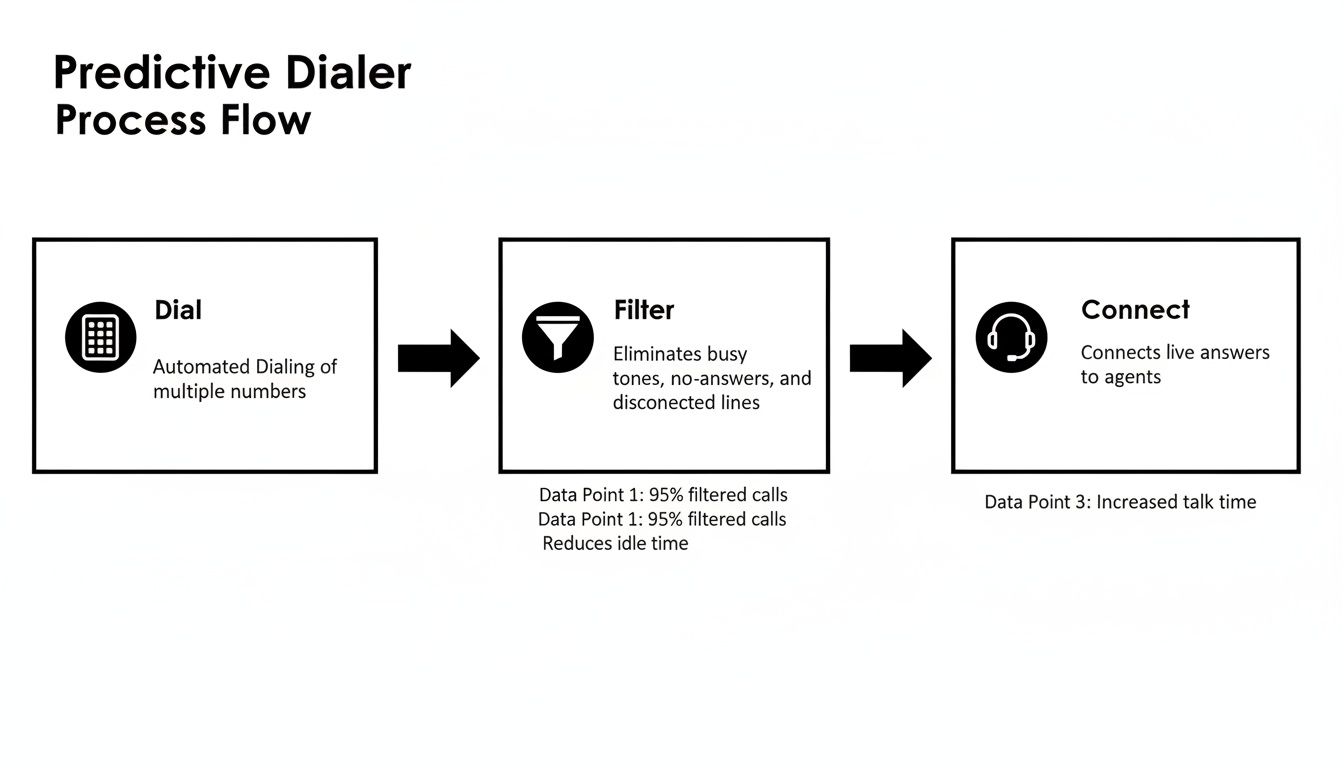
As you can see, the process is simple but powerful: the dialer places the calls, weeds out the duds, and seamlessly passes the live connections to the next available agent.
To give you a clearer picture, let's break down these core components into a simple table.
Key Predictive Dialer Concepts at a Glance
This table provides a quick reference for the essential moving parts of a predictive dialing system and why they're so important for your team's performance.
| Concept | What It Does | Why It Matters For Your Business |
|---|---|---|
| Pacing Algorithm | Analyzes real-time data to determine how many numbers to dial per available agent. | This is the "brain" that balances call volume with agent availability to maximize talk time without creating excessive abandoned calls. |
| List Management | Imports, organizes, and scrubs your contact lists, often removing duplicates or known bad numbers. | Clean lists mean higher connection rates and better compliance. A good system ensures you're calling the right people. |
| Answering Machine Detection (AMD) | Uses audio analysis to differentiate between a live human voice and a pre-recorded voicemail greeting. | This feature is crucial for filtering out unproductive calls, ensuring agents only get connected to real people. |
| Call Filtering | Automatically screens out busy signals, disconnected lines, and other non-productive call outcomes. | Eliminates the single biggest time-waster in manual dialing, freeing up hours of agent time each day. |
| Agent Scripting | Provides on-screen scripts and talking points for agents to follow during a live call. | Ensures consistent messaging, helps new agents ramp up faster, and keeps your team compliant with required disclosures. |
| CRM Integration | Connects the dialer to your Customer Relationship Management (CRM) system to log calls and update records. | Automates data entry, provides agents with customer context ("screen pops"), and keeps your sales data accurate and centralized. |
These components all work together to create a system that’s far more than just a rapid-fire dialer; it’s a complete workflow engine built for high-efficiency outreach.
The Core Goal: Maximizing Agent Talk Time
At the end of the day, the single most important metric a predictive dialer is built to improve is agent talk time. This is the actual amount of time your agents spend in meaningful conversations with prospects.
Think about it: in a manual dialing environment, an agent might only spend 15-20 minutes of every hour actually talking to someone. The rest of that hour is burned on dialing, listening to rings, leaving voicemails, and getting dead-ends. It's incredibly inefficient.
A predictive dialer completely flips that ratio. By cutting out all the wasted motion, it can push agent talk time to up to 50 minutes per hour. This is why the technology is such a game-changer for any team doing high-volume outreach.
For industries like insurance, where agents are selling complex products like Medicare or auto policies, the impact is huge. We've seen teams increase their connect rates by up to 300% compared to dialing by hand. While every campaign is different, the core benefit remains: agents simply get to have more conversations every single day. For more data on these trends, check out the market analysis from Grand View Research.
A predictive dialer essentially transforms an agent's role from a 'dialer' into a 'closer.' By automating the most repetitive and least productive parts of the job, it frees them to focus solely on building rapport and driving sales.
This shift isn't just about the numbers. It boosts team morale and helps everyone hit their targets more consistently. When your reps are constantly engaged in live conversations, their skills sharpen, their confidence grows, and the results follow—directly impacting your bottom line.
The Tangible Benefits of Predictive Dialing

Knowing how a predictive dialer works is one thing, but seeing how it directly impacts your bottom line is what really matters. The biggest benefit you’ll see is a dramatic, almost immediate jump in agent productivity. It accomplishes this by completely changing the rhythm of an agent's day.
Instead of getting bogged down in manual, repetitive tasks, agents are kept in a steady flow of live conversations. That single shift is the key to unlocking some serious gains in both efficiency and revenue.
Skyrocketing Agent Talk Time
The single most important metric a predictive dialer transforms is agent talk time. This is the slice of each hour an agent actually spends talking to prospects, not dialing numbers, waiting for an answer, or navigating voicemail systems.
In a traditional setup, an agent might be lucky to get 15 to 20 minutes of real talk time in an hour. The rest of that time just evaporates into unproductive busywork. Predictive dialers completely flip that ratio, often pushing talk time past 50 minutes per hour.
By getting rid of nearly all the manual grunt work, a predictive dialer lets agents focus entirely on what they do best: building rapport, qualifying leads, and closing deals.
This massive boost in productive time means your team can deliver more pitches, qualify more prospects, and generate more opportunities every single day—without having to hire more people.
Improving Lead Penetration and Campaign Efficiency
Beyond just making individual agents faster, predictive dialing makes your entire campaign more effective. It gives your team much deeper lead penetration, making sure you actually contact every possible lead on your list without wasting time.
Think about a home services company sitting on a list of 1,000 old leads. An agent dialing manually could take a week or more to get through that list. With a predictive dialer, a small team can power through that same list in just one afternoon.
This kind of speed and efficiency unlocks a few key advantages:
- Faster Lead Follow-Up: You can connect with new leads within minutes of them showing interest, which is a massive factor in conversion rates.
- Consistent Outreach: The system makes sure no lead is ever forgotten or accidentally skipped, helping you get the most out of every dollar you spend on marketing.
- Reduced Operational Costs: Automating the dialing process cuts down the labor costs tied to manual outreach, leading to a much higher return on your investment.
Predictive dialing first hit the scene in the late 1990s as an evolution of basic auto-dialers. It changed the game by using historical data to guess when someone would answer, automatically dropping calls that went to voicemail or busy signals. Today, industries like healthcare and insurance are driving huge demand for these systems, which can connect agents to live prospects 200-400% faster than older dialing methods. You can find more stats on the predictive dialer software market on Market.us.
Gaining Real-Time Campaign Insights
Modern predictive dialers are more than just dialing machines; they're powerful analytics platforms. They give managers a live window into how a campaign is performing, going way beyond simple call counts to offer deep, actionable insights.
You can instantly track the key performance indicators (KPIs) you need to optimize your strategy on the fly:
- Live Answer Rate: See the exact percentage of calls connecting to a real person. This helps you pinpoint the absolute best times of day to be calling your lists.
- Agent Status Monitoring: Get a live look at how many agents are actively on calls, waiting for the next one, or in wrap-up time after a conversation.
- Call Outcome Tracking: Automatically log whether a call ended in a sale, an appointment, a wrong number, or a request to call back later.
This data lets you make smart, immediate adjustments to your campaigns. You can A/B test different call lists, scripts, or calling hours and see right away what’s working and what’s not, ensuring your resources are always pointed where they’ll have the biggest impact.
Navigating the Risks of Abandoned Calls and Compliance

The incredible efficiency of a predictive dialer comes with a critical trade-off, and every manager needs to have this on their radar. While the system is built to maximize agent talk time, its real power comes from dialing more numbers than you have available agents. This strategy is what creates the central challenge that sits at the intersection of customer experience and legal compliance.
That challenge is the abandoned call. It’s what happens when the dialer connects with a live human, but no agent is free to take the call within a couple of seconds. For the person on the other end, it's a deeply frustrating experience—they say "hello" only to be met with dead air before the line clicks off. This is more than just a bad first impression; it's a primary focus of federal regulations.
Understanding the Abandonment Rate
The abandonment rate is simply the percentage of answered calls that get dropped because no agent was available to speak. Under the Telephone Consumer Protection Act (TCPA), there are hard-and-fast rules governing this metric. If your abandonment rate creeps too high, you’re not just risking your brand's reputation—you're risking serious fines.
The legal limit for abandoned calls is a number you absolutely have to know. In the U.S., your abandonment rate must stay below 3% of all answered calls, calculated over a 30-day period.
This isn’t a guideline; it's a bright red line. Step over it, and the penalties can be severe, with fines ranging from $500 to $1,500 per violation. For any high-volume outbound campaign, those numbers can stack up frighteningly fast, turning a profitable operation into a massive financial liability.
Finding the Balance Between Speed and Responsibility
The key to using a predictive dialer successfully is finding that sweet spot between aggressive dialing and responsible outreach. It's tempting to crank up the pacing algorithm to connect with more people, but pushing it too hard introduces serious downsides that will absolutely hurt your business in the long run.
Setting the dialer to an overly aggressive pace creates a cascade of problems:
- Increased Hang-Ups: Prospects who get hit with dead air are far more likely to hang up, block your number, and mark you as spam.
- Agent Burnout: A relentless, back-to-back call pace with no breathing room will overwhelm your team, leading to lower-quality conversations and higher turnover.
- Damaged Brand Reputation: Every abandoned call is a negative brand interaction. It poisons the well, making any future outreach from your team far less likely to succeed.
Responsible dialing means configuring your system with care. The goal isn't just to dial fast; it's to dial smart. By monitoring your abandonment rate in real-time and tweaking your pacing, you can keep productivity high without crossing legal or ethical boundaries. This proactive approach ensures you get all the power of the technology while protecting both your customers and your business. It turns the tool from a potential risk into a sustainable engine for growth.
Choosing the Right Dialer for Your Sales Campaign
Knowing what a predictive dialer is and how it can help your team is a great start, but it’s only one piece of the puzzle. The world of automated dialing isn't a one-size-fits-all solution. Picking the right technology comes down to your campaign goals, how complex your sales process is, and the value of each person you're contacting.
Think of it like choosing a vehicle for a job. You wouldn't use a race car to haul lumber, and you wouldn't take a cargo truck to a speed trial. The dialer you choose has to fit your team's workflow perfectly to get the job done right. Let's break down the three main automated dialing modes to see which one is the best fit for you.
Predictive Dialer: The High-Volume Engine
As we've covered, the predictive dialer is the undisputed champion of high-volume outreach. Its entire purpose is to maximize how much time agents spend talking to real people. It does this by dialing multiple numbers for every available agent, betting that at least one person will pick up just as an agent wraps up their last call. It’s built for pure speed and efficiency.
This approach is perfect for campaigns where the main goal is just to connect with as many people as possible, as fast as possible.
- Best For: Large-scale campaigns with massive lead lists, like telemarketing, political outreach, or simple customer surveys.
- Example: An insurance agency wants to contact 10,000 leads about a new auto policy. A predictive dialer lets a small team burn through that list in days, not weeks.
But all that speed comes with a trade-off. Because the system dials ahead of your agents, there's always a risk of abandoned calls. This requires careful management to stay compliant and avoid a poor customer experience.
Power Dialer: The Reliable Workhorse
The power dialer takes a more straightforward, one-to-one approach. It dials one number at a time for each agent and only starts dialing the next one after the previous call is finished. This simple change completely eliminates the risk of abandoned calls, since a call is never placed unless an agent is ready and waiting.
A power dialer is a huge step up from dialing by hand. It saves agents from physically punching in numbers and automatically filters out busy signals, disconnected lines, and voicemails. It's the perfect middle ground, boosting productivity without the compliance headaches of a predictive dialer.
- Best For: Teams that need more efficiency than manual dialing but don't require the extreme volume of a predictive system.
- Example: A B2B sales team is following up with a list of warm leads from a recent trade show. A power dialer lets them work through that list methodically, one quality call at a time.
Progressive Dialer: The Precision Tool
The progressive dialer takes the power dialer's model and adds a layer of control and preparation time. Just like a power dialer, it dials one number at a time per agent. The key difference is that the system waits for the agent to confirm they are ready before it places the next call.
This built-in pause gives the agent a moment to review the lead's information in the CRM, understand the context of the conversation, and mentally prepare their opening. It's the perfect choice for more complex or high-value conversations where personalization and context are absolutely critical for success.
A progressive dialer prioritizes call quality over sheer quantity. It ensures every conversation begins with a well-informed agent, which is essential for consultative sales.
- Best For: High-value sales that require research, like legal intake, medical device sales, or complex financial services.
- Example: A legal intake specialist needs to review case notes before speaking with a potential new client. A progressive dialer gives them that crucial window to prepare before each call is automatically placed.
A Comparison of Automated Dialing Modes
To make the decision even clearer, here’s a side-by-side comparison of the three main dialing modes. This table breaks down their key differences and shows you which scenarios they're built for.
| Dialing Mode | How It Works | Best For | Key Advantage | Main Drawback |
|---|---|---|---|---|
| Predictive | Dials multiple numbers per agent, connecting only live answers. | High-volume, low-complexity outreach (e.g., telemarketing, surveys). | Maximum agent productivity and talk time. | Risk of abandoned calls and stricter compliance needs. |
| Power | Dials one number at a time as soon as an agent finishes a call. | General sales and follow-up campaigns that need efficiency. | Simple to use and eliminates abandoned calls. | Less efficient than a predictive dialer for large lists. |
| Progressive | Dials one number at a time only when an agent is ready. | High-value, consultative sales requiring preparation. | Ensures agents are prepared for every call. | Slower pace than other automated dialers. |
At the end of the day, the right dialer is the one that best supports your sales motion. By understanding these distinctions, you can align your technology with your business goals, empowering your team to work smarter, not just faster.
How AI Is Evolving Outbound Sales Calls
Predictive dialers were a massive step up for sales teams. They solved the most glaring problem in outbound sales: agent idle time. By automating the mind-numbing task of manual dialing, they ensured agents were always in conversation, not waiting for the next connection.
But what happens after you’ve maxed out on pure efficiency? The next leap forward isn't just about dialing faster; it's about dialing smarter. And that’s exactly where artificial intelligence comes into play.
Modern AI and machine learning are completely rewriting the rules of outbound outreach. A classic predictive dialer uses historical data to guess when an agent might be free. AI-powered systems, on the other hand, can analyze individual lead profiles to pinpoint the perfect time to call a specific person, not just another number on a list.
The game has changed. We're moving away from simply connecting calls to orchestrating intelligent, perfectly-timed interactions that stand a much, much higher chance of success.
From Predicting Availability to Orchestrating Conversations
The real magic happens when you infuse predictive dialing with AI. These new systems use intelligent algorithms to analyze everything—from agent performance metrics to individual customer behaviors—to make stunningly accurate predictions.
This shift is already making a huge impact, with North America currently commanding over 50% of the market for this technology. Industries like credit repair and legal intake, where consistent and timely follow-up is the name of the game, are reaping the rewards. For a deeper dive into the numbers, you can check out the full report on the predictive dialer software market.
Instead of just looking at basic call stats, AI-driven systems are now handling far more sophisticated jobs:
- Real-Time Sentiment Analysis: AI can listen to the tone and emotion in a live conversation, feeding agents on-screen prompts and coaching tips to help them navigate tough objections or spot buying signals.
- Best Time to Call Prediction: By crunching data points like industry, time zone, and past interaction history, AI can figure out the ideal window to contact each lead, driving connection rates through the roof.
- Automated Call Summaries: The second a call ends, AI can generate a perfect, concise summary and log it in the CRM. This frees up the agent from tedious data entry and slashes wrap-up time.
These features are pushing the boundaries of what an outbound system can be, transforming it from a simple productivity tool into a powerful strategic asset.
The Rise of Autonomous AI Voice Agents
This brings us to the most profound evolution in outbound tech yet: the AI voice agent. If a predictive dialer automates the dialing, an AI voice agent automates the entire conversation. It’s the logical next step, representing a fundamental shift in how businesses can scale their outreach.
An AI voice agent doesn't just connect a call; it is the caller. It’s a system built to handle the entire top-of-funnel sales process on its own, from the first "hello" to a fully qualified, scheduled appointment.
Platforms like Voicedial.ai are pioneering this movement. Their systems use incredibly human-like AI agents to qualify leads, field initial questions, navigate common objections, and book meetings directly onto a sales team's calendar—24/7. This isn’t about replacing your team; it’s about giving them an unstoppable force multiplier.
Scaling Conversations, Not Just Calls
Imagine this: you can now contact every single lead in your database within minutes of them showing interest. You can re-engage every cold lead from the past year. And you can do it all without adding a single person to your payroll. That’s the reality of conversational AI.
This technology empowers you to:
- Handle thousands of calls simultaneously, guaranteeing instant follow-up.
- Operate around the clock, reaching leads when they're actually available.
- Free up your human agents to focus only on high-intent, pre-qualified appointments.
By deploying AI voice agents, businesses can finally scale conversations at a rate that was never possible with human-only teams. It transforms the outbound sales model from a linear process shackled by headcount into an exponential growth engine, driving a more predictable and robust sales pipeline.
Your Top Questions About Predictive Dialing, Answered

Jumping into predictive dialing always brings up a few key questions. Let's clear up the most common ones so you can move from just understanding the tech to actually using it with confidence.
How Does a Predictive Dialer Handle Answering Machines?
Modern predictive dialers have a secret weapon called Answering Machine Detection (AMD). This tech is designed to figure out in the first few seconds of a call whether it's a real person or a voicemail greeting on the other end.
AMD listens for tell-tale audio cues, like the length of a greeting or common phrases like "please leave a message." Once it detects a machine, you can tell the system exactly what to do.
It can either hang up instantly—so your agents don’t waste a single second—or automatically leave a pre-recorded message with your callback info. This smart filtering makes sure your team spends their time talking to live humans, not listening to beeps.
Is Using a Predictive Dialer Legal?
Yes, using a predictive dialer is completely legal, but there’s a big "but": you have to follow the rules to the letter. In the United States, the main law you need to know is the Telephone Consumer Protection Act (TCPA).
Following the TCPA isn't optional. It comes down to a few critical rules for any outbound campaign.
- Abandoned Call Rate: You have to keep your abandoned calls below 3% for every campaign, measured over a 30-day period.
- Do Not Call Registry: Before you dial anyone, your lists must be scrubbed against the National Do Not Call (DNC) Registry.
- Consent for Mobile Numbers: You absolutely must have prior express written consent before you use an autodialer to call a mobile number.
Any good dialer software will have built-in tools to help you stay compliant, but remember, the ultimate responsibility for running a legal campaign always lands on your business.
Can a Predictive Dialer Integrate With My CRM?
Absolutely. In fact, seamless CRM integration is what separates a decent dialer from a great one. This connection is what turns the dialer from a simple calling tool into the engine of your sales workflow.
The moment a call connects, the integration triggers a "screen pop." This instantly brings up the lead's entire record from your CRM—contact details, past conversations, notes—right on your agent’s screen. No fumbling around for information.
Syncing your dialer and CRM gets rid of manual data entry. That doesn't just save time; it slashes the risk of human error, keeping your customer data clean, synchronized, and always up-to-date.
When the call is over, the system automatically logs the outcome, new notes, and any follow-up tasks right back into the CRM. It creates a perfect, closed-loop system where your data is always accurate and your agents are always ready for the next conversation.
What Is the Difference Between a Predictive Dialer and an AI Voice Agent?
This is a huge one, and it really shows where outbound technology is headed. Think of it this way: a predictive dialer is a tool built to make human agents radically more efficient. Its only job is to dial numbers and connect live calls to your team as fast as humanly possible. The dialer itself never says a word to the customer.
An AI voice agent is the next step up. It's a system that not only dials the numbers but can also handle the entire top-of-funnel conversation on its own, using a surprisingly human-like voice.
Here’s a quick breakdown of how they stack up:
| Feature/Role | Predictive Dialer | AI Voice Agent |
|---|---|---|
| Primary Function | Connects live calls to human agents | Conducts entire conversations with leads |
| Interaction | Never speaks to the prospect | Qualifies leads and answers questions |
| Outcome | Delivers a live connection | Books a qualified appointment |
| Purpose | A productivity tool for your team | An autonomous member of your team |
Basically, a predictive dialer is like giving your sales team a lightning-fast assistant that lines up calls for them. An AI voice agent, on the other hand, is like hiring an entire team of virtual reps who qualify hundreds of leads on their own, letting your best people focus only on closing deals.
Ready to see how AI can take over the entire top-of-funnel sales process, not just the dialing? At Voicedial.ai, we provide human-like AI voice agents that handle calls 24/7, qualify leads, and book appointments directly on your team's calendar. Learn more at https://voicedial.ai.