

When you hear the term “call center services,” you might picture rows of agents with headsets. While that's part of it, the reality is much bigger. Think of these services as your business's central hub for every customer conversation, managing everything from phone calls and support tickets to outbound sales campaigns.
It’s the structured, professional engine that handles all your communications, whether it's helping a customer with a problem or reaching out to generate new leads.
What Exactly Are Call Center Services

Imagine your entire communication network is the central nervous system of your company. In that analogy, call center services are the brain, processing every single customer interaction with speed and precision. They’re far more than just a room full of phones; they represent a strategic function designed to build relationships, qualify leads, and deliver critical support when it matters most.
This function acts as a scalable conversation engine, especially for businesses in demanding fields like insurance, home services, or legal intake. For them, managing the constant flow of communication would be completely overwhelming otherwise. Whether it’s a customer with an urgent question or a sales team that needs a steady stream of qualified appointments, these services provide the infrastructure and people to get it done.
The Two Pillars of Call Center Operations
At its heart, the world of call center services stands on two fundamental pillars that define how communication flows. Getting a handle on these two categories is the first step to seeing their full potential.
Inbound Services: This is the reactive side of the house. Inbound services are all about managing communications coming in from the customer. Think of a support hotline for a medical device company or an order line for an online store. The main goal here is to resolve issues, answer questions, and leave the customer with a positive experience.
Outbound Services: This is the proactive side. Outbound services are where agents initiate contact with customers or prospects. This could be anything from telemarketing and setting appointments for a credit repair specialist to conducting market research or following up on leads for an insurance agency. The objective is usually tied to sales, lead generation, or gathering information.
By mastering both inbound and outbound functions, a business can create a complete, 360-degree communication strategy that not only serves existing customers but also actively drives new growth opportunities.
A Growing Industry Fueled by Customer Demand
The sheer importance of these services is clear when you look at the market’s growth. The global call center industry was valued at USD $352.4 billion in 2024 and is on track to hit an impressive USD $500.1 billion by 2030. This boom is driven by a simple reality: call volumes are rising, and customers expect immediate, personal support more than ever before.
Even with digital channels like email and chat, a live conversation is still the go-to for many. In fact, 71% of Gen Z respondents believe a live call is the fastest and easiest way to reach customer care. This highlights just how relevant voice communication remains. You can find more insights in these call center statistics and what they mean for modern business.
This persistent demand is exactly why investing in high-quality call center services is a smart move for any company looking to keep customers happy and stay efficient in a competitive market.
Exploring the Spectrum of Call Center Services
Think of a business, and you probably picture different departments—sales, support, marketing. Call center services work the same way. It’s not a one-size-fits-all deal; it's a whole menu of specialized functions, each built to handle a specific kind of customer interaction. Figuring out this spectrum is the first step to making it work for you.
The simplest way to slice it is by the direction of the call: is it coming in or going out? This basic distinction creates two powerful, totally different categories that drive very different business goals. Let's break down what inbound and outbound services actually look like in the real world.
Inbound Call Center Services: The Reactive Powerhouse
Inbound services are your business’s front line. This is the welcome desk, the support hub, and the order counter all rolled into one. When a customer decides to pick up the phone and call you, it’s an inbound service that picks up on the other end.
The main goal here is to be helpful, sharp, and quick on your feet. These services are absolutely critical for keeping customers happy and loyal because a single bad inbound experience can tarnish a brand’s reputation in a heartbeat.
Common types of inbound call center services include:
- Customer Support: This is the classic. Agents help customers with account problems, billing questions, or just general inquiries. For an insurance agency, this might mean walking a client through their policy details or starting a claim.
- Technical Help Desk: For any business selling tech, a help desk is non-negotiable. It provides specialized backup for troubleshooting products or software. A medical device company, for example, would use this to guide clinic staff through setting up equipment or figuring out an error message.
- Order Processing: Agents take orders right over the phone, handle payments, and answer questions about shipping. It’s a personal touch that a lot of ecommerce customers still really value.
- Inbound Sales: When a great marketing campaign gets a potential customer to call you, inbound sales agents are ready to answer their questions and steer them toward a purchase.
At its core, inbound services are all about managing and resolving demand as it comes in, making sure every single incoming call is handled like a pro.
Outbound Call Center Services: The Proactive Growth Engine
While inbound is all about reacting to customer needs, outbound services are about proactively creating opportunities. This is where your business reaches out to customers and prospects to hit specific goals, which usually revolve around growth and sales.
Outbound campaigns demand a different set of skills—engagement, persuasion, and a whole lot of resilience. A well-run outbound strategy can fill your sales pipeline, pull in priceless market data, and drive revenue in ways that sitting back and waiting for the phone to ring just can't.
The real difference comes down to intent. Inbound services fulfill existing needs, which strengthens customer relationships. Outbound services create new opportunities, which drives business expansion and gets your name out there.
Here are a few prime examples of outbound services in action:
- Lead Generation and Qualification: Agents call potential leads to see how interested they are and figure out if they’re a good match for the sales team. For a legal firm, this would involve specialized intake services to qualify new cases before they ever land on an attorney's desk.
- Appointment Setting: This is a total game-changer for sales teams. Outbound agents do the heavy lifting—the cold calls and the follow-ups—to book qualified appointments. This frees up your closers to do what they do best: sell. A home services company could use this to pack its technicians' schedules with solid, confirmed jobs.
- Market Research and Surveys: Want direct feedback from your target audience? Outbound agents can conduct phone surveys to get you firsthand data on customer preferences, how people see your brand, and what’s happening in the market.
- Telemarketing: The classic outbound service. It involves directly selling products or services over the phone, letting you reach a massive audience with a specific offer.
By blending both inbound and outbound call center services, a business can build a complete communication strategy. You’ll be nurturing the customers you already have while actively finding new ones, creating a powerful cycle of retention and growth.
The Technology Powering Modern Call Centers
Behind every smooth customer conversation is a sophisticated suite of technology. A modern call center isn't just a room full of people on phones; it’s a finely tuned machine where software and hardware work together to manage interactions at scale. Lifting the curtain on this tech stack reveals what separates a high-performing operation from an outdated phone bank.
The core tools are all about bringing order to chaos. When hundreds or thousands of calls pour in, you need a system that can route them intelligently and instantly. This is where the foundational components of any professional call center come into play.
The Foundational Tech Stack
At its most basic level, call center technology exists to connect the right customer with the right agent as quickly as possible. This is handled by two workhorse systems that have been the bedrock of the industry for years.
- Interactive Voice Response (IVR): Think of an IVR as a digital receptionist. It greets callers with pre-recorded prompts ("Press 1 for sales, Press 2 for support") to figure out why they're calling and get them to the right department. It’s the first line of defense that saves agents from having to ask the same initial questions over and over.
- Automatic Call Distribution (ACD): Once the IVR knows what the caller needs, the ACD takes over. This system is like an intelligent traffic cop, automatically sending incoming calls to available agents based on pre-set rules, like who has the right skills or who has been waiting the longest. This keeps the workload balanced and the lines moving.
While those tools manage the flow of calls, another piece of software is absolutely critical for managing the actual relationships. Customer Relationship Management (CRM) integration is non-negotiable. A CRM is the central brain for all customer data, giving agents a complete picture of a caller's history, past purchases, and previous conversations the moment the phone rings. This context turns a generic call into a personal, effective touchpoint.
This map breaks down the core functions that this technology supports, splitting services into the two main categories: inbound and outbound.
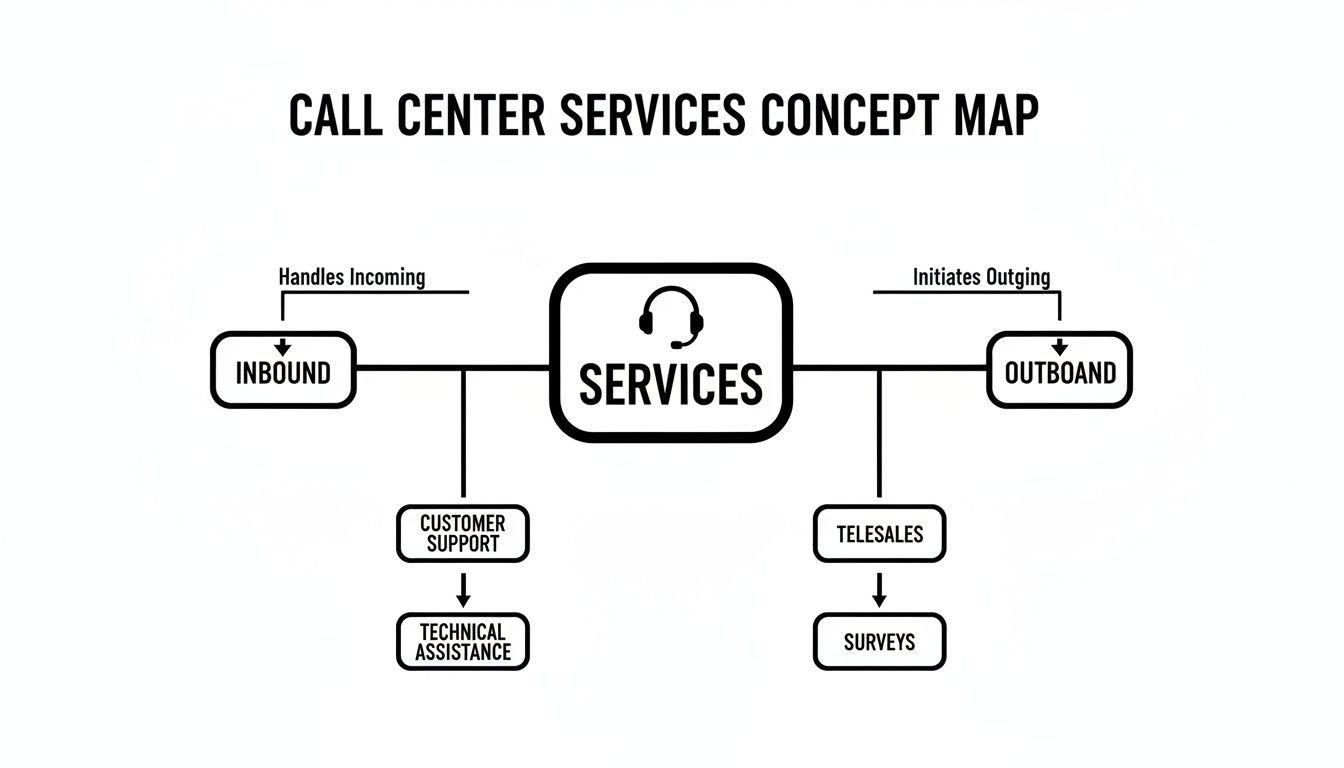
As you can see, the technology has to support two very different goals: reacting to customer needs and proactively creating new opportunities.
Game-Changing Innovations in Call Center Services
The real shift in recent years has come from the cloud and artificial intelligence. These advances have untethered call centers from physical buildings and armed them with powerful new tools for making smarter decisions. This isn't just a minor upgrade; it's a complete overhaul of how the industry operates.
The move to cloud-based platforms is massive. The Contact Center as a Service (CCaaS) market is on track to hit $82.43 billion by 2030. This explosion is driven by businesses that need more flexibility, especially for managing remote teams and getting real-time insights. At the same time, advanced analytics have become essential, with nearly 95% of customer interactions expected to run through sentiment analysis tools by 2025. Read the full research about emerging call center trends.
The fusion of CCaaS and AI isn't just an update; it's a fundamental change in how call centers operate. It transitions them from being reactive cost centers to proactive, data-driven engines for business growth and customer satisfaction.
These modern platforms deliver features that were once unimaginable, giving managers a level of visibility and control that was impossible just a decade ago.
Here are a few key features unlocked by this new wave of technology:
- Real-Time Analytics Dashboards: Managers can now watch key performance indicators (KPIs) live. They can track call volumes, agent wait times, and first-call resolution rates as they happen, allowing them to make immediate adjustments to staffing or strategy on the fly.
- Customer Sentiment Analysis: AI algorithms can analyze a caller's tone of voice and word choice to figure out their emotional state—frustrated, happy, or neutral. This gives agents a heads-up, helping them de-escalate tense situations and providing invaluable feedback for improving service.
- Enhanced Remote Management: Cloud platforms make managing a distributed workforce simple. Supervisors can listen in on calls, provide live coaching, and pull performance reports for agents working from anywhere in the world, ensuring quality and consistency are maintained no matter where their team is located.
Ultimately, this modern tech stack ties directly to real business results. It automates routing, delivers deep insights into customer behavior, and gives businesses the agility to adapt to whatever comes their way. It’s a smarter, faster, and more efficient way to manage every single conversation.
How Call Center Services Drive Business Growth
Sure, you can get bogged down in the features and tech specs of call center services, but the real magic happens when you see how they translate into actual business results. Bringing these services into your workflow isn't just an operational tweak; it’s a strategic move that directly boosts your bottom line, sharpens your efficiency, and really gets the growth engine humming.
Right off the bat, you'll see a massive drop in operational costs. Trying to build a call center from scratch is a huge financial drain—think recruiting, training, salaries, benefits, office space, and all the tech infrastructure. Partnering with a provider completely sidesteps that headache, turning what would have been a giant capital investment into a simple, predictable operating expense.
This approach gives you incredible financial flexibility. Suddenly, you have access to enterprise-grade talent and technology without the crushing enterprise-level price tag. You get a team of pros, ready to represent your brand from day one.
Unlocking Scalability and Market Agility
One of the biggest wins you get with professional call center services is the insane level of scalability they offer. Your business is never static—demand ebbs and flows. You might have seasonal rushes, a huge marketing campaign blowing up, or you might suddenly break into a new market.
An outsourced partner can scale its team up or down almost instantly to meet whatever you throw at them. This kind of agility means you can handle a sudden flood of customer questions or sales calls without having to scramble through a chaotic and expensive hiring spree. You're always staffed perfectly for the moment, never paying for people you don't need or missing calls because you're short-handed.
This on-demand capacity lets you be far more aggressive and opportunistic in your strategy. Instead of worrying if you can handle the response to a new campaign, you can launch it with total confidence, knowing the support is already in place to capture every single lead.
Think about a medical device company trying to expand its footprint. With an AI-powered outbound service like Voicedial.ai, they could run a campaign to contact hundreds of clinics in a single afternoon. That same task would tie up an in-house team for weeks. With a scalable service, it’s a simple one-day project that absolutely stuffs the sales pipeline with qualified appointments.
Driving Revenue Through Specialized Outreach
Beyond just making things run smoother, call center services are a powerful engine for generating revenue. They are masters at handling the specialized tasks that your internal teams often just don't have the time or specific skills for. This is especially true for outbound campaigns focused on generating and qualifying leads.
A skilled team can take a cold list of data and turn it into a pipeline of warm, interested leads. They do the grinding work of systematically calling through lists, engaging prospects, and finding those glimmers of genuine interest. This frees up your best salespeople to do what they do best: close deals with people who are already vetted and ready to have a serious conversation.
- Enhanced Lead Conversion: By making sure every lead gets a fast follow-up with consistent messaging, specialized services can dramatically boost the percentage of leads that become paying customers.
- Reactivating Dormant Leads: Almost every business is sitting on a goldmine—a big database of old, inactive leads. A targeted outbound campaign can wake this audience up, uncovering hidden opportunities and turning what was once a dead end into a fresh revenue stream.
Here’s a real-world example: a credit repair firm used an AI voice agent to tackle a massive list of dormant leads. The system chewed through the list, efficiently qualifying anyone who showed interest and booking them directly onto the calendars of their consultants. They reactivated a forgotten asset and turned it into a consistent flow of high-quality appointments. That kind of direct impact on the sales funnel shows the undeniable ROI of smart call center services.
How to Choose the Right Call Center Partner

Picking a call center provider is one of the biggest decisions you’ll make for your brand. This partner isn't just a vendor; they become the voice of your company for thousands of customers and an extension of your team. The wrong choice can burn through your budget, damage customer relationships, and leave massive opportunities on the table.
But get it right? A great partnership can unlock a whole new level of efficiency and scale. This guide is a no-nonsense checklist to help you cut through the sales pitches, ask the right questions, and find a partner who truly gets your business goals.
Do They Actually Know Your Industry?
The first and most important filter is industry experience. A call center that’s great at handling e-commerce returns probably won’t know the first thing about the compliance needs of a legal intake firm or a medical device company. Generic solutions just don't work because they lack the context needed to have real conversations with your customers.
Ask potential partners for case studies and references from companies in your exact niche. Do they know your industry’s acronyms, common pain points, and customer expectations? For example, a home services business needs a partner that’s a rockstar at appointment setting, while a credit repair firm needs agents who can talk about sensitive financial matters with empathy and authority.
Choosing a provider with proven expertise in your vertical isn't just a nice-to-have; it's a must. They’ll get up to speed faster, need less hand-holding, and deliver better results because they already speak your customers' language.
How Serious Are They About Security?
In a world where data breaches are front-page news, security and compliance are table stakes. A security slip-up from your call center partner is still your responsibility, and the fallout can be devastating. You absolutely must ensure any provider you’re considering has ironclad protocols to protect sensitive data.
This is especially true in tightly regulated fields. Ask them to show you the paperwork for their compliance with regulations relevant to your business:
- HIPAA: Essential for anyone touching protected health information, like medical device companies or insurance providers.
- TCPA: A must-have for any outbound calling to avoid crippling fines tied to telemarketing laws.
- SOC 2: A key certification that proves they have secure systems and controls for handling customer data.
Don’t just take their word for it. Dig into their agent training programs, data encryption methods, and physical security measures. A partner worth their salt will be completely transparent about their security posture and ready to show you the proof.
What’s Under the Hood? (Technology & Reporting)
The technology a call center uses directly impacts its performance and the insights you get back. An outdated tech stack leads to dropped calls, clumsy agent workflows, and zero visibility into your campaign’s results. You need a partner who invests in modern tools that give you both power and transparency.
A real-time analytics dashboard is non-negotiable. It’s your window into the operation, letting you track key metrics like call volume, answer rates, and conversions as they happen. Without it, you’re flying blind.
Also, ask how well their systems play with yours. Can they integrate with your CRM? A smooth integration means all customer data and call outcomes are logged automatically, creating a single source of truth for your sales and support teams.
And don't overlook the power of modern call center services. Platforms like Voicedial.ai use AI to deliver instant follow-up with perfect consistency, making sure no lead ever goes cold. This level of automation and data access isn't just a feature—it's a serious competitive advantage.
Vendor Evaluation Checklist
Choosing the right partner requires a methodical approach. Use this checklist to compare providers and ensure you're digging into the criteria that truly matter for a successful, long-term relationship.
| Evaluation Criteria | Key Questions to Ask | What to Look For |
|---|---|---|
| Industry Expertise | "Can you share case studies or references from clients in our industry?" "How do you train agents on our niche?" | Proven track record in your vertical. Familiarity with your specific terminology, customer types, and business challenges. |
| Compliance & Security | "What are your data security protocols?" "Can you provide documentation for HIPAA, TCPA, or SOC 2 compliance?" | Transparent policies, industry-standard certifications, and a clear commitment to protecting sensitive customer data. |
| Technology Stack | "Can you demo your agent interface and reporting dashboard?" "How do you integrate with our CRM (e.g., Salesforce)?" | A modern, user-friendly platform. Real-time analytics, seamless integration capabilities, and reliable uptime. |
| Agent Training & Quality | "What is your agent hiring and training process?" "How do you monitor calls and ensure quality assurance?" | A rigorous, ongoing training program. Regular call monitoring, coaching, and a clear QA process to maintain standards. |
| Scalability & Flexibility | "How do you handle unexpected spikes in call volume?" "What are your contract terms and how flexible are they?" | The ability to scale services up or down as needed. Flexible contract terms that align with your business growth. |
| Reporting & Analytics | "What KPIs do you track?" "How customizable are your reports and how often will we receive them?" | Detailed, actionable reporting that goes beyond basic call counts. Insights into agent performance, and conversion data. |
| Pricing Structure | "Can you provide a clear breakdown of all costs?" "Are there any hidden fees for setup, training, or reporting?" | A transparent, easy-to-understand pricing model (per minute, per hour, per agent) with no surprise charges. |
By using a structured checklist, you can move beyond vague promises and make a data-driven decision that sets your business up for success.
The Future of Outreach Is AI Voice Agents
The world of call center services is at a crossroads, and artificial intelligence is paving the new path forward. AI voice agents aren't just another shiny new tool; they represent a fundamental shift in how businesses can connect with leads and customers. This isn't about replacing your team but supercharging them with a tireless, perfectly consistent digital workforce.
Let's be honest, traditional call centers run into human walls—burnout, scheduling headaches, and the natural ups and downs of human performance. AI-powered agents simply don't have these problems. They unlock a level of operational power that was once unthinkable, turning outreach from a logistical nightmare into a smooth, automated process.
The New Competitive Edge in Business Communication
The real magic of AI voice agents is their ability to erase the friction points that let hot leads go cold. In today's market, speed and consistency are everything, and this is where AI truly dominates. A human team can only do so much, but an AI system acts with a speed and precision that gives you a massive advantage.
Here’s what sets them apart:
- True 24/7 Operational Capacity: An AI agent never sleeps. It doesn't take breaks or go on vacation. This means your business can engage leads around the clock, catching the night owls and early birds without paying a dime in overtime.
- Instantaneous Lead Follow-Up: The second a new lead hits your CRM, an AI voice agent can be on the phone with them. This immediate contact strikes while interest is at its absolute peak, dramatically boosting your chances of a real conversation before a competitor even knows the lead exists.
- Flawless Message Consistency: Every single call is delivered with the exact same tone, energy, and information. You completely remove the risk of an agent having an off-day or stumbling over a script, ensuring your brand is always represented perfectly.
This shift means no lead is ever missed due to bad timing, and no opportunity is lost because of a poorly delivered message. Your sales team’s valuable time is spent only on highly qualified prospects who have already been vetted and booked.
Redefining Scale and Efficiency
Picture this: you need to contact 500 prospects in one afternoon. For a human team, that’s a monumental task requiring all hands on deck. For an AI-powered platform like Voicedial.ai, that's just a regular Tuesday. This ability to scale your outreach on demand completely changes the game for outbound campaigns.
This technology lets you re-engage massive lists of old leads, test out new market segments, or follow up after a trade show with an efficiency you've never seen before. Better yet, implementation is way faster than building a human team from the ground up. You can often get purpose-built campaigns launched in just a few weeks.
The result is a future where your pipeline stays consistently full—not through grueling manual effort, but through an intelligent, automated system built for one thing: booking more qualified appointments.
Got Questions About Call Center Services? We’ve Got Answers.
Diving into the world of call center services can feel a bit overwhelming. As you start to figure out what’s right for your business, a lot of questions pop up. We get it. To help clear things up, we’ve put together straightforward answers to the most common questions we hear from business owners.
Think of this as your final checklist to make sure you're ready to move forward with total confidence.
What’s the Real Difference Between a Call Center and a Contact Center?
You’ll hear these terms thrown around, sometimes even used for the same thing, but there’s a simple, key difference.
A traditional call center is all about the phone. Its entire world revolves around handling voice calls, whether they’re coming in (inbound) or going out (outbound). It’s a voice-first, and often voice-only, operation.
A contact center is the modern evolution of that model. It’s built to manage conversations wherever your customers are, which today means a lot more than just the phone. A contact center handles calls, email, live chat, social media messages, and even SMS. It’s the omnichannel big brother to the classic call center.
So, How Much Do Call Center Services Actually Cost?
There’s no one-size-fits-all price tag, and the cost can swing pretty wildly depending on the service model, how complex your needs are, and where the agents are located. But generally, providers stick to a few common pricing structures.
Here’s what you’ll typically see:
- Pay-Per-Minute: You’re billed for the exact time an agent spends on the phone. This is a great fit if your call volume goes up and down unpredictably.
- Pay-Per-Hour: You buy agent time in hourly chunks. It’s a predictable model that works well for businesses with a steady, consistent flow of calls.
- Pay-Per-Agent: You pay a flat monthly rate for a dedicated agent (or a whole team) that works exclusively on your business.
- Pay-Per-Appointment: This is common for outbound services. If you’re hiring a team for appointment setting, you might just pay a fixed fee for every qualified meeting they book.
A word of caution: Cheaper isn't always better. An unusually low price might be a red flag for lower-quality agents, outdated tech, or a team that lacks training in your specific industry. In the long run, that can cost you far more in missed opportunities.
How Long Until My Campaign Is Up and Running?
The timeline really hinges on what you need. A straightforward inbound customer support line, for example, could take several weeks to get going. There's scripting to write, agents to train, and tech integrations to sort out.
But this is where modern AI-driven call center services completely change the game, especially for outbound campaigns. With a platform like Voicedial.ai, you can design and launch a highly targeted campaign in as little as three weeks. That kind of speed means you can jump on market opportunities and start seeing results way faster than with a traditional human-only setup.
Ready to see how an AI-powered outbound team can fill your calendar with genuinely qualified appointments? Voicedial.ai uses human-like AI voice agents to engage leads 24/7, making sure you never miss another opportunity. Learn more and book your demo today.