

Voice over IP (VoIP) has fundamentally transformed how businesses communicate, moving conversations from traditional phone lines to the internet. But what does this technology actually look like in practice? It's more than just a cheaper phone bill; it’s a strategic ecosystem of hardware, software, protocols, and intelligent automation that drives modern business operations.
This guide provides concrete examples of VoIP across its entire spectrum. We will explore the tangible components that make up a powerful communication stack, from the physical phones on your desk and the cloud platforms that run them, to the AI agents that now make the calls. You will gain a clear understanding of not just what these tools are, but the strategic advantages they offer and how you can implement them in your own operations.
Our goal is to give you a comprehensive catalog of real-world solutions. We'll examine specific providers, platforms, devices, and protocols, complete with screenshots and direct links to help you evaluate each option. Whether you're a home services company deploying your first phone system, an insurance broker looking to scale lead follow-up, or a law firm seeking to automate client intake, these examples provide a clear roadmap.
This list is designed to be actionable. For each example, we break down its strategic purpose, tactical application, and provide practical takeaways. Forget generic descriptions; you'll get a detailed look into how these VoIP solutions solve specific business problems, helping you find the right tools to achieve tangible growth and operational efficiency.
1. Voicedial.ai
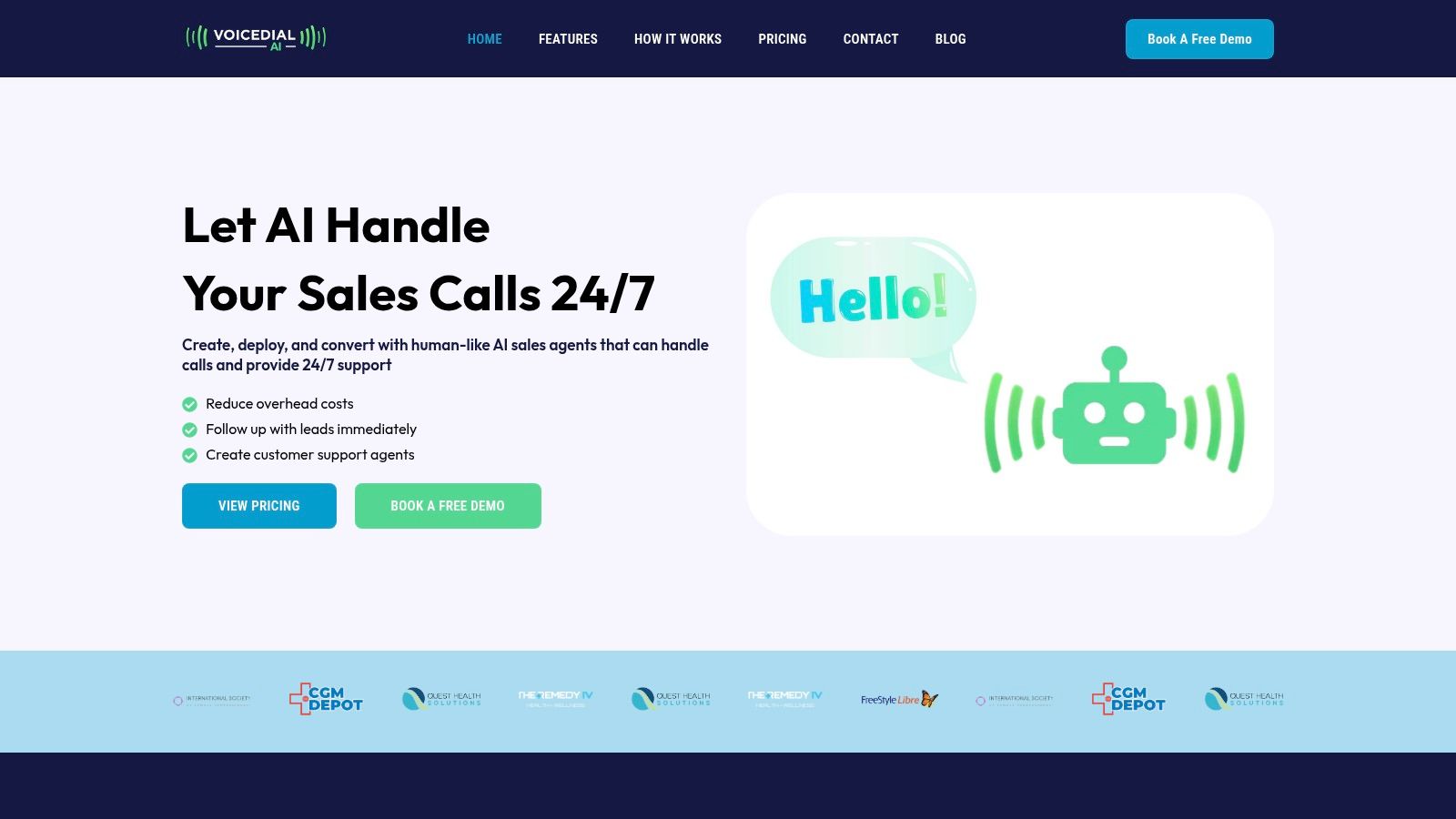
Voicedial.ai represents a powerful evolution in VoIP technology, showcasing how AI-driven voice agents can automate and scale communication for specific business goals. Unlike traditional VoIP providers that focus solely on infrastructure, Voicedial.ai offers a specialized platform that deploys human-like AI agents for high-volume outbound and inbound calling. This makes it one of the most compelling examples of voip in action for sales, lead qualification, and appointment setting.
The platform is engineered to handle thousands of calls simultaneously, 24/7, allowing businesses to engage leads instantly without the overhead of a large call center staff. This solves a critical bottleneck for industries reliant on consistent outreach, such as insurance, home services, and legal intake.
Strategic Analysis: Why Voicedial.ai Stands Out
Voicedial.ai’s strategic advantage lies in its purpose-built design for revenue-generating conversations. While many VoIP systems provide the tools for calls, Voicedial.ai provides the caller. The platform’s AI agents are not just robocallers; they are designed to conduct natural, two-way conversations, answer questions, and achieve specific outcomes like booking a demo or qualifying a prospect.
The emphasis on fast deployment is another key differentiator. With an average launch time of 21 days, businesses can implement a sophisticated automated calling campaign far more quickly than hiring and training a team of human agents. This rapid time-to-value is a significant competitive edge.
Key Features & Capabilities
- Human-Like AI Voice Agents: Utilizes advanced conversational AI to engage prospects naturally, handling objections and answering common questions.
- 24/7 Scalability: The AI agents operate around the clock, ensuring no lead goes cold and maximizing contact rates.
- Custom, Industry-Specific Scripts: Scripts are tailored to each business’s unique value proposition and target audience, ensuring relevance and effectiveness.
- Automated Appointment Booking: Agents can directly access and book appointments on a company's calendar, seamlessly converting conversations into scheduled meetings.
- Proprietary Real-Time Dashboard: This provides complete transparency into campaign performance, with metrics on answer rates, call outcomes, bookings, and performance trends.
Tactical Insights for Implementation
To maximize the effectiveness of a platform like Voicedial.ai, businesses should focus on several key tactics:
- Integrate with Your CRM: Connect the platform to your existing CRM to ensure lead data flows seamlessly. This allows for instant follow-up on new leads and keeps all interaction data centralized.
- Define Clear Call Objectives: Be specific about the primary goal of each campaign. Is it to book an appointment, qualify a lead against BANT criteria, or conduct a survey? A clear objective allows for a more focused and effective script.
- Establish a Hand-Off Protocol: While the AI is powerful, have a clear process for transferring complex or high-intent conversations to a live sales representative to ensure a smooth customer experience.
Strategic Takeaway: Voicedial.ai demonstrates how VoIP can be leveraged not just for communication, but as a proactive, automated sales and lead generation engine. Its value is measured in appointments booked and leads qualified, not just call minutes.
Platform Breakdown
| Feature | Analysis |
|---|---|
| Pricing Model | Pricing is not public but is described as affordable for high-volume campaigns. This subscription-based model is best suited for businesses with a large, consistent lead flow. |
| User Experience | The platform is centered around its real-time analytics dashboard, which is designed for clarity and actionable insights, allowing users to monitor campaign ROI without technical expertise. |
| Customer Support | Voicedial.ai emphasizes ongoing account support, a crucial component for optimizing campaigns and scripts over time to improve performance. |
| Target Audience | It is purpose-built for high-volume sectors like insurance (Medicare, ACA), home services, medical device sales, credit repair, and legal intake, where appointment velocity is a key success metric. |
| Compliance | Users must ensure they comply with regulations like the TCPA, particularly regarding consent for outbound automated calls. This is a critical consideration before launching any campaign. |
Pros:
- Scales outreach and books appointments 24/7 without adding headcount
- Fast deployment (average 21 days) with industry-specific scripts
- Transparent, real-time dashboard for tracking ROI and performance
- Proven results in multiple high-volume industries
- Cost-effective solution for large-scale calling campaigns
Cons:
- Not a replacement for human reps in complex, nuanced sales scenarios
- Pricing is not publicly listed and is geared toward high-volume users
- Users are responsible for ensuring their calling practices are compliant
For businesses looking to automate lead engagement and appointment setting at scale, Voicedial.ai is a leading example of specialized VoIP application.
Learn more at: https://voicedial.ai
2. VoIP Supply
VoIP Supply is a leading e-commerce marketplace dedicated entirely to VoIP hardware, making it one of the most critical examples of VoIP infrastructure procurement in the United States. Unlike all-in-one service providers, VoIP Supply focuses on being a specialized, multi-brand hardware vendor. This allows businesses to source everything from IP desk phones and conference systems to headsets and Session Border Controllers (SBCs) from a single, reliable supplier.
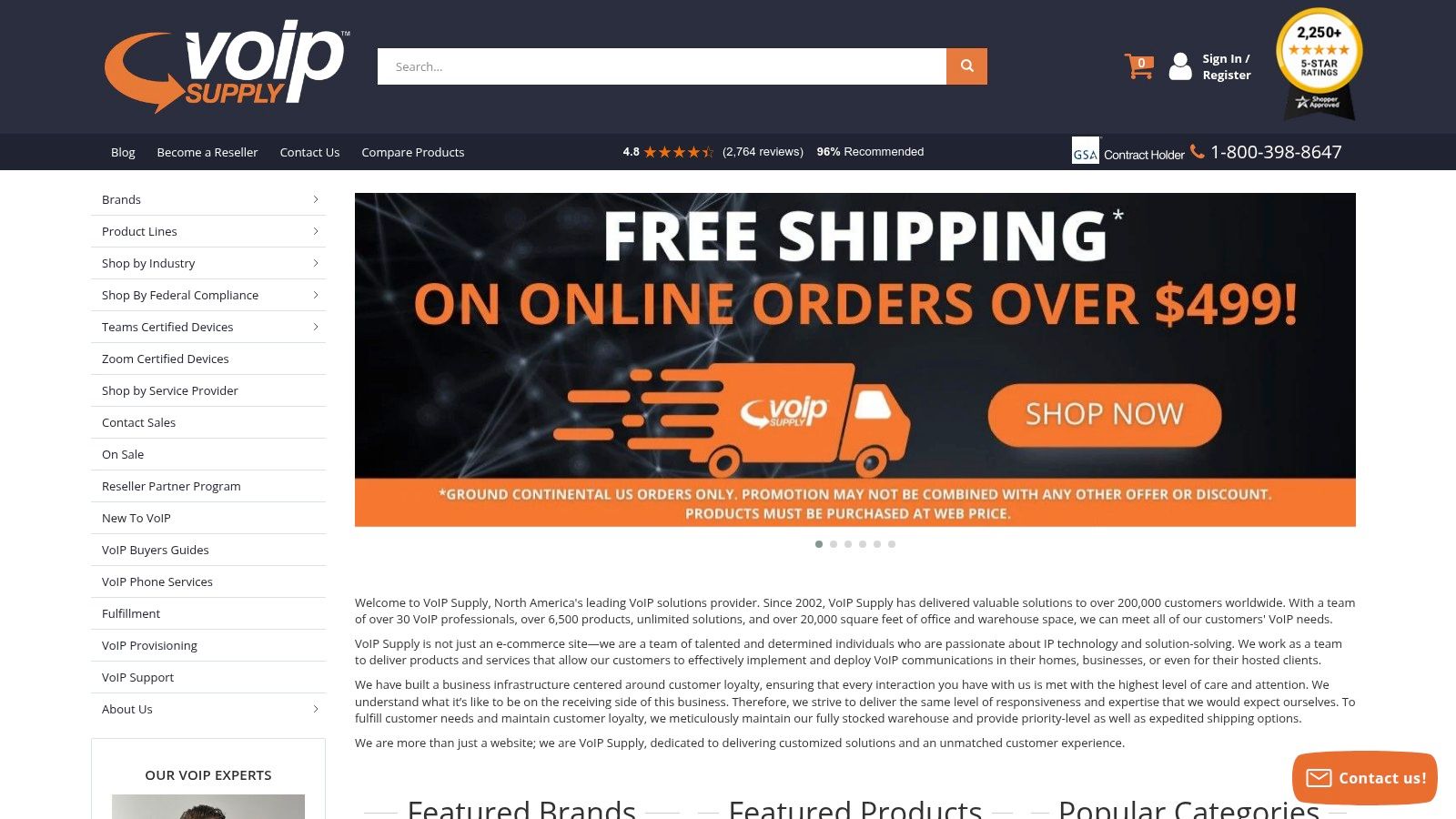
This model is ideal for organizations that have already selected a cloud PBX provider but need to equip their teams, whether it's a 10-person law firm or a 200-seat call center. They provide equipment from all major manufacturers like Poly, Yealink, Cisco, and Grandstream, ensuring compatibility with virtually any SIP-based phone system.
Strategic Analysis: The Hardware Hub Model
VoIP Supply's strength lies in its "hardware-as-a-service" approach, which extends beyond just selling boxes. They offer provisioning services, meaning they can pre-configure devices to work with your specific VoIP provider before shipping. This drastically reduces IT setup time and simplifies deployment, especially for remote or multi-location teams.
A standout feature is their "Refresh" program for refurbished hardware. This allows businesses to purchase certified, pre-owned equipment with a six-month warranty, significantly lowering the upfront capital expenditure for large-scale deployments. For a high-volume appointment setting team or a growing medical device sales force, this can mean saving thousands on initial costs without sacrificing quality.
Key Insight: By decoupling hardware from the service provider, VoIP Supply empowers businesses to avoid vendor lock-in. You can switch cloud phone systems in the future without needing to replace your entire inventory of desk phones and headsets, offering greater long-term flexibility and cost control.
Tactical Takeaways and Implementation
For businesses scaling their call operations, VoIP Supply provides a clear path to efficient hardware management.
- Actionable Takeaway: Use the platform to build a standardized hardware kit for new hires. A home services company could create a bundle with a specific Yealink desk phone, a noise-canceling headset, and an Analog Telephone Adapter (ATA) for a fax line, ensuring every new agent has the exact same setup for consistent performance.
- Pro Tip: Before a large purchase, contact their pre-sales support. Their specialists can help design a hardware stack that matches your specific industry needs, whether it's HIPAA compliance for a telemedicine provider or robust multi-line phones for a busy legal intake team.
- Link: https://www.voipsupply.com/
Pros & Cons
| Pros | Cons |
|---|---|
| Huge multi-vendor catalog | Hardware focus; no bundled phone service |
| Fast US shipping from their warehouse | Refurbished inventory can be limited |
| Refurbished program lowers deployment cost | Best for businesses with existing IT resources |
3. B&H Photo Video
While renowned for cameras and creative gear, B&H Photo Video has emerged as a surprisingly powerful resource for VoIP hardware, making it one of the most reliable examples of VoIP equipment procurement for businesses. Acting as a mainstream national retailer rather than a niche supplier, B&H brings competitive pricing, vast inventory, and enterprise-grade logistics to the world of IP telephony. They carry a robust selection of hardware from leading brands like Yealink, Cisco, Poly, and Grandstream.
This platform is ideal for businesses that know exactly what hardware they need and prioritize fast, reliable shipping and clear inventory status. Whether a law firm is upgrading to Poly CCX series phones or a medical sales team needs Zoom-certified conference units, B&H provides a straightforward e-commerce experience with detailed product specifications and transparent delivery estimates.
Strategic Analysis: The Mainstream Retailer Advantage
B&H’s core strength is applying its massive scale and logistical expertise to the VoIP hardware market. Unlike specialized distributors that may have complex ordering processes, B&H offers a frictionless consumer-style purchasing experience. This is invaluable for small to mid-sized businesses that lack a dedicated IT procurement department.
A key differentiator is their clear stock availability and expedited shipping options, often including free two-day delivery on many items. This speed is critical for time-sensitive deployments, such as outfitting a new agent for an appointment setting team or replacing a broken conference phone in a busy financial services office before a major client call. They also feature a "Used" section, offering open-box or refurbished equipment at a discount, providing another avenue for cost savings.
Key Insight: B&H excels at transactional hardware fulfillment. By treating VoIP phones like any other high-value electronic device, they provide a level of price transparency, shipping speed, and purchasing simplicity that many specialized VoIP vendors cannot match, empowering businesses to acquire equipment quickly and efficiently.
Tactical Takeaways and Implementation
For organizations needing to self-manage their VoIP hardware procurement, B&H is a go-to resource.
- Actionable Takeaway: Use B&H’s detailed filtering and comparison tools to identify the perfect hardware for a specific use case. A Medicare insurance brokerage could filter for Yealink phones that are explicitly Microsoft Teams certified to ensure seamless integration with their existing communication stack.
- Pro Tip: For urgent hardware needs, check B&H first. Their real-time inventory and reliable shipping estimates can be the fastest way to get a replacement desk phone or headset, minimizing downtime for a high-performing agent or intake specialist.
- Link: https://www.bhphotovideo.com/c/buy/VoIP-Phones/ci/13094
Pros & Cons
| Pros | Cons |
|---|---|
| Fast US delivery and wide choice including certified conference systems | Limited hands-on deployment support like pre-provisioning |
| Competitive pricing on new and used/open-box equipment | Certain enterprise SKUs may be special order or back-ordered |
| Clear availability status and delivery estimates | Less specialized technical guidance compared to dedicated VoIP VARs |
4. Best Buy
Best Buy represents the consumer and small-office entry point for VoIP hardware, making it one of the most accessible retail examples of VoIP in the market. While not a specialized B2B supplier, its vast network of physical stores and online presence provides immediate access to plug-and-play VoIP solutions. This makes it a critical resource for sole proprietors, home-based businesses, or small offices that need a quick, simple way to get started with internet-based calling without a formal IT procurement process.
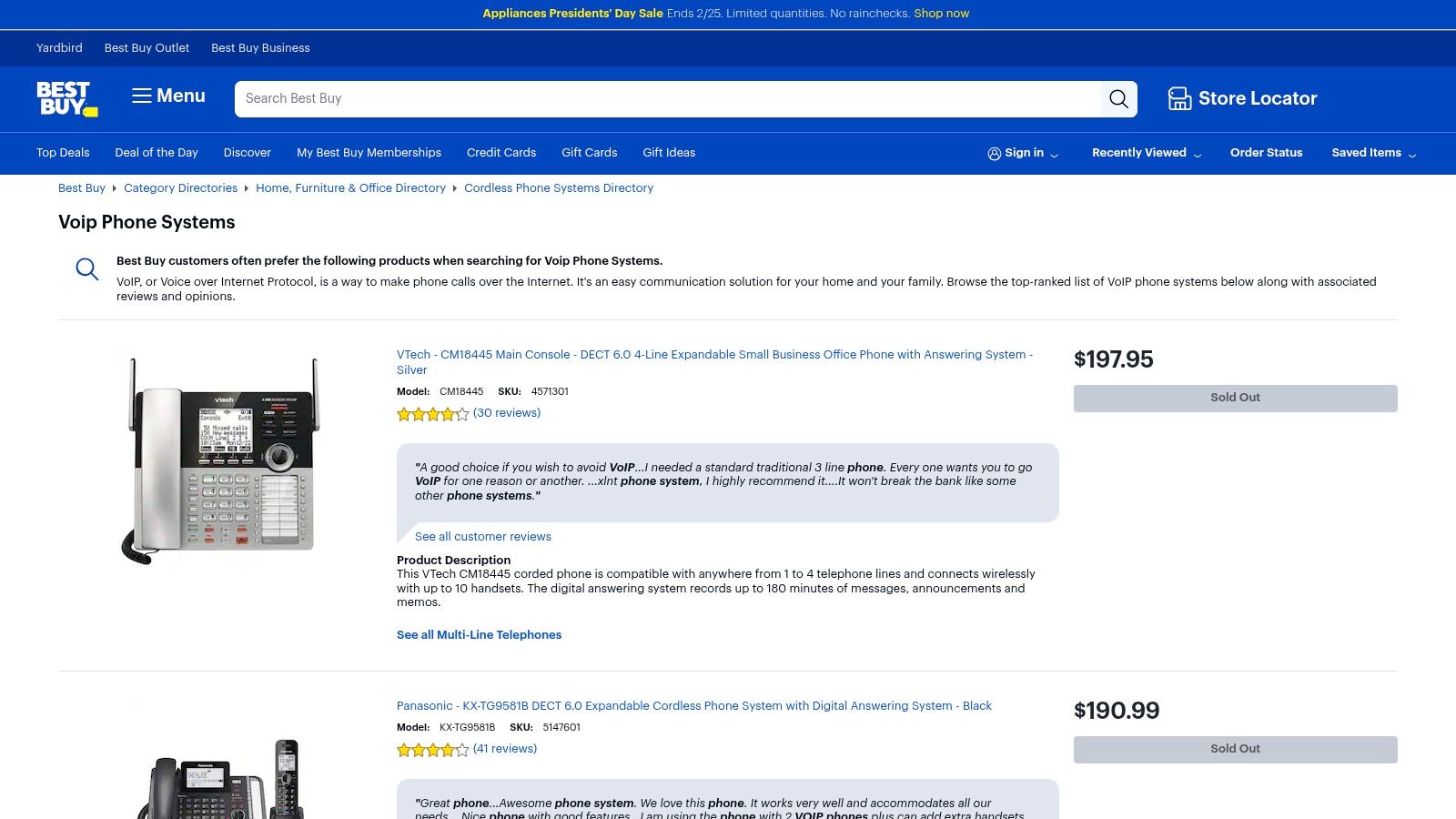
The platform primarily stocks solutions like Ooma Telo and MagicJack, which are designed for ease of use and appeal to users transitioning from traditional landlines. It also offers VoIP-ready cordless phone systems and basic Analog Telephone Adapters (ATAs). This consumer-friendly selection is perfect for a financial services consultant working from a home office or a small home services business needing just one or two phone lines.
Strategic Analysis: The Immediate Access Retail Model
Best Buy’s strategic advantage is convenience and speed for the small-scale user. While enterprise suppliers focus on bulk orders and complex provisioning, Best Buy excels at "I need a phone line today." An insurance agent whose office phone system goes down can walk into a local store and walk out with a working Ooma system in under an hour. This immediate availability and simple return policy de-risks the initial adoption of VoIP technology for non-technical users.
The focus is on all-in-one consumer VoIP kits where the hardware and service are tightly integrated. These devices are built for self-installation, often requiring little more than plugging the device into a router and a power outlet. For a solo law practitioner who needs a dedicated business line separate from their personal cell phone, this model provides a professional solution with minimal technical overhead and a predictable, low monthly cost.
Key Insight: Best Buy serves the "micro-business" segment that is often too small for traditional VoIP providers. By offering consumer-grade hardware with easy setup, it empowers individuals and small teams to access the cost savings and features of VoIP without needing IT expertise or committing to a complex service contract.
Tactical Takeaways and Implementation
For fast-moving small businesses or individual professionals, Best Buy offers a low-friction entry into VoIP.
- Actionable Takeaway: A newly licensed Medicare agent can use Best Buy to immediately establish a professional business line using an Ooma Telo. They can purchase the device online for in-store pickup and have a dedicated, compliant phone number active the same day they close their first client.
- Pro Tip: Look for "open-box" deals on VoIP hardware like ATAs or cordless phone systems. These certified-functional items can further reduce the already low startup cost for a home office, making it an excellent way to test a VoIP setup before committing more resources.
- Link: https://www.bestbuy.com/site/shop/voip-phone-systems?utm_source=openai
Pros & Cons
| Pros | Cons |
|---|---|
| Convenient for fast replacement or initial setup | Selection skews consumer/SOHO; lacks enterprise SIP phones |
| Clear, upfront pricing and nationwide availability | Limited deep VoIP configuration or deployment support |
| Easy in-store returns and frequent promotions | Not suitable for multi-line or call center deployments |
5. RingCentral (RingEX)
RingCentral is one of the most prominent examples of VoIP, representing the enterprise-grade Unified Communications as a Service (UCaaS) model. It bundles high-availability voice, video, and team messaging into a single platform called RingEX. Unlike some providers focused on basic calling, RingCentral delivers a mature, feature-rich ecosystem designed for businesses requiring sophisticated call management, from multi-level auto-attendants to advanced call queues and real-time analytics.
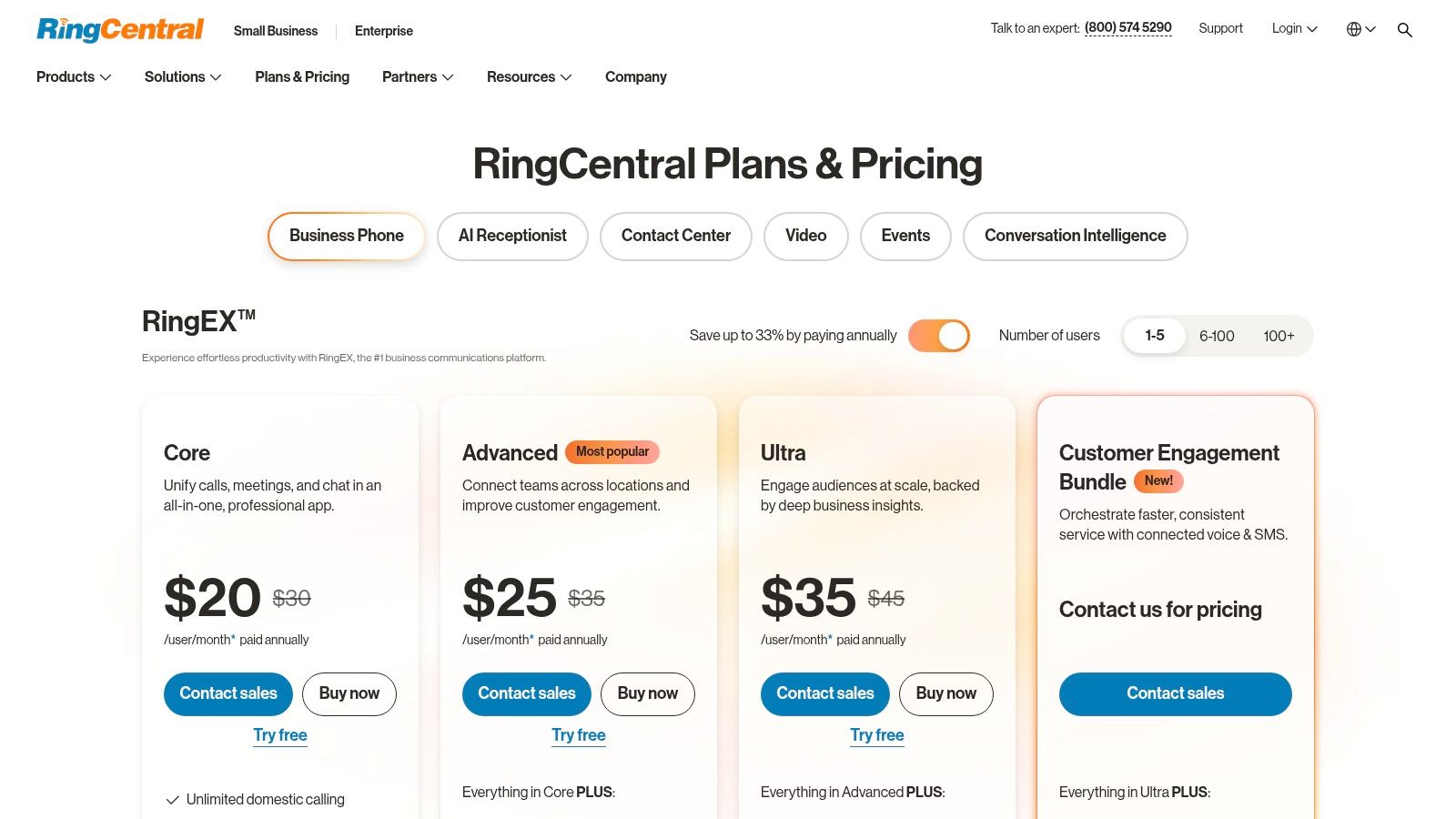
This all-in-one approach is built for organizations that cannot afford downtime and need integrated tools out of the box. A credit repair firm, for instance, can use its robust Interactive Voice Response (IVR) to route clients to specific departments, while a medical device sales team can leverage its built-in video conferencing and SMS capabilities for prospect follow-up and appointment confirmations.
Strategic Analysis: The Integrated UCaaS Ecosystem
RingCentral's core strength is its deeply integrated, all-in-one platform that minimizes the need for third-party tools for core communications. Its architecture is engineered for reliability and scalability, making it a go-to choice for regulated industries like finance and healthcare, as well as high-volume sales teams. Features like call recording, advanced analytics, and open APIs are not just add-ons; they are integral parts of the system.
The recent infusion of AI features directly into RingEX further solidifies its position. Live transcriptions, automated meeting summaries, and sentiment analysis provide actionable data from every call. For an insurance brokerage, this means call center managers can quickly review call transcripts for compliance and quality assurance without manually listening to hours of recordings. This transforms voice data from a simple record into a strategic asset for training and performance improvement.
Key Insight: RingCentral's value lies in providing an enterprise-grade "communications operating system." It is designed for businesses that view their phone system not just as a utility, but as a central hub for customer interaction, data collection, and operational efficiency, with a clear upgrade path as needs evolve.
Tactical Takeaways and Implementation
For teams needing advanced call control and analytics, RingCentral provides a powerful, centralized solution.
- Actionable Takeaway: A law firm can configure a multi-level IVR to direct callers immediately: Press 1 for new client intake, 2 for existing case updates, and 3 for the billing department. This frees up paralegals and receptionists from repetitive call routing tasks.
- Pro Tip: Leverage the open API and developer sandbox to build custom integrations. A home services company could connect RingCentral to their scheduling software, automatically logging inbound calls from clients and creating follow-up tasks for dispatchers.
- Link: https://www.ringcentral.com/office/plansandpricing.html
Pros & Cons
| Pros | Cons |
|---|---|
| Mature platform with robust call handling | Advanced features and add-ons increase total cost |
| Clear upgrade path as business needs grow | Per-user pricing can be high for large teams |
| Excellent for regulated industries and compliance | May be overly complex for very small businesses |
6. Zoom Phone
Zoom Phone is a cloud-based business phone system built directly into the familiar Zoom ecosystem, making it a powerful example of VoIP for unified communications. Instead of being a standalone service, it integrates seamlessly with Zoom's video meetings, chat, and collaboration tools. This creates a single platform where users can transition from a phone call to a video meeting with a single click, streamlining internal and external communication.
This model is exceptionally well-suited for organizations that are already heavily invested in the Zoom platform for daily operations. It allows them to consolidate vendors and provide a consistent user experience across all communication channels. The service offers standard VoIP features like number porting, SMS/MMS, call queues, and an interactive voice response (IVR) system, all managed within a simple administrative dashboard.
Strategic Analysis: The Unified Communications Hub Model
Zoom Phone’s strategic advantage is its deep, native integration within a platform millions already use. For a company where sales teams use Zoom for demos and support teams use it for customer meetings, adding phone capabilities is a logical, low-friction extension. This eliminates the need for separate apps and reduces the learning curve for employees, leading to faster adoption and higher productivity.
The service's flexible pricing, including Metered (pay-as-you-go), US/Canada Unlimited, and Global Select plans, allows businesses to choose a cost structure that matches their call volume. For an insurance brokerage with fluctuating call patterns during open enrollment, the metered option can offer significant savings, while a high-volume credit repair firm would benefit from the predictability of an unlimited plan.
Key Insight: Zoom Phone leverages its dominant position in video conferencing to create a sticky, all-in-one ecosystem. By bundling voice into its core product, it simplifies the tech stack for businesses and makes it harder for competitors to poach customers with single-point solutions.
Tactical Takeaways and Implementation
For businesses embedded in the Zoom ecosystem, implementing Zoom Phone is a clear path to communication efficiency.
- Actionable Takeaway: A medical device sales team can use Zoom Phone to call prospects and instantly escalate the conversation to a full video demo within the same application. This removes the friction of scheduling a separate meeting and captures the client's interest at its peak.
- Pro Tip: Evaluate your organization's call patterns before selecting a plan. The Metered plan is attractive for low-volume users, but be sure to monitor per-destination rates closely to avoid unexpected costs. High-volume outbound teams, like appointment setters, should default to an unlimited plan for cost control.
- Link: https://www.zoom.com/en/products/voip-phone/solutions/business-phone-service/
Pros & Cons
| Pros | Cons |
|---|---|
| Seamless phone, video, and chat stack | Add-ons for advanced features can raise the total cost |
| High user adoption for existing Zoom users | Metered plan requires careful monitoring of usage |
| Simple administration and number porting | May be less feature-rich than some specialized PBX providers |
7. Twilio Programmable Voice
Twilio Programmable Voice is a developer-centric Communications Platform as a Service (CPaaS) that provides the raw building blocks for custom voice applications. It stands out as one of the most powerful examples of VoIP because it is not a pre-built phone system. Instead, it offers a suite of APIs that allow businesses to integrate voice calling directly into their software, workflows, and AI-driven processes with granular control.
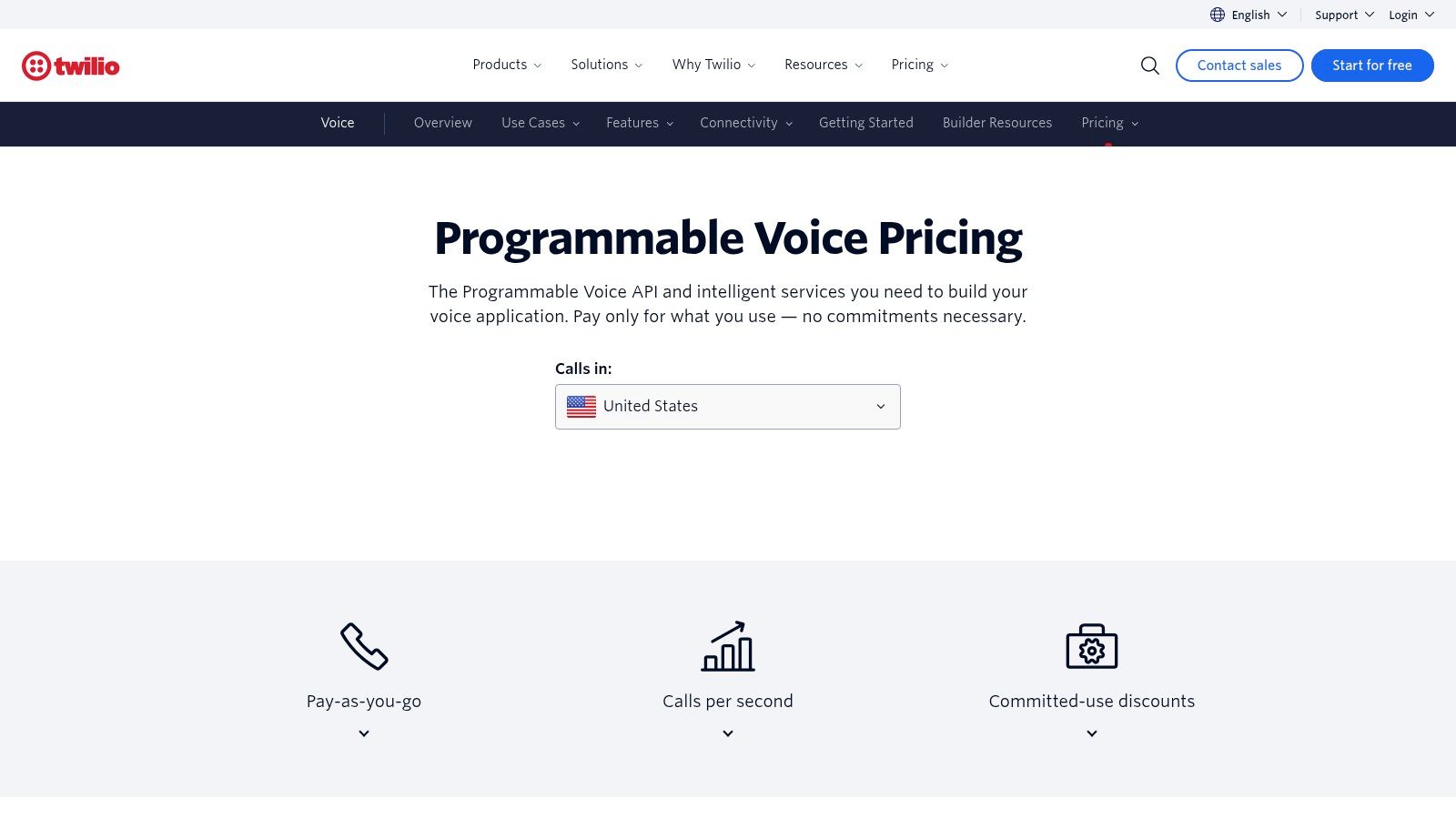
This model is designed for organizations that need more than a standard cloud PBX. It's ideal for tech-savvy home services companies building automated appointment reminders, medical device sales teams creating custom click-to-call functions within their CRM, or financial services firms that require bespoke call recording and compliance logic. Twilio provides the underlying SIP and WebRTC infrastructure, while your development team builds the exact call experience you need.
Strategic Analysis: The API-First Model
Twilio's core strength is its API-first, usage-based approach. You pay per-minute for inbound and outbound calls and per-month for phone numbers, with transparent pricing and documentation. This allows businesses to build highly scalable and cost-effective voice solutions without being locked into a fixed per-seat subscription model. The platform is engineered for developers, providing extensive SDKs, documentation, and tools.
A key feature is its ability to handle complex, multi-leg call flows programmatically. For example, an insurance brokerage could build an intelligent lead router that first calls an agent, and upon connection, automatically dials the outbound lead, bridging the two calls. Twilio's Media Streams API is also a game-changer for AI integration, allowing real-time audio to be fed directly to AI models for transcription, sentiment analysis, or even to power AI voice agents that handle initial intake.
Key Insight: Twilio decouples telephony from the user interface. This means you are not limited by a vendor's softphone or application. You can embed calling functionality directly into the tools your team already uses, whether it's a proprietary CRM, a legal practice management system, or an internal dashboard, creating a seamless and efficient workflow.
Tactical Takeaways and Implementation
For organizations with development resources, Twilio unlocks unparalleled customization.
- Actionable Takeaway: A credit repair company can use Twilio's API to build an automated payment reminder system. When a payment is due, the system automatically triggers an outbound call that plays a pre-recorded message or connects the client to an agent if they press "1," all tracked within their internal software.
- Pro Tip: Start with Twilio Studio, a visual workflow builder, to prototype your call logic before writing code. This allows non-developers to design IVRs or call routing flows, which can then be handed off to a developer for full implementation, dramatically speeding up the development cycle.
- Link: https://www.twilio.com/voice/pricing
Pros & Cons
| Pros | Cons |
|---|---|
| Highly flexible for advanced routing and AI integrations | Requires developer resources; not a turnkey PBX |
| Scales from prototypes to large volumes with API control | Per-minute billing can complicate cost forecasting |
| Transparent, programmatically accessible pricing | Best for custom builds, not standard office use |
Top 7 VoIP Providers Comparison
| Solution | Implementation Complexity 🔄 | Resource Requirements ⚡ | Expected Outcomes ⭐📊 | Ideal Use Cases 💡 | Key Advantages |
|---|---|---|---|---|---|
| Voicedial.ai | Moderate 🔄 (custom scripts, ~3-week onboarding) | Low ongoing staff ⚡ (platform handles calls); compliance checks required | High ⭐⭐⭐ — fast lead contact, appointments booked; real-time call analytics 📊 | High-volume outbound/inbound outreach (insurance, home services) 💡 | Human-like voices, fast deployment, customizable scripts, real-time dashboard |
| VoIP Supply | Low 🔄 (hardware procurement; optional provisioning) | Moderate ⚡ (purchase & provisioning; bulk spend) | Variable ⭐⭐ — rapid device availability; outcome depends on PBX/service 📊 | Bulk hardware sourcing for call centers or deployments 💡 | Massive catalog, multi-vendor choice, refurbished options, US shipping |
| B&H Photo Video | Low 🔄 (retail purchase, minimal setup) | Low ⚡ (buy-and-deploy; limited deployment support) | Moderate ⭐⭐ — reliable equipment and fast delivery 📊 | Mid-market purchases, certified conference phones, quick replacements 💡 | Detailed specs, in-stock fast shipping, new/used options |
| Best Buy | Very Low 🔄 (plug-and-play consumer gear) | Low ⚡ (local pickup, simple returns) | Basic ⭐ — suitable for SOHO/small-office needs 📊 | Small offices or home users needing quick local solutions 💡 | Convenience, promotions, easy returns, nationwide availability |
| RingCentral (RingEX) | Moderate–High 🔄 (cloud PBX setup, admin config) | Moderate ⚡ (per-user licensing; add-ons raise cost) | High ⭐⭐⭐ — enterprise telephony, routing, analytics 📊 | Organizations needing UCaaS, advanced call flows and compliance 💡 | Mature platform, built-in IVR/queues/analytics, upgrade path |
| Zoom Phone | Moderate 🔄 (integration into Zoom ecosystem) | Moderate ⚡ (per-seat plans; add-ons possible) | High ⭐⭐/⭐⭐⭐ — unified phone+video+chat; good adoption speed 📊 | Teams already using Zoom for meetings and collaboration 💡 | Seamless integration with Zoom, simple admin, competitive entry pricing |
| Twilio Programmable Voice | High 🔄 (developer-led, custom voice logic) | High ⚡ (dev resources; pay-as-you-go costs) | High ⭐⭐⭐ — flexible custom flows, real-time AI/analytics 📊 | Developer teams building bespoke IVR, AI calling, and integrations 💡 | API-driven control, global numbers, SIP/WebRTC and media-streaming capabilities |
The Future is Voice: Key Takeaways for Your Business
As we've explored, the world of VoIP is far more than a simple replacement for traditional phone lines. The diverse examples of VoIP we've examined, from comprehensive UCaaS platforms like RingCentral to highly specialized AI voice agents like Voicedial.ai, illustrate a dynamic and multi-layered technological ecosystem. This isn't just about making calls over the internet; it's about fundamentally reshaping how businesses communicate, engage with customers, and drive operational efficiency.
The key takeaway is that "adopting VoIP" is no longer a single decision. It's a strategic process of selecting and integrating the right combination of services, hardware, and intelligent software to solve specific business problems. Your path forward begins not with a product, but with a clear diagnosis of your primary communication challenges.
Strategic Synthesis: From Examples to Action Plan
Let's distill the core insights from our examples into an actionable framework. The modern VoIP stack can be viewed through three distinct but interconnected layers: the foundation, the hardware interface, and the intelligence layer.
The Foundation (UCaaS & CPaaS): Platforms like RingCentral and Zoom Phone provide the core infrastructure. They are the central nervous system for your team's internal and external communications, offering a unified suite of tools. For businesses needing custom-built solutions, a CPaaS provider like Twilio offers the raw building blocks. Your first step is deciding if an all-in-one solution or a custom-built platform best serves your long-term goals.
The Hardware Interface (IP Phones & Softphones): This is how your team interacts with the system. While providers like VoIP Supply and retailers like B&H offer a vast array of physical IP phones, the rise of powerful softphone applications means a desk phone is no longer a necessity. The critical choice here is balancing the tactile reliability of hardware with the flexibility and cost-effectiveness of software.
The Intelligence Layer (AI Voice Agents): This is the most transformative layer. An AI agent like Voicedial.ai doesn't just facilitate communication; it automates and optimizes it at a scale humans cannot match. It sits on top of your foundational VoIP infrastructure to execute high-volume, repetitive tasks like appointment setting, lead qualification, and follow-ups with perfect consistency.
By understanding these distinct categories and how the various examples of VoIP fit within them, you can move from a vague desire for "better phones" to a precise strategy for a more powerful communication infrastructure.
Choosing Your Path: Aligning VoIP with Business Needs
Your ideal VoIP setup depends entirely on your specific industry and operational model. For the insurance agent, home services company, or credit repair provider, the most significant bottleneck is often the sheer volume of outbound calls required to set appointments and qualify leads.
Strategic Insight: For high-volume outreach, the most impactful investment is often at the intelligence layer. An AI agent can handle thousands of initial calls, freeing up your skilled human agents to focus exclusively on high-intent, revenue-generating conversations.
Consider these critical factors as you map out your implementation:
Identify the Core Problem: Are you trying to improve internal collaboration or automate external outreach? A law firm might prioritize a robust UCaaS system for secure client communication, while a medical device sales team will gain more leverage from an AI agent that can handle initial lead follow-up.
Scalability is Key: Your chosen solutions must grow with you. Cloud-based platforms and AI agents offer near-infinite scalability, allowing you to add or remove capacity on demand without significant capital expenditure.
Integration Capabilities: Ensure any new tool can integrate with your existing CRM and other business software. A seamless flow of data between your voice platform and your system of record is non-negotiable for maximizing efficiency.
The journey into modern voice technology is one of strategic selection and integration. By moving beyond the simple concept of a "phone system" and embracing the full stack of possibilities, you can transform your communication from a cost center into a powerful engine for predictable growth and unparalleled customer engagement.
Ready to see how the most advanced examples of VoIP can directly impact your bottom line? Voicedial.ai leverages a powerful AI voice agent to automate your appointment setting and lead follow-up, allowing your team to focus on closing deals. Explore how you can multiply your outreach and accelerate your revenue at Voicedial.ai today.