

A sales team has a voice-agent demo that sounds convincing. Then someone asks whether it can handle a real objection without talking over a prospect, follow the team's calling rules, update the CRM correctly, and keep working when call volume spikes. The demo doesn't answer what each completed conversation will cost, either, or who will step in when the agent reaches a situation it shouldn't handle alone.
That's the gap between a promising prototype and a production call system. The best AI agent builder isn't automatically the one with the longest feature list. It's the one that fits your sales workflow, technical resources, expected call volume, integration needs, and compliance requirements.
There's demand, but adoption isn't uniform: McKinsey's 2025 survey of AI adoption found that 23% of respondents said their organization was scaling an agentic AI system in at least one function, while 39% had begun experimenting. For a practical starting point, compare AI agent tools and their operating models, then focus on the seven options below. They range from managed sales-call services to developer APIs, and they make different trade-offs in control, setup effort, and cost at scale.
1. Voicedial.ai

Voicedial.ai is a managed sales-call service for teams that want calls handled rather than another voice stack to assemble. It provides customizable inbound and outbound agents for lead follow-up, qualification, common questions, and appointment booking. Scripts are built for a specific business and its industry, and the live dashboard shows call activity, outcomes, answer rates, and performance trends.
That model trades control for speed. Teams spend less time choosing models, connecting voice components, and constructing call flows, but give up direct control over the underlying stack. Voicedial.ai says businesses typically launch in about 21 days and provides ongoing support. Specific rates aren't listed on its website, so ask for a quote that spells out the expected cost at your actual call volume, including how pricing scales once you move past the pilot stage.
Built for sales workflows
The service is positioned for areas such as insurance, medical devices, home services, memberships, credit repair, and legal intake. Those workflows need more than a natural-sounding conversation. A useful agent must qualify a lead, answer within approved boundaries, book an appointment when appropriate, and hand off when a person needs to take over.
The vendor cites customer-reported examples, such as four appointments booked in the first 48 hours for a Medicare agent, and six appointments from more than 300 leads reached in an afternoon for an ACA agent. Treat those as vendor-supplied figures, not a guarantee of your own results. Ask how the dashboard captures outcomes and how your team will review calls that end in a transfer, unanswered objection, or incomplete booking.
Best fit: Sales teams that value supported deployment and high-volume calling more than building every part of the agent themselves.
Before signing, confirm the launch plan, CRM workflow, escalation rules, compliance review, and full pricing model. Choose this service when the goal is putting a custom calling operation into production without hiring a team to engineer the voice experience from scratch.
2. Retell AI

Retell AI suits teams that want a hosted voice-agent platform but still expect developers to connect it to business systems. It supports workflows such as appointment setting, lead qualification, and intake, with agent templates, simulation testing, APIs, and webhooks. Its voice-agent platform also provides call analytics, transcripts, and logs, which help teams inspect what happened rather than judging an agent by a handful of polished demo calls.
Check the full minute cost
Retell lists $10 in free credits, then pricing from $0.07 to $0.31 per minute. Those figures don't automatically tell you the cost of a live sales conversation. Confirm which telephony, model, and voice charges apply to your configuration, and estimate the impact of retries, transfers, and calls that don't complete the intended task.
The platform's combination of a quicker starting point and developer controls makes it more flexible than a narrowly managed calling service. That flexibility still requires someone to own integration work and production testing. A CRM connection that works in a simulation isn't enough; test whether the agent can reliably find the right lead, write back the correct disposition, and avoid duplicating or overwriting records.
G2 showed 4.8/5 from 2,638 reviews when checked, but review scores don't establish whether a particular setup will meet your sales, security, or compliance requirements. Retell is the practical pick when you want a hosted foundation with room for custom integrations. Get enterprise support terms in writing, then calculate the all-in cost against completed outcomes, not minutes alone.
3. Synthflow

Synthflow is a visual builder for teams that want to shape inbound and outbound voice workflows without starting from a blank codebase. Its voice-agent platform supports appointment booking, call transfers, integrations, and testing through a Test Center and analytics tools. That makes it a reasonable fit for sales operations teams that need to adjust call paths as campaigns change.
The published plans provide a starting point for budgeting: Starter is $29 per month with 50 minutes, Pro is $450 per month with 2,000 minutes, or $375 per month billed annually, and Growth is $900 per month with 4,000 minutes, or $750 per month billed annually. Enterprise pricing is quoted, with contracts stated to start at $30,000 annually. Check the current plan details and scope before treating those figures as your forecast.
Visual control comes with capacity questions
A visual workflow can make it easier for business users to update branches, transfers, and appointment steps. But the interface doesn't eliminate the need to test what happens when a lead goes off script or a connected system fails. The team still needs clear rules for when the agent should stop, escalate, or avoid changing a record.
Published minutes and concurrency can help estimate basic capacity, but overages and concurrency limits can change the economics as call volume grows. Some integrations and capabilities vary by plan, while enterprise implementation support and SIP telephony options need scoping. Synthflow is the right category of tool when business users need hands-on workflow configuration. Ask the vendor to model your expected peak load and overage exposure before a campaign goes live.
4. Vapi

Vapi is a developer-first platform for teams that want to assemble and control their own voice-agent stack. Its platform and API provide a broad catalog of models and providers, testing tools, telephony options, and API-based integration. Engineers can choose components and tune how they work together instead of accepting a single fixed setup.
That control is useful if your product or sales operation has unusual integration requirements. It also means the team must understand how separate charges add up. Vapi lists a $0.05-per-minute hosting fee for usage-only access and $5 in free credits; model, transcription, voice, and telephony costs may be additional. The optional Core package is $29 per month. Treat the hosting rate as one line in the budget, not the complete cost of a call.
A low platform fee is only a win if your team can manage the providers, integrations, and failures around it.
Vapi's flexibility makes it attractive for a technical team that wants to prototype with usage-based access and then refine its architecture. The same flexibility can create more setup and troubleshooting work than a visual builder. Test a complete call from dial to CRM update, including interruptions, retries, and handoff, and build the cost model from actual configuration choices. Choose Vapi when stack customization is a real requirement, not merely because its headline platform rate looks low.
5. Bland AI
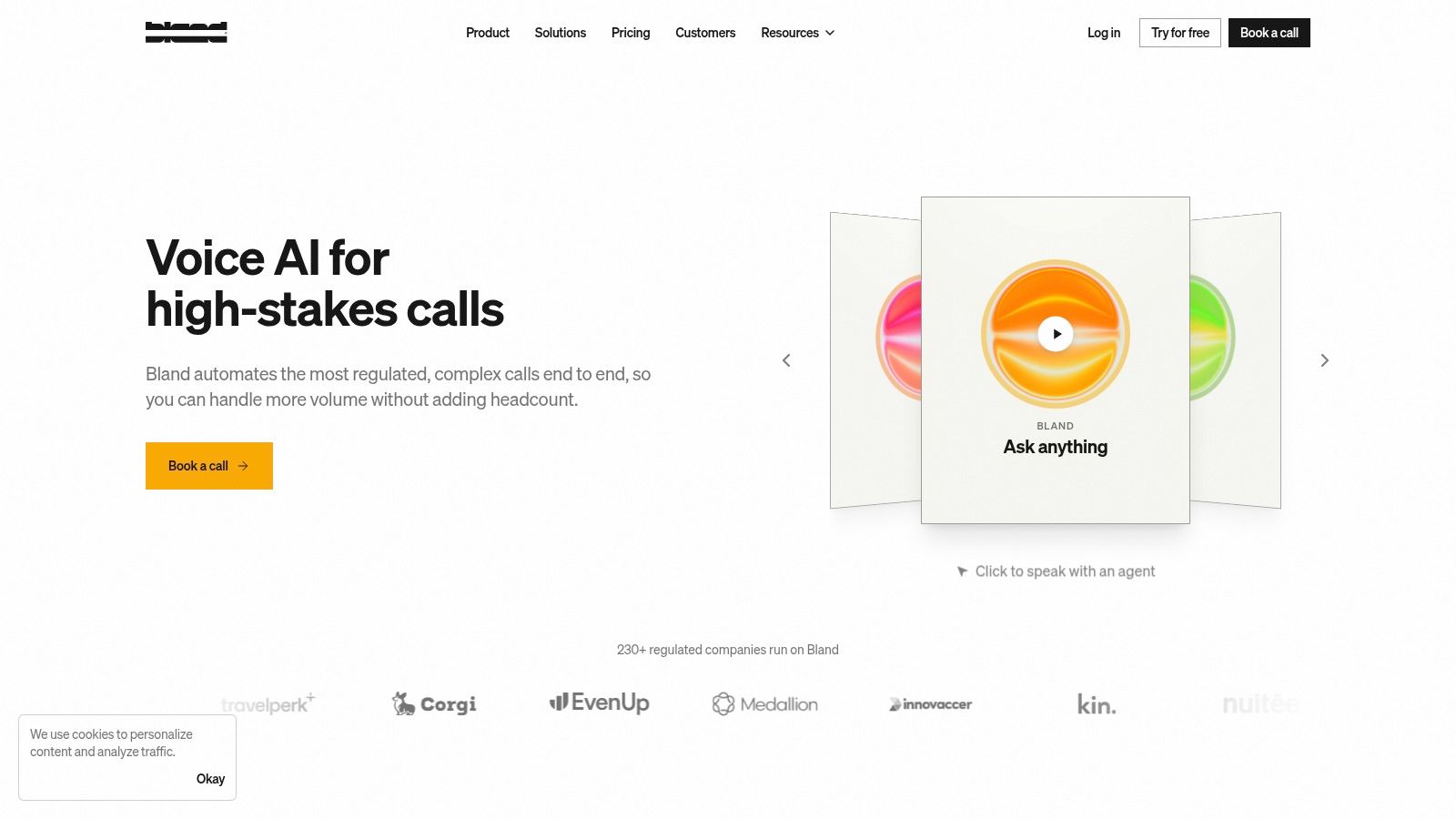
Bland AI focuses on automated phone interactions and business calling workflows. Its pricing is presented on a per-minute basis, and the vendor allows customers to use their own telephony setup. The Bland AI platform lists a Start plan at $0.14 per minute with no platform fee, and a Build plan at $299 per month plus $0.12 per minute. The vendor says its usage rate includes the LLM, speech-to-text, and text-to-speech, while telephony may be billed separately.
Useful rates still need a workload model
Compared with a plan that bundles a fixed block of minutes, a per-minute rate is easier to put into a basic call-volume estimate. It still doesn't answer how much a qualified lead, booked appointment, or correctly updated CRM record will cost. Include telephony, transfers, and the calls that require human follow-up when evaluating the full operating cost.
Bringing your own telephony can make sense if your company already has a phone system and wants to preserve existing arrangements. It also makes responsibility for the telephony connection part of your implementation work. Higher concurrency or organizational requirements may require a paid plan or a conversation about enterprise terms.
Bland AI is a practical option when you want a voice-agent platform with a straightforward usage structure and control over telephony choice. The vendor says self-serve users can deploy an initial agent quickly, but speed to a first call doesn't prove the workflow is ready for a campaign. Verify reporting, transfer behavior, permissions, and failure recovery with the exact sales process you intend to run.
6. ElevenLabs ElevenAgents
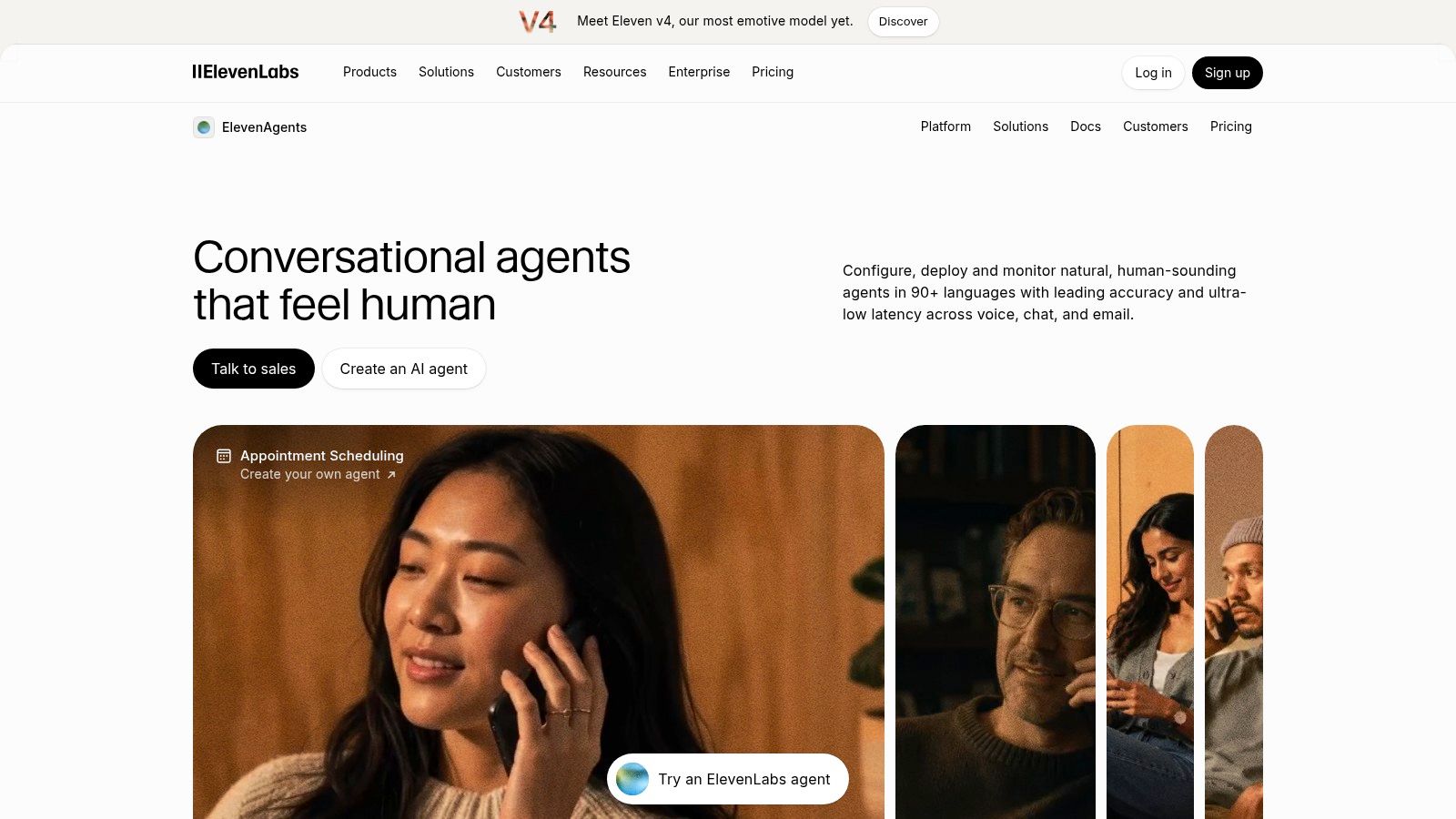
ElevenLabs ElevenAgents combines agent-building and deployment tools with ElevenLabs voice technology. Its agent platform supports voice and chat, APIs and SDKs, workflow building, and knowledge-base features. It's worth evaluating when a sales experience depends on voice quality or multilingual interactions, but compare it with real prospects and scripts rather than assuming that a strong voice demonstration guarantees good call handling.
Published plans range from Free at $0 per month with 15 minutes to Business at $990 per month with 12,375 minutes. Additional minutes are listed at $0.08 per minute under standard conditions. LLM and telephony costs may be separate, so confirm what the plan includes before projecting the total cost of a live campaign.
Match plan limits to call operations
Included minutes and concurrency limits can affect whether a plan works for a team's expected activity. A low-cost entry plan can help with experimentation, but it may not cover the volume or simultaneous calls needed for a production operation. The same caution applies when assessing support for regulated workflows: ask about relevant controls and terms directly rather than inferring them from the product description.
The platform offers a path from self-serve development to enterprise arrangements, but teams still need to account for integration effort and any external model or telephony charges. ElevenAgents fits teams that value voice and language options and are prepared to manage those operational details. Run tests with real objections, noisy audio, transfers, and CRM updates before expanding from a test environment.
7. Deepgram Voice Agent API
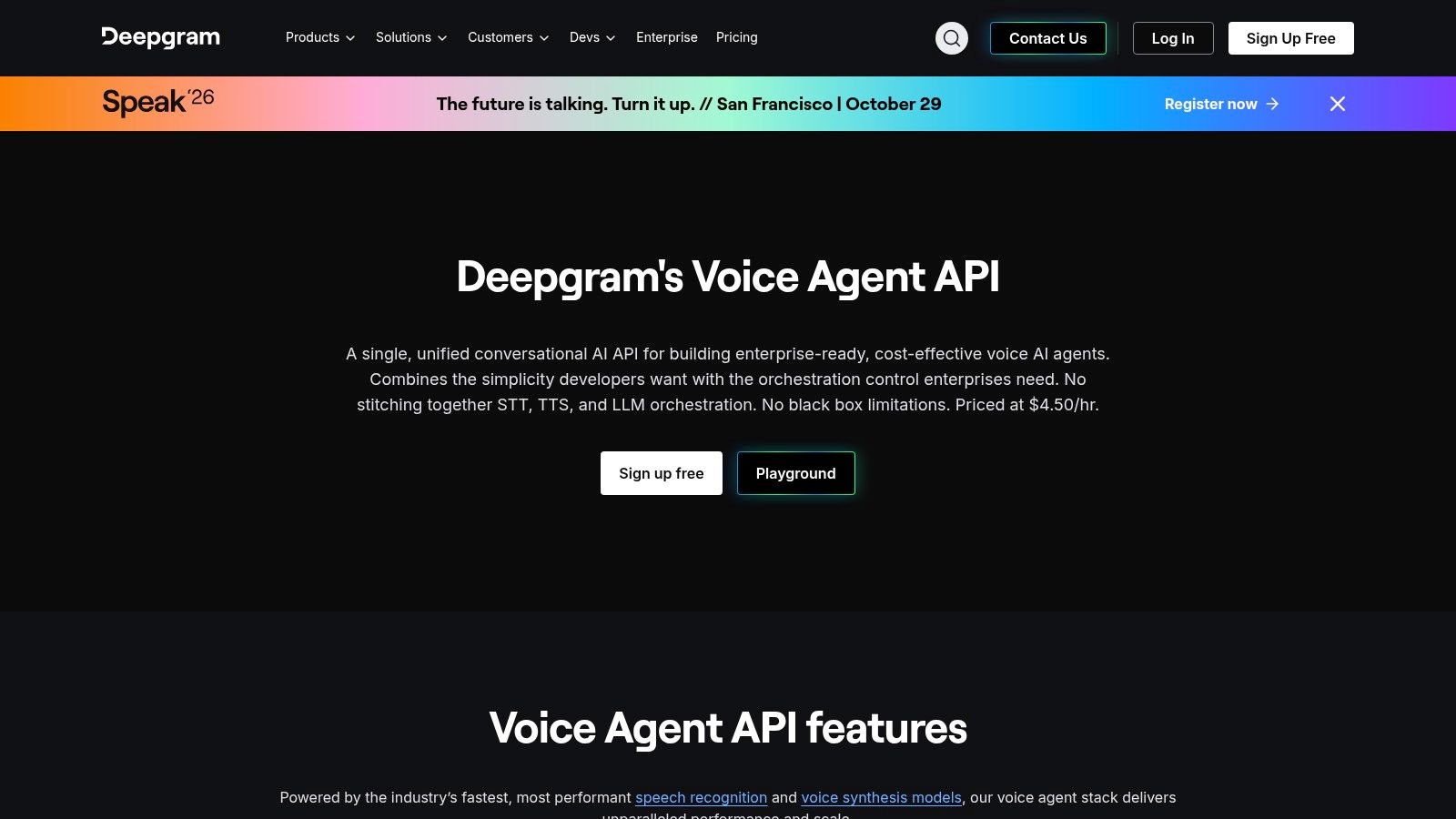
Deepgram Voice Agent API is infrastructure for technical teams, not a visual campaign builder. It brings speech recognition, speech synthesis, and real-time agent orchestration into a unified API. The Voice Agent API includes interruption handling, turn-taking, and function calling, with options to bring your own LLM or text-to-speech provider.
Deepgram lists a full-stack rate of $4.50 per hour, with different pricing when you bring your own models, and advertises free credits for developers. Confirm exactly what the full-stack rate covers and how your chosen providers change the estimate. A single API can reduce the work of coordinating separate voice components, but it doesn't build your sales campaign, CRM rules, or reporting process for you.
Choose the API when your engineers want infrastructure control and are ready to own the application around it.
Managed, dedicated, and self-hosted deployment options are described by the vendor, along with enterprise deployment and data-residency options. Those are useful capabilities to assess, not proof that a particular configuration meets your organization's obligations. Ask for the technical and contractual details that apply to your deployment.
Deepgram makes the most sense for teams with engineering resources that want to build a customized voice experience around an API. It's less suited to business users who need to launch and manage campaigns through a visual interface. Before committing, verify outbound campaign management, operational reporting, integration behavior, and the support model your team will rely on.
Best AI Agent Builder Comparison: 7 Voice Platforms
The seven platforms in this comparison split into four operating models: a managed sales-call service (Voicedial.ai), a visual builder (Synthflow), developer platforms (Retell AI, Vapi, Bland AI, ElevenLabs ElevenAgents), and a voice infrastructure API (Deepgram). The right pick depends less on feature lists than on two questions: who does the integration work, and what the bill looks like at production volume.
| Platform | Operating Model | Who Owns Integration Work | Headline Pricing | Best Fit |
|---|---|---|---|---|
| VoiceDial.ai | Managed service with custom scripts and ongoing support | Vendor leads setup; your team supplies scripts, CRM access, and campaign rules | Not published; quote-based for high call volumes | Businesses wanting managed, high-volume sales follow-up |
| Retell AI | Developer platform with templates and APIs | Shared; templates cover basics, custom connections need engineering | From $0.07/minute after free credits | Teams balancing launch speed with integration needs |
| Synthflow | Visual workflow builder for business users | Mostly your team; complex CRM or data connections may need technical help | From $29/month; enterprise from $30,000/year | Business teams configuring agents without code |
| Vapi | Developer-first API platform | Your engineers; you build the application around the API | $0.05/minute hosting, plus provider and telephony costs | Technical teams building custom voice-agent experiences |
| Bland AI | Developer platform with bring-your-own telephony | Your team connects phone infrastructure and calling workflows | From $0.14/minute | Companies automating calls on existing phone systems |
| ElevenLabs ElevenAgents | Agent platform with workflow tools, APIs, and SDKs | Shared; visual tools help, deeper builds need developers | Free plan; paid tiers up to $990/month | Teams prioritizing voice quality and multilingual reach |
| Deepgram Voice Agent API | Unified voice infrastructure API | Your engineers; infrastructure only, you own the app layer | $4.50/hour full-stack rate | Developers building custom real-time voice systems |
Headline rates are entry points. Telephony charges, model provider fees, per-minute overages, and concurrency limits change the final bill once you move past a pilot. Price each platform against your expected monthly volume, then weigh that number against the engineering time each operating model demands from your team.
Choose for the Call Center You Will Actually Run
Choose Voicedial.ai when your priority is supported deployment, customized inbound and outbound conversations, and high-volume pipeline execution. A managed sales-call service reduces the need for your team to assemble the voice stack itself, and Voicedial.ai's custom scripts and real-time dashboard are designed around lead follow-up, qualification, and appointments. Get a quote based on your expected volume and confirm the launch plan, escalation process, CRM connection, and compliance responsibilities before you commit.
Choose a visual builder such as Synthflow when business users need to configure call flows without deep engineering support. That operating model makes workflow adjustments more accessible, but you still need to test integrations, capacity, and what happens when an agent reaches an exception. Published minute allowances are a useful starting point for planning, not a substitute for calculating overages and peak concurrency.
Choose a developer platform or API such as Retell AI, Vapi, Bland AI, ElevenLabs ElevenAgents, or Deepgram when customization, provider choice, or infrastructure control matters more than convenience. These tools vary in how much they bundle, so compare the full bill and the engineering work required to connect telephony, models, CRM, scheduling, analytics, and handoff. A component-level price can look attractive while leaving substantial integration and operational work with your team.
Production readiness deserves more attention than feature count. G2's 2025 enterprise survey on AI agents reported that 57% of surveyed organizations had agents running in production, while others remained at pilot or pre-pilot stages. For sales teams, the important question is whether a platform can move a repeatable workflow into production with permissions, auditability, escalation, and recovery in place.
Run a paid pilot with real scripts and representative objections before choosing a long-term platform. Test interruptions, ambiguous responses, opt-outs, failed CRM calls, and human transfers, then measure completed outcomes rather than conversation length. Build a total-cost model that includes platform and provider fees, telephony, integration work, retries, monitoring, and human review. For another perspective on the platform options, compare agentic AI platforms and their deployment approaches. Pick the tool that your team can operate safely at real call volume, not the one that merely wins a demo.
Voicedial.ai provides customizable AI voice agents for inbound and outbound sales calls, with business-specific scripts, lead qualification, appointment booking, and a real-time dashboard for call outcomes. If you're evaluating the best AI agent builder for a production sales workflow, visit Voicedial.ai to discuss your use case, launch plan, and pricing for your call volume.