

At its core, telephony is simply the technology that lets us talk to each other over a distance. It’s the entire ecosystem that makes a phone call possible, from the old-school copper wires buried underground to the cloud-based software powering today's video calls.
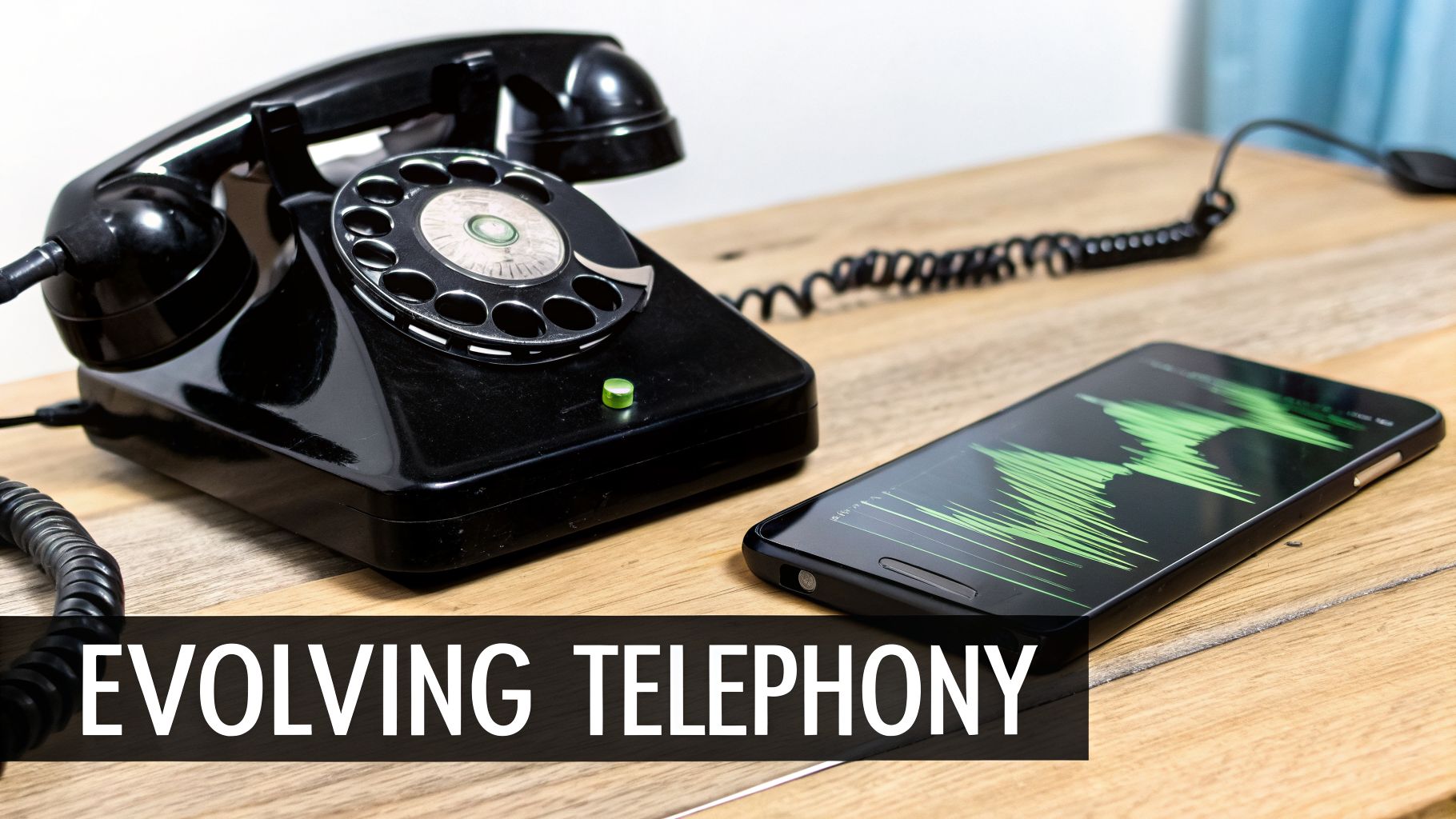
From Analog Wires to Digital Packets
Telephony has come a long way. Many of us can still recall the distinct whirr and click of a rotary phone or the faint static on a long-distance call. That was the era of analog telephony, a marvel of engineering built on a massive, physical network of copper wires and mechanical switches.
That system, known as the Public Switched Telephone Network (PSTN), worked like a dedicated railroad track. When you made a call, a physical, end-to-end circuit was opened just for your conversation. It was reliable, sure, but also incredibly rigid and expensive. That "track" stayed occupied for the entire call, whether you were talking or just listening.
Contrast that with the crystal-clear calls we make today from our laptops and smartphones. Modern telephony, powered by Voice over Internet Protocol (VoIP), is completely different. Instead of a dedicated track, it breaks your voice into tiny digital "packets" and sends them over the internet, just like an email or a video. This method, called packet-switching, is vastly more efficient, flexible, and affordable.
This fundamental shift from analog to digital, from physical circuits to internet packets, is what makes today’s communication tools possible.
To help you keep these core concepts straight, here’s a quick rundown of the fundamental technologies we'll be exploring.
Key Telephony Technologies at a Glance
| Technology | Core Function | Primary Medium |
|---|---|---|
| PSTN | The traditional, circuit-switched telephone network | Copper Wires |
| PBX | An on-premise phone system for businesses | Internal Hardware |
| VoIP | Transmits voice calls over the internet | Internet/IP Networks |
| SIP | The protocol that starts and ends VoIP calls | Software/Protocols |
| RTP | The protocol that carries the actual voice data | Software/Protocols |
Each of these technologies plays a role in how we connect, whether it's through an old desk phone or a modern AI voice agent.
Why This Evolution Matters for Your Business
So, why does this history lesson matter? Because the move from hardware to software has completely changed what a phone system can do. It's no longer just a utility for making calls; it’s a strategic tool for growth.
This evolution brings three huge advantages:
- Drastic Cost Reduction: With no need for pricey on-site hardware or dedicated phone lines, the savings are immediate and substantial. Your phone bill gets a lot smaller.
- Work-From-Anywhere Flexibility: Your team can make and receive business calls from their laptop at home, a cell phone on the road, or a desk in the office. All they need is an internet connection.
- Powerful Integrations and Features: Modern telephony systems easily connect with other business software like your CRM. This opens the door for automated workflows, data-driven outreach, and much smarter customer conversations.
This shift is the foundation for everything that comes next. It’s what allows technologies like AI voice agents from Voicedial.ai to exist, turning a simple phone call into an automated, efficient, and powerful business process.
To really get why modern calling is so powerful, it helps to look back at how it all started. For more than a century, traditional telephony was a physical marvel—a massive, intricate system of wires and switches that literally connected the world.
At its core were two key pieces of the puzzle: the Public Switched Telephone Network (PSTN) and the Private Branch Exchange (PBX).
Imagine an invisible web stretching across the globe, connecting every home and office phone with a real copper wire. That’s the simplest way to picture the PSTN. This was the classic phone system, the one that gave you a dial tone and routed your calls through a complex series of mechanical switches.
When you made a call, the PSTN used a method called circuit-switching.
Think of it like booking a private, temporary road just for your conversation. From the moment you picked up the phone until you hung up, a dedicated, unbroken physical line was reserved only for your call. This made for a crystal-clear, stable connection.
This approach was incredibly reliable for its time. But it was also wildly inefficient. That "private road" stayed blocked off for your entire call, even during moments of silence. This tied up network resources that no one else could use, which is exactly why long-distance and international calls used to be so expensive.
The Rise of the On-Premise PBX
As companies got bigger, they ran into a problem. Giving every single employee a direct, costly line to the public network just wasn't practical. The solution was the Private Branch Exchange (PBX), a game-changer for business communication.
A PBX is basically a company's own private, miniature telephone network, usually housed in a server closet on-site. It acted like a smart, internal switchboard, managing all the phones within the organization.
Here’s how a PBX made life easier for a typical business:
- Internal Calls: Employees could call each other for free just by dialing a short extension (like "x101"). The PBX connected them internally without ever touching the expensive public network.
- External Calls: When someone needed to call an outside number, the PBX would connect their extension to one of the company's limited outside lines. This let a business with 100 employees get by with just 10-20 external phone lines, which saved a ton of money.
- Essential Business Features: The PBX also introduced what we now consider standard business features, like call transferring, voicemail, and auto-attendants ("Press 1 for Sales, Press 2 for Support").
While the PBX was a huge step forward, it was still physically tethered to the old PSTN. The hardware was expensive to buy and a headache to maintain, demanding specialized technicians for even minor changes.
The Limits of Legacy Systems
Need to grow? It wasn't easy. Scaling a traditional phone system was a major project. Adding new phone lines meant a technician had to come out, physically run new wiring, and reconfigure the PBX hardware.
The whole process was slow, costly, and disruptive. For a company dealing with fast growth or seasonal spikes in demand, this inflexibility was a serious roadblock.
Ultimately, the combination of high costs, dependency on physical hardware, and the inability to scale on the fly created a clear demand for something better. The rigid, circuit-switched world of traditional telephony was reliable, but its expense and inflexibility paved the way for the digital revolution of internet-based calling.
The Leap to Modern Cloud Telephony and VoIP
The old world of telephony, with its physical constraints, eye-watering costs, and general inflexibility, was practically begging for a digital upgrade. The next big chapter in the story of "what is telephony" is all about moving our conversations from those old copper wires onto the internet. And the technology that makes it all possible is Voice over Internet Protocol (VoIP).
VoIP is the engine running under the hood of almost every modern voice call you make. Instead of needing a dedicated, physical line for a conversation, VoIP cleverly converts your voice into digital data. This data is then chopped up into tiny "packets" and zipped across the internet to the person on the other end.
Think of it like this: You have a long message to send. Instead of writing it on one giant, clumsy scroll, you break it down into a series of small, numbered postcards. You mail them out, and even if they take slightly different paths, they get reassembled in the right order at the destination, perfectly recreating your original message.
That’s a pretty good picture of how VoIP works. Your voice is the message, and the internet is the postal service, delivering your “postcards” (data packets) almost instantly. This method, called packet-switching, is incredibly efficient because it shares network resources. It's the main reason internet-based calls are so much cheaper than old-school long-distance.
Moving the Switchboard to the Cloud
Building on the foundation of VoIP, cloud telephony takes the whole idea a massive step further. It essentially takes your entire business phone system—including that clunky old PBX hardware in the server closet—and moves it into the cloud. Your on-premise switchboard becomes a virtual, software-based system hosted on secure servers that you can access from anywhere with an internet connection.
The difference is stark when you see the old and new systems side-by-side. The concept map below illustrates the rigid, physical path of a traditional phone call: from the public network, to a private switchboard, and finally to a user's phone.
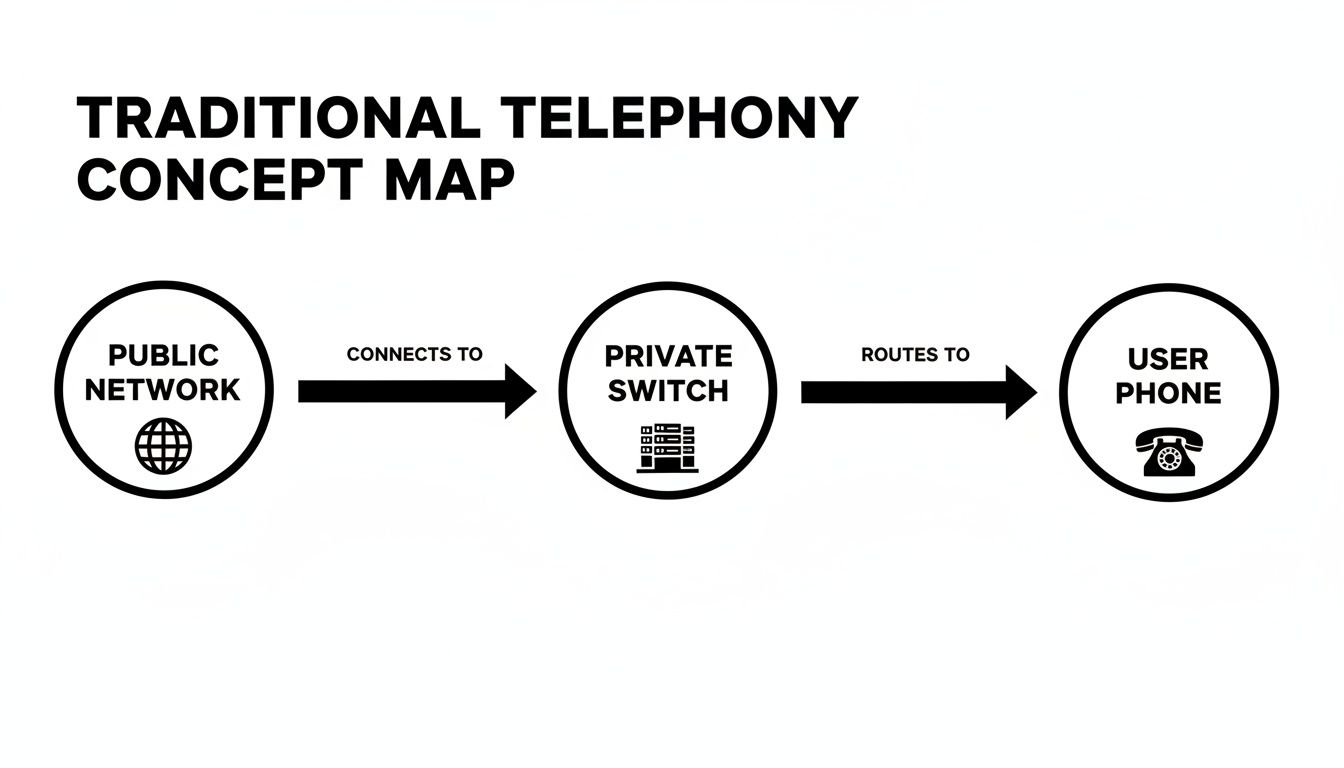
You can see how hardware-dependent the legacy systems were. Every single connection point was a physical piece of gear that needed maintenance, space, and manual changes. Modern cloud systems completely replace this hardware chain with software, unlocking a level of flexibility and scalability that was simply unimaginable before. This has had huge implications for how businesses grow and operate today.
The Protocols Making It All Work
For VoIP calls to actually sound clear and be reliable, they depend on a set of rules, or protocols, that manage the entire connection. While there are a bunch of them out there, two are absolutely fundamental to the whole process: SIP and RTP.
Session Initiation Protocol (SIP): Think of SIP as the traffic controller for your call. Its main job is to start the conversation, manage it while it's happening, and end it cleanly. When you dial a number on a VoIP phone, SIP is what sends out the signal to find the person you're calling, makes their device "ring," and formally establishes the connection when they pick up.
Real-time Transport Protocol (RTP): As soon as SIP has connected the call, RTP takes over the heavy lifting. Its one and only job is to deliver the actual voice data—those little packets we talked about—smoothly and in the correct order. RTP is the protocol that works to make your conversation sound natural and minimize things like lag or jitter.
Putting it simply, SIP handles the "who" and "when" of the call, while RTP handles the "what"—the actual sound of your voice. This powerful partnership is what makes internet-based communication a truly dependable alternative to traditional phone lines.
The incredible explosion in mobile connectivity just goes to show how central this technology has become. It's projected that by the end of 2025, there will be 5.9 billion mobile service subscriptions across the globe. Even more telling, 4.7 billion of those users—that's roughly 58% of the world's population—were already using mobile internet, cementing telephony’s role as the backbone for worldwide connectivity. This massive user base makes having efficient, scalable calling systems more important than ever.
Why Modern Telephony Is a Business Game Changer
It’s one thing to understand the technical shift to digital packets and cloud systems. It's another thing entirely to see how that shift directly pads your bottom line. Modern telephony isn't just a different way to make calls—it’s a strategic asset that gives you concrete, measurable advantages. Your phone system transforms from a simple utility into a powerful engine for growth.
The benefits are clear and almost immediate. When you ditch the old model of expensive hardware and rigid contracts, you unlock a level of business agility that was just a fantasy a decade ago.
Let's break down the four key areas where this transformation makes the biggest difference.
Drastic Cost Efficiency
The most immediate and compelling reason businesses switch to modern telephony is the massive cost savings. Traditional phone systems were a financial drain, saddled with expensive on-site PBX hardware, pricey maintenance contracts, and punishing per-minute rates for long-distance and international calls. VoIP and cloud telephony pretty much wipe those costs off the board.
Because the whole system runs as software over your existing internet connection, there's no need for a huge upfront investment in physical equipment. Better yet, call costs plummet. Since your calls are just data packets zipping across the internet, the old, arbitrary pricing based on geography disappears. Suddenly, national or even international outreach becomes far more affordable.
Effortless Scalability
Picture this: your business is heading into its busy season, and you need to triple your sales team for the next three months. With a traditional phone system, this would be a logistical nightmare of technicians, new wiring, and costly hardware installations that you'd be stuck with later.
With modern telephony? It's as simple as clicking a few buttons in a web browser.
Cloud-based systems are built for flexibility. You can add or remove phone lines and user accounts in real time through a simple online dashboard. This means your communication infrastructure can scale up or down instantly to perfectly match your business needs.
This on-demand scalability is a true game changer for growing companies or businesses with seasonal demand. You only pay for what you use, when you use it, making sure you never waste another dollar on idle capacity. That’s the kind of flexibility you need to compete in today's market.
Enhanced Reliability and Compliance
It might sound strange, but moving your phone system to the cloud actually makes it more reliable. Your old on-premise PBX was a single point of failure—vulnerable to power outages, hardware malfunctions, or even just a spilled coffee.
In contrast, cloud systems are hosted in geographically distributed, highly secure data centers. This built-in redundancy means that if one server goes down, your service seamlessly switches to another without you even noticing. It's a robust disaster recovery plan right out of the box.
Plus, modern telephony platforms come packed with features that are critical for compliance and quality assurance.
- Call Recording: Automatically record and store calls to meet regulatory requirements in industries like finance or insurance, or simply for training your team.
- Detailed Call Logs: Get comprehensive records of every single inbound and outbound call for easy auditing and performance analysis.
- Secure Connections: Your conversations are protected with encryption protocols, ensuring the privacy and integrity of your business communications.
Powerful Business Integrations
This might be the most significant long-term advantage: modern telephony can connect with the other tools you use to run your business. Because it's all software, your phone system can finally "talk" to your Customer Relationship Management (CRM) platform, helpdesk software, and other core applications. This creates a unified and intelligent workflow that was impossible before.
This connectivity fuels incredible efficiency. The telecommunications sector, which generated around $1.15 trillion in global service revenue in 2024, is seeing a strange trend: call volumes are rising, but per-call prices are falling. To stay competitive, businesses have to make every single call more efficient, and integration is how you do it. You can explore more of these industry revenue trends from PwC.
For example, when an inbound call comes in, your agent can see the customer's entire history pop up on their screen before they even say hello. When making an outbound call, they can dial directly from a CRM record, and the activity is logged automatically. This fusion of communication and data gives your teams the context they need to have smarter, more effective conversations.
The Next Frontier: AI Voice and the Future of Telephony
Modern telephony, with its incredible scale and data-rich digital backbone, has set the stage for something truly remarkable. The jump from analog copper wires to digital voice didn't just make calls cheaper and more flexible; it built the perfect launchpad for the next leap in business communication: AI voice agents.
This is the point where your phone system stops being a passive tool and becomes an active, automated engine for growth.
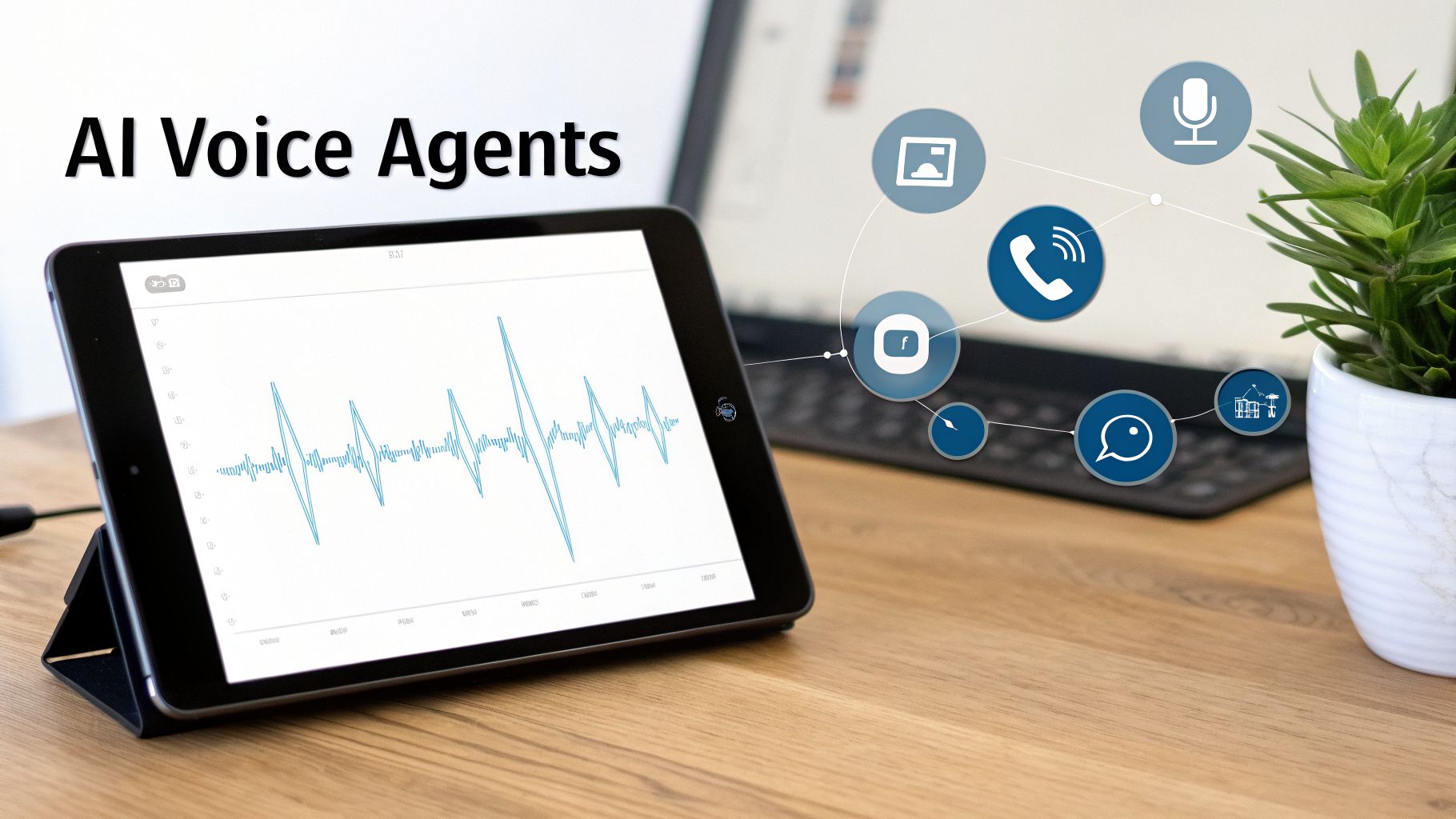
AI voice agents don’t just use modern telephony; they supercharge it. They tap directly into the power of VoIP and cloud infrastructure to automate conversations at a scale that was simply unimaginable a few years ago. Imagine a world where you’re no longer limited by the number of human agents you have or the hours in a day.
How AI Augments Human Teams
This technology acts as a powerful force multiplier for your existing teams. AI voice agents can handle the repetitive, time-consuming parts of outreach, freeing up your skilled people to focus on what they do best: closing deals and managing complex customer relationships.
Think of it as giving every member of your team their own tireless assistant.
An AI voice agent can:
- Place thousands of calls simultaneously, a task that would require an entire call center of human agents.
- Instantly qualify leads by asking targeted questions, sorting interested prospects from dead ends in seconds.
- Answer common questions with perfect consistency, ensuring every lead gets the correct information, every single time.
- Book qualified appointments directly into your team’s calendars, filling their schedules with high-value conversations.
This level of automation completely changes the economics of outbound calling. It makes large-scale outreach campaigns efficient, affordable, and predictable.
With AI handling the initial outreach, your human agents can enter conversations at the most critical moment—when a lead has already shown interest and is ready to talk. This dramatically improves efficiency and morale, as your team spends less time dialing and more time selling.
Turning Telephony into a Growth Engine
By integrating AI, your answer to "what is telephony?" evolves. It's no longer just about connecting two people for a chat. It’s about creating an automated system that proactively finds opportunities, nurtures leads, and drives real business outcomes around the clock.
Platforms like Voicedial.ai are designed to make this a reality today. They give you the tools to build, launch, and manage custom AI callers that follow scripts, understand responses, and take specific actions.
For industries like insurance, home services, or medical device sales, this means you can re-engage thousands of old leads or follow up with new inquiries instantly—all without adding a single person to your payroll. The future of telephony isn’t just about better calls; it’s about smarter conversations.
Got Questions About Telephony? Let's Get Them Answered.
As we’ve walked through the evolution from old-school phone closets to cloud-powered systems, you're probably starting to connect the dots to your own business. It's only natural to have a few practical questions. Getting a real handle on modern telephony usually comes down to a few key "what's the difference?" moments.
Let's clear up some of the most common points of confusion, tackle practical concerns like keeping your number, and peek under the hood to see how tools like AI voice agents actually work.
What Is the Main Difference Between PBX and VoIP?
The simplest way to think about it is hardware versus software. A traditional Private Branch Exchange (PBX) is a physical box of equipment that lives in your office. Think of it as your own private, on-site telephone switchboard, managing calls over traditional phone lines. It’s the classic server closet humming away in the corner.
VoIP, or Voice over Internet Protocol, isn't a box at all. It’s the method of turning your voice into digital data and sending it over the internet. When people talk about a “cloud PBX” or a “hosted VoIP system,” they mean all the functions of that old PBX hardware have been moved into the cloud and now run as software. This gets rid of the need for clunky on-site equipment and gives you a level of flexibility the old systems just can't match.
Can I Keep My Business Phone Number If I Switch to VoIP?
Yes, absolutely. This is probably the most common—and critical—question businesses have, and thankfully, the answer is a resounding yes.
There's a standard, regulated process called “number porting” that lets you transfer your existing phone number from your old provider to a new VoIP service. This is a routine procedure that ensures you don't lose your business identity. You get to maintain complete continuity without the massive headache of updating your number on every website, business card, and customer record. Your customers won't have a clue anything changed on the backend.
The ability to port your number is a game-changer. It frees businesses to choose the best technology for their needs without being held hostage by a phone number they’ve spent years building.
How Does an AI Voice Agent Actually Make a Call?
An AI voice agent is where smart software meets modern cloud telephony. It’s a seamless integration that allows an AI to hold a real conversation over the phone.
Here’s how it works, step-by-step:
- Initiation: The AI software, armed with a conversational script, uses advanced text-to-speech tech to generate a surprisingly natural, human-like voice. It then tells a telephony platform (via an API) that it’s ready to make a call.
- Connection: The telephony platform takes over and uses VoIP to place the outbound call, dialing the recipient’s number just like any other internet-based call.
- Conversation: The moment someone answers, the AI’s speech recognition kicks in. It listens to what the person says, understands their intent in real-time, and delivers the next part of the conversation. This creates a genuine, back-and-forth dialogue.
This powerful combination is what allows an AI to handle thousands of calls a day, qualifying leads and booking appointments completely on its own.
By turning telephony into an automated growth engine, Voicedial.ai helps businesses scale their outreach and fill their calendars 24/7. See how our AI voice agents can start booking appointments for your team by visiting https://voicedial.ai.