

When a customer picks up the phone to call your business, it’s fundamentally different from you calling them. That simple action—them initiating the contact—is the essence of an inbound call. Think of it as a customer walking through your digital front door. They already know who you are and have a specific reason for being there.
What Is An Inbound Call and Why It Matters for Your Business
At its heart, an inbound call is a direct lifeline from a customer to your company, and it’s always on their terms. Unlike outbound calls where you’re proactively reaching out, these interactions are driven by high intent. The person on the line has a problem, a question, or an interest they believe you can address right now.
This customer-first dynamic is precisely what makes inbound calls so powerful. They aren't just interruptions; they're genuine opportunities. While they’ve always been the backbone of customer service, their role has only grown. In the wake of 2020, a full 61% of call center leaders reported a significant jump in inbound call volumes, proving their staying power in our hyper-connected world. You can dig into this trend and other key call center statistics from CMSWire.
The Core Characteristics of an Inbound Call
To really get a feel for inbound calls, it helps to break down what makes them unique. These calls are far more than just another support ticket—they’re a live indicator of customer engagement, sales potential, and brand health.
Each ring is a moment of truth where a customer has actively chosen to connect with you. Here’s what defines that interaction:
- Customer-Initiated Contact: This is the big one. The customer or prospect makes the first move because they have a reason to.
- Reactive Business Response: Your team’s job is to listen and react. Whether it's solving a technical glitch, clarifying a billing question, or processing a new order, you're responding to their lead.
- High Intent and Urgency: People don't call just to chat. They usually have a pressing need or are close to making a buying decision, making these interactions incredibly valuable and time-sensitive.
- Diverse Purposes: An inbound call can be anything. It might be a cry for help with a broken product, a question about your services, or a request to book an appointment.
To put it all together, here’s a quick snapshot of what defines an inbound call.
Quick Glance Inbound Call Characteristics
| Attribute | Description | Business Example |
|---|---|---|
| Initiator | The customer or prospect always makes the first move. | A potential client calls your law firm after seeing a billboard. |
| Business Role | The company’s role is to answer and resolve the caller's need. | A support agent walks a user through troubleshooting a software issue. |
| Caller Intent | Usually high and driven by a specific, immediate need. | A homeowner calls a plumber because their sink is leaking. |
| Primary Goal | To provide support, answer questions, or facilitate a transaction. | A receptionist books a new patient appointment for a dental clinic. |
Understanding these fundamentals is the first step toward building a strategy that treats every inbound call not as a task, but as a golden opportunity.
An inbound call is more than just a ringing phone; it's a direct signal of customer need and a real-time opportunity to build trust, solve a problem, or close a deal.
Once you see them this way, you can start building processes to make sure every single one of those opportunities counts.
Inbound vs Outbound Calls: Understanding the Critical Difference
To really get why an inbound call is so valuable, it helps to put it side-by-side with its counterpart: the outbound call. While both are just phone conversations between your business and a customer, their direction, purpose, and the skills needed to handle them are worlds apart. Nailing this difference is fundamental to any sales or service strategy that actually works.
Think of it like fishing. An inbound call is like a fish hitting your line. The fish (your customer) is already looking for something, found your bait (your marketing), and is taking action. Your job is to react skillfully to reel in the opportunity. It’s a reactive process, driven entirely by the customer's immediate need.
An outbound call, on the other hand, is like casting a wide net. You're the one starting the action, reaching out proactively hoping to catch someone who might be interested. This approach requires you to generate interest where none might have existed a moment before.
Different Goals, Different Mindsets
Because the starting point is so different, the goals for each call type diverge in a big way. The customer’s frame of mind is also completely different, which changes the kind of skills your team needs to succeed.
For inbound calls, the main goals are pretty straightforward:
- Problem Resolution: The caller has a problem, and your team needs to solve it—fast.
- Information Provision: They need an answer, a quote, or details about a product, and you have to deliver it clearly.
- Sales Conversion: They’re already interested. Your role is to guide them smoothly to a purchase or booking.
Outbound goals, however, are all about creating new activity:
- Lead Generation: Reaching out to see if potential customers even have a need.
- Appointment Setting: Calling prospects to lock in a sales demo or consultation.
- Surveys and Feedback: Proactively gathering market data or customer opinions.
The real difference is intent. Inbound callers show up with a specific need and a high level of interest; outbound agents have to create that interest from scratch.
This is why the required skills are so different. An inbound agent needs killer listening skills, empathy, and deep product knowledge. They have to diagnose a need and deliver a solution on the spot. In contrast, an outbound agent needs persistence, a thick skin, and serious persuasion skills to cut through the noise and build rapport out of thin air.
To make it crystal clear, let's look at them head-to-head.
Inbound vs Outbound Calls: A Head-to-Head Comparison
The table below breaks down the core distinctions between inbound and outbound calls, highlighting how they differ in nearly every aspect, from who initiates the call to how success is measured.
| Feature | Inbound Calls | Outbound Calls |
|---|---|---|
| Initiator | Customer or prospect | Business or agent |
| Primary Purpose | Customer support, sales inquiries, issue resolution | Lead generation, sales prospecting, appointment setting |
| Customer Mindset | High-intent, seeking an immediate solution | Often unaware, may feel interrupted |
| Agent's Role | Reactive problem-solver and guide | Proactive persuader and educator |
| Key Skillset | Active listening, empathy, product knowledge | Resilience, persuasion, quick thinking |
| Success Metric | First Call Resolution, Conversion Rate | Dials per hour, Appointments Set, Lead Quality |
Ultimately, understanding this comparison helps you staff your teams correctly, set the right goals, and choose the right technology—like AI voice agents from a platform like Voicedial.ai—to handle each type of call effectively.
How AI Voice Agents Are Changing The Game For Inbound Calls
For any growing business, that constant stream of inbound calls is a double-edged sword. Every ring is a potential new client, but every missed call is a definite lost opportunity. Staffing a reception desk 24/7 is a huge expense most companies can't justify. This is where AI voice agents come in. They act as a force multiplier, making sure nothing slips through the cracks.
Think of it like having an assistant who never sleeps, never has a bad day, and answers every single call with the same professional tone. That’s an AI voice agent. They deliver an immediate, surprisingly human-like response at any time, day or night. For industries like legal intake, home services, or medical sales, where that first impression is everything, this is a massive advantage.
Automating The Work That Matters
Today's AI agents do a lot more than just answer the phone. They're built to handle specific, high-value tasks that used to require a human, freeing up your team to focus on the complex problems that really need their attention.
This automation directly solves common business headaches: leads lost to unanswered calls, sky-high staffing costs, and the inability to capture interest after 5 PM. By taking over these foundational tasks, AI builds a more reliable and responsive system for your business.
- 24/7 Call Answering: Capture every single lead, day or night. No exceptions.
- Lead Qualification: Use custom scripts to ask the right questions, so your team only talks to high-quality prospects.
- Appointment Booking: Connect directly to your calendar and schedule consultations or service calls on the spot.
- FAQ Handling: Give instant answers to common questions about your services, hours, or pricing, taking that load off your staff.
An AI voice agent turns your inbound call process from a reactive chore into a proactive, automated lead-generation machine that works around the clock.
This is what it looks like inside a platform like Voicedial.ai, where you can track exactly how your AI agent is performing.
Having a real-time dashboard gives you total visibility into how your calls are being handled, turning every phone call into useful data.
The Financial and Operational Impact of AI
The move toward AI in call handling isn't just a small trend; it's a major market shift with the numbers to back it up. The call center software market is booming, and that growth is being pushed by AI that promises to make things run better and cheaper.
The market, valued at $41.7 billion in 2025, is set to climb as more businesses catch on. In fact, real-world data shows AI can boost resolutions per hour by 14% and slice average handle time by 9%, showing a clear return on investment. You can dig into more stats on the growth of AI in call centers with Giva Inc.
AI agents are designed to perfect the inbound part of your business communications. By making sure that first touchpoint is handled flawlessly every time, you’re building a much stronger foundation for the entire customer relationship.
The Numbers That Actually Matter for Inbound Calls
If you want to know if your inbound calls are actually helping your business, you have to look past the total number of rings. Just counting calls is a vanity metric. The real value comes from understanding the quality and outcome of each conversation.
When you start tracking the right Key Performance Indicators (KPIs), you stop thinking of your phone line as a cost center. Instead, it becomes a powerful, data-driven engine for growth.
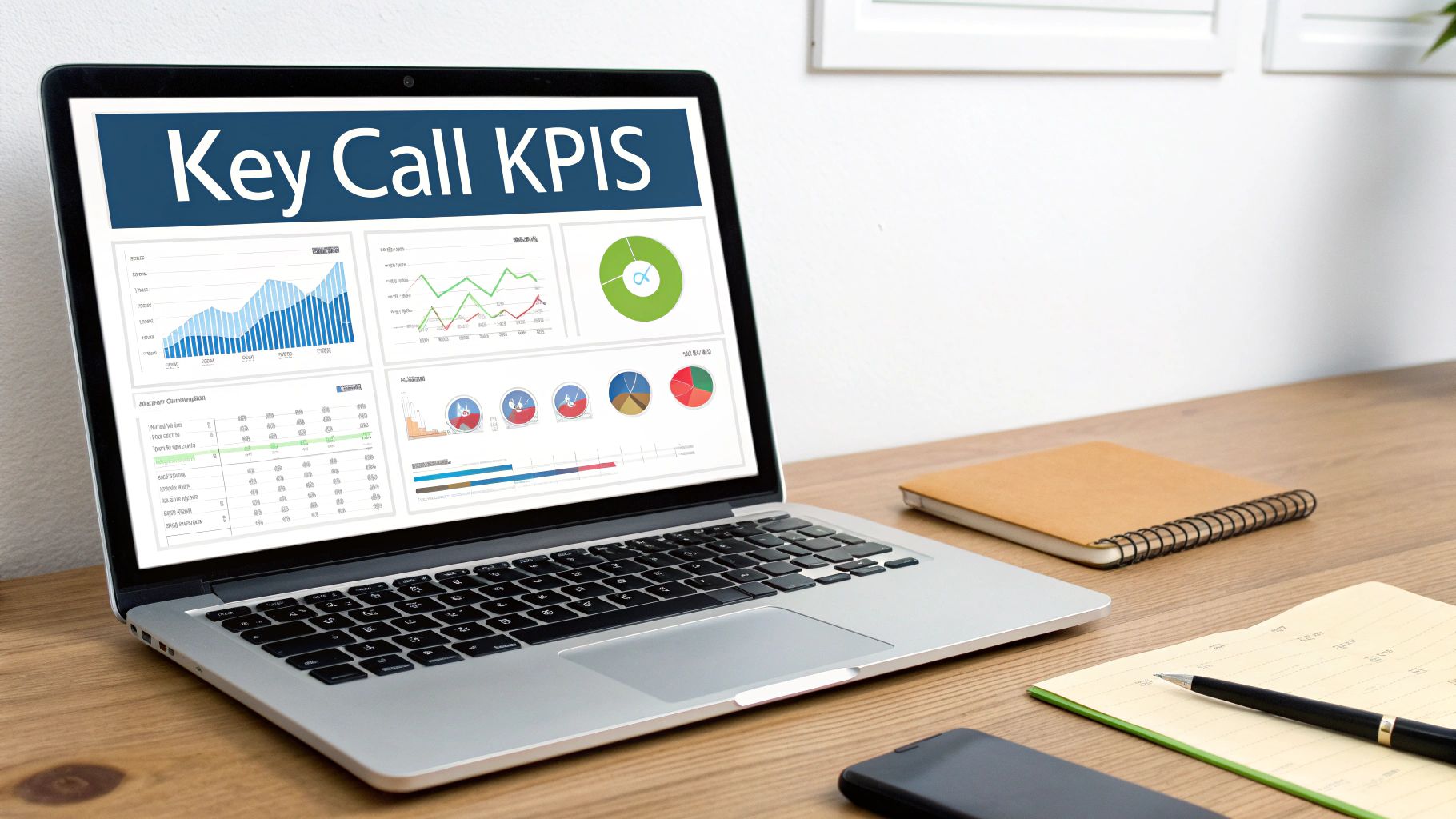
These numbers give you a clear, honest picture of your team’s efficiency, how happy your customers are, and the real impact on your bottom line. By watching these metrics, you can spot bottlenecks, give credit to your top performers, and constantly fine-tune your entire process.
Core KPIs for Inbound Performance
Think of these metrics as the vital signs for your customer communications. Just a few core numbers will give you immediate insight into the health of your entire inbound operation.
Here are four essential KPIs you should start tracking today:
- First Call Resolution (FCR): This is the gold standard. It measures the percentage of calls where a customer's problem is solved completely on the first try, with no need for a callback or follow-up. A high FCR is a fantastic indicator of both agent skill and genuine customer satisfaction.
- Average Handle Time (AHT): This metric tracks the average length of a call, from the moment an agent answers until all the after-call work is done. While a lower AHT can signal efficiency, you have to balance it with FCR. Rushing customers off the phone just to keep this number low is a recipe for disaster.
- Abandonment Rate: What percentage of people hang up before they even get to talk to someone? That’s your abandonment rate. A high number here is a major red flag, usually pointing to painfully long wait times or a confusing phone menu that's frustrating your customers.
- Conversion Rate: For any team focused on sales, this is the KPI that pays the bills. It tracks the percentage of inbound calls that lead to a valuable action—like booking an appointment, making a sale, or signing up. This number directly connects your phone calls to your revenue.
By focusing on outcomes like Conversion Rate and FCR, you shift the focus from merely answering calls to actively creating value with every single inbound interaction.
This data-first approach lets you see what’s really working. You might find that calls with a slightly longer handle time actually have a much higher conversion rate, proving that a few extra minutes spent building rapport really pays off.
Modern tools, like the dashboards available through platforms like Voicedial.ai, help you see all these metrics in real-time. This allows you to make smarter decisions on the fly and optimize your entire inbound process from top to bottom.
Nail Your Inbound Call Strategy With These Best Practices
Getting inbound calls right is about more than just picking up the phone. It’s about turning every ring into a structured, valuable interaction that respects both your customer’s time and your team’s. A solid strategy ensures you’re capturing opportunities and delivering a great experience without burning out your staff.
First, you need intelligent call routing. Think of an Interactive Voice Response (IVR) system as your digital receptionist. It guides callers to the right place—sales, support, or billing—without anyone on your team lifting a finger. This one change instantly filters your call traffic, cuts down wait times, and makes for a much smoother caller experience.
Next up: smart call scripts. Don’t leave important conversations to chance. You should have clear, simple scripts ready for the most common scenarios, whether it's qualifying a new lead, answering frequently asked questions, or walking a customer through a support issue. This guarantees every caller gets a consistent, professional, and on-brand response.
An inbound strategy isn't just about being available; it's about being effectively available. Every practice should lead to a better outcome for the caller with less wasted effort on your end.
This is especially critical when a new lead is on the line.
How to Handle New Leads Like a Pro
Turning an inbound call into actual revenue all comes down to how you manage your leads. You need to know who you're talking to and make sure their information goes right where it needs to.
Here’s the breakdown:
- Define What Makes a Good Lead: Figure out the exact questions you need to ask to spot a high-value lead. This might be about their budget, timeline, or specific needs. Make sure your team—or your AI agent—is equipped to ask these questions on every first call.
- Sync Everything to Your CRM: Every call is a piece of the puzzle. Your phone system should automatically log call details, notes, and outcomes straight into your Customer Relationship Management (CRM) software. This creates a single source of truth and stops precious lead info from getting lost in the shuffle.
- Be Ready 24/7: A surprising number of potential customers will call you after hours. Using an AI voice agent, like the ones from Voicedial.ai, means you never miss that call. It can capture lead details and even book appointments around the clock, turning what would have been a missed call into a solid opportunity.
Put these practices in place, and you’ll build a system that transforms your inbound calls from a reactive chore into a proactive engine for growth.
The Real-World Value of Inbound Calls Across Industries

It’s one thing to talk about inbound calls in theory, but their real impact hits home when you see what a single phone call can mean for a business. A ring isn’t just an interruption; it’s a high-intent prospect who has already done their homework, found your number, and decided you might be the answer to their problem.
This is where the magic happens. They’ve essentially qualified themselves, making an inbound call one of the most valuable leads you can possibly get. Each one represents a direct line to revenue, but only if it’s handled right.
Where a Single Call Is Everything
In some industries, the value of an inbound call gets amplified tenfold. A missed call isn't just a missed opportunity—it's thousands in lost revenue, a new client walking straight to your competitor, or even a patient not getting the help they need. The stakes are incredibly high.
Think about these real-world scenarios:
- Insurance (Medicare & Auto): A senior is calling a Medicare broker during the narrow open enrollment window. This isn't just a casual question; it's a critical, time-sensitive decision. If that call goes to voicemail, the broker loses that client for an entire year.
- Legal Services: Someone was just in a car accident and is calling a personal injury law firm. They’re actively looking for representation, and the first firm that answers the phone and shows competence is almost guaranteed to get the case.
- Home Services: A homeowner’s roof is leaking in the middle of a rainstorm. They're frantically calling roofers for an emergency repair. The contractor who picks up and can schedule a visit right away wins the job. Period.
- Medical Device Sales: A patient's family member is calling to order a specific device their doctor recommended. They aren’t shopping around—they’re ready to buy and just need clear information and a quick process.
In every one of these cases, the inbound call is a moment of truth. The business that responds instantly doesn't just make a sale; it solves an urgent problem and builds immediate trust.
The True Cost of a Missed Call
The common thread here is immediacy. The caller has a pressing need and zero patience. If you don't answer, they won't leave a message and wait—they’ll just hang up and dial the next number on their search results.
This is why a bulletproof system for catching every single call is non-negotiable for businesses in these fields. Whether it’s a dedicated human receptionist or a sophisticated AI voice agent from a platform like Voicedial.ai, the mission is identical: capture every high-intent lead the second they reach out. This turns your phone line from a simple utility into your most powerful engine for consistent growth.
Your Questions About Inbound Calls, Answered
Even when you know the basics, the practical side of managing inbound calls can bring up a lot of questions. Let's tackle some of the most common ones that business owners have when they start thinking about automating how they handle incoming calls.
Can a Small Business Handle Inbound Calls Without a Receptionist?
Absolutely. You don't need a full-time receptionist sitting at a desk anymore. Technology like AI voice agents or virtual receptionist services can manage your calls far more efficiently.
An AI agent is a particularly smart move because it scales with you. It can answer calls 24/7, ask the right qualifying questions to see if a caller is a good fit, and book appointments directly into your team's calendar. This way, no opportunity gets missed, and you keep your overhead costs way down. It's the perfect fix for handling a call volume that goes up and down without hiring more staff.
What Is the Most Important Inbound Sales Metric?
While you'll hear a lot about metrics like First Call Resolution for support teams, when it comes to sales, the Conversion Rate is king. This is the number that tells you how many of your inbound calls are actually turning into real business, like a booked consultation or a closed deal.
Your conversion rate is the bridge between your marketing spend and your revenue. It shows the true ROI of whatever is making your phone ring. It’s not just about how many people call—it’s about how good you are at turning that interest into income.
Can AI Really Handle Complex Customer Inquiries?
Modern AI voice agents are brilliant at handling the routine questions that take up so much time. Think things like, "Are you open on weekends?" or "Are you accepting new clients?" They can qualify leads and get the basic info locked down.
For the really complex or emotional conversations, the best approach is a hybrid one. The AI gathers all the key information first and then hands the call off seamlessly to a specialized human agent. This creates a powerful system where AI manages the volume and your team tackles the complexity.
Ready to see how an AI voice agent can completely change your inbound call game? Explore Voicedial.ai and find out how to capture every single lead, any time of day or night.
Learn more at https://voicedial.ai.
Made with the Outrank app