

If you’ve ever made a call on WhatsApp or FaceTime, you’ve already used a VoIP telephone service. It’s a simple concept with a fancy name: Voice over Internet Protocol, which really just means making phone calls over the internet.
What Is a VoIP Telephone Service and Why Does It Matter

Instead of depending on the old-school network of physical copper wires, VoIP technology takes your voice and turns it into digital data. This lets you make and receive calls from anywhere you have a stable internet connection, whether you're using a desk phone, a laptop, or an app on your smartphone.
Let's use an analogy. A traditional landline is like sending a letter through the postal service—it travels along a fixed, dedicated physical path. VoIP is more like sending an email. It breaks your conversation into tiny digital packets, zips them across the most efficient internet routes, and reassembles them instantly on the other end.
This shift from analog to digital is what makes a VoIP telephone service so powerful for modern businesses. It frees your communications from a specific physical location and unlocks a world of advanced features, cost savings, and flexibility that traditional phone systems just can't touch.
The Shift from Analog to Digital Calling
For decades, the Public Switched Telephone Network (PSTN)—the classic landline system—was our only option. It was dependable, but also rigid and surprisingly expensive, especially for long-distance or international calls. VoIP completely changes that model by treating your voice calls just like any other type of data flowing over the internet.
This isn’t just a small trend; it's a massive market disruption. The global VoIP market was valued at an incredible $176.16 billion in 2025, growing from $132.47 billion in 2023. Projections show it soaring to an estimated $388.97 billion by 2034, all thanks to the clear advantages it offers businesses around the globe. You can dig into the drivers behind this explosive growth in a detailed market report on Fortune Business Insights.
VoIP is more than a replacement for your old phone system; it's an upgrade to your entire business communication strategy. It turns your phone into a flexible, data-driven tool that integrates directly into your business operations.
Key Differences Between Landlines and VoIP
To really grasp why so many businesses are making the switch, it helps to see the practical differences side-by-side. For high-volume calling environments like sales teams, insurance agencies, or customer support centers, these distinctions translate directly into better efficiency and a healthier bottom line.
The table below breaks down the core distinctions between old-school landlines and modern VoIP service.
| Feature | Traditional Landline | VoIP Telephone Service |
|---|---|---|
| Infrastructure | Requires physical copper wires installed and maintained by a phone company. | Only needs a reliable internet connection (broadband, fiber, etc.). |
| Cost Structure | High monthly rental fees, per-minute charges for long-distance, and expensive hardware. | Typically a lower-cost subscription model, often with unlimited calling included. |
| Flexibility | Phone number is tied to a single physical address. Moving offices is a major hassle. | Your number goes where you go. Use it on a desk phone, computer, or mobile app anywhere. |
| Features | Basic features like caller ID and voicemail, often for an extra fee. | Packed with advanced features: call routing, auto-attendants, analytics, and call recording. |
| Scalability | Adding or removing lines is a slow, manual process that requires a technician. | Add or remove users instantly through a simple online dashboard. Scales up or down with your business. |
As you can see, VoIP isn’t just a different way to make calls—it’s a fundamentally more agile and powerful platform built for the way businesses operate today. It moves your phone system from a fixed utility to a flexible software tool.
The Real Business Benefits of Switching to VoIP
Sure, knowing the tech behind a VoIP telephone service is interesting, but what really gets business owners to sit up and take notice are the real-world advantages. Making the switch isn't just about a new way to dial; it's about fundamentally upgrading how your company communicates, scales, and operates. For anyone focused on the bottom line, these benefits translate directly into a more agile, cost-effective business.
Let's start with the most obvious win: a massive cut in costs. Traditional landlines are notoriously expensive. You're hit with high monthly fees for each line, extra charges for long-distance calls, and expensive maintenance contracts. A VoIP system slashes most of these costs right off the bat.
Because VoIP runs over your existing internet connection, you can ditch the need for separate, costly phone wiring. Most plans even offer unlimited calling within certain regions, which means your sales team can make hundreds of outbound calls without you worrying about per-minute charges piling up. For businesses that live and die by call volume—think credit repair firms or insurance agencies—this can mean savings of 40% to 80% on their monthly phone bill. It’s a game-changer.
Achieve Unmatched Scalability and Flexibility
Business needs are never static. One quarter you might be hiring a new group of sales agents, the next you're opening a satellite office, and then you're staffing up for a seasonal rush. With an old-school phone system, scaling up or down is a nightmare—a slow, expensive process that requires technician visits and clunky hardware changes.
A VoIP telephone service flips that script entirely.
Because VoIP is software-based, you can add or remove phone lines and users instantly through a simple online dashboard. This gives you the power to scale your communications infrastructure in real-time, perfectly matching your team’s size and operational demands.
Picture a home services company gearing up for its busy spring season. With just a few clicks, the manager can activate ten new phone lines for the seasonal technicians and support staff they just brought on. Once the rush is over, those lines can be deactivated just as easily. You only pay for what you actually use. That kind of agility is simply impossible with landlines.
Empower a Truly Mobile Workforce
In today's world, your team needs to be productive from anywhere, not just chained to a desk. VoIP is the engine that powers true workforce mobility. Since an employee's business number is tied to their account—not a physical phone on a specific desk—they can make and receive calls on their business line from any device with an internet connection.
This opens up some powerful ways to improve productivity and be more responsive:
- Work from Anywhere: An agent can take a critical client call on their laptop from their home office or use a mobile app on their smartphone while traveling. As far as the customer knows, they’re calling from the main office line.
- Never Miss a Lead: Calls can be set to ring on multiple devices at once. This means that if one person is tied up, another team member can grab the call, preventing a valuable lead from getting dumped into voicemail.
- Maintain Professionalism: Your team no longer has to give out their personal cell numbers for business calls. Every outbound call they make shows the official company caller ID, keeping your brand image consistent and professional.
For any business where being responsive is non-negotiable—from legal intake teams to on-the-go sales reps—this mobility ensures you are always connected to your clients and opportunities. Moving from a fixed office phone to a flexible VoIP telephone service gives your team the freedom to work at peak efficiency, no matter where they are.
Unlocking Essential VoIP Features for Your Team
Beyond the big wins in cost and mobility, a modern voip telephone service is where your phone system stops being a simple utility and starts acting like a powerful business tool. The real magic isn't just in making calls over the internet; it's in the advanced features that boost your team's performance, sharpen the customer experience, and give you deep insights into your operations.
Think of it this way: a traditional phone system is like a basic flip phone. It makes and receives calls, and that’s pretty much it. A VoIP system, on the other hand, is the smartphone in your pocket. It still handles calls perfectly, but it also runs powerful applications that help you work smarter, not harder.
Let’s dig into some of these game-changing features.
Building a Flexible Communication Backbone
Two core components lay the foundation for a truly powerful VoIP setup: SIP Trunks and a Hosted PBX. Getting a handle on these two helps explain how VoIP delivers such incredible flexibility.
A Hosted PBX (Private Branch Exchange) is your business's central switchboard, but it lives in the cloud, not in a dusty server closet. This virtual command center manages all your calls—routing them to the right people, handling voicemail, and setting up auto-attendants ("Press 1 for Sales…"). Since it's hosted by your provider, you get all the power without the headache and expense of maintaining complex hardware on-site.
To connect your cloud PBX to the outside world, you use SIP (Session Initiation Protocol) Trunks. You can think of a SIP Trunk as a digital, multi-lane highway that replaces that tangled bundle of old-fashioned phone lines. Instead of being limited to one call per physical line, a single SIP Trunk can handle tons of simultaneous calls, giving you massive capacity that scales up or down on demand.
The a voip telephone service combines these elements to drive core business goals, as this visual shows.
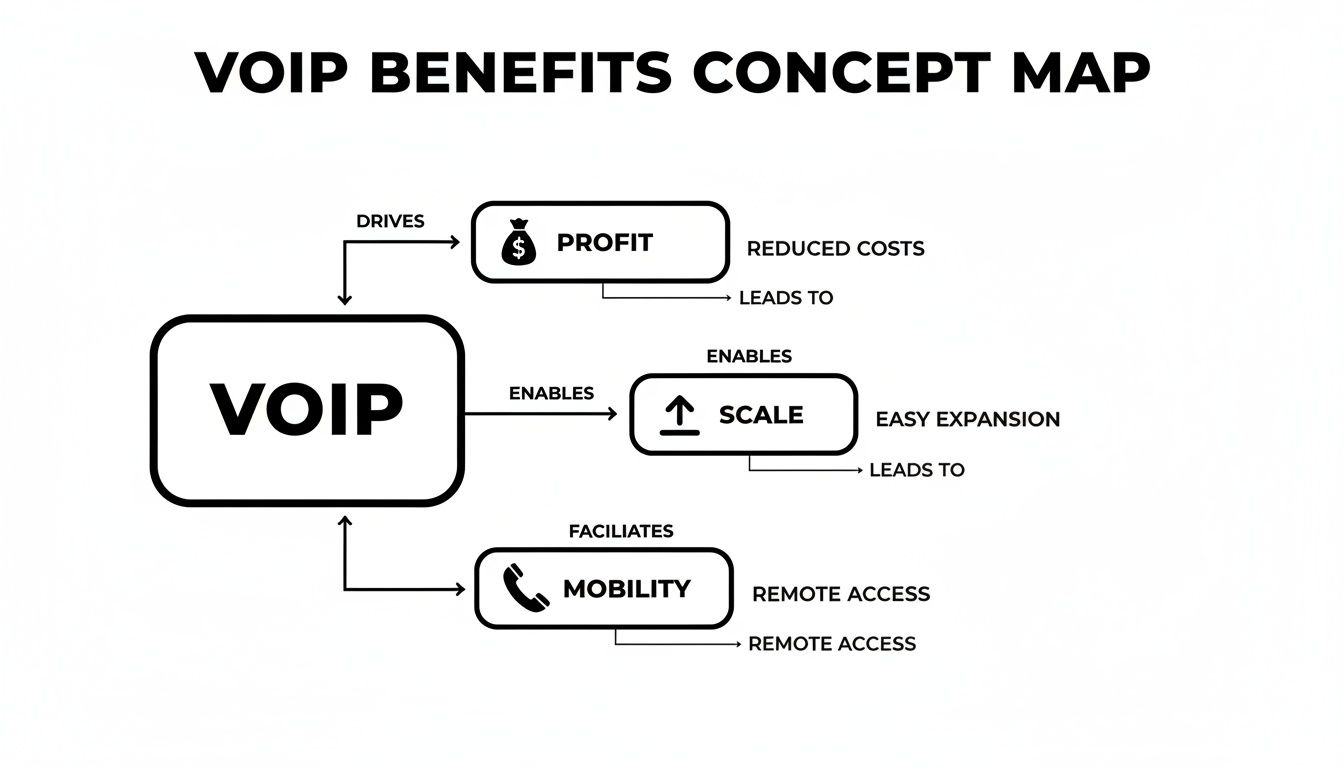
This structure is what directly improves profitability, enables rapid growth, and supports a workforce that's no longer tied to a desk.
Driving Performance with Intelligent Call Management
Once that foundation is solid, you can start using the features that directly impact how well your sales and service teams perform. Two of the most critical are intelligent call routing and detailed analytics.
Intelligent Call Routing makes sure every single incoming call is handled with maximum efficiency. Instead of a receptionist manually juggling calls, you can create automated rules that get callers to the right person or department instantly.
Here are a few real-world examples:
- Skills-Based Routing: A call from a Spanish-speaking customer is automatically sent to a bilingual agent. No more awkward hand-offs.
- Time-of-Day Routing: After-hours calls can go straight to an answering service or a designated on-call team member.
- Round-Robin Distribution: New sales leads are distributed evenly among your reps, ensuring everyone gets a fair shot.
This is absolutely crucial for high-volume teams like legal intake firms or insurance agencies, where connecting a prospect to the right specialist immediately can mean the difference between winning and losing their business.
By automating the flow of communication, intelligent routing eliminates bottlenecks and slashes customer wait times. The result is a seamless experience that makes your brand look sharp and professional.
Call Analytics and Reporting give you a completely new level of visibility into your team's performance. Old phone systems offered little to no data, leaving you to guess about call volumes and agent activity. VoIP changes all that by tracking everything.
With just a few clicks, you can pull up dashboards showing the metrics that matter:
- Total calls made and received
- Average call duration
- Peak call times
- Missed call rates
- Individual agent performance
For a sales manager, this data is pure gold. You can see which reps are hitting their outreach goals, spot coaching opportunities by looking at call durations, and staff your team more effectively based on real call volume trends. This data-driven approach turns your phone system into a genuine source of business intelligence.
Integrating VoIP with Your Business Systems
A modern voip telephone service shouldn’t just sit on its own. Its real potential comes alive when it stops being a standalone tool and starts acting as the communications hub for your entire business, plugged directly into the software you use every day. When your phone system is cut off from your customer data, you create friction, force your team into manual data entry, and leave them flying blind on calls.
Integration is the bridge that connects your conversations to your business intelligence. This means linking your VoIP system with tools like your Customer Relationship Management (CRM) platform—the heart of your sales and service operations. When these systems talk to each other, your entire operation gets smarter, faster, and more responsive.
The goal is to make information flow seamlessly. When a team member makes or takes a call, that activity should automatically appear in the customer's record. No more tedious, error-prone manual updates. This simple change frees up your people to focus on what they do best: building relationships and moving deals forward.
Connecting VoIP to Your CRM for a 360-Degree View
The magic behind these connections is a piece of technology called an API (Application Programming Interface). Think of an API as a universal translator that lets different software programs communicate and share data securely. A good VoIP provider will offer robust APIs that make linking your phone system to other platforms surprisingly simple.
When you integrate your VoIP telephone service with your CRM, every single interaction becomes a valuable piece of the puzzle. This creates a unified, 360-degree view of every customer relationship, all within the platform your team already lives in.
By automatically logging every call, text, and voicemail, you build a complete, chronological history of communication for every lead and client. This gives your team instant context, eliminating the need to ask repetitive questions and creating a much smoother customer experience.
Imagine a sales rep getting ready to call a prospect. With just one look at the CRM record, they see everything: the date of the last call, the notes from that conversation, and even a link to the call recording. They walk into the conversation fully prepared, which leads to far more personal and productive discussions. That simple connection turns your CRM from a static database into a dynamic command center.
The table below breaks down the real-world impact these integrations have on daily operations.
VoIP Integration Impact on Business Operations
Integrating your VoIP phone system with tools like your CRM or an AI Dialer isn't just a technical upgrade; it's a practical shift in how your teams work. Instead of toggling between screens and manually logging calls, information flows automatically, giving your team the context they need to perform at their best.
| Integration Type | Key Benefit | Example Use Case |
|---|---|---|
| VoIP + CRM | Automated Data Entry and Context: All call activities, recordings, and notes are automatically logged in the customer's CRM profile. | A sales agent sees that a prospect was last contacted three weeks ago and listens to the call recording before dialing, ensuring a relevant follow-up. |
| VoIP + AI Dialer | Automated Outbound Calling at Scale: The system handles dialing, navigating phone trees, and leaving voicemails, connecting agents only to live answers. | An insurance agency loads a list of 1,000 old leads into an AI dialer and has the system qualify them, booking appointments for interested prospects automatically. |
Ultimately, these integrations remove the administrative busywork that slows down sales and service, letting your team focus on the human side of the business—building relationships.
Supercharging Outreach with AI Dialer Integration
While CRM integration makes you more efficient, combining your VoIP service with an AI-powered dialer creates a true force multiplier for your sales efforts. This is where your phone system becomes the engine for a hyper-efficient sales machine, scaling your outreach in ways that are simply impossible with manual dialing.
Platforms like Voicedial.ai take this idea even further by using AI voice agents to handle entire conversations. Instead of just dialing, these AI callers can qualify leads, re-engage old prospects, and even book appointments directly on your calendar—all without a human lifting a finger.
This completely flips the traditional sales workflow on its head. Your team is no longer bogged down by the repetitive, low-yield task of cold calling. They get to spend their days doing what actually matters: having high-value conversations with warm, pre-qualified leads that the AI has already teed up for them.
Here’s a look at how it works in practice:
- Load a Contact List: First, you upload a list of prospects into the AI dialer. This could be anything—old leads that went cold, new inquiries from your website, or a specific market segment you want to reach.
- AI Handles the Calls: The AI agent, using a natural-sounding voice and a smart script, starts calling through the list at an incredible pace. It can make hundreds or even thousands of calls a day.
- Qualify and Schedule: The AI asks qualifying questions, handles common objections, and for anyone interested, it seamlessly books a meeting directly on your sales team's calendar.
- Agents Focus on Closing: Your team's day is now filled with pre-booked appointments with people who have already raised their hand. Their focus shifts from finding leads to closing deals.
Integrating a VoIP telephone service with AI turns your outbound calling from a manual chore into an automated, 24/7 lead generation engine. It’s a strategic advantage that lets a business of any size dramatically grow its pipeline without having to dramatically grow its payroll.
How to Navigate VoIP Security and Compliance

When your business handles sensitive information—whether it’s client financial data, patient health records, or confidential legal matters—security isn't just an option. It's the foundation of trust. So, it’s only natural to ask questions about protecting conversations and staying compliant when moving to a voip telephone service.
The good news? Enterprise-grade VoIP systems are built with these exact concerns in mind. In fact, they often deliver security measures that far surpass what traditional landlines can offer. The trick is to know how these protections work and what to look for in a provider.
Because VoIP calls travel as data packets over the internet, they can be locked down and encrypted just like a secure online banking transaction. This digital nature allows for multiple layers of security, making sure your conversations stay private and shielded from prying eyes.
Protecting Conversations with Call Encryption
The bedrock of securing VoIP calls is encryption. Think of it as creating a private, digital tunnel for every single conversation. Even if someone managed to intercept the call's data packets, all they’d get is unreadable gibberish without the specific key to unlock it.
Two main protocols work in tandem to make this happen:
- Transport Layer Security (TLS): This protocol secures the "handshake" of the call—all the signaling data that sets up, manages, and ends the connection. It stops outsiders from even knowing who is calling whom.
- Secure Real-time Transport Protocol (SRTP): This is the muscle that encrypts the actual audio of your conversation. It scrambles the voice data itself, making it impossible for anyone to eavesdrop on what's being said.
When vetting a voip telephone service, confirming that the provider supports both TLS and SRTP is non-negotiable. This combination provides end-to-end security for the entire call, from the moment you dial to the second you hang up.
By encrypting both the call setup and the audio stream, you create a robust defense against call interception. This is the standard for any business where confidentiality is a top priority.
This level of security is absolutely essential for industries like finance and legal services, where client privilege and data privacy are paramount. It gives you the peace of mind that sensitive discussions aren't vulnerable to digital eavesdropping.
Meeting Industry-Specific Compliance Standards
Beyond general security, many businesses operate under a microscope of strict regulatory rules. A quality VoIP provider gets this. They offer features specifically designed to help you maintain compliance and steer clear of steep fines and legal headaches.
For any healthcare organization, HIPAA (Health Insurance Portability and Accountability Act) compliance is a deal-breaker. This law demands that any technology handling Protected Health Information (PHI) meet rigorous security standards. A HIPAA-compliant voip telephone service will sign a Business Associate Agreement (BAA) and provide features like end-to-end call encryption and secure data storage to safeguard patient privacy.
For businesses that do a lot of outbound calling, like sales or marketing teams, following the TCPA (Telephone Consumer Protection Act) is vital. This regulation dictates how and when you can contact consumers. A VoIP system with built-in compliance tools can help manage consent, honor Do Not Call lists, and track every call attempt, giving you a clear audit trail. This becomes especially critical when using automated dialing systems like the AI callers from Voicedial.ai.
Making sure your provider understands and supports the specific regulations governing your industry is a crucial part of the selection process. It ensures your communication tech is an asset, not a liability.
Choosing the Right VoIP Provider For Your Business
The market for VoIP telephone service is crowded, and picking a partner can feel like a shot in the dark. But make no mistake: this is one of the most important decisions you'll make for your business. The provider you choose directly affects call clarity, system uptime, and even your team's day-to-day productivity.
This isn't just about finding the cheapest plan. It’s about finding the best value. You need a provider that feels more like a partner—someone whose platform fits how you operate today and can scale with you tomorrow. To do that, you need a clear checklist.
Evaluate Core Reliability and Call Quality
Before you even glance at a feature list, you have to nail down the fundamentals. Your phone system is a lifeline. Shoddy, inconsistent service isn't an option.
Start with the uptime guarantee, which is usually found in a Service Level Agreement (SLA). Any provider worth their salt will offer an SLA of 99.99% or higher. That translates to just a few minutes of potential downtime per year. Also, ask about their network. What happens if your internet goes down? They should have clear answers about redundancy and call failover to keep your business online.
Next up is call quality. A provider should be upfront about the audio codecs they use to deliver crisp, clear HD voice. Don’t just take their word for it. Ask for case studies or to speak with a current customer in a business like yours to hear how it performs in the real world.
Analyze Pricing Models and Support
VoIP pricing can be murky, so you have to know exactly what you’re paying for. Most providers fall into one of two camps:
- Per-User, Per-Month: This is a flat-rate subscription for each person on your team. It’s predictable, great for budgeting, and usually includes a bundle of features and either unlimited or a set number of calling minutes.
- Per-Minute (Usage-Based): With this model, you're charged for the actual time your team spends on calls. It can be a great deal for businesses with lower or unpredictable call volumes.
Watch out for hidden fees. Ask point-blank about charges for porting your number, initial setup, add-on features, or what happens if you go over your minutes. A transparent provider will give you a clean, all-in quote with no surprises.
Just as important is their customer support. When something goes wrong, you need help—fast. Find out if their support is available 24/7. What's a typical response time? A provider who understands that a down phone system is an emergency is a much better partner than one who leaves you sitting in a queue for hours.
Align Advanced Features with Your Goals
Finally, turn your attention to the features that will actually help you grow. This is especially true for sales-driven teams that depend on high-volume outbound calling. Your VoIP telephone service should be an engine for growth, not just a dial tone.
Look for a provider that integrates deeply with the tools you already live in, especially your CRM. The ability to automatically log calls and sync data saves a massive amount of time. Even better, seek out providers that offer tools built specifically for sales acceleration.
For instance, integrating your VoIP system with an AI-powered dialer like Voicedial.ai can completely change the game for your outreach. Instead of your reps manually grinding through hundreds of numbers, an AI agent can handle the initial dials, qualify leads, and book appointments all on its own. This frees your reps to spend their valuable time on what they do best: closing deals with prospects who are already interested, driving a much higher return on your investment. Choose a partner whose technology actively helps you hit your revenue targets.
A Few Common Questions About VoIP
As you think about moving your business phones to a modern system, a few practical questions always come up. Here are the answers to the most common things business leaders ask when considering a switch to VoIP telephone service.
How Reliable Is a VoIP Telephone Service Compared to a Landline?
This is probably the biggest question people have, and the answer might surprise you. Today's top-tier VoIP services are incredibly reliable, with providers often guaranteeing 99.99% uptime or even better. In reality, the performance of your phone system is now directly tied to the quality of your internet connection.
As long as you have a stable, business-grade internet plan, your call quality will be just as good—and often clearer—than a traditional landline. On top of that, many providers build in smart business continuity features. Think of it as a safety net; if your primary internet ever goes down, automatic call failover instantly reroutes incoming calls to a mobile number or another location, so you never miss that critical call.
Is It Difficult to Switch My Business to VoIP?
Not at all. The move from old-fashioned landlines to a VoIP telephone service is a well-managed and surprisingly smooth process these days. Your new provider will walk you through a clear onboarding plan from start to finish.
A key part of this is porting your existing business numbers. This means you get to keep the same phone numbers your customers have known for years, so there’s no confusion. The provider handles all the technical heavy lifting behind the scenes—configuring the system, setting up your call flows, and training your team—ensuring you experience almost no disruption to your day-to-day operations.
What Kind of Internet Speed Do I Need?
VoIP is more efficient than most people think; it doesn't need a massive amount of bandwidth to deliver perfect call quality. As a general rule of thumb, each simultaneous call uses about 100 kbps (or 0.1 Mbps) of both upload and download speed. This means a standard business internet connection can easily handle multiple calls at once without a hiccup.
What really matters for call quality isn’t raw speed, but the stability and low latency of your internet. A consistent, steady connection is the secret to crystal-clear, jitter-free audio on every single call.
Can I Use VoIP with an AI Caller for My Sales Team?
Absolutely, and this is where things get really powerful for a sales team. Integrating your VoIP telephone service with an AI-powered platform opens up a whole new level of efficiency. You can automate thousands of outbound sales calls and follow-ups without any human effort.
Imagine an AI agent handling the repetitive, time-consuming work: qualifying new leads, re-engaging old prospects, or booking appointments 24/7. This frees up your human sales reps to stop cold calling and focus only on closing deals with warm, qualified leads who are ready to talk. It's a proven way to dramatically boost both your sales pipeline and your team's productivity.
Ready to see how an AI-powered Voicedial.ai system can supercharge your sales outreach? Explore how our human-like AI agents can book appointments directly on your calendar, allowing your team to focus on closing. Discover Voicedial.ai today!