
Imagine hiring a new team member who works 24/7, never gets tired, and handles the most repetitive parts of sales prospecting with perfect consistency. That’s the core idea behind virtual sales assistant software. It's an AI-powered tool that automates high-volume tasks like making calls, qualifying leads, and booking appointments, freeing up your human team to do what they do best: close deals.
What Is a Virtual Sales Assistant?

Think of it as giving your sales team a “digital twin” of your best Sales Development Representative (SDR). This isn't just a simple website chatbot that types out answers. We’re talking about a specialized AI built to conduct human-like phone conversations and manage the time-consuming, top-of-funnel work that often burns out even the best reps.
This software uses advanced AI voice agents that can make hundreds of calls an hour. It navigates real conversations, understands what a prospect is saying, and takes the right action based on the outcome.
More Than Just a Robot Dialer
It's easy to mistake this technology for a basic autodialer, but they are worlds apart. A virtual sales assistant doesn’t just blast through a call list; it holds genuine, two-way conversations.
For instance, if a lead says, "I'm about to step into a meeting, can you call back tomorrow afternoon?" the AI understands the context. It doesn't just hang up—it automatically reschedules the follow-up in the system for the right time.
This intelligence lets the software handle critical sales functions without any human hand-holding. These include:
- Outbound Prospecting: Methodically calling through new and old lead lists to find hidden interest.
- Lead Qualification: Asking smart, predefined questions to see if a prospect fits your ideal customer profile.
- Appointment Setting: Plugging directly into your team's calendars to book qualified meetings automatically.
- Instant Lead Follow-Up: Calling new web leads within seconds of a form submission, right when their interest is at its peak.
By taking over these tasks, a virtual sales assistant acts as a tireless operator, making sure no lead is ever dropped and every conversation happens at the perfect moment.
A virtual sales assistant works around the clock to ensure speed-to-lead is measured in seconds, not hours. This immediate engagement can increase lead conversion rates by over 300%, as a prospect's interest is highest the moment they inquire.
The Impact on Your Sales Team
The real magic of a virtual sales assistant is the power it gives back to your human reps. The average salesperson spends only about 35% of their time actually selling. The rest of their day is swallowed by admin tasks, prospecting, and data entry.
When you offload all that repetitive, low-return work to an AI, you completely flip that dynamic. Your highly skilled—and expensive—salespeople can finally dedicate their days to building relationships, running strategic discovery calls, and closing high-value deals. This doesn't just boost morale by killing off monotonous tasks; it directly fuels revenue growth and makes your whole sales operation more efficient.
To see the difference in action, let's compare a traditional human SDR with their AI counterpart.
Human SDR vs. Virtual Sales Assistant at a Glance
A side-by-side look makes the operational advantages crystal clear. While a human SDR is essential for complex, relationship-driven tasks, a virtual assistant excels at handling repetitive work at a scale humans simply can't match.
| Capability | Human SDR | Virtual Sales Assistant |
|---|---|---|
| Operating Hours | 8-10 hours/day, 5 days/week | 24/7, 365 days/year |
| Call Volume | 50-100 calls/day | 1,000s of calls/hour |
| Response Time | Minutes to hours | Seconds |
| Consistency | Varies by individual and day | 100% consistent script and logic |
| Cost | Full-time salary + benefits | Monthly subscription fee |
| Scalability | Requires hiring and training | Scales instantly with demand |
| Data Entry | Manual and prone to error | Fully automated and accurate |
Ultimately, the two aren't competitors but partners. The virtual assistant handles the high-volume, predictable work, ensuring your human SDRs receive a steady stream of perfectly qualified, meeting-ready leads.
The Core Features Driving Sales Automation

To really get what virtual sales assistant software does, you have to look under the hood. This isn't one single piece of magic; it’s a set of powerful, interconnected features that work together to automate the grunt work of your sales funnel. Each part is built to handle a specific, time-sucking task, freeing up your team to focus on what matters.
Think of it like a well-oiled machine where every gear has a purpose. One gear dials, another qualifies, and a third books the meeting. It’s this coordinated automation that turns a pile of raw leads into a calendar full of qualified appointments.
This is exactly why the market is growing so fast. The global demand for intelligent virtual assistants—especially voice-based tools for sales—is set to hit $24.3 billion by 2026. Industries like insurance and home services, which live and die by high-volume calling, are driving this boom. You can dig deeper into these trends and their market impact by checking out the global virtual assistant market report.
AI Voice Agents That Hold Real Conversations
The heart of any modern virtual sales assistant is its AI voice agent. Forget the robotic, monotone voices from old automated systems. Today’s agents are designed for human-like conversation, using natural language processing (NLP) to understand not just words, but context, tone, and intent.
These agents can handle interruptions, navigate off-script questions, and adjust their approach on the fly. For instance, if a prospect says, “Sorry, I’m swamped right now, but this sounds interesting,” the AI picks up on the buying signal and pivots to scheduling a callback for a better time.
This ability to hold a fluid, two-way dialogue is what separates a true virtual assistant from a basic autodialer. It creates a genuinely positive first impression and keeps prospects on the line long enough to figure out if they're a fit.
Outbound and Inbound Call Automation
One of the most powerful functions of this software is its ability to manage both outbound and inbound calls at scale. This dual capability acts as a massive force multiplier for your entire sales operation.
Outbound Automation: Your virtual assistant can burn through a list of thousands of leads in an afternoon. It works methodically through cold lists, old leads in your CRM, or new data, screening out bad numbers and voicemails so it only connects your team with live people.
Inbound Automation: The software can also be your frontline for incoming calls, answering instantly, qualifying callers, and routing them to the right place. Even better, it delivers instant lead response for web form submissions, calling a new prospect within seconds of them hitting "submit."
An insurance agency can use this to instantly follow up on every single online quote request. Instead of a hot lead waiting hours for a callback—and likely calling a competitor in the meantime—the AI calls immediately to qualify them while their interest is at its absolute peak.
This level of automation guarantees that no lead ever falls through the cracks and every prospect gets a timely, professional interaction.
Automated Lead Qualification
Once the AI starts a conversation, its next job is to qualify the lead. It does this by asking a series of smart, pre-scripted questions designed to filter out tire-kickers from high-potential prospects.
The process works like a sieve. The AI asks questions to gauge interest, budget, timeline, and decision-making authority, making sure only the most promising leads get through to your sales team.
This feature alone saves your reps countless hours they’d otherwise waste on dead-end conversations. Instead, their calendars start filling up with people who have already been vetted and confirmed to match your ideal customer profile.
Seamless Appointment Booking
The final piece of the puzzle is automated appointment booking. After the AI identifies a qualified and interested prospect, its ultimate goal is to get a meeting onto a human salesperson's calendar.
Top-tier virtual sales assistant software plugs directly into your team's calendars, whether you use Google Calendar, Outlook, or something else. The AI sees real-time availability and can offer specific, open time slots to the prospect right on the call.
When a prospect agrees to a time, the AI instantly books the appointment, sends calendar invites to both the prospect and the sales rep, and updates the lead’s status in your CRM. This whole workflow happens automatically—no more back-and-forth emails, no more scheduling mistakes. The result is a steady, predictable stream of qualified meetings showing up on your team’s schedule.
It's one thing to talk about features, but what really matters is how this technology performs in the real world. A virtual sales assistant isn't some rigid, one-size-fits-all program. Think of it more like a flexible tool that adapts to solve the unique headaches of different industries.
From the high-volume pressure of insurance to the breakneck pace of home services, businesses are figuring out how to turn their call volume from a frustrating bottleneck into a serious competitive edge.
Let's look at how some of the top industries are getting real, profitable results with this kind of automation.
Insurance Tackles High-Volume Outreach
The insurance world, especially when you're talking about Medicare or auto policies, runs on massive lead lists and constant outreach. An agency might be sitting on a list of thousands of potential clients, a list that explodes during critical times like open enrollment. The core problem? A human team can only dial so many numbers in a day.
This is where a virtual sales assistant becomes absolutely essential.
- Massive Scale: An agency can upload a list of 20,000 leads and have the AI voice agent call every single person in a few days, not months. That’s a scale that’s simply impossible for a human team to match.
- Perfect Timing: During open enrollment, every second counts. This software ensures every interested prospect is contacted almost immediately, making the most of that short window of opportunity.
- Agent Focus: Instead of wasting weeks on cold calls that go nowhere, licensed agents get a consistent stream of pre-qualified prospects who are actually ready to talk. Their time is spent on what they do best: advising clients and closing policies, not dialing phones.
One Medicare agency used a virtual assistant to work its entire lead database during the Annual Enrollment Period. The AI asked a few simple questions to qualify prospects based on their current plan and interest, then booked appointments directly onto the calendars of licensed agents. The result was a fully booked schedule and their best enrollment season on record.
Home Services Wins with Speed-to-Lead
If you’re in a home services business—roofing, HVAC, plumbing—you live and die by the rule of "first to call wins." Study after study shows that the first contractor to get a lead on the phone is the one who almost always gets the job. When a homeowner fills out a web form asking for a quote, the race is on.
A virtual sales assistant gives you an unbeatable speed-to-lead advantage. You can set it up to instantly call a new web lead within seconds of them hitting "submit." This immediate contact catches homeowners right when their problem is top of mind.
This kind of instant response completely changes the lead conversion game.
Before: A lead comes in. It sits in an inbox. A sales rep finally calls back hours later, long after the homeowner has already talked to three other companies.
After: The AI calls the lead in under a minute. It qualifies their need (e.g., "Are you looking to repair or replace your roof?") and books an in-home estimate right then and there.
By automating that critical first touchpoint, home service businesses can set more appointments, close more jobs, and see a dramatic increase in the ROI from their marketing dollars.
Law Firms Improve Client Intake Efficiency
Even industries that are traditionally more conservative, like the legal field, are seeing the value. For law firms that handle a high volume of cases like personal injury or mass torts, the initial client intake process is crucial but incredibly repetitive.
Firms can use a virtual assistant to automate the first round of fact-gathering. The AI can call potential clients who filled out a form, run through a series of qualifying questions to make sure the case fits the firm's criteria, and then schedule a follow-up call with a paralegal or an attorney.
This hits two key goals at once:
- Improved Efficiency: It frees up expensive paralegals from spending their day on screening calls with people who don't have a valid case.
- Better Client Experience: Potential clients get an immediate response, which makes them feel heard and valued from the very first interaction.
From insurance agencies to local contractors, this technology offers a direct, profitable fix to some of the most common problems in business. It’s proof that automating the right conversations can unlock some serious growth.
Your Step-by-Step Implementation Guide
Bringing a virtual sales assistant into your workflow might seem like a huge undertaking, but it’s far more manageable than you think. A good provider won’t just hand you software; they’ll walk you through a clear, phased process to get your AI voice agent up and running.
Think of it less like a massive IT project and more like onboarding a highly efficient new team member. The whole journey is designed to move from high-level strategy to live, optimized campaigns in just a few logical steps.
Phase 1: Discovery and Strategy
This is the most critical phase. It's where you and your provider get on the same page and define exactly what success looks like. The goal here is simple: align the AI’s job with your specific business goals.
We’re talking about getting crystal clear on the fundamentals:
- Defining Goals: Do you need to book more qualified appointments? Follow up on leads from a specific marketing campaign? Or maybe reactivate a list of old, cold contacts? Nail this down first.
- Script Design: This is where the AI’s personality comes to life. You'll work with experts to map out the entire conversation, from the opening line and qualifying questions to handling objections and locking in the next step.
- Target Persona: You’ll define precisely who the AI is calling and what a "qualified lead" actually means for your sales team.
This groundwork ensures the AI knows not just what to say, but why it's saying it.
Phase 2: System Configuration and Integration
Once the strategy is locked in, it's time to handle the technical side. This phase is all about plugging the virtual sales assistant into your current tech stack so data flows without a hitch. You want the AI to be a natural part of your sales ecosystem, not some isolated tool.
This usually means connecting the software to your CRM and your sales reps' calendars. This single step allows the AI to automatically log call notes, update lead statuses, and book meetings directly into available slots—no more manual data entry.
Phase 3: Training and Testing
With the system connected, it’s time to put the AI through its paces. The scripts and logic from Phase 1 are loaded in, and you run a series of test calls. This isn't about teaching the AI how to talk; it's about making sure it follows your exact conversational playbook.
You'll listen to test calls to check the AI's tone, pacing, and how it handles different customer responses. This is your chance to make those small but crucial tweaks before going live, ensuring the agent represents your brand perfectly.
Phase 4: Launch and Optimization
After the tests are cleared, you’re ready to launch your first campaigns. Your virtual assistant starts making calls to your target lists, and you can watch the results roll in through your analytics dashboard.
This flowchart shows how different industries typically use this technology to fuel their growth.
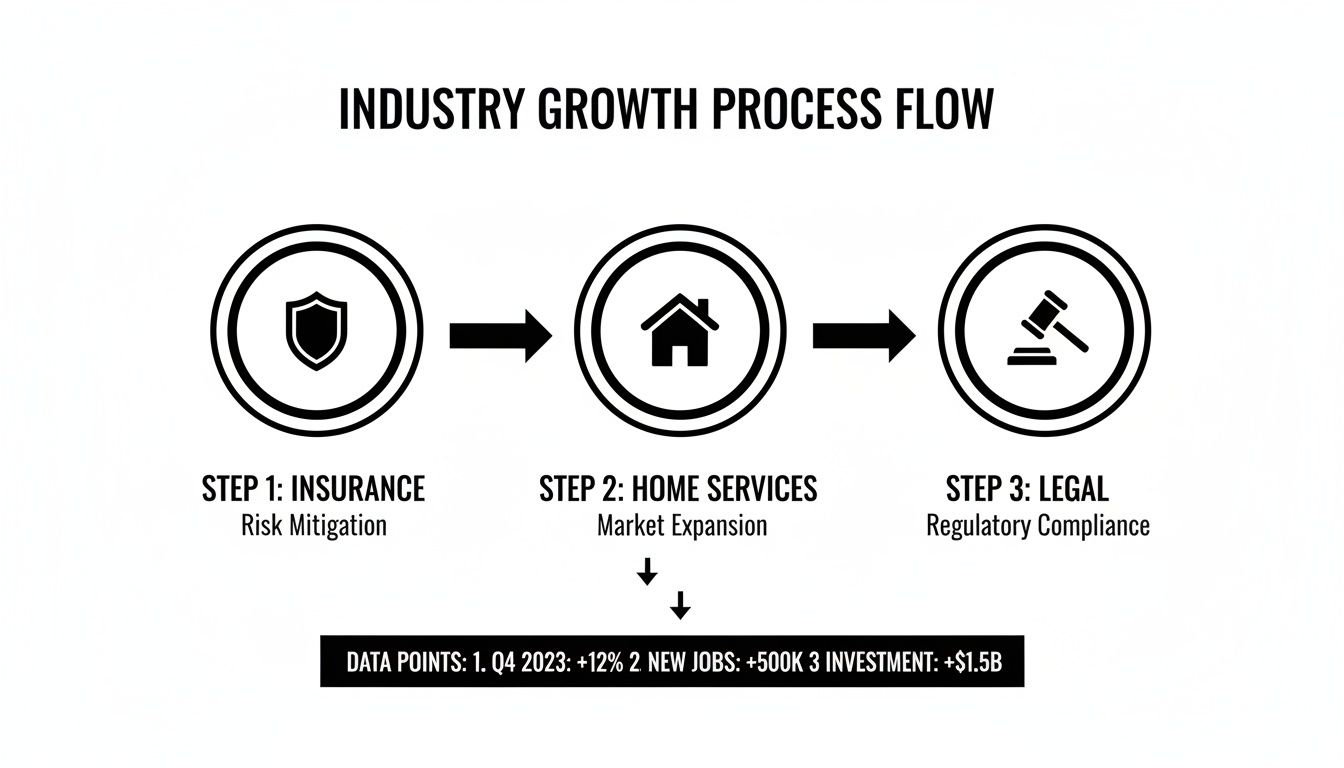
As you can see, industries like insurance, home services, and legal follow a systematic process to scale up their outreach. But launching isn’t the finish line. It’s the start of a continuous feedback loop where you analyze performance, refine scripts, and keep improving your results.
This commitment to using AI strategically is becoming the norm. By 2026, a growing number of companies are making AI a core part of their plans, with sales and marketing teams leading the charge in adoption. You can dig deeper into these virtual assistant statistics on remotecoworker.com.
Measuring Your Success and Calculating ROI
Bringing in any new tech, especially virtual sales assistant software, means you have to prove it’s working. How do you show the investment is actually paying off? The trick is to look past the surface-level numbers and zero in on the metrics that directly impact your bottom line.
Think of it like a fitness tracker for your sales process. You don't just care about the number of steps you took. You want to know how those steps are making you healthier. For a sales team, that means tracking the specific indicators that lead to real financial gains.
Key Metrics That Truly Matter
To build a rock-solid business case, you need to track the right data. These are the metrics that cut through the noise and reveal the true value your virtual assistant is creating.
Here are the essentials to keep on your dashboard:
- Cost Per Lead (CPL): This is the classic starting point—how much does it cost to get a single lead in the door? By automating outreach, a virtual assistant can crush this number compared to manual calling or pricey marketing channels.
- Cost Per Appointment (CPA): This one is even better. It calculates your all-in cost to get one qualified meeting onto a rep's calendar. A falling CPA is a direct sign of sales efficiency.
- Lead-to-Appointment Rate: Of all the leads you generate, what percentage actually turn into booked meetings? A rising rate tells you the AI isn’t just busy; it’s effective at engaging and qualifying real prospects.
- Sales Team Productivity: Measure this in hours saved. Tally up the time your reps get back by offloading cold calls and manual data entry. That reclaimed time is now being spent on closing deals, not administrative grind.
By tracking these numbers, you create a clear "before and after" picture. The data will do the talking, showing the real-world impact on your team's efficiency and the health of your pipeline.
Calculating Your Return on Investment
Calculating ROI doesn't need to be a headache. A straight line to the financial benefit is to simply compare the cost of the software to the fully-loaded cost of a human Sales Development Representative (SDR).
Simple ROI Calculation:
A human SDR might cost $75,000 annually once you factor in salary, benefits, and tools. Now, compare that to a virtual sales assistant subscription at $15,000 annually. The AI delivers a much higher call volume for a fraction of the price, generating a clear and immediate return.
That cost difference alone is compelling, but it’s even more powerful when you consider the AI works 24/7 at a scale no human team could ever match.
This software isn't just about saving money; it’s a growth engine. We're seeing sales teams with AI actually expand their headcount because the tech complements their human talent, it doesn't replace it. Many are shifting to a hybrid model where the AI handles all the top-of-funnel qualifying, freeing up reps to do what they do best—build relationships and close high-value deals. You can find more data on how AI is reshaping sales teams on rev-empire.com. This approach saves an incredible amount of time and allows your team to connect with hundreds more prospects every single day, directly fueling the pipeline and proving its ROI.
Choosing the right virtual sales assistant software is a huge decision. It's going to directly shape your team's performance and your return on investment, so you can't afford to get it wrong. Not all platforms are created equal, and you need a clear checklist to cut through the noise.
This guide will help you ask the right questions and see past the sales pitch to find a partner that actually fits your business goals.
Think of it like test-driving a car. You wouldn't just kick the tires. You'd pop the hood, feel the steering, and make sure it has the muscle to get you where you're going. The same applies here—you need to look under the hood to ensure the software can handle the daily grind of your sales process.
Evaluating Core AI Capabilities
The "brain" of any virtual sales assistant is its AI. How it sounds, thinks, and reacts will either build trust or turn prospects off before a real conversation even gets started. Don't settle for a clunky, robotic system that makes your company sound cheap.
Start by digging into the AI technology itself. Ask vendors these critical questions:
- How human-like is the AI voice? You need to hear it in action. Request live call samples. Does it have natural pacing and tone? More importantly, can it handle interruptions without getting flustered?
- Can we customize scripts for our campaigns? Your business has a unique voice and specific industry terms. The software has to adapt to you, not the other way around.
- How does the AI handle unexpected questions or objections? A great AI can think on its feet. It should be able to answer common questions and, crucially, know its limits and when to pass a complex call to a human agent.
The goal is a seamless interaction where the prospect feels heard. A high-quality AI voice should be so natural that the person on the other end doesn't even realize they're speaking with an AI.
Assessing Functionality and Operations
Beyond the AI's voice, the platform has to fit into your team's existing workflow. A powerful tool is worthless if it has a clunky interface or if you can't get clear data from it. A bad investment is what that is.
Your evaluation needs to cover the operational side of things:
- What kind of analytics and reporting is available? You need a real-time dashboard showing the metrics that matter: call answer rates, lead qualification outcomes, and appointments booked. If you can't measure it, you can't improve it.
- What does onboarding really look like? Get a clear timeline. A good provider should be able to get your first campaign live in a matter of weeks, not months.
- Is the pricing model transparent and built to scale? Look for a simple structure that supports high-volume calling without a bunch of hidden fees. It should be both affordable and predictable.
Using this checklist helps you move beyond a vendor's promises and conduct a thorough, practical evaluation. Choosing the right software isn't just about automating tasks—it's about finding a reliable engine for growing your pipeline.
Frequently Asked Questions
It's natural to have questions when you're looking at a new piece of sales tech. Here are the answers to the ones we hear most often, with no fluff.
Will a Virtual Sales Assistant Replace My Human Sales Team?
Absolutely not. The goal isn’t to replace your top closers; it’s to make them more productive. A virtual sales assistant is built to take over the repetitive, top-of-funnel work that eats up so much time—like making thousands of initial calls and handling basic lead qualification.
This frees your sales reps to live where they create the most value: in high-stakes discovery calls, complex negotiations, and closing deals. Many teams find they can actually grow their sales force because their pipeline is finally full of qualified, meeting-ready prospects.
How Natural Does the AI Voice Actually Sound?
This is one of the biggest differences between providers, and the technology has come a very long way. The best platforms now use AI that generates remarkably human-like voices, complete with natural pacing, tone shifts, and the ability to handle interruptions. The aim is a smooth conversation where the prospect doesn’t feel like they’re talking to a clunky robot.
The best virtual sales assistants are engineered for fluid dialogue. They understand conversational cues and can dynamically adapt, making the interaction feel authentic and engaging from the very first hello.
How Quickly Can I Get Started and See Results?
You can get up and running much faster than you might think. While setup times can vary, a well-organized provider can have your first campaigns designed, tested, and ready to launch in just a few weeks.
The results come even faster. It’s common to see tangible outcomes—like booked appointments and qualified leads popping up on your calendar—within the first few days of going live. Once the system starts dialing through your lead list at scale, the impact on your sales pipeline is both immediate and easy to measure.
Ready to see how a dedicated AI-powered voice agent can fill your sales pipeline? Voicedial.ai provides human-like virtual sales assistants that handle 100% of your outbound calling, qualify leads, and book meetings directly on your calendar. Book a demo today to discover how you can scale conversations and drive growth.