
A lot of teams reach the same point before they look seriously at voice AI. They have leads sitting in a CRM, reps missing follow-up windows, and a strong reason to automate the first conversation. On paper, the workflow looks simple. Call the lead, qualify interest, answer basic questions, and book the appointment.
Then one thing goes wrong. The system mishears a street name, gets a medication brand wrong, misses a “not interested right now,” or books Tuesday when the caller said Thursday. That's when speech recognition accuracy stops being a technical feature and starts looking like the whole business case.
On sales calls, your AI agent can only act on what it correctly hears. If the transcript is wrong, the logic is wrong. If the logic is wrong, the outcome is wrong. That's why speech recognition accuracy has more impact on ROI than voice quality, script writing, or even call volume.
The High Cost of a Single Misheard Word
A single missed word can turn a qualified lead into a dead end.
Take a common appointment-setting call. The prospect says, “I'm free after three, but not Friday.” If the system catches “free after three” and misses “not Friday,” it can confidently offer the wrong slot. The caller now has to correct the system. If that happens once, it's a minor annoyance. If it happens twice, the caller starts doubting the whole interaction. If it happens on your highest-intent leads, your automation becomes a conversion leak.
Where the damage shows up
The business impact rarely looks dramatic in the transcript itself. It shows up downstream:
- Booking errors that create no-shows, reschedules, and frustrated staff
- Qualification mistakes that route bad-fit leads to your closers
- Missed compliance details in regulated industries like insurance or legal intake
- Caller drop-off when people feel the system isn't listening
For a non-technical buyer, the easiest way to think about speech recognition accuracy is this: it's the AI's hearing. Not its voice. Not its script. Not its sales technique. Its hearing.
If that hearing is weak, every other layer on top suffers.
Practical rule: If an AI caller gets the words wrong, it can't reliably get the business outcome right.
That's easy to forget because speech recognition has improved enormously over time. A major historical milestone came in 1976, when Carnegie Mellon University's HARPY system reached DARPA's goal of recognizing about 1,000 words, a major leap from Bell Labs' Audrey system in the early 1950s, which could only recognize spoken digits, according to this history of voice recognition technology. Later progress with Hidden Markov Models and n-gram language models pushed performance much further, making real commercial applications possible.
But sales calls still aren't lab conditions. They're fast, messy, interrupted, and full of names, addresses, jargon, objections, and accent variation. In that environment, “almost right” often behaves like “wrong.”
That's why teams evaluating voice AI should start with the listening layer first. Everything else depends on it.
How We Grade an AI's Listening Skills
When a vendor says their system is accurate, the next question should be: accurate by what measure?
The standard technical yardstick is Word Error Rate, or WER. It measures how many words the system got wrong through substitutions, insertions, and deletions. AWS notes that WER is the normalized edit distance between the reference transcript and the model output, and Microsoft reported 5.9% WER on the Switchboard conversational benchmark in 2017, a result often cited as near human-level on that specific task in AWS's explanation of ASR evaluation.
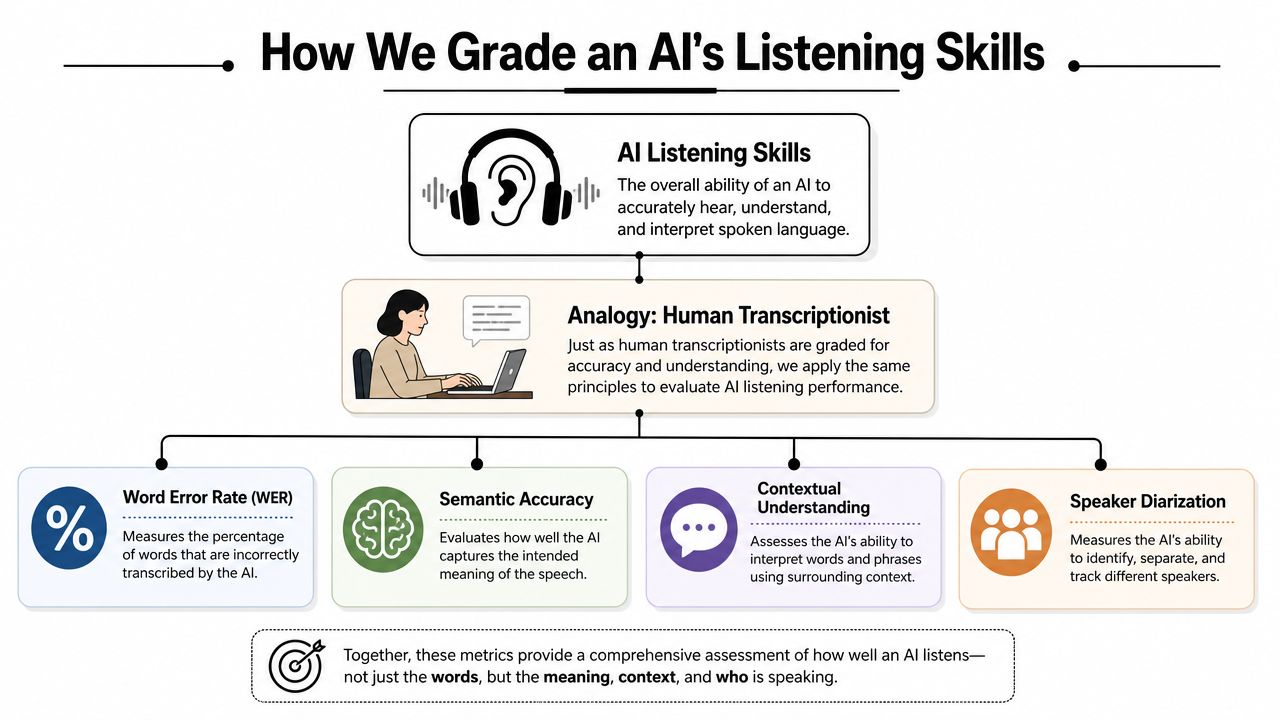
Think like you're grading a transcriptionist
If you hired a human transcriptionist and compared their transcript to what was said, you'd look for three kinds of mistakes:
- Substitutions. They wrote the wrong word.
- Insertions. They added a word that wasn't said.
- Deletions. They missed a word entirely.
That's what WER counts.
For business buyers, WER matters because it gives you a common language for comparing systems. It also has limits. A transcript can score worse because cleanup rules differ. Punctuation, capitalization, filler words, and transcript formatting all affect the score. Two systems can sound similar to a human reviewer and still produce noticeably different WER results if they weren't evaluated under the same normalization rules.
Why WER isn't enough on sales calls
A sales call doesn't succeed because the transcript is pretty. It succeeds because the AI correctly understands what to do next.
That creates three separate layers of evaluation:
| Measure | What it tells you | Why it matters for sales |
|---|---|---|
| WER | How many words were transcribed incorrectly | Useful baseline for comparing listening performance |
| Character-level review | Whether names, product codes, ZIP codes, and emails are captured cleanly | Important for lead records and follow-up accuracy |
| Intent and slot capture | Whether the system understood the caller's goal and captured the critical detail | Determines whether an appointment, transfer, or qualification step succeeds |
A system can have a decent transcript and still fail the call if it misses the intent. “Call me next week” and “don't call me next week” are close at the word level and worlds apart in business meaning.
Grade the system the way you'd grade a rep. Did it hear the words, understand the request, and capture the details that move the deal forward?
Smarter questions to ask a vendor
Instead of asking only for an overall accuracy claim, ask:
- How is WER measured? Same audio, same transcript rules, same evaluation set?
- What happens on names and structured fields? Cities, policy types, model numbers, and appointment times break weak systems.
- How do you measure understanding? A clean transcript is not the same as a successful call outcome.
- What does accuracy look like on phone audio? Not podcasts, not studio recordings, not benchmark demos.
That last question matters more than most buyers realize.
Why Phone Calls Are a Minefield for ASR Accuracy
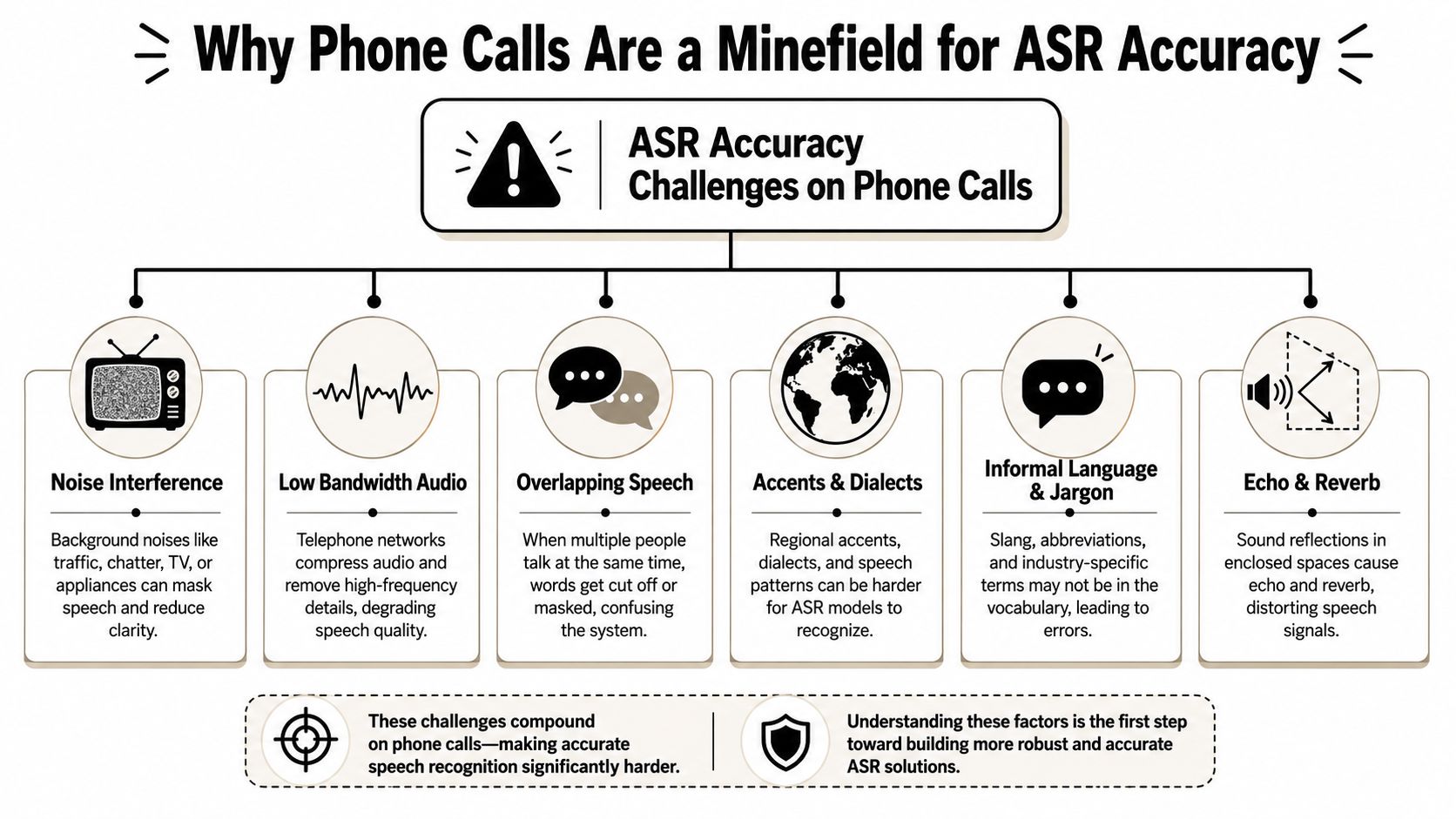
Phone audio is hostile territory for automatic speech recognition.
Even before you get to language, the signal itself is compromised. Calls are narrowband compared with cleaner modern audio sources. Car Bluetooth systems, speakerphones, bad microphones, office chatter, cell handoffs, and compression all chip away at the signal before the recognizer even starts decoding words. A model can look polished in a benchmark and stumble badly when a prospect answers while walking into a store.
The telephony problems vendors often gloss over
Real sales calls combine several failure modes at once:
- Compressed audio strips away detail that helps distinguish similar sounds.
- Background noise masks short words, endings, and low-volume speech.
- Overtalk creates collisions when the caller interrupts the agent or vice versa.
- Short utterances like “yeah,” “mm-hmm,” or “right” carry meaning but are easy to miss.
- Domain vocabulary includes carrier names, neighborhood names, medication names, legal terms, or product lines the base model may not expect.
The biggest mistake buyers make is assuming these are edge cases. They aren't. They're normal calling conditions.
Benchmark accuracy does not equal call accuracy
A medical and AI literature review found speech recognition performance ranging from 0.087 WER in highly controlled dictation to over 50% in conversational or multi-speaker settings, as reported in this review on ASR performance variability. That spread tells you something important. Accuracy isn't a fixed property of a model. It changes with task design, call conditions, speaker overlap, and vocabulary fit.
On live sales calls, those variables move constantly. A prospect may start in a quiet kitchen and finish the call from a running car. They may answer with a full sentence or with fragments. They may switch from clear English to local shorthand the moment they get comfortable.
One average score can hide who gets failed
Accent and dialect parity is where average performance claims become dangerous.
Research found that commercial ASR systems had 0.35 WER for Black speakers versus 0.19 for White speakers in one study, according to the PNAS study on racial disparities in speech recognition. The same study reported that more than 20% of Black-speaker clips crossed a useful-transcription failure threshold, compared with fewer than 2% for White speakers.
If you run outbound campaigns across diverse regions and customer groups, that gap isn't an academic fairness issue alone. It becomes a pipeline issue. Your system may selectively perform worse on the very callers you need to engage well.
An average accuracy number can still hide a bad customer experience for specific communities, accents, and dialects.
What this means for buyers
If your use case is appointment setting, intake, or qualification, don't ask whether the model is “good.” Ask whether it holds up under your conditions:
| Call condition | What usually breaks | Business consequence |
|---|---|---|
| Noisy environment | short confirmations, dates, street names | wrong booking details |
| Fast, interrupted dialogue | turn-taking and intent capture | awkward handoffs, caller frustration |
| Specialized terminology | product names, plan types, medical or legal terms | bad qualification data |
| Accent or dialect variation | repeated misrecognitions of common phrases | lower conversion for specific groups |
That's why telephony-specific testing isn't optional. It's the only way to know if the system will perform where your revenue lives.
What Good Enough Accuracy Looks Like for Sales
Perfect transcription isn't the target. Reliable task completion is.
That changes the conversation. A lead qualification call can still work with some transcript imperfections if the system consistently captures the caller's intent, contact details, and next step. A benefits verification call or a medical device inquiry has much less room for error because the critical words carry more risk and more downstream cost.
Match the accuracy standard to the task
The right benchmark depends on what the caller is trying to do and what happens if the system gets it wrong.
If the AI only needs to detect whether someone wants a callback, you can tolerate more transcript noise. If it needs to capture a prescription name, a legal matter type, or a precise appointment time, you need much tighter control and more validation logic.
Here's a practical way to think about it.
| Task Type | Acceptable WER | Business Impact of Errors |
|---|---|---|
| Simple lead triage | Higher tolerance | Some wording errors are acceptable if the system still identifies interest, disinterest, or callback request correctly |
| Appointment booking | Moderate tolerance | Errors on dates, times, and contact details create reschedules, no-shows, and front-desk cleanup |
| Data verification | Lower tolerance | Wrong names, addresses, DOBs, or policy details can break workflows and trust |
| Technical or regulated intake | Lowest tolerance | Misheard product terms, legal categories, or medical language can derail qualification and create compliance risk |
This table matters because many teams buy voice AI with the wrong mental model. They think in terms of one universal accuracy threshold. In practice, sales operations should think in terms of critical-word accuracy.
What buyers should focus on
A workable sales system usually has these traits:
- It gets the important words right. Product names, competitor names, appointment times, plan types, and service areas matter more than filler words.
- It recovers cleanly. When confidence drops, it asks for confirmation instead of guessing.
- It limits open-ended prompts. Narrower questions produce cleaner inputs and more reliable next steps.
- It escalates when the cost of being wrong is high. Some calls should transfer to a human rather than push through uncertain data.
For many organizations, “good enough” means the AI can move routine calls forward without creating cleanup work that wipes out the efficiency gain.
If your staff spends the afternoon fixing bad bookings and correcting transcripts, the system wasn't accurate enough, even if the demo sounded polished.
The simplest test is operational, not academic. Are booked appointments showing up correctly? Are qualified leads qualified? Are callers completing the interaction without repeated corrections?
That's the version of speech recognition accuracy that pays for itself.
Practical Tactics to Improve Your AI's Performance
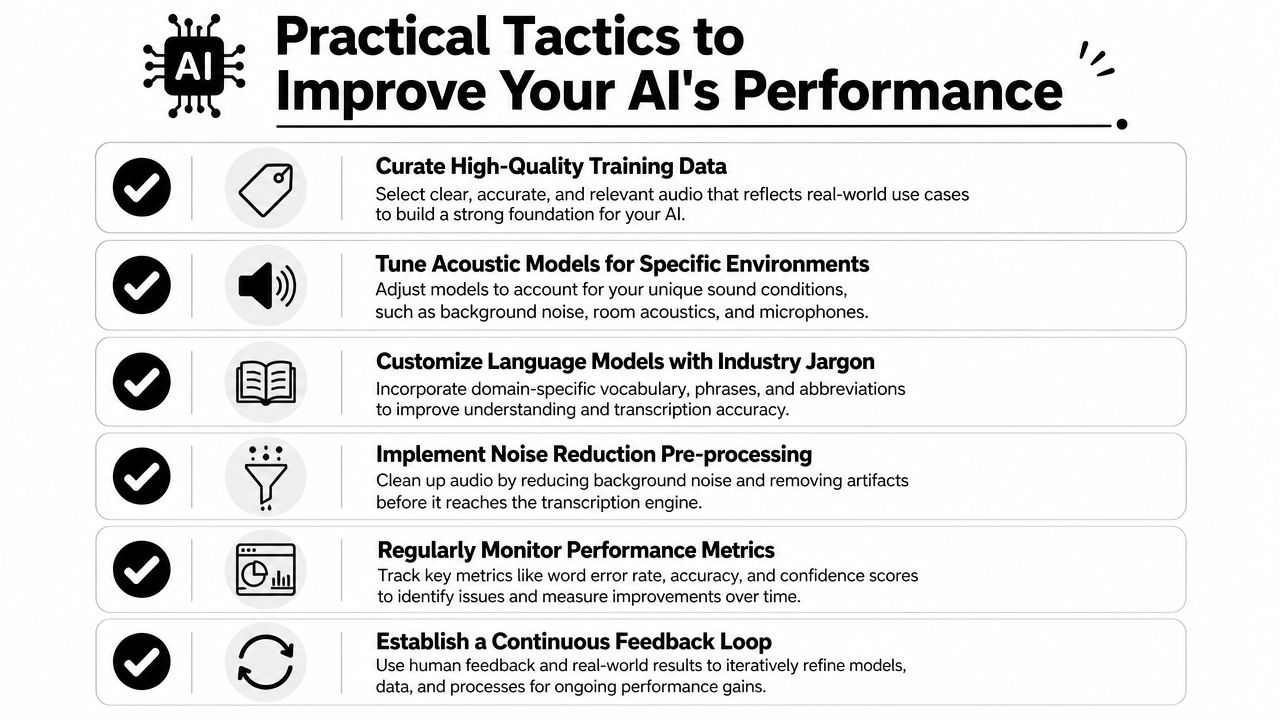
Speech recognition accuracy isn't fixed. Teams can improve it with better audio handling, tighter call design, and stronger adaptation to real customer language.
That matters because the cost of errors in conversation is cumulative. Research on African American users shows that ASR failures don't feel like isolated transcript mistakes. Users often experience the system as outright misunderstanding their speech patterns, names, and phrases, as discussed in this analysis of conversational ASR failures and adaptive solutions.
Start with the script, not the model
A lot of avoidable errors come from how the conversation is framed.
Instead of asking, “Can you tell me a bit about what kind of policy you're looking for and when you'd like to get started?”, ask a tighter question like, “Are you looking for Medicare, ACA, or auto coverage?” Closed choices reduce ambiguity. They also make confirmations easier.
Good prompt design for voice calls usually means:
- Shorter questions that ask for one thing at a time
- Constrained answer formats such as yes or no, this week or next week, morning or afternoon
- Built-in confirmation for high-value details like names, phone numbers, and appointment slots
- Natural repetition when details are business-critical
Feed the system your language
Generic speech models struggle with local and industry-specific vocabulary. That's why custom lexicons and vocabulary injection matter so much in production.
For example, insurance campaigns often include carrier names, county names, neighborhood names, and plan acronyms that a base model may mangle. Medical device teams deal with product names that sound close to ordinary words. Legal intake teams hear matter types and surnames that need exact capture.
Useful setup work includes:
- Build a domain vocabulary list with product names, brand names, cities, rep names, and common abbreviations.
- Review failed transcripts weekly and add recurring misspellings or substitutions.
- Map alternate phrasings that callers use, not just the language in your internal script.
If you also process uploaded recordings for QA or training, ClearAudio's MP3 text conversion guide is a practical reference for thinking through audio-to-text workflows and cleanup considerations before you feed files into analysis.
A short walkthrough helps illustrate where these optimizations fit in production:
Clean the audio before the recognizer hears it
ASR can't recover detail that never reaches it clearly. Audio preprocessing does more than tidy transcripts. It protects the conversation.
Focus on the basics:
- Noise reduction for call-center hum, traffic, HVAC, and speakerphone artifacts
- Level normalization so quiet callers and loud callers don't produce wildly different results
- Echo handling when calls bounce through speakerphone or conference setups
- Channel-aware processing when agent and caller audio can be separated
Design for graceful failure
The best-performing systems don't assume they heard correctly every time. They know when to slow down.
Use confirmation logic when the cost of a mistake is high. Ask callers to repeat uncommon names. Reframe questions when the answer is muddy. Offer handoff paths when the interaction becomes too noisy, too complex, or too emotionally loaded.
A strong voice workflow doesn't just recognize speech well. It recognizes when not to guess.
That's the practical mindset that improves both accuracy and caller trust.
How to Evaluate and Select the Right Voice AI Platform
The wrong way to buy a voice AI platform is to compare homepage claims.
The right way is to run a controlled test with your own call audio. Use recordings that reflect actual calling conditions: mobile phones, background noise, interruptions, local accents, rushed speech, and your real vocabulary. If a vendor only shines on clean demo audio, that tells you very little about production performance.
What your test set should include
A useful evaluation set usually contains a mix of:
- Routine successful calls so you can see baseline behavior
- Messy calls with noise, interruptions, and speaker overlap
- Calls from different regions or dialect groups so you don't hide parity problems inside one average score
- High-value edge cases such as address capture, policy type selection, or appointment booking
Don't overcomplicate the first pass. You're trying to answer a simple question. Does this platform understand your callers well enough to complete the tasks that matter?
Questions that separate polished demos from durable systems
Ask vendors questions that force operational clarity:
| Question | Why it matters |
|---|---|
| Can we test on our own call recordings? | Benchmark claims don't prove performance on your workflow |
| How do you evaluate accuracy on phone audio? | Telephony conditions are different from clean microphone audio |
| Can we customize vocabulary and prompts? | Domain fit often matters more than base-model quality alone |
| What happens when confidence is low? | Safe recovery beats confident guessing |
| How do you monitor drift over time? | Accuracy can degrade as campaigns, caller profiles, and scripts change |
What to watch during trials
During a pilot, look beyond headline transcript quality.
Review whether the system:
- captures the details your team needs
- asks for clarification at the right moments
- mishandles certain caller groups more often than others
- creates cleanup work for staff after the call
- maintains performance across different campaign types
Many buyers realize that speech recognition accuracy is not one metric but an operational pattern. Some systems transcribe well but recover poorly. Others perform well on straightforward calls and unravel on interruptions. A few do a decent job overall but underperform on accents or specialized terminology.
The best platform for your team is the one that stays reliable under your conditions, with your customers, on the calls that generate revenue.
Using Voicedial.ai to Monitor and Master Accuracy
Accuracy management doesn't end at launch. It becomes part of call operations.
The teams that get the best ROI from voice AI treat speech recognition accuracy like a managed performance function. They review failed calls, inspect transcripts, identify recurring breakdowns, and tighten the system where it's weak. That's especially important in high-volume workflows where small listening failures accumulate across hundreds of conversations.
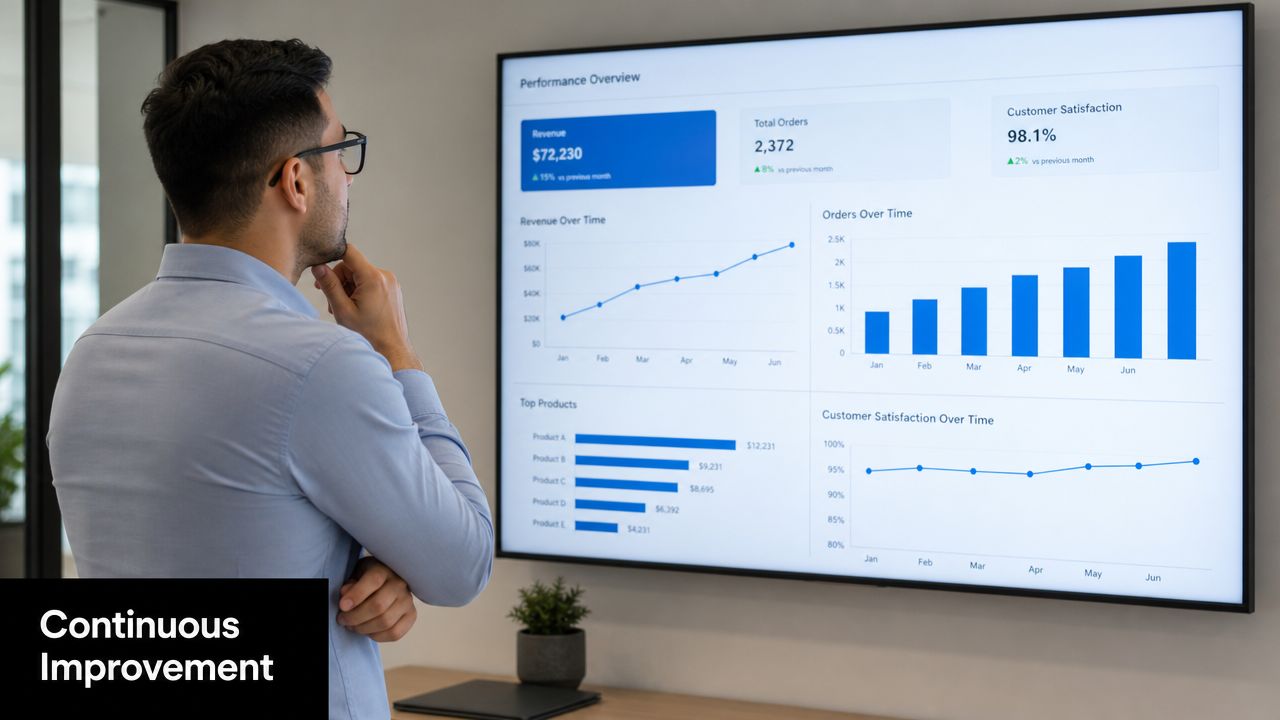
What continuous accuracy work looks like
Inside a platform like Voicedial.ai, the practical loop is straightforward:
- Review call outcomes and find calls that failed, stalled, or produced bad downstream data.
- Inspect transcripts and recordings to see whether the issue was recognition, prompt design, or workflow logic.
- Spot patterns such as a competitor name being misheard, a local city name getting mangled, or callers struggling with one open-ended question.
- Update the system by refining the script, adding vocabulary, changing confirmation rules, or adjusting routing.
That process is close to what software teams do when addressing production issues with AI observability. You need visibility into what the system heard, what it decided, and where the interaction started drifting.
Why this matters for ROI
Speech recognition accuracy affects every layer above it. Better listening produces cleaner qualification, better bookings, less manual correction, and more trustworthy automation. Poor listening creates hidden labor, damaged caller trust, and conversion loss that's easy to blame on the script when the actual problem started earlier.
The practical advantage of a platform with a strong dashboard is simple. You can see where accuracy problems are happening and fix them before they become your normal baseline.
If you want a voice AI system that does more than place calls, Voicedial.ai helps teams build, monitor, and improve AI calling workflows that book appointments, qualify leads, and scale outreach without adding headcount.