

Territories usually look fine in a spreadsheet right up until the quarter starts.
Then the cracks show. One rep inherits a patchwork of accounts spread too far apart to cover well. Another gets a compact book full of renewal-friendly customers and enough whitespace to prospect aggressively. Marketing keeps sending leads into shared inboxes because ownership rules aren't clear. Managers spend forecast calls arguing about fairness instead of fixing conversion.
That's why sales territory planning matters. It isn't admin work. It's a revenue design problem. A widely cited benchmark says optimized territory design can raise revenue by 2% to 7%, according to Xactly's summary of Harvard Business Review research. In most organizations, that lift doesn't come from heroic selling. It comes from better coverage, cleaner ownership, smarter routing, and fewer wasted rep hours.
The companies that treat territories as a living operating system usually outperform the ones that treat them as annual map maintenance. The difference is simple. Static plans assign accounts. Dynamic plans control how revenue moves.
Why Your Current Sales Territories Are Holding You Back
The first sign of a bad territory design usually shows up in the weekly pipeline call. One rep says inbound leads sit too long before anyone responds. Another says half the named accounts in the book will never buy. A third is on pace but only because the territory is packed with renewals and nearby expansion targets. Leaders often treat those complaints as noise. They are usually symptoms of a coverage model that is wasting selling time and misallocating revenue potential.
The problem is not just uneven maps. It is a static plan trying to manage a moving market.
Reps chase low-fit accounts because the book was assigned once and never re-tiered. Good leads stall because ownership rules are loose or routing depends on manual cleanup. High-potential pockets stay under-covered because the territory looked balanced by geography even though account density, travel time, install complexity, or renewal mix were nowhere close to equal. Then managers pressure reps to execute harder against a structure that already put them behind.
Fair on paper doesn't mean productive in the field
A territory can look equal in a spreadsheet and still produce very different outcomes. One rep may have a compact set of accounts with short sales cycles and clear cross-sell paths. Another may cover a larger area, juggle more stakeholders per deal, and spend hours each week on windshield time or service handoffs. Those books are not equivalent, even if the account counts match.
In home services, two ZIP clusters can carry completely different economics. One may be heavy on replacement jobs, past customers, and referrals. The other may be full of one-time repair calls with lower close rates and lower average ticket sizes. In insurance, one rep may inherit a renewal-rich book with obvious upsell paths while another gets high quote volume and weak conversion. If both reps carry the same quota, one is being measured on production and the other on endurance.
Good territory planning starts with one question. Where can this team win efficiently?
That lens changes the decisions. Instead of drawing borders once a year, teams build coverage rules that reflect real selling effort, account value, and speed to lead. That is also where modern execution tools matter. If AI-based routing, voice agents, and follow-up automation sit outside the territory model, the plan breaks down the minute lead volume shifts. If they are built into the model, the territory becomes an operating system that can absorb change without creating rep conflict.
The cost of leaving it alone
Poor territory structure shows up in the P&L through missed response windows, quota disputes, duplicate outreach, and forecast noise. It also drives hidden cost into the sales org. Managers spend time resolving account ownership fights. RevOps teams create exception after exception. Strong reps lose trust in quota fairness and start looking elsewhere. None of that appears as a line item called territory failure, but it still drags revenue.
A simple example makes the point. If a high-intent inbound lead waits three hours because routing is unclear, the rep may still call it "worked." The buyer often has already spoken to a competitor. Multiply that delay across a quarter, then add the hours wasted on low-potential accounts that should have been deprioritized or routed to automated nurture. The result is not a small efficiency problem. It is lower conversion on expensive demand, weaker rep productivity, and a sales plan that depends on heroics.
Static territory plans create those losses because they assign ownership without controlling execution. Strong plans do both. They define who covers what, how leads move, when automation steps in, and when the book needs to be rebalanced before the quarter slips.
Laying The Data Foundation for Your Plan
Strong sales territory planning is data-first. Mature plans use multi-dimensional inputs such as TAM, historical win rates, and account complexity instead of relying on simple geographic slicing, as outlined in Fullcast's territory planning workflow.
That standard matters because most territory mistakes begin before assignment. Leaders pull last year's account list, sort by state or ZIP, and start dividing. The result is usually tidy and wrong.
What to pull before you draw anything
Start by consolidating the inputs that explain both opportunity and effort.

Use a working dataset that includes:
- CRM account history: Closed won deals, lost deals, open pipeline, customer tenure, product mix, and ownership history. This tells you where revenue has come from and where churn or stagnation may be hiding.
- Historical win patterns: Not just total revenue. Look at win rates by segment, deal type, and account class. A lower-revenue segment with a strong win pattern may deserve more attention than a larger segment that rarely converts.
- Lead and opportunity flow: Source quality, lead volume, follow-up speed, conversion points, and handoff gaps. This reveals where a territory needs faster response rather than more headcount.
- TAM and market potential: Estimate reachable market by geography, vertical, account type, or service line. This keeps you from overvaluing existing revenue while ignoring whitespace.
- Account complexity: Some books look small but require intense coordination, multiple stakeholders, site visits, or long evaluation cycles. Those books can overwhelm a rep faster than raw account count suggests.
- Geospatial inputs: Travel time, clustering, branch coverage, service radius, and physical access. Especially important for home services, field insurance teams, and medical device coverage models.
Why each input changes the plan
Revenue history is backward-looking. Win rate and complexity show whether that revenue was easy to earn or expensive to maintain. TAM shows whether a territory is mature, underpenetrated, or overestimated. Lead flow tells you whether the issue is account quality, rep capacity, or response mechanics.
A Medicare or ACA agency can't build smart territories from county maps alone. The primary question is where qualified demand appears, how fast those leads need attention, and which accounts require licensed follow-up versus lighter-touch nurturing. A home services business has the same challenge in different form. Two neighborhoods may produce similar inquiry volume but very different job value, repeat potential, and scheduling burden.
Practical rule: If the only clean field in your planning file is geography, you're not ready to assign territories.
Build one operating view, not five disconnected reports
Loss of control often stems from fragmented data. Sales ops has one export. Marketing has another. Finance has a quota sheet. Managers keep side files with local exceptions. Reps trust their own notes more than the system.
Create one planning table that combines opportunity, workload, and execution signals in the same place. At minimum, each account or segment should show:
| Planning field | Why it matters |
|---|---|
| Account or lead segment | Defines what kind of coverage model fits |
| Historical revenue | Shows existing value |
| Win pattern | Helps separate momentum from noise |
| Potential or TAM | Shows whitespace |
| Complexity | Estimates service burden |
| Geography or travel factor | Captures field effort |
| Current owner | Prevents conflict during redesign |
When this foundation is clean, territory design gets easier. When it's messy, every assignment becomes political because nobody trusts the math.
How to Segment Accounts and Define Territories
Segmentation is where territory planning stops being a data exercise and starts becoming a go-to-market choice.
A common mistake involves choosing one variable and forcing the whole business into it. Geography is the usual default. Sometimes that works. Often it doesn't. A better approach is to match segmentation to how customers buy and how your team sells.
A home services example that shows the difference
Take a residential services company offering HVAC, plumbing, and electrical work across a metro area. If leadership assigns territories only by ZIP code, the books may look balanced by household count. But they won't be balanced by job type, urgency, or revenue quality.
One ZIP cluster might generate lots of emergency plumbing calls and quick-turn jobs. Another may lean heavily toward higher-consideration HVAC replacements that require estimates, follow-up, and financing conversations. If the same territory model governs both, one rep gets speed and volume while another gets fewer, more complex opportunities.
A better segmentation model layers three things:
Start with the buying pattern
First, separate work by sales motion.
- Reactive demand: Emergency jobs, urgent service needs, and inbound quote requests often need speed-first routing.
- Consultative demand: Larger replacements or multi-system projects usually need tighter qualification and deliberate follow-up.
- Relationship demand: Repeat customers, maintenance plans, and referral-heavy books benefit from continuity and account stewardship.
These groups don't behave the same way, so they shouldn't always live in the same ownership model.
Then layer account value and fit
Within those groups, tier accounts or opportunities by potential.
A practical model is to classify books into priority accounts, growth accounts, and coverage accounts. The names can vary. The point is to stop giving every account the same level of rep attention.
For an insurance brokerage, that might mean:
- ACA opportunities segmented by geography and speed to contact
- Group benefits segmented by employer size and renewal complexity
- Cross-sell targets segmented by existing relationship depth and product fit
For medical device distribution, the model may split by facility type, procedure relevance, and service intensity rather than city lines alone.
Segmentation should answer one question clearly. “What coverage model gives this account the best chance of converting and expanding?”
Define territories as service units, not just shapes on a map
Once the segments are clear, define the territory around execution rules.
That means specifying:
- Which accounts belong in the territory
- Which products or services the rep owns
- What happens when an inbound lead sits outside the core geography
- Whether channel, inside sales, or field reps can touch the same account
- Who keeps ownership after a handoff or install
At this point, many plans break. Leaders define where a rep can sell but not how ownership works.
A strong territory is operationally specific. If a homeowner calls from a bordering ZIP code, the system should know whether to route by distance, service line, or current customer status. If a broker receives an inbound request from a national account with local branches, the plan should state who owns the parent, who handles the branch, and who gets credit for expansion.
Geography still matters. It just shouldn't carry the whole design.
Balancing Workload and Opportunity for Peak Performance
This is the part leaders usually underestimate. Segmentation creates logical groups. Balancing determines if those groups are sellable.
Thoughtfully designed territories can produce 10% to 20% sales productivity gains when teams optimize territory size and iterate before finalizing assignments, according to Alexander Group's territory design guidance. The same guidance warns against two common errors: using only one dimension such as geography, and ignoring rep capacity.
The three variables that matter most
Every territory needs balance across three forces:
Revenue potential
How much realistic opportunity sits in the book.Workload
How much activity the rep must perform to cover, qualify, visit, quote, and follow up.Rep capacity
How much selling time and skill the assigned rep can apply.
A territory fails when one of those variables is out of proportion. High potential with impossible travel burden still fails. Low workload with low opportunity still fails. Big opportunity assigned to a rep without the right experience may underperform for reasons that look like market weakness but are really matching errors.

The most common planning mistake is treating accounts like inventory. They aren't. Each one carries a service cost in time, coordination, and follow-up.
A simple scoring model that exposes imbalance
You don't need a complicated model to spot obvious problems. Use a weighted comparison that forces the team to evaluate both upside and burden.
Example Territory Balancing Calculation
| Metric | Territory A | Territory B |
|---|---|---|
| Revenue potential | High | Moderate |
| Account density | High | Low |
| Travel burden | Low | High |
| Service complexity | Moderate | High |
| Lead response demand | High | Moderate |
| Rep fit | Strong closer, limited field time | Good relationship manager, strong field coverage |
| Overall balance | Viable if inside support is strong | Risk of undercoverage unless account load is reduced |
This kind of table changes the conversation. Instead of arguing over raw account count, you can see why two territories with similar size may require different support models.
What good balancing looks like in practice
Balanced territory design usually includes a few uncomfortable decisions:
- Take accounts away from top performers when their books have become too rich to be fair.
- Shrink geographically large books even if revenue looks modest, because travel and complexity are suppressing output.
- Separate hunting from servicing when one territory is carrying too much follow-up work to prospect effectively.
- Use overlays carefully for specialist products or strategic accounts, but only with explicit ownership rules.
Some leaders avoid these moves because they trigger compensation debates or rep resistance. That hesitation is expensive. If a territory is too large to mine or too small to be economic, keeping it intact doesn't preserve stability. It preserves underperformance.
Iterate before you lock assignments
Territory balancing shouldn't end in the planning room. Run the design through frontline review.
Ask managers:
- Where would a rep lose time first?
- Which accounts look attractive but are historically hard to move?
- Where do service demands crowd out selling time?
- Which handoffs will break if ownership rules stay vague?
Then test edge cases. Shared metros. Border ZIPs. Named accounts inside another rep's geography. Renewals that can trigger new product sales. Those are the places where elegant plans usually fail.
Good balancing gives every rep a credible path to target. Not the same path, but a fair one.
Activating Your Plan with AI-Powered Routing and Cadence
A territory plan only matters if daily execution follows it.
That's where many redesigns stall. Leadership approves the model, updates the CRM, sends a kickoff note, and assumes the field will absorb the change. Instead, reps keep working old habits. Inbound leads still bounce between inboxes. Callbacks depend on whoever notices first. Shared accounts become political because nobody translated the territory design into operating rules.

Turn the plan into rules the system can execute
Start with assignment logic that your CRM, dialer, and scheduling tools can enforce.
That means defining:
- Lead ownership rules: By ZIP, product line, account tier, existing customer status, or round-robin within a valid segment
- Speed-to-lead rules: Who gets first shot, how long they have, and what happens if they don't act
- Conflict rules: Which rep owns parent accounts, branches, referrals, partner-sourced leads, and cross-sell opportunities
- Recycling rules: When stale leads return to queue and who receives them next
This work is operational, not glamorous. It's also where a territory plan becomes real.
Use AI for the first layer of execution
Modern AI tools are especially useful in the activation phase because they solve the gap between assignment and response.
For teams handling large lead volumes, AI voice agents can call new leads immediately, ask qualification questions, confirm basic fit, answer common questions, and route the opportunity to the correct territory owner with context already attached. That changes the economics of coverage. Reps spend less time on first-contact attempts and more time on active opportunities.
That's valuable in industries where timing affects conversion. An auto insurance lead that waits too long gets quoted elsewhere. A home services prospect with an urgent issue won't wait around for manual follow-up. A legal intake lead may contact several firms in a row. Territory design gives those leads an owner. AI-powered routing and voice workflow help that owner engage at the speed the market expects.
Operating rule: If the first response depends on rep availability alone, your territory plan will underperform no matter how elegant the map looks.
Build a cadence that matches the territory type
Different territories need different outreach rhythms.
A high-velocity inbound territory might use:
- Immediate call attempt
- Qualification and appointment booking
- Rapid rep handoff for close-ready opportunities
- Automated recycle for no-answer leads
A strategic account territory needs a different cadence:
- Named account research
- Sequenced outreach
- Multi-contact follow-up
- Specialist involvement based on product or buying stage
The territory model should dictate cadence design. Not the other way around.
A useful example is a home services business with mixed demand. Emergency inbound requests should trigger immediate voice follow-up and scheduling logic. Estimate-driven replacement opportunities may need qualification first, then assignment to the right comfort advisor based on service line and geography. If both motions go into the same generic queue, the team loses speed where speed matters and wastes rep time where pre-qualification would have helped.
Here's a useful walkthrough on what AI calling can look like in practice:
Keep reps focused on the work only they can do
The best territory systems remove low-value handling from high-value sellers.
Reps should spend their time:
- Running discovery
- Managing objections
- Building proposals
- Advancing deals
- Expanding customer relationships
They shouldn't spend most of the day repeatedly trying to reach unqualified leads, answering the same basic questions, or sorting ownership confusion. AI tools don't replace territory design. They make it executable at scale.
That's the shift from static map-drawing to a dynamic revenue system.
Monitoring KPIs and Rebalancing Territories Over Time
Territory plans drift faster than leaders expect. Markets shift. Lead sources change. One region fills with repeat business while another turns into a prospecting grind. Reps get stronger, weaker, overloaded, or promoted.
That's why high-performing teams review territory plans at least quarterly and build growth plans looking 6 to 12 months ahead, according to Pigment's territory planning guidance. The same guidance reports that optimized plans are associated with 10% to 20% greater sales productivity, 10% to 15% more cost reduction and reallocation, and about 20% more of the market coverage benefit tied to better alignment.
Watch the indicators that show imbalance early
Use a dashboard that highlights whether a territory is healthy, overloaded, or underpowered.
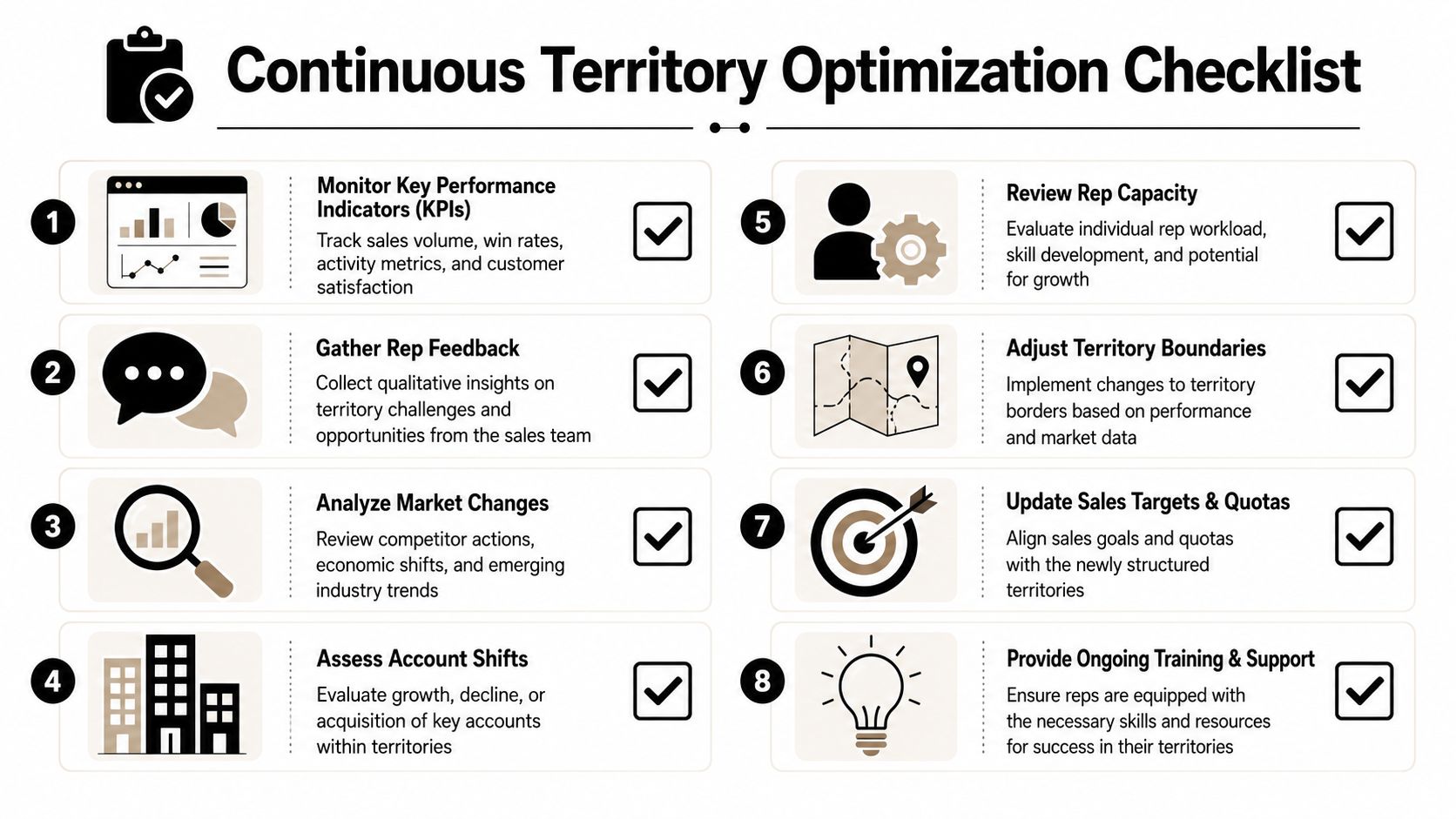
Track these consistently:
- Pipeline-to-quota ratio: Shows whether a rep has enough coverage to realistically hit target.
- Win rate by territory: Helps separate rep execution issues from structural territory quality.
- Deal velocity: Reveals where complexity, slow follow-up, or poor fit are dragging the cycle.
- Rep effort-to-return: Compare activity intensity against results to spot books that require too much labor for too little outcome.
- Lead-to-opportunity conversion: Especially useful in inbound-heavy models where routing and response speed matter.
Know when to rebalance
Don't wait for annual planning if the operating reality has already changed.
Triggers usually include:
- One territory becoming consistently overloaded while another has recoverable whitespace
- Large account changes, acquisitions, or major product launches
- Repeated ownership disputes at territory borders
- Material shifts in lead mix by geography, service line, or segment
- A rep's capacity changing because their role or book complexity changed
Quarterly reviews work best when they combine dashboard data with rep feedback. The numbers show where imbalance exists. The field tells you why.
The goal isn't constant disruption. It's controlled adjustment. Strong sales territory planning creates a system that can absorb change without forcing the team to rebuild from scratch every time the market moves.
If your team has the territory design but still struggles to respond fast enough, Voicedial.ai can help close the execution gap. Its AI voice agents handle inbound and outbound sales calls around the clock, qualify leads, answer common questions, and book appointments automatically, so territory owners spend more time closing and less time chasing first contact. For insurance, home services, legal intake, medical device, and high-volume lead teams, that can turn a territory plan from a static assignment model into a reliable follow-up engine.