

An agent can work a full thirty-hour week, dial hard, and still finish with a calendar full of appointments that nobody attends. The problem usually isn't effort. It's an insurance appointment setting script that treats the call as a monologue, then treats the calendar invite as the finish line.
Held meetings depend on three pressure points: the first ten seconds, the first five minutes, and the workflow after the call. Leads contacted within five minutes are reported to be 21 times more likely to convert than leads contacted after thirty minutes, according to this insurance appointment-setting benchmark. A separate operational problem appears after booking, where published estimates place no-show rates at 20% to 35% without reminders in insurance workflows, as documented in the same source.
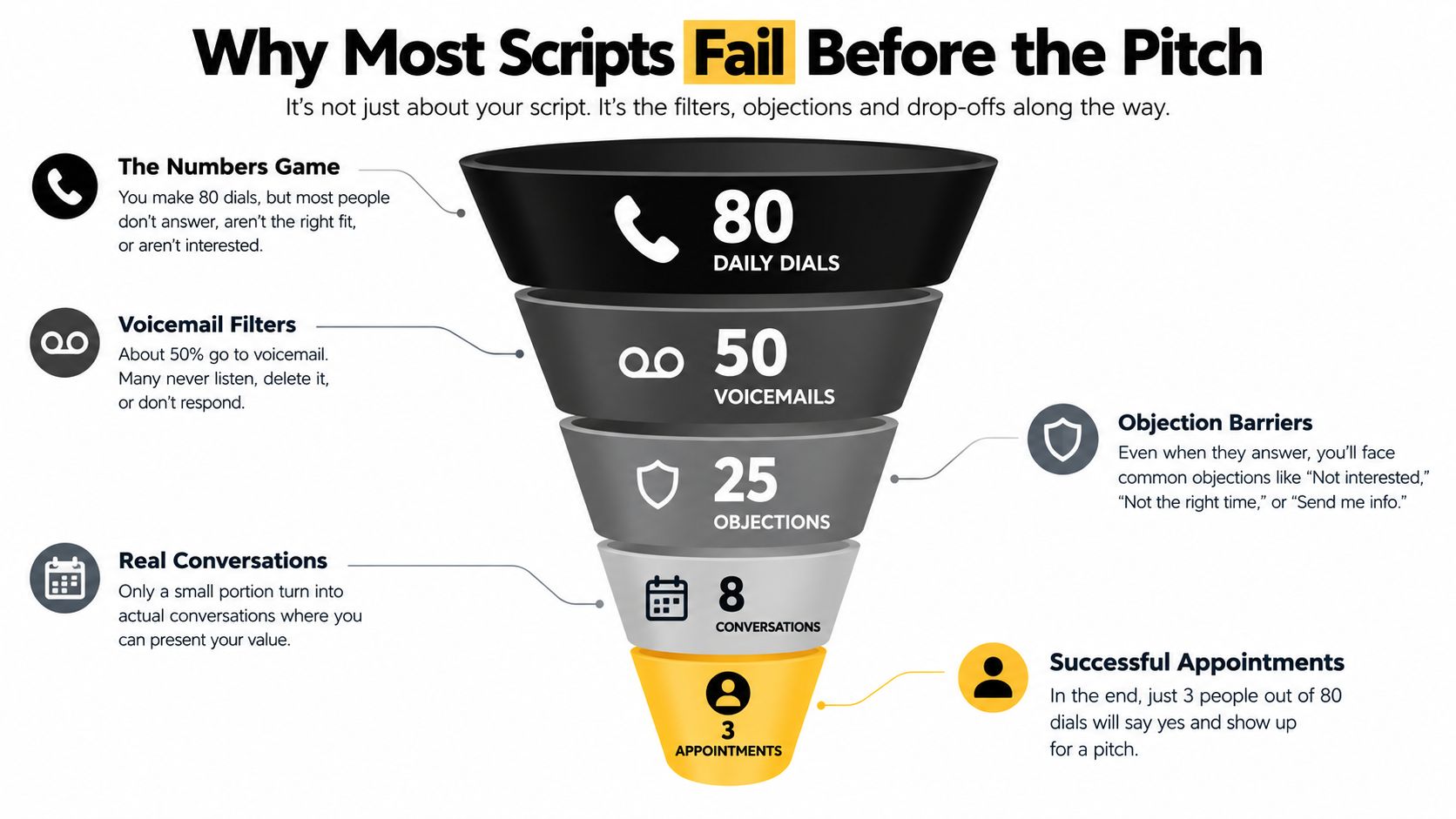
Why Most Insurance Appointment Scripts Fail Before the Pitch
The typical failure starts before the agent mentions coverage. The opener announces a product, the prospect interrupts with “I'm not interested,” and the rep either argues or exits. A longer benefits pitch won't repair a call that never established identity, intent, or permission to continue.
The first ten seconds
Your opening line has one job, earn the next moment. It shouldn't explain every product benefit or force the prospect into a quote conversation. Confirm who you're speaking with, identify the reason for contact, and ask for a small amount of permission.
For an inbound lead, that might mean referencing the form they completed. For an outbound call, it means stating the purpose plainly without pretending you already know their needs. The wording should sound like a person beginning a relevant conversation, not like an announcement read from a teleprompter.
The first five minutes
Once the prospect stays on the line, resist the urge to pitch. Confirm the lead's intent, ask a few relevant questions, and use the answers to decide whether a meeting makes sense. Insurance selling is often multi-touch, with industry scheduling guidance stating that at least two meetings may be required before a policy is issued. The appointment setter therefore isn't trying to close every policy on the first call. The setter is creating a qualified next conversation.
Practical rule: A booked appointment isn't a success until the prospect knows why they're meeting, what will happen, and how to change the time.
The workflow after the call
A confirmation message should follow immediately. A practical sequence uses a booking confirmation, a reminder 24 hours before, and another one hour before, with a calendar invite and a short agenda added promptly, according to this insurance appointment-setting workflow guide.
That sequence turns the script into an operating system. The call earns attention, the calendar captures commitment, and the reminders protect the meeting from forgetfulness or uncertainty. If your team only measures booked appointments, it may reward scripts that create weak invites instead of conversations that take place.
How Medicare, ACA, and Auto Insurance Scripts Actually Differ
A generic insurance script fails because the qualifying path changes by vertical. Medicare requires a careful compliance handoff before plan-specific discussion. ACA conversations depend on household and financial context. Auto calls need enough driver and vehicle information to make the next meeting quote-ready without turning the appointment-setting call into a full quote session.
| Element | Medicare | ACA Marketplace | Auto |
|---|---|---|---|
| Opener | Confirm the inquiry, location, and current coverage context | Confirm the request for marketplace help and the enrollment reason | Confirm the request for a rate comparison or policy review |
| Qualifying fields | Location, current coverage, preferred appointment participant, and products the prospect wants to discuss | Household size, income bracket, state, current coverage, and timing | Driver profile, vehicles, VIN details, current carrier, and renewal timing |
| Compliance language | Explain the required Scope-of-Appointment process before discussing specific plans | Avoid misleading subsidy or savings claims and follow applicable state and marketplace rules | Present comparison language accurately and avoid promising a specific premium |
| Average call length | Keep the opening concise, then move into documented qualification | Use enough time to establish eligibility context without making unsupported conclusions | Move quickly toward quote-ready information and a dedicated review |
| What counts as set | A scheduled, documented meeting with the correct scope and participants | A confirmed meeting with the information needed for marketplace guidance | A confirmed review with the driver, vehicle, and policy details available |
Medicare setters should ask about age-related eligibility context, location, and existing coverage without jumping into plan benefits. ACA setters should clarify the household situation and relevant income bracket, but they shouldn't tell a prospect that they definitely qualify before the appropriate review. Auto setters can move faster, yet a rushed call that omits the current carrier or vehicle details creates rework for the licensed agent.
The shared structure remains stable: verify identity, confirm why the person engaged, ask focused questions, offer a clear reason for the meeting, and close with two specific times. Each appointment also needs a documented next step, not merely a vague promise to “send something over.”
The Anatomy of a High-Converting Appointment Script
A strong insurance appointment setting script gives the representative a sequence, not a speech. Each line earns the next line, and every transition tells the prospect why the next question is relevant.
Start with permission and identity
Opener: “[soft tone] Hi, is this [Name]? This is [Agent] with [Agency]. You recently [requested information / looked into coverage / spoke with our team] about [coverage type]. I'll keep this focused. May I ask two quick questions to see whether a meeting would be useful?”
The opener identifies the person, gives a reason for the call, and asks for a modest commitment. Don't claim the lead wants a quote if the record only shows an information request.
“Before I suggest a next step, I want to make sure I have the right situation. Are you looking at coverage for yourself, or for someone else?”
That sentence prevents the agent from building a conversation around the wrong person.
Qualify before you frame value
Use three or four questions, selected for the vertical. For auto, ask about the current carrier, vehicles, drivers, and renewal timing. For ACA, ask about household size, current coverage, state, and the reason for reviewing options. For Medicare, ask about current coverage and the product categories the prospect wants to discuss, then follow the required compliance process.
A useful transition sounds like this:
“Thanks, that helps. Based on what you've told me, the next conversation should focus on [specific review], rather than a generic overview.”
Make the close concrete
“Would [Tuesday at 10:00] or [Wednesday at 3:00] work better for a brief review?”
The two-time close reduces ambiguity. Once the prospect chooses, confirm the date, time zone, phone number or meeting channel, agenda, and rescheduling method. The insurance industry benchmark on appointment setting reports contact-to-meeting performance around 10% to 18%, show rates around 60% to 72%, and meeting-to-opportunity conversion around 35% to 55%. Those figures reinforce why the held meeting, not the verbal yes, deserves operational attention.
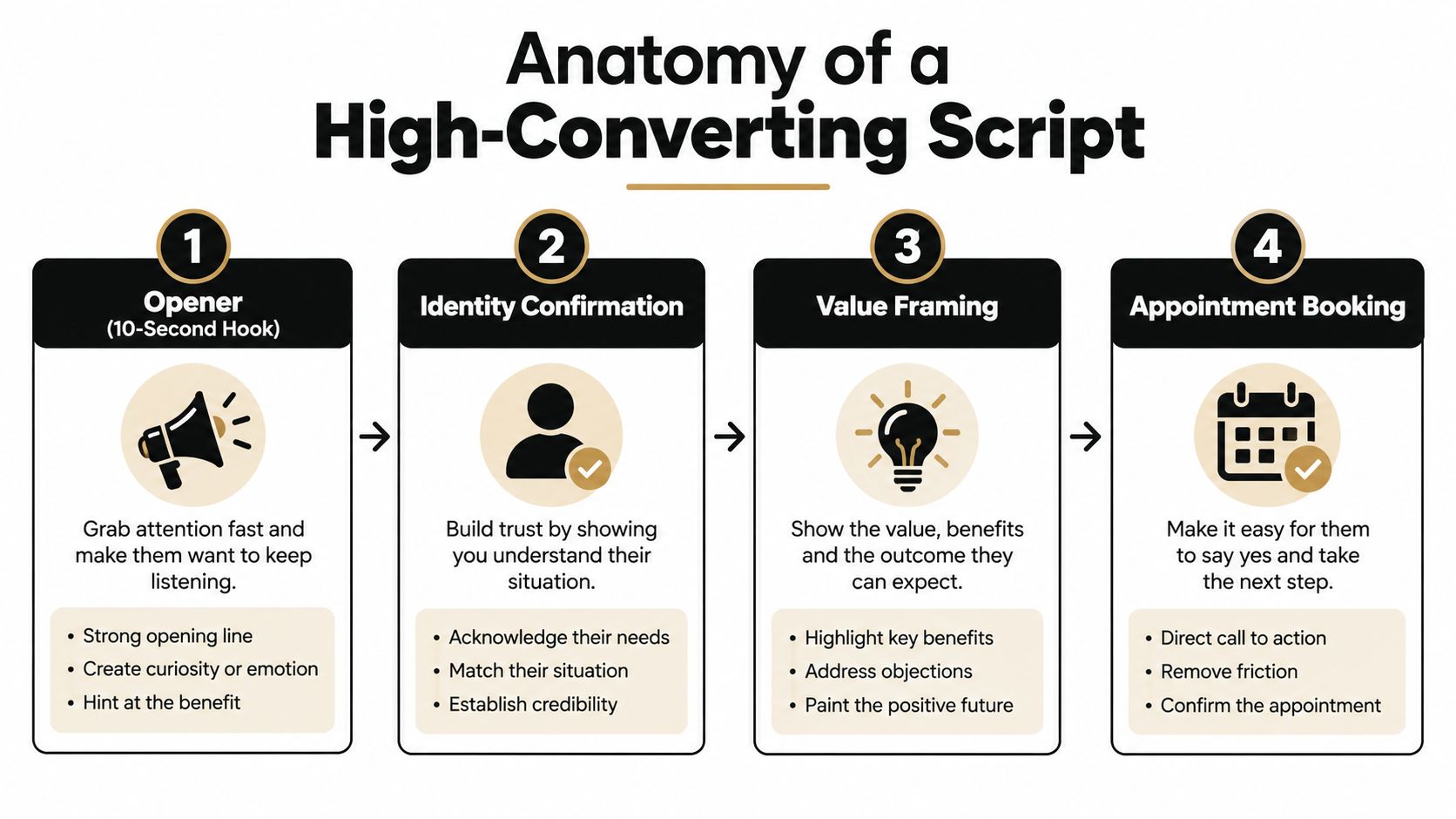
Print this checklist beside the dialer:
- Permission: Earn the next moment.
- Identity: Confirm the person and inquiry.
- Qualification: Ask only questions that shape the meeting.
- Value: Explain what the prospect will gain from attending.
- Close: Offer two specific times.
- Confirmation: Repeat the details and send the invite immediately.
The visual flow below adds a useful training reference for teams coaching transitions between these stages.
Three Ready-to-Use Sample Scripts You Can Customize Today
The samples below are structures to adapt, not lines to recite. Keep the bracketed cues. They remind the agent to pause, listen, and move the conversation forward without sounding like a recorded message.
Outbound cold call
Scenario: The lead hasn't recently requested information.
Agent: “[soft tone] Hi, is this [Name]? This is [Agent] with [Agency]. I'm calling about a possible [auto / life / coverage review]. I'll be brief. Is it okay if I ask two questions to see whether this is relevant?”
Prospect: “What is this about?”
Agent: “It's about understanding whether your current coverage still fits your situation. Are you currently insured with [carrier or coverage type], and has anything changed since you last reviewed it?”
Prospect: “[Answers].”
Agent: “[pause] Thanks. I'm not going to try to complete a full review on an unexpected call. I can arrange a short appointment to compare your options and explain what information we'd need. Would [time one] or [time two] be easier?”
Prospect: “[Chooses a time].”
Agent: “[transition to confirm contact info] Great. I have [phone or email] for the invite. We'll focus on [agenda], and if that time stops working, use the reschedule option in the confirmation.”
Send the confirmation immediately. Add the calendar event promptly, then remind the prospect 24 hours before and one hour before, following the cadence described in this appointment-setting guidance. If the prospect misses the meeting, use: “We missed each other for the [coverage] review. Would [new time one] or [new time two] work better?”
Inbound web lead callback
Scenario: The prospect completed a web form.
Agent: “[friendly tone] Hi, is this [Name]? This is [Agent] with [Agency]. You asked for information about [coverage type] through [lead source], so I'm calling to understand what you need before arranging the right review. Do you have a couple of minutes?”
Prospect: “Yes.”
Agent: “What prompted you to look into this today, and are you replacing existing coverage or exploring it for the first time?”
Prospect: “[Answers].”
Agent: “That gives me useful context. For [vertical-specific reason], the next step is a focused conversation rather than a generic quote. I can schedule [time one] or [time two]. Which suits you?”
Confirm the appointment, the expected agenda, and the best contact method. If the lead goes silent after the booking, keep the message short: “You requested help with [coverage]. Your review is set for [time]. Reply here if you need to change it.” A no-show recovery message should reference the original reason for inquiry rather than restart the entire pitch.
Voicemail
Scenario: The call reaches voicemail.
Agent: “[Name], this is [Agent] with [Agency]. I'm following up about your request or interest in [coverage type]. I have a quick question to make sure we schedule the right kind of review. Call me at [number], or reply to the message I'm sending with a convenient time. Again, this is [Agent] at [number].”
The voicemail should create a reason to respond without making a product promise. Follow it with a short SMS or email that identifies the inquiry, names the next step, and offers a reschedule path if an appointment already exists.
| Vertical | Opener swap | Proof point | CTA |
|---|---|---|---|
| Medicare | “You asked about reviewing your current coverage.” | “We'll clarify which product areas you want to discuss.” | “Would [time one] or [time two] work for the review?” |
| ACA | “You requested help understanding marketplace options.” | “We'll organize the household and coverage information needed for the conversation.” | “Can we reserve [time one] or [time two]?” |
| Auto | “You're looking at your current auto coverage.” | “We'll review the driver, vehicle, and carrier details together.” | “Is [time one] or [time two] better?” |
Objection Handling That Works in Real Insurance Calls
Objection handling isn't a contest to see who can rebut the prospect fastest. It's diagnosis. The prospect's words reveal a concern, but the setter has to discover whether the concern is timing, trust, relevance, effort, or prior frustration.
The lazy response to “Not interested” is “No problem, have a great day.” That ends the conversation before the agent knows what the prospect rejected. “I can send you a brochure” is just as weak when the prospect needs help choosing a next step.
| Trigger phrase | Likely belief | Why the standard reply fails | Replacement response |
|---|---|---|---|
| “I'm not interested.” | “This sounds like a generic sales pitch.” | Leaving immediately confirms the call has no relevance. | “Understood. Is it the coverage itself, or is now just a bad time? I can close this out properly either way.” |
| “Send me something.” | “I want information without a sales conversation.” | Sending material without context rarely answers the real question. | “I can send it. Which part should it address, the coverage, the cost, or how it compares with what you have?” |
| “I already have coverage.” | “There's no reason to review anything.” | A generic claim about savings sounds dismissive. | “That's useful to know. The appointment can simply check whether the current coverage still matches your situation. Would [time one] or [time two] work?” |
| “Call me next month.” | “I'm not ready to give this attention.” | Accepting a vague callback creates no commitment. | “That works. What changes next month, and should we reserve a brief time now so you don't have to restart the process?” |
For Medicare, confusion often hides behind “I already get notices from my carrier.” Try: “That makes sense. The meeting isn't about replacing anything automatically. It's to clarify what you want to discuss and document the appointment correctly.”
When a prospect is tired of carrier calls, lower the pressure: “I understand. I'll keep the appointment limited to the topics you approve, and you can decide whether any further review makes sense.” That response respects control instead of trying to overpower resistance.
Compliance-Safe Language for Medicare and Regulated Lines
Compliance belongs inside the dialogue. A disclaimer stapled to the end of a persuasive pitch creates two problems: the prospect may not understand what they're agreeing to, and the representative may forget the required step under pressure.
For Medicare, the appointment process should capture a documented Scope of Appointment, including the beneficiary or authorized representative's agreement, the products to be discussed, the date, and the required record. The compliance process described in the supplied industry guidance also calls for retaining that record for 10 years, as outlined in this insurance sales script compliance reference.
A safer Medicare handoff
Use language that makes the boundary clear:
“Before we discuss specific Medicare plan benefits, I need your permission to document a Scope of Appointment. It records the Medicare product areas you agree to discuss, the date of the appointment, and who will participate. This doesn't enroll you in a plan. It only defines what we may review. Would you like to continue with that process?”
The agent should then record the approved scope, date, participants, and any required consent details in the CRM. Don't discuss plan-specific benefits before the required permission and documentation are complete. The exact implementation should be reviewed against current carrier, CMS, state, and organizational requirements.
ACA and auto conversations may involve fewer pre-call disclosures, but the core rule remains: don't promise an outcome the agent can't establish. “You qualify,” “you'll save,” and “this is the best plan” turn uncertain results into claims.
| Risky phrase | Why it fails | Compliant replacement |
|---|---|---|
| “You're guaranteed to save.” | The agent can't promise a final price before reviewing the facts. | “We can compare the available options after reviewing your information.” |
| “This is the best plan.” | “Best” depends on needs, eligibility, provider access, and policy terms. | “We can identify options that may fit the priorities you described.” |
| “You qualify.” | Eligibility may require verification and current information. | “We can review the information needed to determine eligibility.” |
Attach this checklist to every CRM record:
- Consent record: Capture the permission relevant to the call and channel.
- Scope record: For Medicare, document the approved product areas and participants.
- Timing: Store the appointment date and the confirmation timestamp.
- Disclosure status: Mark each required disclosure as completed, not assumed.
- Call evidence: Retain the recording or note according to applicable policy.
- Change history: Record reschedules, cancellations, and updated scope.
A shorter script often performs better in regulated lines because it gives the representative fewer opportunities to drift into an unsupported claim.
Testing, Optimization, and AI Voice Automation
A script can sound polished and still produce weak results if the workflow loses leads, fails to confirm meetings, or never records what happened. Measure the operating process alongside the words agents use.
Start with timestamps and track speed to lead under five minutes, contact rate, qualified appointment rate, show rate, no-show rate, meeting-to-quote rate, and meeting-to-close rate. Use the speed-to-lead benchmark from the introduction as the reason for the response target, rather than repeating its statistic or citation. The goal is to connect response time with held meetings and downstream revenue.
Instrument the funnel
Create CRM fields that separate each stage:
- Response timestamp: When the lead entered the queue and when the first attempt occurred.
- Disposition code: No answer, connected, unqualified, appointment set, rescheduled, canceled, or no-show.
- Qualification fields: The information required for that insurance vertical.
- Held-meeting status: Whether the prospect attended.
- Downstream outcome: Quote created, application started, or closed.
Test one script variable at a time. Change the opener, value hook, or close question, then compare held appointments and show rate, not raw contact volume. A variant that books poorly qualified meetings can inflate appointment totals while reducing productive selling time.
Tie each booking to a confirmation and reminder cadence. Send the confirmation immediately, then schedule the 24-hour and one-hour reminders. Record delivery, replies, reschedules, and cancellations in the CRM so the show rate reflects the full workflow, not just the setter's performance.
Before releasing a new variant, confirm:
- Compliance review: Required language appears in the correct position.
- CRM mapping: Qualification and disposition fields save correctly.
- Reminder automation: Confirmation, 24-hour, and one-hour messages fire as intended.
- Human escalation: Complex questions transfer to a licensed or qualified representative.
- Call review: Supervisors check tone, pauses, interruptions, and missing disclosures.
For teams testing conversational support outside voice, an AI chatbot for startups can organize inbound questions and route prospects before a human appointment setter takes over. Voice automation should use the same qualification limits, disclosure steps, escalation rules, and follow-up statuses as the human workflow. It can handle after-hours inquiries, recycle voicemails, follow up with no-shows, qualify leads, and reserve human agents for live transfers and final conversations.
If your team cannot staff a five-minute response window, Voicedial.ai can provide AI voice agents for inbound and outbound calls that work the queue, log dispositions, follow up with prospects, and book meetings into an agent's calendar. Map those outcomes to the CRM fields above, then judge the workflow by response time, qualification quality, show rate, and downstream results.