

Lead qualification is where the rubber meets the road in sales. It’s the disciplined process of sorting the genuinely interested buyers from the casual browsers, making sure your sales team invests their energy on high-potential opportunities instead of chasing ghosts.
Why Most Sales Pipelines Fail and How to Fix Yours
Staring at a pipeline full of leads that never go anywhere? It’s a familiar, frustrating reality for most sales leaders. The hard truth is, most deals aren't lost because of a bad pitch. They’re lost because you were talking to someone who was never going to buy from the start.
This is exactly the problem that smart lead qualification solves.

Think about the hours your team pours into chasing leads, only to find out they were never a good fit. That’s the story behind 67% of lost sales, which can be traced directly back to poor or nonexistent qualification. According to recent B2B sales data, this number highlights a massive weak spot—and a huge opportunity—for teams in insurance, home services, and medical devices. You can explore more of these lead qualification statistics on Landbase.com.
When reps waste time on unqualified leads, it triggers a domino effect of inefficiency. Your pipeline gets bloated with low-value contacts, your forecasts become wildly inaccurate, and eventually, your team’s morale takes a nosedive. The goal isn't just to generate more leads; it's to accelerate the right leads through your funnel.
Common Qualification Mistakes
Many teams, especially in high-volume industries like insurance, legal intake, and home services, fall into the same predictable traps. The first step to building a bulletproof pipeline is recognizing these bad habits.
- Treating All Leads Equally: A lead who downloaded a free guide is not the same as someone who requested a pricing demo. Giving them both the same level of attention is a classic mistake.
- Relying on "Gut Feeling": Without a clear, structured framework, reps are left to their own intuition. This leads to inconsistent qualification and completely subjective results.
- Fear of Disqualification: Salespeople are often reluctant to close the door on any lead, holding out hope for a future conversion. This just clogs the pipeline and steals time from better prospects.
The single most powerful lever for growing revenue isn't just generating more leads; it's getting better at identifying which ones are actually worth your time.
Fixing a broken pipeline requires a modern strategy built on clear, repeatable pillars. This approach transforms the ambiguous "art" of selling into a predictable science, ensuring every lead is systematically evaluated, scored, and prioritized. It’s how you get your team focused exclusively on closing winnable deals.
The table below breaks down the foundational pillars of any strong lead qualification strategy. Think of this as your framework for building a more efficient and predictable sales engine.
Core Lead Qualification Pillars at a Glance
| Pillar | What It Means | Why It Matters |
|---|---|---|
| Ideal Customer Profile (ICP) | A clear, data-driven definition of your perfect customer. | It provides a benchmark to measure every lead against. |
| Qualification Framework | A structured set of criteria (like BANT or MEDDIC) to assess a lead's fit. | It ensures consistent, objective evaluation across the entire team. |
| Scoring Model | A system that assigns points to leads based on their attributes and actions. | It quantifies lead quality, enabling automatic prioritization and routing. |
| Disqualification Rules | Firm criteria for when to remove a lead from the active pipeline. | It keeps the pipeline clean and focuses resources on winnable deals. |
Getting these four components right is the difference between a pipeline that’s full of noise and one that’s packed with real opportunities.
Define Your Ideal Customer and Choose Your Framework
Before you can effectively qualify a single lead, you have to know exactly who you're looking for. Chasing every inquiry is a surefire recipe for burnout and a pipeline bloated with dead ends. The first step toward a smarter process is building a data-driven Ideal Customer Profile (ICP).

This isn't about guesswork or wishful thinking. A strong ICP is a precise description of your perfect-fit customer, created by analyzing your most successful and profitable clients. Look at what they have in common. What industries are they in? What’s their company size? Who are the key decision-makers you end up working with?
By identifying these common threads, you build a benchmark. Every new lead can now be measured against this profile. Is this a small business owner in the home services industry? Do they operate in a specific geographic area? Your ICP acts as the first, most crucial filter in your entire qualification process.
Beyond the Basics of BANT
Once you have a clear ICP, you need a structured method to evaluate each lead’s potential. The classic BANT framework—Budget, Authority, Need, and Timeline—is a well-known starting point. It’s a simple checklist that helps ensure you’re covering the core criteria.
However, a one-size-fits-all approach rarely works in the real world. The best qualification frameworks are adapted to your specific business model and customer journey. The importance of each element can shift dramatically based on what you sell and who you sell it to.
At Voicedial.ai, we see this firsthand with our clients every day:
- A Medicare Agent: For an agent, Need and Timing are everything. A lead turning 65 in the next three months and approaching the Annual Enrollment Period is a top-tier prospect. Their budget is less of a factor, as plans are standardized.
- A Home Services Company: In contrast, a roofing contractor must prioritize Authority (are they talking to the homeowner?) and Budget. A renter with no purchasing power is an immediate disqualification, no matter how badly they need a new roof.
This nuanced approach is what separates good qualification from great qualification. It’s the multiplier that turns a mediocre pipeline into a revenue machine. Properly qualified leads can boast conversion rates as high as 40%, a stark difference from the 11% rate for unqualified ones—a nearly 4x improvement. You can dig into more of these numbers in these 2026 insights on lead generation at Warmly.ai.
Choosing the Right Qualification Framework
While BANT is a solid foundation, other frameworks can provide deeper insights, especially for more complex sales cycles. Understanding these alternatives allows you to build a custom-fit process for your team.
CHAMP is a modern alternative that puts the prospect's pain first. It stands for:
- Challenges: What problem is the lead actually trying to solve?
- Authority: Who is involved in the decision-making process?
- Money: What is the financial impact of the problem and the budget for a solution?
- Prioritization: How important is solving this challenge right now?
By starting with challenges, CHAMP encourages a more consultative conversation. It helps reps position your product as a direct solution to a recognized pain point, making the rest of the conversation flow much more naturally.
For even more complex, high-value B2B sales, many teams turn to MEDDIC (or its variations like MEDDPICC). This framework is incredibly thorough and designed to eliminate uncertainty from large, enterprise-level deals.
MEDDIC: A Framework for Complex Sales
- Metrics: The quantifiable economic benefits of your solution.
- Economic Buyer: The person with ultimate P&L responsibility and veto power.
- Decision Criteria: The formal criteria the company uses to evaluate vendors.
- Decision Process: The step-by-step process for reaching a purchase decision.
- Identify Pain: The business consequences of the problem.
- Champion: An influential insider who advocates for your solution.
While MEDDIC might be overkill for a high-volume team selling a simple service, it's invaluable for enterprise software or medical device sales where multiple stakeholders and long sales cycles are the norm. The key is to select, and even blend, elements from these frameworks to create a system that gives your reps the clarity they need on every single call.
The Art of Asking Questions That Actually Qualify
Knowing your ideal customer profile and choosing a framework like BANT, CHAMP, or MEDDIC are just table stakes. The real work—the art of qualification—happens live, in conversation. So, how do you get the truth about a lead's needs, authority, and timeline without making them feel like they're being interrogated?
It’s about asking smart questions that feel natural but are designed to get to the heart of the matter. Generic questions will always get you generic, useless answers. If you ask, "What's your budget?" you’re going to put the prospect on the defensive. Instead, ask about the cost of their current problem. That changes the entire conversation.
Ditch the Script, Adopt a Playbook
The best qualifying questions don't even sound like questions. They feel like the beginning of a real discussion where you’re trying to help. Your goal is to get the prospect talking about their world—their challenges, their goals, what's broken. That's the raw material you need to figure out if you can genuinely solve their problem.
This means your reps need to stop reading from a rigid script and start working from a conversational playbook. They should know exactly what information they need to gather based on your chosen framework, but have the freedom to get there in a way that matches the conversation's flow.
Here’s what this looks like in the real world:
- For a Law Firm: "Could you walk me through the steps you’ve already taken on this legal matter?" This tells you everything about their proactivity and how messy the situation might be.
- For a Credit Repair Service: "What's the main reason you're looking to improve your credit score right now?" This uncovers their true motivation and urgency—the biggest indicators of real intent.
- For a Home Services Company: "What’s your ideal timeline for getting this project done, and what happens if it's not finished by then?" This question reveals both their urgency and the real-world pain of not taking action.
The single most effective qualifying question you can ask is often the simplest one: "To make sure I don't waste your time, could you tell me a bit more about what prompted you to reach out today?"
This one line completely shifts the dynamic. It immediately positions your rep as a helpful consultant, not a pushy salesperson. It invites the lead to open up and tell you the real story, which is exactly how you start qualifying leads the right way.
The Power of Saying "No" First
Sometimes the fastest path to a healthy pipeline is figuring out who isn't a good fit, and doing it quickly. This is where negative qualification comes in. It’s all about intentionally asking questions designed to uncover deal-breakers right at the start.
This can feel strange to reps who are trained to "always be closing," but it’s an incredibly smart strategy. Wasting hours or days on a bad-fit lead who will never buy—or worse, will buy and then churn—is way more expensive than disqualifying them on the first call. It respects everyone’s time and keeps your pipeline clean.
Here are a few sharp examples of negative qualifying questions:
- "Our platform is really built for teams making at least 500 outbound calls a day. Does that sound like your current volume?" This gets right to a critical usage threshold.
- "Just to be totally transparent, our implementation process usually takes about three weeks. How does that timeline fit with your expectations?" This sets clear expectations and surfaces any deal-breaking urgency.
- "We've found our most successful clients have a dedicated project manager on their end. Do you have someone who would be in that role?" This checks if they have the internal resources to actually succeed with your product.
Using these kinds of questions lets you gracefully exit conversations that are going nowhere. It frees up your team to pour their energy into prospects who actually have the problems you solve and the ability to buy, which is how you dramatically speed up your sales cycle and close more deals.
Building Your Lead Scoring and Prioritization Model
Once you've defined your ideal customer and have your qualifying questions dialed in, it's time to translate that knowledge into a system that works at scale. This is where a solid lead scoring model becomes your best friend.
Think of it as a playbook that assigns points to leads based on who they are and what they do. It’s the difference between staring at a wall of names and instantly seeing who’s ready for a sales call versus who needs more time in a nurture sequence.
Without a scoring system, your reps are flying blind. They’re forced to rely on gut feelings, which leads to inconsistent follow-up and wasted hours on prospects who were never going to buy. With scoring, you create a clear pecking order, making sure your team’s time—their most valuable asset—is spent on the hottest opportunities first.
Combining Explicit and Implicit Data
A great scoring model doesn’t just look at one thing. It blends two crucial types of information: explicit and implicit data.
Explicit Data: This is the stuff a lead tells you directly. Think firmographics like company size and industry, or demographics like a job title. These are the hard facts about who they are.
Implicit Data: This is what you learn by watching their behavior. It’s about tracking their engagement—website visits, email opens, content downloads, and demo requests. These are the actions that signal real intent.
The real power comes from combining them. A lead with a "Director" title (+20 points) at a company in your target industry (+15 points) is a decent start. But when that same director also visits your pricing page (+25 points) and then requests a demo (+50 points), they shoot straight to the top of the list. That's a conversation you want to have now.
Setting Up Your Scoring System
You don’t need a data science degree to build a scoring model. Start by listing the key traits and actions that your best customers have in common. Then, assign points to each one. The higher the point value, the stronger the buying signal.
Let’s walk through a practical example.
Sample Lead Scoring Model for a Home Services Company
This table shows how a local home services company might assign points to different lead attributes and actions. It’s a simple but effective way to turn raw lead data into a clear priority list for your sales team.
| Attribute/Action | Example | Points Assigned |
|---|---|---|
| Firmographics | Homeowner vs. Renter | Homeowner = +20 |
| Demographics | Lives in service area | Yes = +15 |
| Behavior | Visited pricing page | +10 |
| High-Intent Action | Submitted "Request an Estimate" form | +40 |
| Engagement | Opened follow-up email | +5 |
| Negative Signal | Unsubscribed from emails | -50 |
This simple framework turns abstract interest into a concrete number. A lead who is a homeowner in your service area and requests an estimate immediately gets a score of 75, flagging them as a high-value opportunity that needs immediate attention.
The goal of lead scoring isn’t to create a complex algorithm. It’s to create a simple, shared language between marketing and sales that clearly defines what a "good lead" actually is.
This shared understanding is everything. The reality is that only about 25% of leads generated by marketing are truly ready for a sales conversation. It's a gap that 85% of B2B marketers admit makes it tough to connect their work to revenue. You can dig deeper into how to bridge this marketing-sales gap on goadstra.co.
Modern tools like Voicedial.ai even tackle this in real-time by scoring prospects during live conversations, assigning points for keywords like a "Director" title (+30) or a confirmed budget (+40).
From MQL to SQL
Finally, your scoring model is useless if the scores don't trigger specific actions. You need to set clear thresholds that define the handoff point between marketing and sales. This is where you establish the difference between a Marketing Qualified Lead (MQL) and a Sales Qualified Lead (SQL).
- Marketing Qualified Lead (MQL): This is a lead who fits your general profile and has shown some interest, but isn't quite ready for a sales call. For example, you might set your MQL threshold at any lead with a score between 40-79 points. These folks belong in a nurturing sequence.
- Sales Qualified Lead (SQL): This is a lead who has demonstrated clear buying intent and is ready to talk to a salesperson. For instance, any lead with a score of 80+ points could be considered an SQL. These leads should be routed directly to your sales team for immediate follow-up.
These thresholds give you clear rules of engagement. Marketing’s job is to get leads to the MQL score. Sales knows to focus their energy exclusively on the SQLs. This simple system eliminates the friction and guesswork, turning your lead pipeline into a well-oiled machine.
Using Automation and AI to Qualify Leads at Scale
Let’s be honest: manually qualifying every single lead is a recipe for burnout, especially if your marketing is working and you’re dealing with high volume. This is where your strategy meets technology. It’s how you scale the entire qualification process without overwhelming your team or, worse, letting good leads go cold.
Automation and AI aren't just about moving faster. They're about precision and timing.
Imagine an AI voice agent dialing new web leads just minutes after they hit your inbox. That immediate response is a game-changer. We know that getting back to someone in under an hour can boost conversions by as much as 7x. An AI agent makes that happen 24/7, catching leads at the absolute peak of their interest.
This isn’t about replacing your reps. It’s about taking the repetitive, soul-crushing tasks off their plate so they can do what they do best: talk to qualified people and close deals.
A Real-World Scenario
Picture an insurance brokerage that just ran a big campaign. They wake up to 200 new web leads. The old way? The sales team spends the entire day just trying to get people on the phone.
The new way? An AI agent takes over.
- It instantly starts dialing all 200 leads.
- It uses your proven qualification script, asking the right BANT or CHAMP questions.
- It scores every lead in real-time based on their answers.
- For the best prospects, it books appointments directly on your sales team’s calendars.
When your team logs in for the day, they aren't staring at a cold list. They're looking at 15 qualified meetings already booked and a full report on every single lead. That’s how you turn a lead-gen expense into a predictable revenue driver.
This is the basic flow. You turn raw lead data into prioritized opportunities that your team can act on immediately.
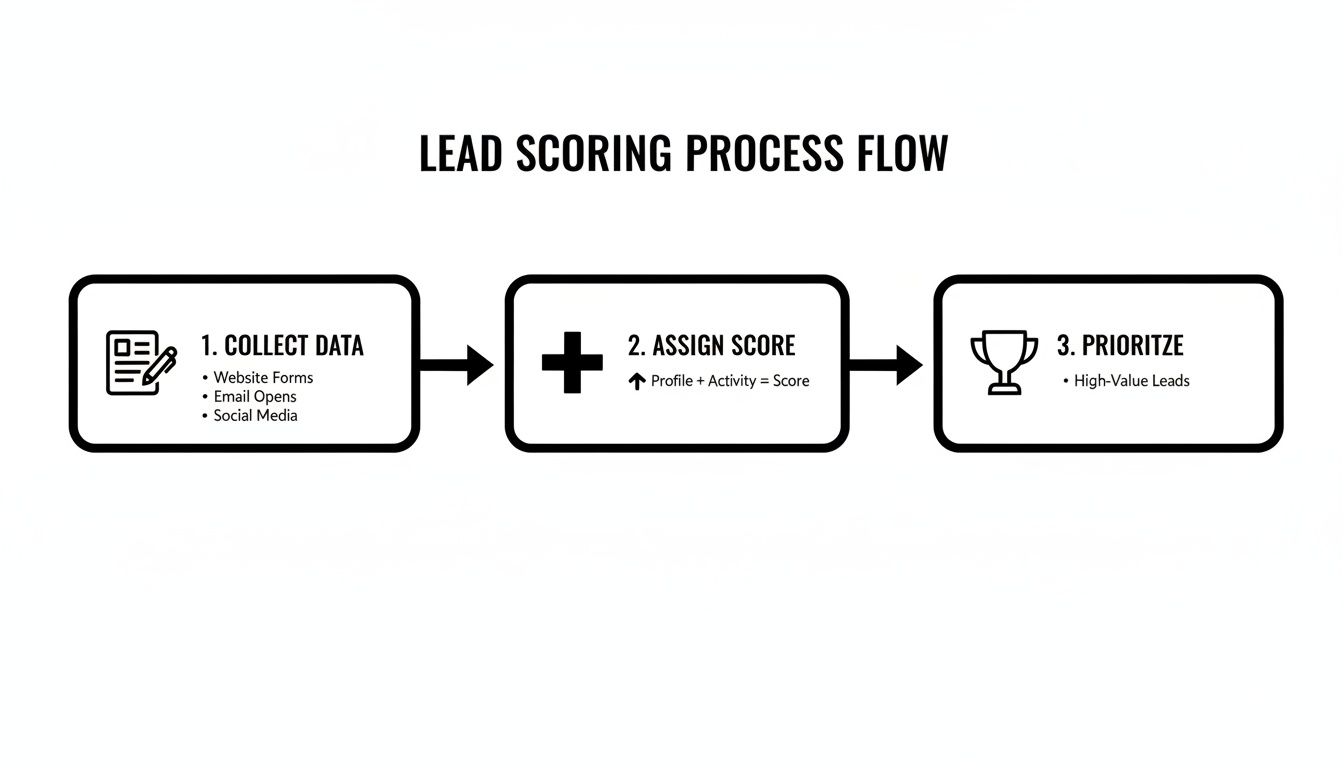
As you can see, the system takes new leads, applies your scoring rules, and neatly organizes the output so your team knows exactly who to call first.
Operationalizing Your AI Qualification Strategy
Putting this into motion is more straightforward than you might think. Platforms like Voicedial.ai are built to make this accessible, letting you deploy custom AI callers that feel like a natural extension of your sales team.
Getting started usually looks something like this:
- Script Customization: You load your proven qualifying questions and conversation flows into the AI. This is where your sales expertise really shines.
- Integration: You connect the platform to your CRM or other lead sources. This allows all the data to flow back and forth seamlessly.
- Campaign Launch: You set the trigger—for instance, "call any new lead from our website form within five minutes"—and let it run.
From there, the AI handles the initial outreach and qualification. Your human reps are freed up to focus on what they were hired for: high-value conversations and closing deals.
Recent benchmarks show just how effective purpose-built AI agents are. A sales-specific AI agent outperformed a general model like ChatGPT by 20% in creating personalized outreach. It also did 16% better at engaging leads with accurate, relevant responses over a multi-turn conversation.
This isn’t surprising. These systems are trained on real-world sales scenarios. They understand the nuances of what you sell and are far better at picking up on the buying signals that a general-purpose AI would miss.
Gaining Real-Time Visibility
One of the biggest wins of using an AI-powered system is the data. Instead of relying on what reps remember from their calls, you get a crystal-clear, data-driven view of your entire qualification machine.
A real-time dashboard gives you complete visibility into every call.
This kind of dashboard lets you track key metrics like answer rates, call outcomes, and how different scripts are performing, all at a glance.
This visibility is power. If one script is consistently booking more meetings, you can double down on it. If answer rates are tanking in the afternoon, you can adjust your campaign timing. It creates a continuous feedback loop that lets you constantly refine and improve your lead qualification process, making sure you’re always operating at peak efficiency.
Measuring Success and Optimizing Your Sales Funnel
Your lead qualification process isn’t a one-and-done project. It’s a living system that needs constant attention. If you want to truly master how to qualify sales leads, you have to commit to measuring what’s working and what isn’t. Otherwise, you’re just guessing.
This is what separates the good sales teams from the great ones. By tracking the right key performance indicators (KPIs), you can turn your sales funnel into a predictable, efficient engine for revenue. These metrics show you where your process is strong and, more importantly, where it’s breaking down.
Core Metrics for Your Qualification Dashboard
To measure success, you need a clear view of how smoothly leads are moving from one stage to the next. Focusing on a handful of core conversion rates will give you immediate insight into the health of your qualification efforts.
Start by tracking these essential KPIs:
- Lead-to-MQL Rate: This is the percentage of raw leads that meet your initial criteria to become Marketing Qualified Leads (MQLs). If this rate is low, it’s a strong signal that your marketing campaigns might be attracting the wrong audience.
- MQL-to-SQL Conversion Rate: This shows how many of those MQLs the sales team actually accepts as Sales Qualified Leads (SQLs). A low number here is a classic sign of misalignment between marketing and sales on what a "good" lead really looks like.
- Sales Cycle Length: This tracks the average time it takes to close a deal from the moment a lead is accepted as an SQL. A shorter cycle often means your qualification process is doing its job, filtering for high-intent prospects who are ready to buy.
These numbers tell a story. If your MQL-to-SQL rate suddenly tanks, it's time to get marketing and sales in a room to review your lead scoring model or the BANT questions your reps are asking.
Turning Data into Actionable Improvements
Data is only useful if you act on it. Modern sales tools give you real-time dashboards that make this process incredibly straightforward. For example, a platform like Voicedial.ai provides a clear view of call outcomes, so you can see which scripts and qualification questions are actually moving leads forward.
Optimization isn't about massive, disruptive changes. It's about making small, data-informed adjustments over time—tweaking a lead score, refining a qualifying question, or adjusting a follow-up cadence—that compound into significant gains.
Let's say you notice your sales cycle is unusually long for leads from a specific industry. That's a signal to dig deeper. You can use that insight to adjust your Ideal Customer Profile (ICP), refine the scoring points for that segment, or create industry-specific qualifying questions to better gauge urgency.
This constant feedback loop is what keeps your qualification strategy sharp. It ensures your process evolves and improves, keeping your sales team focused on the deals that are most likely to close.
Frequently Asked Questions About Lead Qualification
Whenever you roll out a new qualification playbook, two questions always come up from the team. They’re fair questions, and you need to have good answers.
First, people want to know how long it will take to see a real difference. While there’s no magic number, most teams start feeling the impact on pipeline quality and rep efficiency within 30-60 days. The new rules bring immediate clarity.
The second, and often tougher, challenge is getting the team on board. Seasoned reps can be skeptical of new processes. The key is to show them exactly how this makes their life easier—fewer admin tasks and more conversations with people who are actually ready to buy.
A great way to do this is to start small. Run a pilot with a few of your more open-minded reps, track their success, and then use those wins as internal proof to bring everyone else along.
What Happens to Disqualified Leads
So, what about the leads who don't qualify? Don't just hit delete. Disqualifying a lead doesn't mean they're worthless; it just means they're not ready right now.
A "no" today isn't necessarily a "no" forever. A lead might be disqualified due to timing or budget, but that could change in six months.
Instead of tossing them out, move these contacts into a long-term nurturing sequence. It doesn't have to be complicated. A monthly newsletter or an occasional case study is often enough to keep your brand on their radar.
This is a low-effort way to reactivate old leads when their situation changes. That "no" from last quarter could very well become your next closed deal.
Ready to qualify leads faster and more effectively? Voicedial.ai provides AI voice agents that handle initial outreach 24/7, scoring leads and booking meetings automatically so your team only talks to the best prospects. See how it works.