

You launch a new outbound calling workflow. Sales wants faster follow-up. Operations wants lower cost per conversation. Someone plugs in an AI caller, routes call outcomes into the CRM, and starts recording for quality review. Then the hard questions show up all at once.
Where is consent stored. Which version of the script was used. Who can change disclosures. How long are recordings retained. Can a vendor employee hear account details. What happens if a regulator asks for the record from a call made six months ago.
That's what financial services compliance looks like in practice. It isn't a binder on a shelf. It's the set of controls that decides whether your calls, messages, scripts, recordings, approvals, and vendors can stand up to scrutiny when your firm grows.
What Is Financial Services Compliance Really About
A lot of firms realize they're in regulated territory later than they should. An insurance agency adds automated callbacks. A credit-related business starts collecting more sensitive customer information. A legal intake team begins screening payment or finance-related matters over the phone. The business still feels like sales and service. Regulators will see workflows, records, disclosures, and supervision.
At that point, financial services compliance stops being a legal abstraction. It becomes an operating model. It affects how your team speaks to customers, what your systems store, who can approve a script, and how fast you can prove what happened on a given call.
Deloitte reports that operating costs spent on compliance have increased by over 60% for retail and corporate banks since the 2008 financial crisis, and for smaller institutions with assets under $100 million, compliance costs can reach nearly 10% of total noninterest expense, according to Deloitte's analysis of the cost of compliance. The lesson for fast-growing firms is simple. Compliance is already an operational cost center. You either design it deliberately, or you pay for it through rework, slowdowns, and avoidable exposure.
What compliance actually covers
In plain English, financial services compliance means your firm can do four things consistently:
- Explain the rule: You know which obligations apply to your products, communications, and customer data.
- Run the process: Staff and systems follow the approved workflow, not improvisation.
- Keep the evidence: You can retrieve the records that show what happened.
- Fix the gaps: Exceptions trigger review, correction, and documented follow-up.
Practical rule: If a control only exists in someone's memory, it doesn't exist.
That's why the strongest programs don't treat compliance as a final review step. They build it into call flows, QA queues, access permissions, retention settings, and vendor oversight from day one.
The Core Regulations You Cannot Ignore
A growth-stage firm launches an AI calling workflow to speed up outreach, then learns the problem is not the model. The problem is everything around it: who approved the script, where consent is stored, whether the recording is a regulated record, how long transcripts must be retained, and which vendor can access customer data. That is how compliance failures start. They show up in operations first.

Records and supervision
For regulated communications, recordkeeping is part of supervision. If a prospect receives a scripted call about a financial product, your firm needs more than the audio file. You need the script version used on that date, the approval trail, the disposition selected by the agent or system, any escalation notes, and a retention setting that matches the rule.
Enforcement makes the point clearly. In September 2022, the SEC fined 16 broker-dealers a combined $1.3 billion for recordkeeping failures. Global financial institutions also paid about $6.6 billion in penalties in 2023, a 57% increase from 2022, for failures related to AML, KYC, and sanctions. Egnyte's financial compliance guide also notes that FINRA Rule 17a-4(f) requires non-rewriteable, non-erasable storage, with retention periods that can extend up to six years.
SOX Sections 302 and 404 add another layer. They require documented and tested internal controls over financial reporting. In practice, that means firms need a defensible process for approving communications, restricting edits, and proving that the system of record has not been altered after the fact.
AML and KYC in operational terms
AML and KYC controls reach far beyond onboarding. They shape how your communication systems collect, route, and preserve customer information.
If an agent, bot, or AI caller gathers identity details, updates account information, or surfaces suspicious activity, your controls should show four things:
- Who was verified
- What data was collected
- Which red flags triggered escalation
- How the review was resolved and recorded
Fast-growing firms get exposed when, even with a written AML policy, a team fails operationally because the CRM allows free-text notes, the call platform has no required fields, and investigators cannot reconstruct the timeline from the record.
Data privacy and security
Privacy risk usually sits in the places teams forget to map. Transcripts. Call recordings. QA exports. CRM notes. Ticketing systems. Shared drives. Vendor dashboards.
That creates a direct requirement for script design and system design. A good intake script limits collection to the data needed for the transaction, prevents agents from typing sensitive details into open notes, and sends payment or identity verification steps into a controlled channel. Data minimization is not only a privacy principle. It reduces breach scope, vendor exposure, and discovery risk.
For firms using cloud tools around payment workflows, architecture choices matter. If cardholder data touches adjacent systems, this guide to navigating PCI DSS with Firebase is useful because it explains how security obligations affect application design and service-provider oversight.
Communications rules are workflow rules
Consumer communication rules become operational requirements the moment your team uses outbound dialing, prerecorded messages, AI voice agents, SMS follow-ups, or call recording. The control points are practical:
| Control area | What must be defined |
|---|---|
| Consent | Where it was obtained, how it's stored, and how revocation is honored |
| Script governance | Who approved the language and how changes are versioned |
| Recording | Which calls are recorded, announced, reviewed, and retained |
| Escalation | When the system transfers to a human or stops the workflow |
| Complaints | How objections, disputes, and error claims are logged and resolved |
I advise firms to read every communications rule through three lenses: script, system, and vendor. If the script says one thing, the dialer does another, and the vendor cannot produce audit evidence on demand, the firm owns the gap.
A policy library will not fix that. A controlled workflow will.
How to Build a Modern Compliance Program
A workable compliance program looks less like a policy library and more like a control system. It needs owners, inputs, approvals, monitoring, and correction loops. If any one of those is missing, the program becomes theater.

Start with policies people can actually use
Most compliance manuals fail for a simple reason. They're written for auditors, not operators. A call-center supervisor, CRM admin, and vendor manager need instructions they can execute without interpretation.
Strong policies answer concrete questions:
- Call scripts: Who writes them, who approves them, and what triggers reapproval
- Data handling: What agents may collect, where they store it, and what they must never enter in notes
- Retention: Which systems are records of authority and when records can be deleted
- Incident response: What counts as a breach, error, complaint, or unauthorized disclosure
Write your policy stack in layers. Keep a short governing policy. Then attach working procedures by team and system. That's how you prevent the official rule from drifting away from the actual workflow.
Train for decisions, not memorization
Annual training alone doesn't change behavior. Teams need scenario-based guidance tied to the moments where mistakes happen: identity verification, disclosures, objections, revocation of consent, account-specific questions, and complaint handling.
A useful training design includes:
- Role-based instruction for agents, supervisors, QA staff, and administrators.
- System-specific examples that show exactly where evidence is captured.
- Escalation drills so staff know when to stop talking and transfer the case.
- Change management refreshers whenever scripts, products, or vendors change.
Train people on the sentence they should say next, not just the policy they should remember.
Make fairness and transparency measurable
A modern program also has to account for customer comprehension, not just formal disclosure. That matters even more in digital and phone-heavy interactions where speed can hide confusion.
A LexisNexis study found 69% of financial institutions reported transparency issues affecting underserved customers, which is a strong signal that firms need evidence of understandable communication and equitable access, not just generic compliance language, according to LexisNexis risk insights on financial inclusion.
In practice, that means testing whether customers can follow your process. Review complaint themes. Listen for confusion around fees, timing, next steps, or required documents. Check whether your automated flows make it harder for some customers to reach a human, correct an error, or understand a disclosure.
Monitor what breaks first
The first failures in a growing firm are usually repetitive and boring. Script drift. Wrong dispositions. Missing consent records. Inconsistent call transfers. Recordings stored in the wrong place. Those issues are exactly what monitoring should catch.
A solid review cadence includes:
- Pre-launch review for scripts, prompts, routing, and retention settings
- Ongoing QA against approved language and required disclosures
- Exception reporting for missing records, failed integrations, and unresolved complaints
- Periodic audits to test whether stated policy matches actual system behavior
If your monitoring only happens after a complaint, you don't have a compliance program. You have incident cleanup.
The Role of Technology in Financial Compliance
Technology can either tighten control or multiply risk. It depends on whether the system is designed around evidence, approvals, and supervision. Firms that use automation well don't just move faster. They produce cleaner records and more consistent customer treatment.
A modern stack should make the compliant path the default path. Agents and AI workflows should pull approved language, write to controlled fields, timestamp changes, and preserve an audit trail automatically.

Where automation actually helps
Industry regtech guidance points to practical monitoring use cases such as real-time margin calculation, CCP selection, risk engines, end-of-day transaction reconciliation, and voice-to-text analytics for communications surveillance, all of which show why automated surveillance and reconciliation become necessary when firms handle high-volume, mixed-format data, according to the Institute of International Finance report on RegTech in financial services.
That same logic applies to customer communications. Once you have high call volume, multiple channels, and several systems feeding records, manual review stops scaling. You need automation to:
- Capture evidence automatically so call outcomes, transcripts, and approvals don't rely on human follow-up
- Trigger alerts when scripts deviate, required fields are blank, or disclosures are skipped
- Route exceptions to QA, legal, or compliance before the issue spreads
- Create case history that shows who reviewed what and when
AI callers need compliance controls at the prompt level
An AI voice workflow isn't compliant because the vendor says it is. It's compliant when your firm controls the operational details. That starts with script architecture.
Build prompts and decision trees that define what the system may say, what it may ask, what it must never infer, and when it must hand off to a person. Don't give an AI caller broad freedom in regulated conversations. Bound the workflow tightly.
This is also where practical buying guidance matters. Teams evaluating automation should review resources like how to avoid AI phone system problems because the biggest failures usually come from loose scoping, weak supervision, and poor evidence capture, not from the speech engine itself.
A useful gut check is simple. If you can't show the exact script logic, approval history, and retention path for an automated call, you aren't ready to deploy it in a regulated workflow.
Here's a short explainer on the operational side of compliance technology:
Vendors don't absorb your regulatory obligation
Firms get careless when they outsource dialing, storage, transcription, QA, or customer service, assuming the vendor's controls solve the problem. They don't.
Regulatory guidance emphasizes that banks do not transfer compliance responsibility to outsourced partners and must oversee them as if the work were done in-house, as outlined in Ankura's review of third-party compliance in financial services.
Your vendor can perform the task. Your firm still owns the outcome.
That means vendor management has to cover security, access, retention, business continuity, subcontractors, script governance, complaint handling, and audit support. Procurement alone can't do that. Compliance, legal, operations, and IT all need to be in the room.
Compliance Scenarios in the Real World
The fastest way to test your program is to walk through real conversations and see where the controls fail.
ACA insurance follow-up with an AI caller
An agency wants instant callback on inbound leads. The AI caller can confirm interest, answer common questions, and book a licensed agent. The risky version of this setup lets marketing write the script, stores the consent record in a separate lead platform, and gives supervisors no way to verify which script version ran on each call.
The workable version is tighter. Consent is tied to the contact record before the call starts. The approved script includes exact disclosures and transfer rules. The system logs whether the customer asked to stop, requested a human, or raised a complaint. QA reviews a sample of calls specifically for disclosure accuracy and handoff behavior, not just booking rate.
Credit repair outreach and dispute handling
A credit-related business often has the biggest gap between what sales wants and what compliance can support. Agents want flexible conversations. Compliance needs disciplined representations, careful intake, and a complete record of customer communications.
The right operating move is to restrict free-form claims. Use approved talk tracks for timelines, results, and customer obligations. Route disputes and complaints into a separate workflow with mandatory notes, timestamps, and supervisory review. If a customer challenges a prior representation, the firm should be able to pull the call record, transcript, and follow-up messages quickly instead of reconstructing the file from memory.
Legal intake with finance-related information
A law firm intake team may not think of itself as a financial services operation, but the moment it starts collecting payment details, debt-related facts, insurance information, or other sensitive data by phone, the same control logic applies. Intake staff need guidance on what to gather, what not to record in general notes, and when to move the conversation to a more secure process.
The common mistake is using one broad intake script for every matter. The stronger model separates screening, sensitive-data capture, and attorney escalation. Access to recordings is limited. Notes are structured. Any third-party answering service is supervised like an internal team, with documented expectations around confidentiality, retention, and issue escalation.
Your Financial Services Compliance Checklist
If you need a practical starting point, use this like an operating checklist rather than a legal memo. A good financial services compliance program is built one controlled decision at a time.
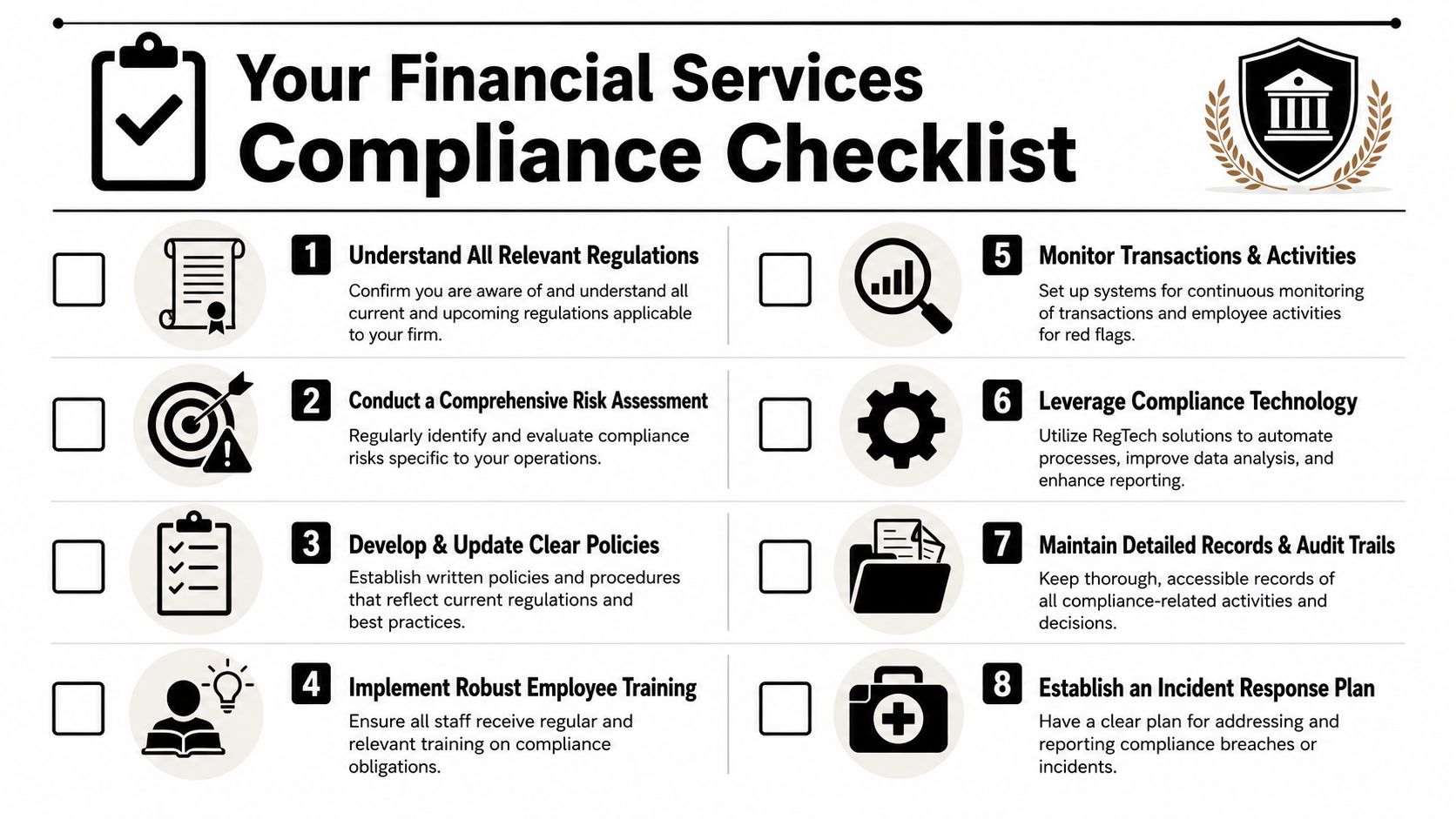
Foundation controls
- Map your regulated activities: List every customer-facing workflow that involves outreach, intake, disclosures, identity verification, complaints, or sensitive data.
- Assign real ownership: Name the people responsible for policy, script approval, QA, record retention, and vendor oversight.
- Define systems of record: Decide where consent, recordings, transcripts, notes, and approvals officially live.
Communication controls
- Lock down script changes: Require review and approval before any customer-facing language goes live.
- Design escalation paths: Define when a bot, agent, or intake specialist must transfer, stop, or open a case.
- Control note-taking: Replace open text where possible with structured fields and limited, approved note categories.
Data and record controls
- Set retention rules by record type: Calls, transcripts, complaints, approvals, and customer updates should each have a documented retention approach.
- Limit access: Give recordings and sensitive notes only to people who need them for operations, QA, or review.
- Test retrieval: Pull a sample file and confirm you can reconstruct the full communication history quickly.
Oversight controls
- Audit vendors like internal teams: Review their security, staffing, subcontractors, change management, and support for audit requests.
- Review exception reports: Look for missing records, failed integrations, complaint spikes, and off-script behavior.
- Run scenario drills: Test how your team handles revocation of consent, a disputed statement, a missing recording, and a suspected privacy issue.
The checklist matters because growth hides control failures. Small teams remember what happened. Larger teams need systems that prove it.
Print this list and walk through it with operations, legal, compliance, and whoever owns the telephony stack. The gaps show up quickly when everyone looks at the same workflow.
Turn Compliance into Your Competitive Edge
A growth-stage firm usually understands the full value of compliance the first time a regulator, bank partner, or enterprise client asks a simple question: show us the script version used on this call, the consent record behind it, the transcript, and who approved the workflow. Firms with disciplined controls answer in hours. Everyone else starts chasing screenshots, Slack messages, and vendor emails.
The firms that do this well treat compliance as operating infrastructure for communications, data, and vendor oversight. That changes day-to-day execution. Scripts stay within approved language. AI callers and human agents follow defined escalation rules. Recordings, transcripts, and consent logs are stored in a way the business can retrieve and defend.
Leadership sees the benefit quickly. New channels launch with less internal friction. Audits move faster. Sales, operations, and compliance spend less time arguing about what happened on a call because the evidence is already there.
Trust in financial services comes from repeatable behavior. A firm that can show what was said, why it was permitted, where the record lives, and how exceptions were handled is easier to examine, easier to partner with, and safer to scale.
For teams trying to put that kind of control into a live calling operation, the technology decision matters as much as the policy.
If your team is scaling inbound or outbound calling in a regulated environment, Voicedial.ai is worth evaluating because it gives you a structured way to run high-volume voice workflows with visibility into scripts, outcomes, and call activity. For firms using automation but still accountable for every customer interaction, that makes it easier to keep operational control as volume grows.