
You're probably looking at a queue that's full of “hot” leads, open tickets, and unanswered follow-ups, and still watching revenue slip because nobody owns the last mile. The problem usually isn't demand. It's the gap between the first signal of intent and the moment a person gets a useful response.
That's where customer experience optimization stops being a branding exercise and starts acting like an operating model. The companies that treat CX as a growth lever have reported stronger revenue and profit outcomes, and customers themselves now rank experience as a primary purchase factor, which changes the math for every sales, service, and intake team.
Why Customer Experience Optimization Is a Revenue Lever
A qualified lead calls after hours. The phone rings out, the voicemail box is full, and by morning the prospect has already booked with a competitor who answered first. That's not a marketing problem, and it's not just a service problem either. It's a direct leak in the revenue path, and it's exactly where customer experience optimization earns its keep.
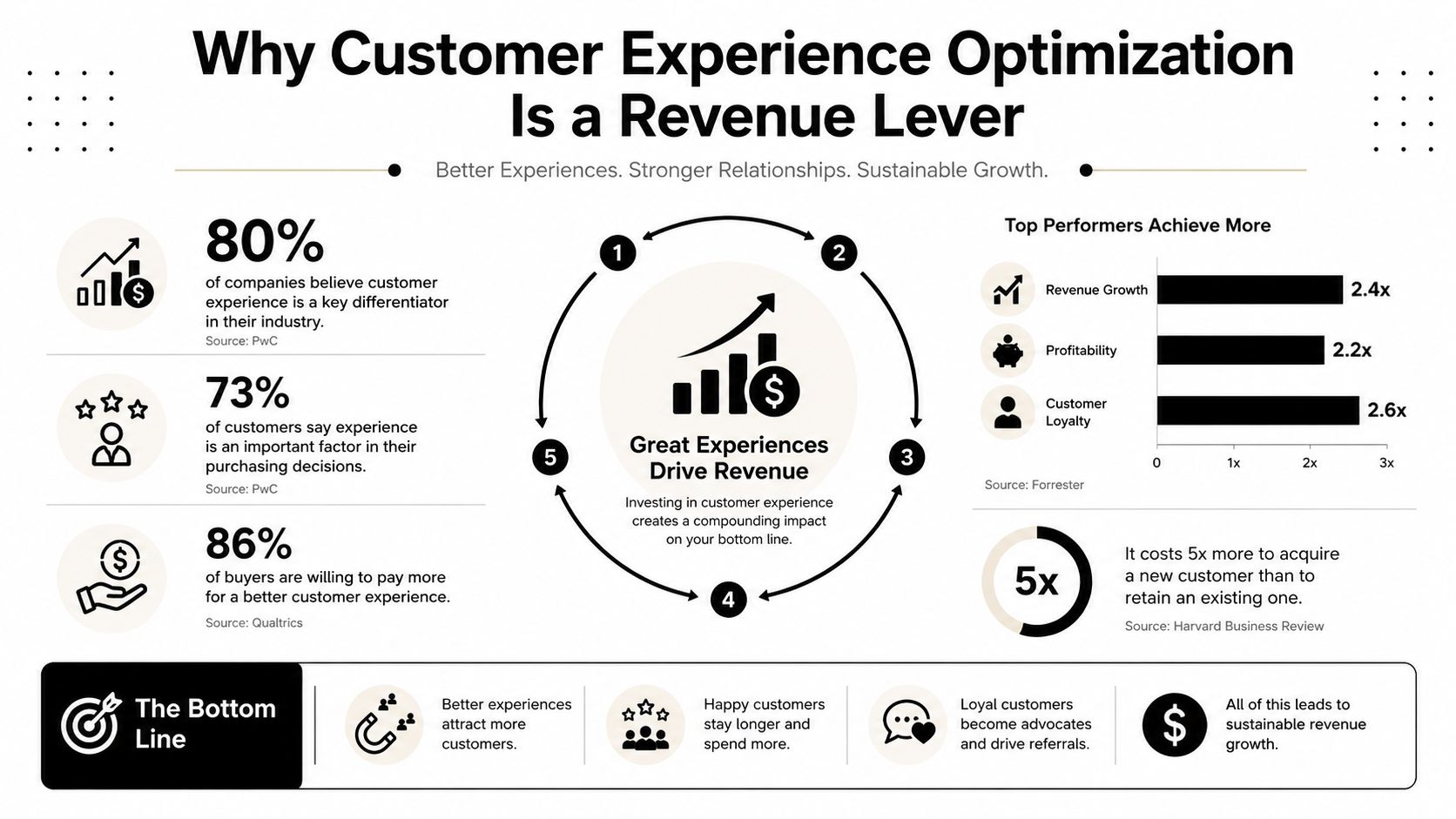
Large-scale CX research has made the commercial case harder to ignore. Companies that focus on CX have reported an 80% increase in revenue, while customer-centric brands have reported 60% higher profits than companies that don't prioritize CX, according to Zendesk's 2026 CX data on customer experience and business outcomes. The same body of data says 73% of customers consider experience the number one factor in purchase decisions, and 80% of leaders planned to increase customer service budgets over the next year. That combination matters because it shows how quickly service has moved from a cost center to a revenue system. Zendesk CX statistics on revenue, profit, and budget plans
What changes when experience becomes the buying trigger
When customers compare vendors, they're often not comparing features in a vacuum. They're comparing responsiveness, confidence, and whether the process feels easy enough to trust. In other words, the brand that responds cleanly and consistently tends to win the first conversation, and often the second one too.
That's why experience quality now sits alongside pricing and product fit in many buying decisions. Independent CX research says the best experiences drive materially better spend and repeat purchase behavior, and customers also expect personalized interactions at a high rate. Wavetec's CX research notes that 71% expect personalization, 76% feel frustrated when they don't get it, 62% want to switch channels without repeating their story, and 47% expect a response within 4 hours. Wavetec customer experience statistics on personalization, channel switching, and response speed
Practical rule: if your team can't answer quickly, consistently, and with context, the customer experience is already costing you conversion.
The operational takeaway is simple. Speed matters, but so does continuity. A fast answer that forces the customer to repeat themselves, explain the issue again, or wait for a handoff is still a broken experience. That's why the strongest CX programs aren't built around one channel or one score. They're built around how the customer moves through the journey.
Choosing the Right Journey to Optimize First
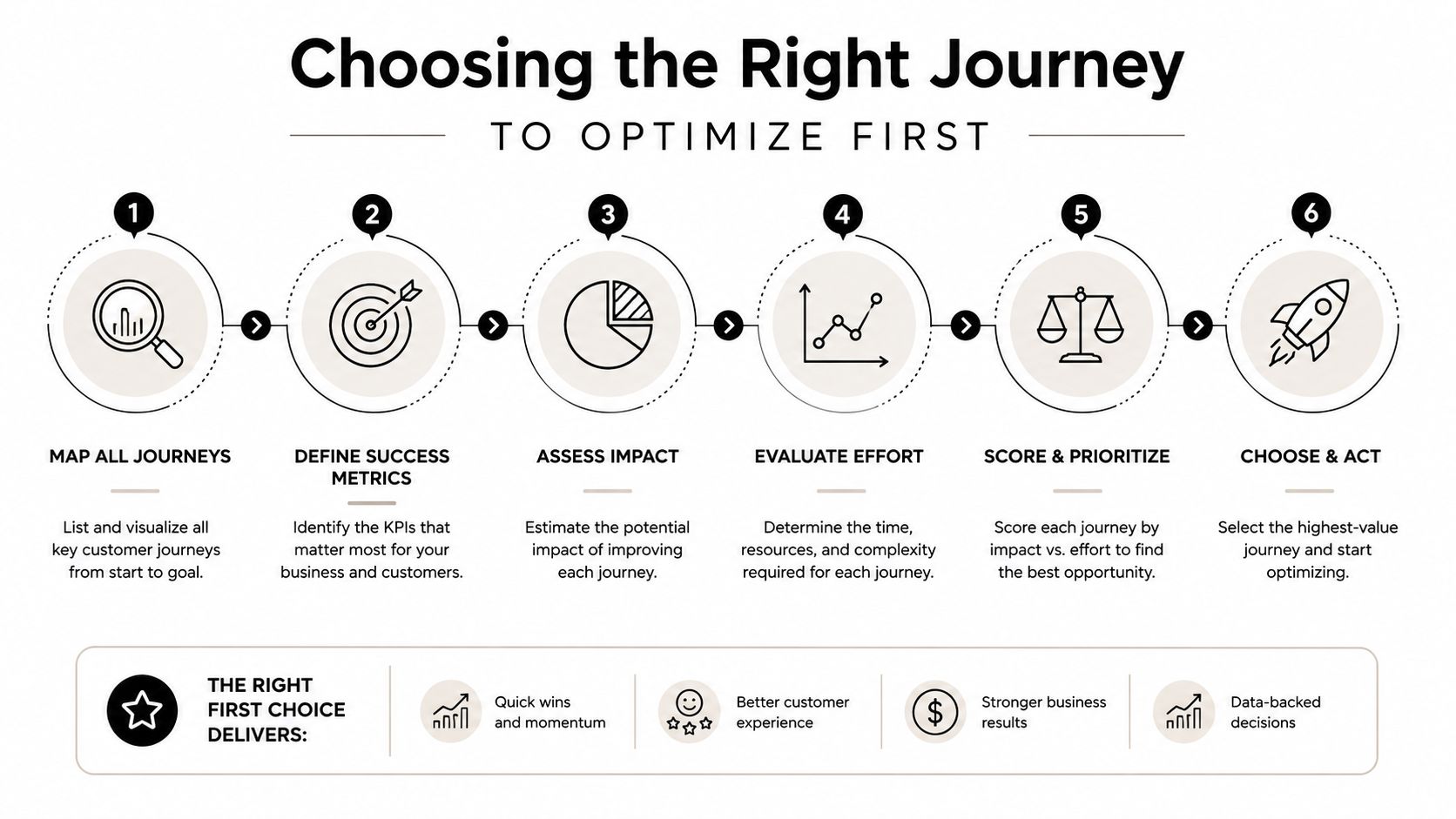
Every team thinks it knows the bottleneck. Sales blames speed to lead. Operations blames sloppy intake. Service blames broken handoffs. If you try to fix all of it at once, nothing moves because the work gets diluted across too many owners and too many touchpoints. The better move is to choose one journey that sits close to revenue, affects enough customers to matter, and can be fixed without a six-month transformation.
McKinsey's journey work is clear that successful CX programs start by identifying the journeys a company must excel in, then redesigning those journeys with cross-functional ownership and continuous improvement. That approach has delivered 15–20% higher sales conversion, 20–50% lower service costs, and 10–20% better customer satisfaction across more than 900 companies. A second McKinsey study reports typical CX transformation gains of 5–10% revenue growth and 15–25% cost reductions. The lesson isn't “optimize everything.” It's “pick the journey with the strongest commercial impact.” McKinsey on successful customer experience transformations
How to score the first journey
Start with a short list of candidate journeys. In most companies, the contenders are inbound lead response, appointment confirmation, onboarding, claims intake, or post-sale follow-up. Then score each journey on three things, in this order.
- Revenue proximity. How directly does this journey affect conversion, retention, expansion, or service cost?
- Customer volume affected. How many customers touch it every week or month?
- Difficulty to fix well. Can the team improve it with existing systems, or does it require a major platform rebuild?
The highest-priority journey is usually the one that touches revenue first and fails often enough to matter. For example, a legal intake workflow that misses call-backs is usually more urgent than a nice-to-have nurture sequence, because the lost cases are gone before anyone can recover them. In home services, appointment confirmation often beats broad brand work because no-show prevention is a direct operational win. In insurance, the highest-value journey is often the first response to a quote request or benefits question, because trust decays fast when the prospect has to chase you.
Pick the journey where the customer is most likely to disappear if you're slow.
A useful shortcut is to ask one blunt question. If this journey works better, does the business get paid faster, keep more customers, or spend less to serve them? If the answer is yes, it belongs near the top of the queue. If the answer is “it would be nice,” it probably doesn't.
For teams looking at digital onboarding or SaaS-style flows, sample user journeys for SaaS teams can help frame how to compare discovery, activation, and follow-up paths without turning prioritization into guesswork.
Common ways teams get this wrong
The first failure mode is the broad program. Teams launch a dozen improvements at once, none of them get owned tightly, and leadership can't tell what moved the metric. The second failure mode is digitizing complexity instead of simplifying it. McKinsey warns against layering automation onto a broken process, because the customer still experiences the same confusion, just at a faster pace. That's why the first journey should be narrow, revenue-linked, and fixable with discipline.
How the journey selection process is often presented in practice
Building a Multi-Metric Measurement Framework
Satisfaction scores can tell you whether people liked the interaction. They can't tell you whether the interaction made the business healthier. That's why a serious CX program needs a measurement model that separates what happens at the touchpoint, what happens across the journey, and what happens to the business.
Practical benchmarking guidance recommends tracking completion rate, time to first action, repeat-contact rate, activation speed, conversion, retention, refund rate, and support cost per customer. It also recommends pairing operational metrics with business metrics for every live experiment, so a touchpoint win doesn't get mistaken for a true journey win. A 10-point NPS gap can be associated with 15–20% suppression of expansion revenue, which makes score movement worth watching, but not in isolation. Practical CX optimization benchmarking and metrics guidance
Separate the three layers of measurement
The cleanest framework I've used in the field is to measure at three levels.
| Measurement Level | Example Metrics | What It Tells You |
|---|---|---|
| Touchpoint | Time to first action, completion rate, repeat-contact rate | Whether the individual interaction is easy enough to finish |
| Journey | Activation speed, conversion, retention | Whether the full customer path is improving |
| Business | Refund rate, support cost per customer, expansion revenue | Whether the change is financially real |
That table matters because a single metric can fool you. A lower handle time can look good until you realize it pushed more customers into callbacks. A higher CSAT score can look impressive until retention stays flat. The job is to make sure every experiment has a touchpoint reading, a journey reading, and a business reading.
What to use in live experiments
For a lead-response workflow, time to first action and conversion matter more than vanity scores. For onboarding, activation speed and repeat-contact rate matter more because they show whether the customer got moving. For service-heavy environments, support cost per customer and refund rate can reveal whether the new flow is easier to run. Each case needs its own pairing, but the principle stays the same, measure the experience and the economics together.
If a metric moves and the customer story doesn't improve, the metric is probably lying to you.
Human validation still matters. Feedback conversations, call reviews, and qualitative review of failed cases tell you whether the improvement reflects real clarity or just a narrow process gain. That's especially important when a team optimizes one screen, one script, or one queue and assumes the whole journey got better.
Deploying AI Voice Agents for Scale and Follow-Up
The fastest way to lose a customer after improving speed is to make the handoff feel fake. An AI voice agent can answer immediately, qualify the caller, book the appointment, or re-engage an old lead, but if the transition to a human is clumsy, the customer remembers the friction more than the automation. The point isn't to replace people. It's to make sure no lead sits idle while the business waits for office hours.
A useful resource on how voice AI assistants work can help teams think through the basic mechanics before they wire it into live workflows. The deeper operational question is what happens after the AI conversation ends. If the system promises a callback, the callback has to happen. If it promises a booking, the calendar has to reflect that booking. CX optimization breaks down when the promise and the delivery path diverge.
Where AI voice agents actually help
AI voice agents are most useful in four places. They can handle instant outbound follow-up after a web form submission, answer inbound calls when no one is available, qualify prospects before a rep gets involved, and reopen old leads that never got a proper second contact. In those workflows, the value comes from consistency and timing, not from sounding clever.
The implementation standard should be simple:
- Use AI for first response. Let the system acknowledge the customer immediately and gather the basic facts.
- Route to humans at the right threshold. Hand off when the issue is complex, emotional, or requires judgment.
- Preserve context. The human should see what the AI collected, not force the customer to repeat it.
- Close the loop. If the system says follow-up will happen, someone owns that follow-up.
That last point matters more than most teams admit. Handoffs fail when the customer gets inconsistent promises across channels, or when the automation finishes its part and the human process never catches up. Independent CX commentary has pointed to sales-to-delivery handoff problems as a recurring issue, and McKinsey's journey research stresses cross-functional redesign rather than isolated automation. The benchmark is whether the organization can reliably do what it said it would do.
Design for transparency, not just efficiency
Customers don't need every interaction to be human. They need it to be clear. If a caller is speaking with an AI voice agent, the experience should feel straightforward, accurate, and easy to escalate. If the handoff happens, it should feel like a continuation of the same conversation, not a reset.
That's where a lot of automation projects fail. Teams automate the front end, ignore the follow-up process, and then wonder why conversion stalls. Voicedial.ai fits into this category as one option for handling outbound and inbound calls 24/7, qualifying prospects, booking appointments, and re-engaging dormant leads, but only if the human follow-up path is designed with equal care. The tool doesn't fix a broken process by itself. The operating model does.
Industry-Specific Applications and Compliance Considerations
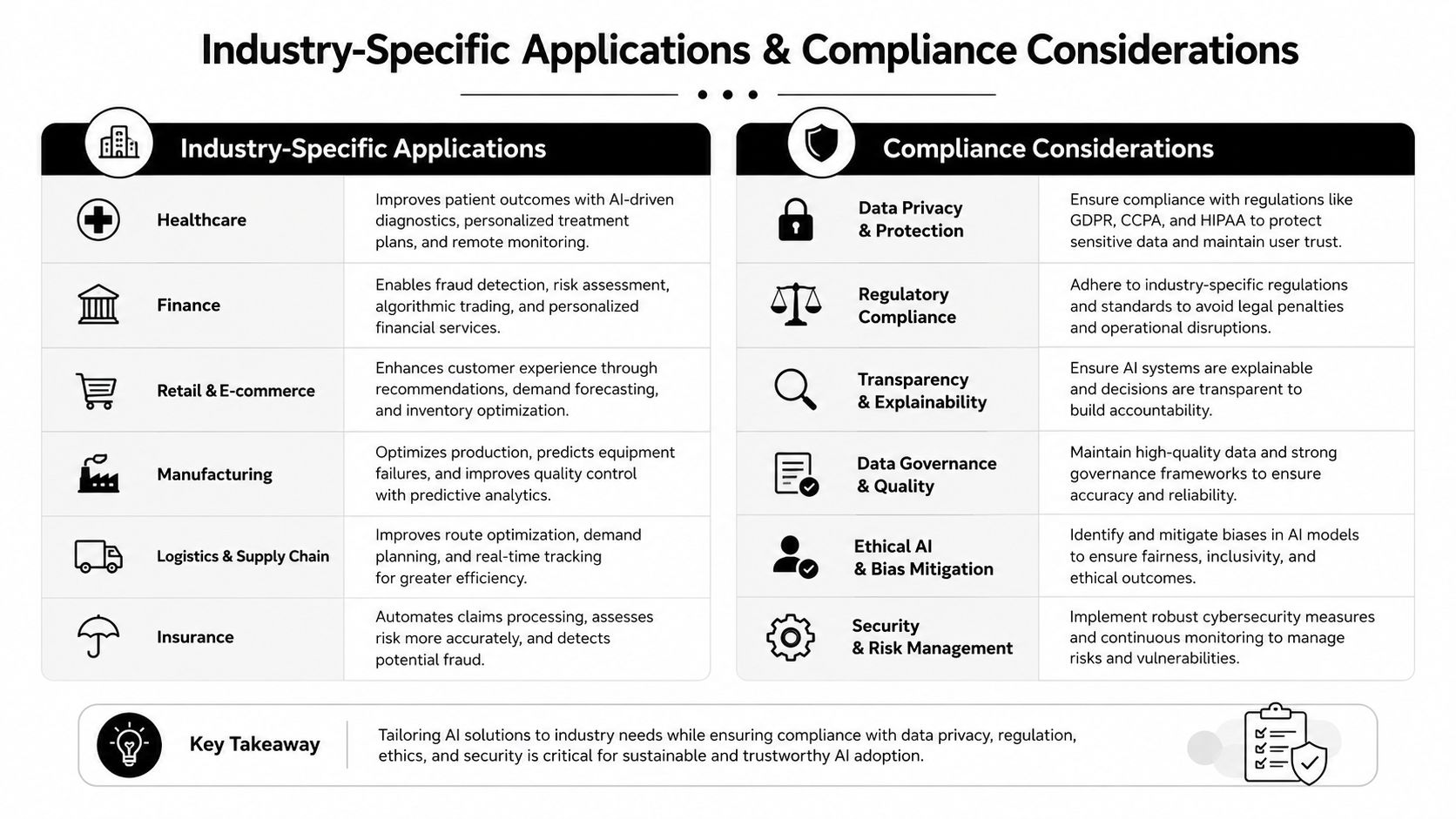
Insurance, home services, medical devices, credit repair, and legal intake all share one trait. The customer usually reaches out with urgency, and the first clean response shapes the entire relationship. In those markets, customer experience optimization isn't about making a homepage prettier. It's about making sure the right person gets the right answer fast, while the business stays consistent and compliant.
In insurance, the highest-value journey is often the first response to a Medicare, ACA, or auto inquiry. If the lead doesn't get contacted quickly and the handoff to an agent is messy, the quote window closes fast. In home services, appointment setting and confirmation matter because no-shows and missed callbacks create obvious revenue drag. In legal intake, a missed follow-up can mean the matter never gets opened. In medical device sales and credit repair, the same pattern shows up around qualification, documentation, and timely outreach.
What changes by industry
Each industry needs a different operating rhythm, but the same measurement logic still applies. Insurance teams should look closely at response speed, booking completion, and whether the lead reached the right licensed person. Home services teams usually care about call answer rates, appointment confirmation, and follow-up reliability. Legal intake teams need clean handoffs, accurate issue capture, and prompt next-step communication. Medical device and credit repair teams have to balance persistence with controlled messaging and strong recordkeeping.
Lead Printer's B2B SaaS outbound leads resource is useful for teams that need to think about outbound volume without losing structure, especially when lead re-engagement has to happen at scale. The principle carries across industries. The workflow has to be repeatable, the message has to be consistent, and the customer must never wonder whether the business lost track of them.
Compliance and consistency are part of the experience
Compliance can't sit outside the CX program, because customers feel it when outreach becomes sloppy or inconsistent. A compliant workflow still needs to be human, clear, and responsive. That means tight script control, clear escalation paths, and a record of what the customer was told. It also means the automation layer can't make promises the human team can't honor.
In practice, the best teams treat compliance as a design constraint, not an afterthought. They build approved script blocks, define what AI voice agents may say, and set rules for when a human must take over. That reduces risk, but it also improves trust because the customer hears the same message no matter who picks up the thread. In regulated environments, consistency isn't just an internal standard. It's part of the customer experience itself.
Testing, Iterating, and Embedding Continuous Improvement
The first optimization rarely holds on its own. Teams fix the front end, the metric improves, and then the process drifts because no one owns the new standard. Continuous improvement is what turns a one-off win into a durable operating habit.
McKinsey's CX transformation work ties this to cross-functional redesign and continuous improvement loops, not one-time launches. The same research warns against digitizing complexity instead of simplifying it. That's the hard truth here. If the old process was confusing, adding automation won't rescue it unless the team has already redesigned the workflow around the customer's actual path.
A practical loop for keeping CX work alive
Start with one live experiment. Define the touchpoint metric, the journey metric, and the business metric before launch, then review them together, not separately. If the touchpoint improved but repeat contact rose, the change needs another pass. If the journey improved but support cost didn't move, the fix may be too narrow. If the business metric improved and customers still describe the experience as messy, the team should keep digging.
Use customer feedback as the final check. Call recordings, short survey comments, and frontline notes will tell you whether the improvement is real or just cosmetic. That's especially important when a process includes automation, because AI can make a bad handoff feel smoother on the surface while the customer still feels ignored underneath.
Continuous improvement works when the team treats every gain as provisional until the customer story matches the metric.
The operating model has to reflect that mindset. Assign a named owner to the journey, keep the measurement cadence regular, and make sure changes get documented so frontline teams don't drift back to old habits. That's how CX work stops being a campaign and starts becoming a system.
If you're ready to stop losing leads at the handoff and want a workflow built around instant follow-up, clear routing, and measurable call outcomes, visit Voicedial.ai. It's a practical fit for teams that need AI voice agents to handle outbound and inbound conversations while keeping the human follow-up path intact.