

Imagine trying to solve an urgent problem, but instead of a frustrating, robotic phone menu, you’re greeted by a helpful, intelligent assistant who gets it right away. That’s the real promise of conversational customer service—it’s a move away from rigid, one-way scripts and toward natural, two-way dialogues powered by smart technology.
What Is Conversational Customer Service, Really?

Think about the difference between a vending machine and a great concierge. A vending machine is completely predictable: you press B4, and you get B4. There's no room for questions or special requests. But a concierge listens. They understand what you’re looking for and give you personalized recommendations. For too long, customer service has felt like that vending machine, forcing people down a narrow path.
Conversational customer service is the concierge model, but built to work at modern scale. It uses technologies like artificial intelligence to have dynamic, context-aware conversations across any channel, whether it's a phone call or a messaging app. The entire point is to make customers feel heard and understood, turning simple problem-solving into genuine relationship-building.
The Shift From Scripts to Dialogue
For decades, customer interactions were trapped inside scripts. While scripts can create consistency, they fall apart the second a customer’s issue doesn’t fit the pre-written answers. This new approach breaks free from that rigid model. Instead of just reacting to keywords, it’s all about understanding a customer’s intent and even their frustration.
This shift isn't just a gimmick; it's a response to how customer expectations have completely changed. People now expect instant, personalized help, 24/7. They’re not willing to wait on hold or explain their problem to three different agents. Conversational AI delivers on this by providing immediate, intelligent help anytime, day or night.
At its heart, conversational customer service is about making technology feel more human. It’s not about replacing people but about augmenting their abilities and handling routine interactions so they can focus on more complex, high-value conversations.
Key Characteristics of This Approach
To really get what makes this model work, you have to look at its core components. These are the elements that separate a truly conversational experience from a basic chatbot.
- Personalization: The system remembers your history. It uses past interactions and customer data to give relevant, tailored support.
- Context-Awareness: It follows the flow of the conversation, so you never have to repeat yourself. It just knows.
- Omnichannel Consistency: The experience feels the same whether a customer calls, visits your website, or uses a messaging app.
- Proactive Engagement: Instead of just waiting for something to go wrong, it can reach out to offer help or useful information.
The financial upside here is massive. Projections show that conversational AI is on track to cut call center agent labor costs by a staggering $80 billion globally by 2026. Those savings come from automating all the routine, repetitive interactions, which frees up businesses to handle more inquiries without constantly hiring. As a result, executives are seeing huge boosts in agent productivity and much faster issue resolution. You can explore more about how AI will impact customer service and its cost-saving potential.
For businesses like insurance agencies or home service companies, this isn’t just an improvement—it’s a total game-changer. Platforms like Voicedial.ai use incredibly human-like AI voice agents to deliver this elite level of service at scale, managing conversations with remarkable precision, all without the need for a massive call center.
The Real-World ROI of Conversational AI
Let's cut through the hype. Adopting conversational AI isn't just a tech upgrade; it's a core business strategy with a very clear return on investment. The real impact goes way beyond answering questions a little faster. We’re talking about a fundamental shift in how you find, engage, and keep customers.
This shift is built on three pillars: slashing operational costs, driving up sales, and creating a customer experience people remember. By automating the right conversations, companies are unlocking value that was previously trapped in manual, repetitive work. This isn't about replacing people—it’s about making them exponentially more effective.
Pillar 1: Slashing Operational Costs
The most immediate and obvious win from conversational customer service is the dramatic drop in operational costs. Just think about all the time your team burns on low-value, repetitive tasks. Answering the same five questions, qualifying lukewarm leads, scheduling appointments—every single one of those interactions has a price tag in time and money.
Conversational AI handles these jobs with perfect consistency, 24/7, without needing a single coffee break.
- Task Automation: It takes over routine inquiries, freeing your skilled human agents to focus on the complex, high-stakes activities that actually generate revenue. An insurance agent, for example, can spend their day closing policies instead of chasing down leads just to book a meeting.
- Smart Scalability: You can handle thousands of conversations at once without having to build a massive call center. This lets you scale your outreach and support at a fraction of what it would cost to do it the old-fashioned way.
This shift allows a small team to perform like a much larger enterprise. Imagine an AI agent booking over 50 qualified meetings for an insurance broker overnight—a task that would require a dedicated team and a hefty payroll. That's the kind of operational leverage we're talking about.
Pillar 2: Skyrocketing Sales and Revenue
Beyond just saving money, conversational AI is a powerful engine for bringing in new revenue. Speed and persistence are everything in sales, and this is where AI truly shines. It makes sure no lead is ever left behind and that every single opportunity gets pursued relentlessly.
For instance, a home services company might be sitting on a list of hundreds of old, unclosed quotes. Manually calling each one is a huge time-sink with a pretty low success rate. An AI voice agent, on the other hand, can dial that entire list in a single afternoon, pinpoint anyone who's still interested, and book jobs automatically. It turns a "dead" list into a fresh source of paying customers.
That kind of instant, persistent follow-up ensures you’re the first one to respond when a new lead comes in, which dramatically increases your odds of winning their business.
Pillar 3: Elevating the Customer Experience
Finally, and maybe most importantly, conversational AI helps you create a customer experience that builds genuine loyalty. In a world of endless choices, a fast, helpful, and consistent interaction can be the one thing that makes a customer choose you over a competitor. This technology delivers immediate, accurate answers anytime, wiping out the frustration of waiting on hold or getting lost in confusing phone menus.
This isn't just a nice-to-have; it's what customers now expect. The bar for conversational AI is getting higher, with 73% of people anticipating that AI interactions will improve service quality and 75% believing it can deliver help on par with a human. Why the shift? Because people value speed; 51% prefer bots for getting immediate answers. Better yet, proactive AI support that anticipates needs before they become problems boosts satisfaction for 72% of users. You can explore more about conversational AI trends and customer expectations to see where the industry is moving.
By providing this level of responsive and intelligent service, you’re not just solving a problem—you’re creating a positive memory that keeps customers coming back. This is how conversational customer service becomes a real competitive advantage, turning routine interactions into opportunities to build lasting loyalty.
To really see the difference, it helps to put the old and new models side-by-side. The table below breaks down how a conversational, AI-powered approach stacks up against the traditional, human-only model.
Comparing Traditional vs. Conversational Service Models
| Metric | Traditional Customer Service | Conversational Customer Service (with AI) |
|---|---|---|
| Cost Per Interaction | High (fully loaded agent cost) | Low (fraction of human agent cost) |
| Availability | Limited to business hours | 24/7/365 |
| Response Time | Minutes to hours | Instant (seconds) |
| Scalability | Linear (hire more people) | Exponential (handles thousands of calls at once) |
| Consistency | Varies by agent and time of day | 100% consistent with every interaction |
| Data Capture | Manual and often inconsistent | Automated, structured, and instantly logged |
| Customer Effort | High (wait times, navigation) | Low (immediate, direct answers) |
The contrast is pretty stark. While the human touch is irreplaceable for complex issues, AI handles the high-volume, repetitive tasks with a level of efficiency and consistency that's simply not possible for a purely human team. This hybrid approach is where the real power lies.
Choosing Your Toolkit: Voice AI vs. Chatbots
Picking the right conversational tools is a lot like deciding whether to send a quick text or make an important phone call. Both get the message across, but they’re built for entirely different situations. Your two main options are text-based chatbots and advanced voice AI, and knowing where each one shines is the key to building a system that actually works.
Chatbots are your digital front desk. They’re fantastic for handling a high volume of simple, predictable tasks right on your website or in a messaging app. Their real strength lies in gathering information quietly and answering straightforward questions from a script or knowledge base. They’re perfect for interactions that don't need emotional nuance or any real persuasion.
But that text-only format has its limits. It's tough to build genuine rapport or navigate a high-stakes conversation through a chat window. That’s where AI voice agents come in.
When to Use Text-Based Chatbots
Chatbots are the workhorses for simple, transactional conversations. They excel when a customer has a clear goal and the path to get there is straightforward.
Think about using a chatbot for things like:
- Answering FAQs: Giving instant answers to common questions like, "What are your hours?" or "Where are you located?"
- Basic Data Collection: Grabbing the initial info for a support ticket or a quote, like a name, email, and a quick summary of the issue.
- Website Navigation: Acting like an interactive search bar, guiding users to the right page or resource on your website.
A good chatbot can handle these tasks efficiently, keeping the simple stuff away from your human team and offering 24/7 availability for basic support. They're a solid starting point for almost any conversational strategy.
Think of a chatbot as your first line of defense. It filters and manages the routine traffic, making sure only the more complex and valuable conversations get escalated to a more capable resource—whether that’s a person or a powerful voice AI.
When to Deploy Human-Like Voice AI
Voice AI, especially a human-like agent from a platform like Voicedial.ai, is your power tool. It’s designed for conversations where tone, personality, and the ability to persuade are what make or break the outcome. The human voice carries a ton of nuance that text just can’t replicate, making it the clear winner for high-value interactions.
AI voice agents are a perfect fit for:
- Serious Sales Lead Qualification: An AI can call a new lead within seconds of them showing interest, ask qualifying questions with a natural and engaging tone, and figure out if they’re a good fit.
- Firm Appointment Setting: This is more than just sending a scheduling link. A voice agent can proactively call prospects, navigate their schedule, handle objections, and send confirmations, which dramatically boosts show-up rates.
- Building Rapport and Re-engagement: The warmth of a human-like voice is ideal for warming up old leads or following up on past quotes, turning a cold list into a hot pipeline.
This flowchart helps visualize the strategic choice between a traditional, high-effort model and a more efficient approach using conversational AI.
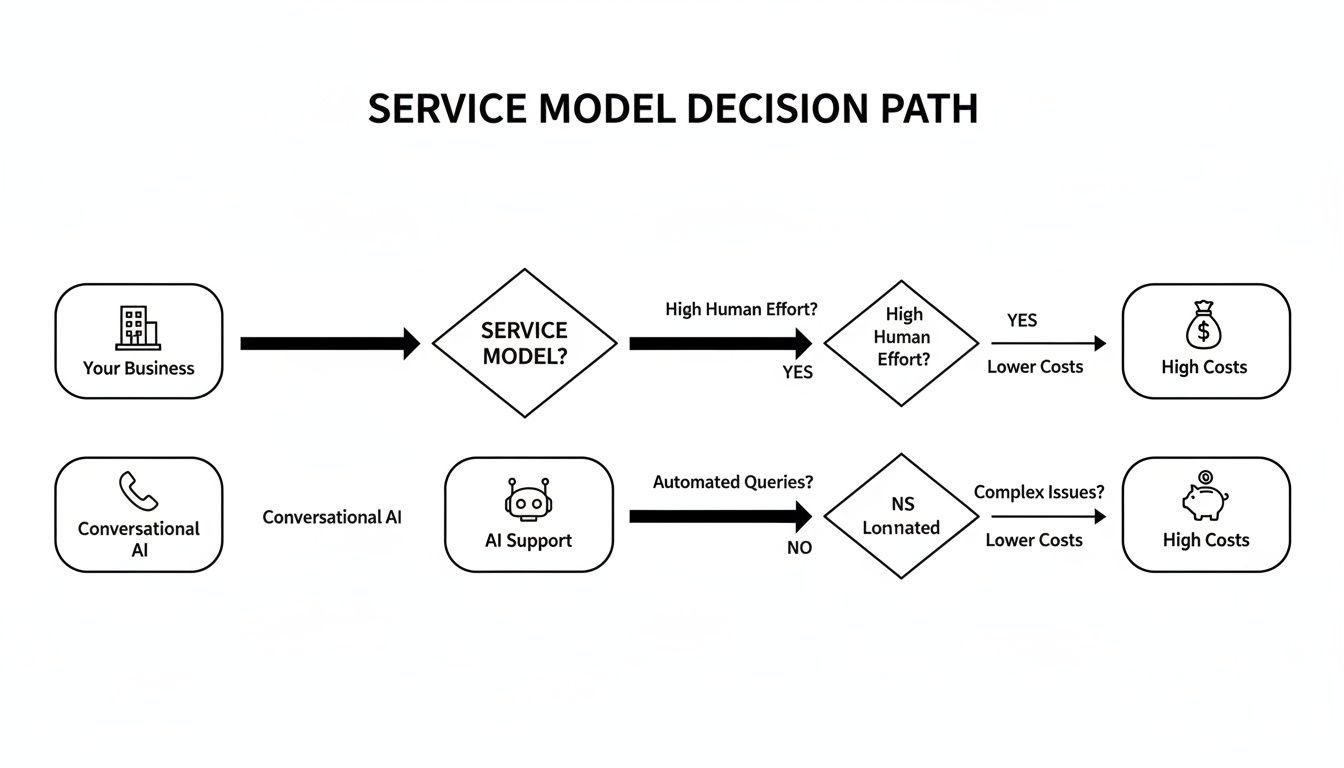
As you can see, leaning into conversational AI creates a much more cost-effective service model than sticking with purely traditional methods.
The Powerful Hybrid Approach
Often, the smartest strategy isn't about choosing one tool over the other—it's about making them work together. A hybrid model creates a seamless customer journey that gives you the best of both worlds.
Here’s how that might look:
- Initiation: A prospect fills out a form on your site. A chatbot instantly pops up to confirm their details and answer any quick, initial questions.
- Escalation: The moment the chatbot identifies the lead as qualified, it triggers the AI voice agent.
- Conversion: The voice AI immediately calls the prospect, builds a personal connection, and books a firm appointment, moving them straight down the funnel.
This hybrid approach gives you instant engagement, efficient qualification, and a powerful, personal touch right when it counts the most. It’s a perfect example of how a well-designed conversational system can automate the entire journey from a new lead to a booked appointment.
Putting Conversational AI to Work—Without the Headaches

The idea of launching an AI in your business probably sounds complicated, maybe even a little intimidating. But it doesn't have to be. Getting a powerful conversational AI up and running is far more about having clear goals than it is about technical wizardry. Modern platforms are built for business owners, not engineers, making the whole thing surprisingly straightforward.
This isn’t some year-long IT project that requires a team of developers. Think of it more like a guided, multi-week process focused entirely on solving a business problem. By breaking it down into a few manageable stages, you can go from a simple idea to a fully functioning AI agent that’s already making an impact.
Let's walk through the simple, jargon-free roadmap to get you there.
Stage 1: Start With a Single, Clear Goal
Before you do anything else, you have to decide exactly what you want your AI to accomplish. A vague goal like "improve customer service" is a recipe for a stalled project. The most successful launches start by targeting one specific, high-impact business problem. This sharp focus makes every other decision easier and ensures you see a real return, fast.
Start by looking for the biggest bottleneck in your sales or service process. Where are you bleeding the most time or money?
- For an insurance agency: The goal might be to book more qualified appointments with Medicare prospects.
- For a home services company: It could be to re-engage old quote lists and fill empty slots in the schedule.
- For a credit repair firm: The focus might be on automating initial client intake to qualify new leads faster.
Choosing one critical objective gives you a clear target. It drives the entire strategy—from the scripts you build to the metrics you track—and makes sure your first step into AI delivers tangible results.
Stage 2: Craft Your AI's Voice and Scripts
Once the goal is set, it's time to figure out what your AI agent will actually say. This is where you translate your brand's personality into a conversation. The aim isn't to create a robot that just reads a script, but to design a natural, engaging dialogue that guides a customer toward the finish line.
The best scripts feel less like a sales pitch and more like a genuinely helpful conversation.
Think of it like training a new team member. You wouldn't just hand them a manual; you'd teach them how to talk to your customers, handle common questions, and represent your company's values. The process is exactly the same for your AI agent.
Platforms like Voicedial.ai specialize in this. We work with you to build scripts that are already proven to work in your industry, focusing on a human-like flow that builds rapport and gathers information without ever sounding forced. This collaborative script-building stage is what makes or breaks a great conversational experience.
Stage 3: Integrate With Your Existing Systems
An AI agent is only as powerful as the tools it works with. The third stage is connecting your new conversational tool to your Customer Relationship Management (CRM) system. This simple integration is what turns conversations into actionable data.
This step ensures that every interaction is automatically logged, tracked, and updated. For example, when your AI voice agent books a meeting, that event should instantly pop up in your CRM and on your team’s calendar. No more manual data entry. No more leads falling through the cracks. It gives you a single source of truth for every customer interaction and keeps your entire workflow humming along.
Stage 4: Launch, Monitor, and Optimize
The final stage is bringing your AI agent to life. But the launch isn't the end of the road—it's the beginning of the optimization cycle. With a modern platform, you can monitor performance in real-time through a simple dashboard, giving you immediate insight into what's working and what isn't.
You’ll track Key Performance Indicators (KPIs) that tie directly back to your initial goal. These might include:
- Answer Rate: How many calls are actually being picked up?
- Appointment Booked Rate: What percentage of conversations result in a scheduled meeting?
- Lead Qualification Rate: How many prospects are meeting your core criteria?
This data allows you to make small tweaks to your scripts or call timing to continuously improve results. It’s a "launch and learn" approach that ensures your conversational AI strategy evolves and gets better over time, maximizing your return.
Conversational Service in Action Across Industries
Theory is great, but the real test for any business strategy is how it holds up in the real world. Conversational customer service isn't just an idea floating around in boardrooms; it's a practical tool that solves expensive, frustrating problems for businesses every single day. The impact becomes obvious when you see it applied to specific industry challenges.
From re-engaging old leads to making sure every new prospect gets an immediate follow-up, AI-powered voice conversations are turning dormant data into a reliable source of revenue. The following examples show how a human-like AI voice agent can tackle a distinct business pain point and deliver tangible growth.
Insurance Agencies Supercharging Lead Follow-Up
For insurance agents, especially in competitive markets like Medicare, speed-to-lead is everything. When a new lead isn't contacted within five minutes, the chance of converting them plummets. But manually calling every single person that quickly is next to impossible for a busy agency.
- The Problem: A steady stream of new leads comes in at all hours, but the sales team can only make calls during business hours. This means leads that arrive overnight or on weekends go cold. Agents end up spending more time chasing than selling.
- The Solution: An AI voice agent is set up to call every new lead the moment it hits the CRM. It works 24/7, engaging prospects with a natural, friendly voice to qualify their interest and book consultations directly on a licensed agent's calendar.
- The Result: The agency stops bleeding valuable leads to delays. Agents walk into the office to find their calendars already packed with qualified, high-intent appointments. They can focus entirely on closing policies instead of cold dialing.
This simple change transforms the entire sales pipeline, making sure no opportunity is ever missed.
By using an AI voice agent for initial outreach, one insurance agency booked over 50 qualified meetings in a single evening from a fresh lead list. That's a scale that is simply out of reach with a purely manual approach.
Home Services Filling the Schedule Automatically
Home service companies—from roofers to HVAC technicians—are often sitting on a goldmine of old, unclosed quotes. Manually calling hundreds of past prospects is a low-priority, time-consuming task that rarely gets done. The thing is, many of those homeowners are still in the market for the service they asked about months ago.
- The Problem: The sales team is laser-focused on new, incoming leads, while a massive list of past quotes gathers dust. This represents thousands of dollars in potential revenue just sitting there, completely untapped.
- The Solution: A conversational AI agent from a platform like Voicedial.ai gets to work, calling the entire list of old quotes. It uses a carefully crafted script to see if the homeowner is still interested, answer basic questions, and schedule an appointment for a new estimate.
- The Result: Suddenly, the company's schedule starts filling up with jobs from a list that was previously considered dead. The AI agent efficiently sifts through hundreds of contacts, finds the handful who are ready to buy now, and books them automatically. It creates a new revenue stream with zero extra work for the sales team.
Credit Repair Building Trust Through Consistency
In the credit repair industry, building trust and maintaining consistent communication is everything. The follow-up process, however, can be repetitive and time-consuming. On top of that, clients often feel hesitant or judged when talking about their financial situation. This makes it a perfect use case for conversational customer service delivered by a non-judgmental AI.
- The Problem: Manually following up with dozens of clients for document collection and updates is a huge drain on staff time. Plus, the sensitive nature of the topic can make constant human outreach feel intrusive or uncomfortable.
- The Solution: An AI voice agent takes over all routine follow-up calls. It provides gentle reminders, confirms when documents are received, and gives status updates with a consistently patient and professional tone, which builds a real sense of reliability.
- The Result: The credit repair firm dramatically boosts its operational efficiency, freeing up specialists to work on complex cases. Clients appreciate the regular, non-judgmental check-ins, which improves their experience and helps them stay on track. This consistent touchpoint strengthens the client relationship without adding any manual workload.
How Voicedial.ai Delivers Human-Like Conversations at Scale

Understanding the theory is one thing. Seeing it actually work and drive results is something else entirely. This is where Voicedial.ai bridges the gap, turning powerful concepts into a practical tool that makes human-like conversations a scalable reality for any business.
It’s built from the ground up to solve the core challenges of modern outreach: cost, consistency, and speed. We’ve moved far beyond the robotic voice that customers immediately hang up on. Voicedial.ai uses advanced voice technology to create natural-sounding conversations with realistic tones, inflections, and pauses.
That human touch is what builds rapport, and it’s critical for high-value interactions like qualifying leads or setting firm appointments.
The Engine Built for Growth
At its core, Voicedial.ai is an engine designed for relentless efficiency. The system operates 24/7, making sure no lead ever goes cold. When a prospect shows interest at 10 PM on a Saturday, an AI voice agent can follow up instantly—something that’s just not possible for a human-only team.
This instant response is a massive driver of conversions. We all know that contacting a lead within the first five minutes can dramatically increase your chances of success. Our platform doesn't just make calls; it makes smart, timely connections when they matter most.
Voicedial.ai acts as the perfect partner for businesses ready to scale conversations, reduce overhead, and convert more leads—all without the expense and management of hiring more people. It’s an investment in efficiency that pays for itself through performance.
Visibility and Control Over Your Pipeline
A great conversational strategy needs more than just good calls; it needs clear, actionable data. Voicedial.ai gives you a real-time ROI dashboard that offers complete transparency into every single campaign. You can monitor key metrics and know exactly how your outreach is performing at any moment.
You can easily track the numbers that matter:
- Answer Rates: See exactly how many calls are connecting.
- Lead Status: Know precisely how many leads were qualified, not interested, or asked for a callback.
- Appointments Booked: Measure the most important outcome for your sales team.
This data-driven approach allows for constant optimization. By seeing what’s working and what isn’t, you can tweak your customizable scripts and calling strategies to improve results over time. It’s how you ensure your investment delivers measurable growth.
Got Questions? We’ve Got Answers.
Stepping into the world of conversational AI can bring up a few practical questions. It's a shift, for sure. Let's tackle some of the most common things business owners ask when they’re thinking about bringing an AI voice agent on board.
Will an AI Voice Agent Sound Like a Robot?
That's a fair question, especially if you're thinking of those old-school, clunky robocalls. But today's AI voice technology is a completely different ballgame. Platforms like Voicedial.ai use incredibly advanced AI to build voices with natural tones, human-like pauses, and realistic inflections. They sound surprisingly smooth.
The point isn't to trick anyone. It’s all about creating a pleasant and super-efficient experience for those routine tasks, like scheduling a demo or handling that initial qualification call. Honestly, most customers just appreciate the speed and the fact they can get an answer 24/7.
How Much Technical Skill Do I Actually Need to Set This Up?
Way less than you'd imagine. Modern conversational AI platforms are built for business owners and sales managers, not a team of engineers. The whole process is typically managed for you. You focus on the goals and help shape the script, while the provider handles all the heavy lifting on the back end.
Most businesses can be up and running in just a few weeks. You'll track everything on a simple dashboard without ever needing to write a single line of code. It’s designed to be a straightforward, guided process from start to finish.
Is This Really Affordable for a Small Business?
Absolutely. What was once technology reserved for massive enterprises is now accessible and genuinely cost-effective for small and medium-sized businesses. The cost for each interaction is incredibly low, which allows companies in competitive spaces—like home services, insurance, or solar—to scale up their outreach in a big way.
This kind of model lets you hit an appointment-setting volume that was previously only possible with a huge, expensive call center. It’s a powerful tool for leveling the playing field and driving real growth.
Ready to see how human-like conversations can completely change your sales pipeline? With Voicedial.ai, you can deploy a tireless AI agent that works around the clock to qualify leads and book solid meetings.
Schedule your free demo today to see it in action.
Powered by Outrank