

At its core, business call recording is the simple act of capturing and storing phone conversations between your company and your customers. But thinking of it as just a recording tool is like thinking of a smartphone as just a device for making calls. It's so much more.
Today, call recording is a powerful source of business intelligence, helping teams sharpen their sales tactics, elevate customer service, and streamline operations by analyzing what's actually being said in the real world.
Why Business Call Recording Is a Strategic Asset
Imagine every single customer phone call as a mini focus group. Each conversation is packed with raw, unfiltered feedback about your products, your sales process, and the quality of your customer service. Without a system to capture these interactions, all that incredibly valuable data just vanishes the second the call ends.
Modern business call recording platforms turn these fleeting moments into a permanent, searchable library of business intelligence. This is the single source of truth for your most important conversations.

This isn't about clunky hardware or dusty tapes anymore. Today’s solutions are cloud-based, completely automated, and deeply woven into the tools your team already uses every day. Think of it as a flight data recorder for your customer journey, capturing every detail so you can understand what went right, what went wrong, and—most importantly—why.
Unlocking Business Intelligence from Conversations
By recording calls, you get a clear, unbiased look at how your business actually operates. This lets you move beyond assumptions and hunches, allowing you to make critical decisions based on what customers are really saying.
Here are just a few of the immediate benefits:
- Improved Sales Performance: You can analyze the calls of your top performers to pinpoint the exact phrases and objection-handling techniques that close deals. This data is gold for building a repeatable sales process that new hires can master in a fraction of the time.
- Enhanced Customer Service: Quickly identify common customer pain points and knowledge gaps in your support team. Recordings are an invaluable coaching tool for training agents on empathy, accuracy, and effective problem-solving.
- Airtight Compliance and Dispute Resolution: For regulated industries like insurance, legal intake, or medical devices, recordings offer indisputable proof of consent and verbal agreements. A clear recording can resolve a messy "he said, she said" dispute in minutes.
The market’s explosive growth reflects this incredible value. The global call recording segment within the Contact Center as a Service (CCaaS) market hit USD 369.5 million in revenue, largely driven by industries that absolutely depend on compliant and verifiable call handling. Projections show this market soaring to USD 1,017.4 million by 2030. You can explore more data on the call recording market to see its growth trajectory for yourself.
To put these functions into perspective, let's break down the core roles that a modern call recording system plays in any business.
Key Functions of Modern Call Recording Systems
| Function Area | Primary Goal | Key Business Impact |
|---|---|---|
| Quality Assurance | Monitor and improve agent performance. | Higher customer satisfaction and first-call resolution rates. |
| Sales Coaching | Identify and replicate winning sales tactics. | Shorter sales cycles and increased revenue per agent. |
| Compliance & Risk | Ensure adherence to legal and industry regulations. | Reduced legal exposure and lower risk of fines. |
| Dispute Resolution | Provide a verifiable record of conversations. | Faster, fact-based resolution of customer disagreements. |
| Business Insights | Extract customer sentiment and market trends. | Data-driven decisions for product and service improvements. |
As you can see, the technology moves far beyond simple recording and becomes a central hub for operational intelligence.
A Tool for Every Industry
The applications for business call recording are incredibly broad and impactful. A home services company can perfect its appointment-setting script by reviewing how dispatchers handle inbound calls. An insurance brokerage can easily verify that agents followed all disclosure protocols, protecting the firm from costly legal challenges.
In essence, call recording is the single source of truth for your most important interactions. It provides the clarity needed to optimize scripts, train teams, and protect your business.
Ultimately, adopting this technology is a deeply strategic move. It gives your organization the ability to listen at scale, transforming everyday conversations into a core asset for growth, quality control, and risk management.
Getting Call Recording Laws and Compliance Right
Jumping into business call recording without getting a handle on the legal side of things is a massive risk. These laws are all about protecting privacy, and messing up can bring some serious heat in the form of fines and penalties. When you boil it all down, the entire legal framework hangs on one simple idea: consent.
The biggest distinction you need to understand is the difference between one-party and two-party consent, which changes from state to state.
Think of it this way: you're taking a group photo. In some places, as long as you're in the picture (that's one-party consent), you can snap away without asking everyone. In other places, you need to get a clear "yes!" from every single person in the frame before you even think about pressing the shutter (that's two-party consent).
Getting this rule wrong can land your business in hot water, especially when your calls cross state lines.
One-Party vs. Two-Party Consent States
Most of the U.S. follows one-party consent rules. In these states, you can legally record a call as long as just one person on the line knows about it and agrees. Since you're the one hitting the record button, your consent is usually enough.
- One-Party Consent States Include: The majority of states—38 of them, plus the District of Columbia—fall into this camp. Think of places like New York, Texas, Ohio, and Arizona.
On the flip side, two-party consent states (also called "all-party consent") demand that every single person on the call is told they're being recorded and agrees to it. This is the highest standard and, honestly, the safest approach to take no matter where you do business.
- Two-Party Consent States Include: A smaller but important group of 11 states have this rule, including major markets like California, Florida, Pennsylvania, and Illinois.
The smartest, simplest compliance strategy? Just act like you're always in a two-party consent state. Tell everyone on every call that they're being recorded. It cuts through the confusion and keeps you protected, no matter where your customers are.
And what happens when a call connects someone in a one-party state with someone in a two-party state? The stricter law almost always wins. So, getting consent from everyone is the only surefire way to stay compliant.
Key Regulations Beyond State Laws
It doesn't stop at state lines. Several big-league federal and international regulations have strict rules about how customer data—including your call recordings—gets handled. These rules often target specific industries or geographies, adding another layer of complexity you need to navigate.
General Data Protection Regulation (GDPR)
If you do business with anyone in the European Union, GDPR is your reality. It considers a recorded voice personal data, which means you need a solid legal reason—like getting explicit consent—to record and store it.
Health Insurance Portability and Accountability Act (HIPAA)
For any company that touches protected health information (PHI), HIPAA is non-negotiable. This applies to medical device companies, insurance brokers, and many others. Any call recordings with patient details have to be encrypted, stored securely, and only accessed by people who absolutely need to, all to prevent data breaches.
Payment Card Industry Data Security Standard (PCI DSS)
Does your team take credit card payments over the phone? Then you have to follow PCI DSS. This standard usually means you need to stop recording when someone is reading off their card number, or use technology that automatically scrubs that sensitive info from both the audio and the transcript.
Ignoring these standards can lead to eye-watering fines and a damaged reputation. The best game plan is to build your recording policies around the toughest rules that apply to you. This way, you’re covered everywhere. Being proactive about compliance isn't just about dodging penalties—it's about earning and keeping your customers' trust.
Understanding How Call Recording Technology Works
To really get a handle on modern business call recording, stop thinking of it as a simple tape recorder. It's much more like building an intelligent, searchable library of every single conversation your company has. Each call becomes a new "book" on the shelf, packed with insights just waiting to be discovered.
So, how does the technology actually grab a spoken conversation and transform it into something your business can use? The whole process rests on four key pillars. It starts with getting the book onto the shelf and ends with a smart librarian who can find hidden connections within its pages.
Call Capture: The Digital Scribe
The first step is Call Capture. This is the technical part—intercepting and recording the audio from a phone call. Back in the day, this meant clunky, on-premise hardware physically wired into phone lines. It was expensive, a pain to scale, and a total nightmare to maintain.
Thankfully, today's best systems are cloud-based. When a call is made or received through a VoIP (Voice over Internet Protocol) system, the audio is captured right in the cloud. This approach is way more flexible and secure, letting you record calls from anywhere, on any device, without needing a server room. It’s like having every new book instantly delivered to your library’s front door.
Secure Storage: The Protected Vault
Once a call is captured, you have to store it safely. This is the Secure Storage pillar, which is like your library's protected, climate-controlled vault. Recordings are often loaded with sensitive information—from customer credit card numbers to protected health information—so rock-solid security is non-negotiable.
Cloud-based storage really shines here. Top providers use robust encryption for the data both while it's being recorded (in transit) and after it's stored (at rest). This scrambles the audio files, making them completely unreadable to anyone without authorization. Plus, cloud platforms offer redundant backups and sophisticated access controls, protecting your data from cyber threats and accidental loss far better than any local server could.
Transcription: Turning Audio into Text
A library full of audio files isn't much help if you can't find what you need quickly. This is where Transcription comes in. Think of it as the cataloger who converts every spoken word from your "books" into searchable digital text.
Using advanced speech-to-text algorithms, the system automatically transcribes the entire conversation. This creates a written record you can instantly search for specific keywords, phrases, or topics. Need to find every call where a customer mentioned a competitor? A simple text search does the trick, turning hours of manual listening into a job that takes just seconds.
This map highlights the critical difference between one-party and two-party consent laws—a key legal detail you absolutely must get right.
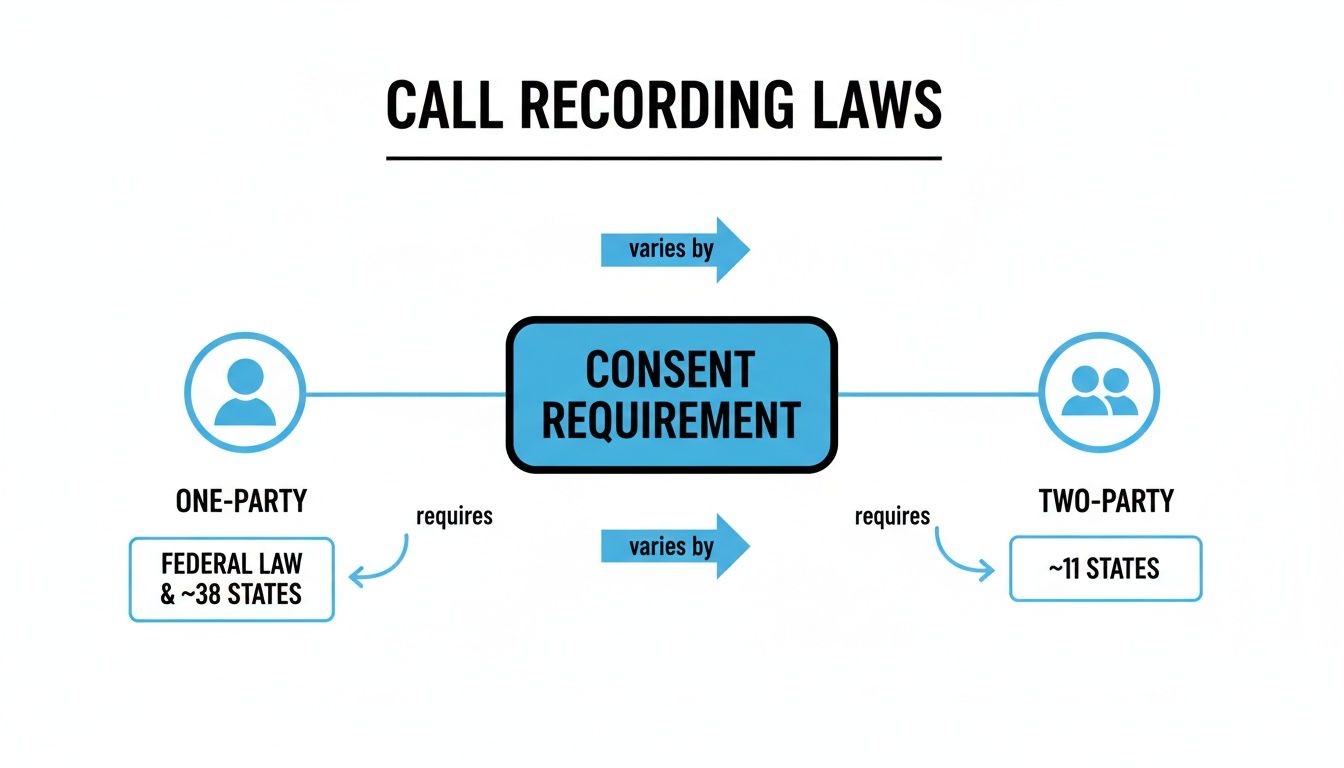
As you can see, while most states are fine with one person knowing about the recording, a dozen key states require everyone on the line to agree. This is why a universal disclosure policy is always the safest bet.
AI Analysis: The Intelligent Librarian
The final and most powerful pillar is AI Analysis. If transcription is the cataloger, AI is the brilliant librarian who has read every book and understands its context, sentiment, and major themes. This is the step that turns a simple recording into a source of deep business intelligence.
AI doesn't just hear words; it understands intent. It can detect customer sentiment (frustration vs. satisfaction), identify trends in customer complaints, and even flag calls for quality assurance review based on predefined criteria.
AI-powered analytics can summarize calls, highlight key moments, and track whether agents are sticking to their scripts. This transforms your call library from a passive archive into an active, intelligent system that proactively helps you improve sales, sharpen your service, and lock down compliance.
Real-World Business Call Recording Applications
Knowing the legal and technical ins and outs of call recording is one thing, but seeing it in action is where the real value clicks. Theory is great, but the technology truly comes alive when you see how it solves tangible, everyday business problems. It’s the difference between knowing how a car engine works and actually driving it to get where you need to go.
Let's move past the abstract and look at exactly how this tool delivers concrete results. From settling customer disputes with absolute certainty to refining a sales pitch that just isn't landing, the applications are as diverse as they are impactful.

Insurance and Dispute Resolution
Picture this: an auto insurance agent wraps up a long call with a client, Sarah, to adjust her policy. A month later, Sarah calls back, frustrated. She’s had a minor accident and is adamant she requested a specific type of collision coverage that wasn’t included. Her memory of the call is completely different from the agent’s notes.
Without a recording, this devolves into a messy "he said, she said" scenario. It’s a situation that can easily damage the client relationship or even escalate into a legal claim. But with business call recording, the agent can pull up the exact conversation in seconds.
They can review the recording and confirm the specific terms Sarah verbally agreed to. By playing back the relevant clip for her, the misunderstanding is cleared up with undeniable proof. The dispute is resolved on the spot, the relationship is preserved, and the agency is protected from liability. What could have been a costly conflict becomes a simple, quick clarification.
Legal Intake and Client Accuracy
Over at a busy personal injury firm, a paralegal is handling initial client intake calls. These conversations are packed with critical details—dates, locations, medical histories, and the specifics of an incident. Just one missed detail could jeopardize an entire case.
Relying on handwritten notes during a fast-paced, often emotional call is a huge risk. It’s easy to mishear a date or forget to ask a crucial follow-up question under pressure.
By recording these calls, the intake team creates a perfect, verbatim record of every conversation. This allows them to:
- Ensure 100% Accuracy: Transcripts can be reviewed to confirm every last detail is captured correctly in the case file.
- Improve Intake Quality: Senior attorneys can use recordings to coach junior staff on asking better qualifying questions and showing the right amount of empathy.
- Maintain Compliance: The firm has a verifiable record of every initial consultation, making it easy to prove professional standards were met.
Call recording transforms the intake process from a high-stakes memory game into a structured, reliable, and trainable operation.
Home Services and Appointment Setting
Now, consider a dispatcher for a regional plumbing company. Her main job is to turn inbound calls into booked appointments, because every missed booking is lost revenue. She feels like she's following the script, but her booking rate is 15% lower than the team average.
Instead of guessing, management can use call recordings to diagnose the problem. After listening to just a dozen of her calls, a clear pattern emerges. She consistently stumbles when customers ask about pricing, sounding uncertain and failing to guide the conversation back to scheduling a visit.
Call recording provides the raw data needed for targeted, effective coaching. It reveals the exact moments where training is needed, turning subjective feedback into objective, actionable advice.
Armed with this insight, the manager can provide specific coaching focused on handling price objections. They can role-play different scenarios and even share recordings from top performers as examples. Within a few weeks, the dispatcher’s booking rate climbs, directly boosting the company’s bottom line. That level of granular performance improvement would be impossible without a clear record of the actual conversations.
How Call Recording Turns an AI Voice Agent into a Powerhouse
If call recording is a great tool for coaching human agents, it’s the absolute lifeblood for training an AI voice agent. For an AI, recorded conversations aren't just for review—they are the fuel that powers its learning and improvement.
Think of it this way: an AI agent without call recordings is like a student who never sees their test scores. They can perform the tasks they were programmed to do, but they have no way to learn from their mistakes or figure out how to get better. Every single recorded call creates a powerful, continuous feedback loop that lets the AI evolve beyond its initial programming.
This is what separates a static, pre-programmed bot from a dynamic, intelligent system that genuinely gets smarter with every call it takes.
Creating a Data-Driven Feedback Loop
For an AI voice agent, recorded calls are its textbook, its teacher, and its final exam all rolled into one. This treasure trove of real-world conversational data gets analyzed to spot patterns, measure what’s working, and pinpoint exactly where the AI needs to improve.
The benefits of this feedback loop show up almost immediately:
- Script and Flow Refinement: By analyzing thousands of call transcripts, you can see the exact moments where customers get confused or where the AI's script just isn't landing. This lets you tweak the wording, reorder questions, and smooth out the entire conversational flow to guide prospects more effectively toward booking that appointment.
- Sharper Intent Recognition: The real world is messy. People use slang, ask weird questions, and go off on tangents. Recording these interactions is crucial for training the AI to understand the nuances of human speech and recognize what a customer really wants, even when they don't say it perfectly.
- Uncovering New Opportunities: When you listen to AI-handled calls at scale, you start to see things you never expected. You might discover new sales angles, common customer objections you hadn't planned for, or even unmet needs. This insight allows you to arm the AI with better responses and proactively address concerns, which directly boosts its conversion rate over time.
This constant cycle of recording, analyzing, and refining is what allows an AI agent to perform at an incredibly high level and keep getting better.
Measuring Performance with Pinpoint Precision
Without business call recording, trying to measure an AI agent’s true performance is mostly guesswork. Sure, you can see basic stats like call duration or how many calls were connected, but you’re missing the qualitative context. You don't know why a call succeeded or failed. Recordings provide that crucial layer of insight.
Call recording data is the ground truth for AI performance. It lets you move from just tracking what the AI did to understanding how well it did it, giving you the specific data needed for targeted improvements.
By pairing recordings with analytics, you can track key performance indicators (KPIs) with stunning accuracy. For example, you can measure the percentage of calls where the AI successfully captured key qualifying details or the rate at which it navigated a complex customer question without needing to escalate. In fact, a study on AI in customer service found that companies using AI-driven analytics saw a 3.5x greater year-over-year jump in customer satisfaction.
Ultimately, call recording transforms your AI voice agent from a simple automation tool into a true data-driven engine. It ensures the AI isn't just making calls but is constantly learning, adapting, and evolving to become a more effective and intelligent extension of your team. This continuous improvement is the key to unlocking the full potential of AI in your business communications.
Implementing Your Business Call Recording System
Alright, so you’re sold on the benefits of call recording. Now comes the important part: getting a system in place. Making this happen requires a clear, structured game plan. A successful launch isn’t about just flipping a switch; it's about building a framework that lines up the right technology with your business goals, legal duties, and your team's day-to-day workflow.
Think of it like building a house. You wouldn't just start laying bricks without a solid blueprint, right? The same logic applies here. A thoughtful plan ensures your business call recording system is built on a strong foundation and delivers value from day one. This roadmap takes the guesswork out of the process and sets your team up to win.
H3: First, Define Your Primary Goals
Before you even glance at a software demo, you need to ask the most important question: “What problem are we actually trying to solve?” Your answer will steer every other decision you make. Are you trying to bump up sales conversion rates? Improve first-call resolution for your support team? Or maybe just create an airtight compliance record?
Your goals need to be specific and measurable. For instance:
- For Sales: “We want to use call recordings to increase our appointment booking rate by 15% next quarter by finding and copying what our top performers are doing.”
- For Service: “Our goal is to cut down on customer callbacks by 20%. We'll use recordings to spot knowledge gaps and beef up our agent training.”
- For Compliance: “We need to get 100% verifiable consent on all calls discussing policy to lower our legal risk.”
Nailing down these objectives first makes sure you pick a system with the features you actually need, instead of paying for bells and whistles you’ll never touch. It also gives you a clear benchmark to measure your return on investment down the line.
H3: Choose the Right Technology Partner
With your goals locked in, you can start checking out providers. The market is crowded, but the right partner will offer a solution that is secure, scalable, and plays nice with the tools you already use. Security is a huge driver for many businesses. In fact, somewhere between 50-60% of companies now use call recording specifically to detect and prevent fraud. For industries like insurance and finance, that's not a nice-to-have; it's essential.
The U.S. call recording software market is currently valued at USD 1.39 billion and is expected to hit USD 2.54 billion by 2033, which shows just how critical this technology has become. You can dig deeper into the call recording software market trends on snsinsider.com.
As you evaluate your options, having a clear checklist helps cut through the marketing noise and focus on what truly matters for your business.
Feature Checklist for Selecting a Call Recording Solution
Here’s a breakdown of the core features you should be looking for, what they do, and why they’re so important for getting real value from your investment.
| Feature | What It Does | Why It's Important |
|---|---|---|
| CRM Integration | Automatically logs call recordings and transcripts in your customer relationship management system (e.g., Salesforce, HubSpot). | It creates a single source of truth for all customer interactions, saving agents time and making your data way more accurate. |
| AI-Powered Analytics | Uses artificial intelligence to analyze sentiment, track keywords, summarize calls, and score agent performance automatically. | This unlocks deep insights from conversations at scale. You can spot trends and coaching opportunities in minutes, not days. |
| Robust Security | Includes end-to-end encryption, secure cloud storage, and detailed access controls to protect sensitive customer data. | This is non-negotiable for compliance with rules like HIPAA and GDPR. It protects both your business and your customers. |
| Automated Transcription | Converts audio recordings into searchable text, often identifying different speakers automatically. | It makes finding key moments in a conversation incredibly easy, so you don't have to listen to entire recordings. |
Choosing a provider that nails these features will ensure your system is more than just a recording tool—it becomes a powerful source of business intelligence.
H3: Develop Clear Internal Policies
Finally, a successful rollout depends on creating clear rules of the road for your team. You need a comprehensive usage policy that outlines who will be recorded, how recordings will be used, and how long they’ll be kept.
A well-defined policy is your best defense against misuse and a clear signal to your team that recording is a tool for professional development, not a way to micromanage.
Make sure this policy is easy to understand and always accessible. Training is just as important. Your team needs to know how to access recordings, use the system’s features, and nail the compliance script for getting consent. When employees see the system as a tool to help them get better and succeed, adoption rates skyrocket, and you’ll start seeing the true potential of your investment.
Got Questions About Call Recording? We've Got Answers.
Even after seeing all the pieces, you probably still have a few practical questions kicking around. Let's tackle the most common ones we hear from business owners thinking about recording their calls.
What's the Real Difference Between One-Party and Two-Party Consent?
This one trips people up, but it's simpler than it sounds. It all comes down to how many people on a call need to agree to the recording.
- One-Party Consent: In these states, only one person on the line needs to know the call is being recorded. Since you're the one hitting the record button, you're covered. This is the rule in most states.
- Two-Party Consent: This is also known as "all-party consent," and it means everyone on the call has to be told and agree to the recording. States like California and Florida fall into this category.
So, how do you stay out of trouble? Simple. Act like you're always in a two-party consent state. A quick, automated "This call is being recorded for quality and training purposes" at the beginning of every call is the easiest way to ensure you're compliant everywhere.
How Long Should We Keep Call Recordings on File?
There’s no magic number here. How long you keep recordings really depends on your industry and any legal rules you have to follow.
For example, if you're in a field governed by HIPAA, you might need to hold onto records for six years or even longer. Financial services firms have their own set of rules. A good rule of thumb is to create a policy that matches your specific compliance needs and covers the statute of limitations for any potential disputes. Just don't keep them forever—that just racks up storage costs and can actually increase your legal risk.
Can Call Recording Actually Improve Our Sales?
Absolutely. In fact, it's one of the most powerful sales coaching tools you can get your hands on. Think about it: you can literally listen in on what your top performers are doing differently. You can pinpoint the exact phrases, objection-handling tactics, and closing questions that turn a "maybe" into a "yes."
This isn't about theory; it's about building a proven, repeatable sales playbook based on what's actually working in the real world. New hires get up to speed in a fraction of the time, and your whole team can start using the strategies that close more deals and bring in more revenue.
How Hard Is It to Hook a Recording System into Our CRM?
It used to be a nightmare, but not anymore. Modern cloud-based recording platforms are built to play nice with other software. Most of the top systems offer plug-and-play connections for major CRMs like Salesforce or HubSpot.
This connection is a game-changer. It automatically attaches call recordings and transcripts right to the customer's contact record. Suddenly, you have a single, undeniable source of truth for every conversation, which kills the need for manual data entry and gives your team the full story before every follow-up. The setup is usually a breeze and should be a top feature on your checklist when choosing a provider.
Ready to turn your conversations into your biggest strategic asset? Voicedial.ai pairs advanced call recording with smart AI voice agents to help you scale your outreach, qualify every lead, and book appointments 24/7. See how you can automate your sales calls by visiting voicedial.ai.