

Let's be honest. When you hear the words automated voice messaging, your mind probably jumps straight to those annoying, one-way robocalls that everyone hates. But that’s old news. Today's systems are nothing like that—they're smart, conversational AI agents built for actual two-way dialogue. The goal isn't just to make noise; it's to help businesses build real connections at scale.
From Robocall To Intelligent Conversation

It’s time to clear the air. The old-school idea of automated calling involves a clunky, pre-recorded message blasting out on a loop. It's a one-way street, broadcasting a generic pitch to an audience that isn't listening. This is exactly the kind of technology that gave "robocalls" their terrible reputation.
Modern automated voice messaging, on the other hand, is a completely different animal. Think of it less like a recorded announcement and more like a conversation with a really good assistant. Today’s AI voice agents are built to understand what people are saying, figure out their intent, and respond intelligently on the spot.
The Shift From Monologue to Dialogue
The biggest change is the move from a monologue to a real, dynamic dialogue. Instead of just talking at someone, these systems are designed to listen and react. It's a fundamental difference.
- Legacy Robocalls: These are completely static. They can’t answer a single question, tell when someone’s busy, or adapt to a conversation. It's a blunt instrument with a terrible success rate.
- Modern AI Voice Agents: These systems are dynamic. They use natural language processing to understand what a person is actually saying. This allows them to answer questions, handle objections, and guide the conversation toward a goal, like booking a demo or qualifying a lead.
This isn't just a small upgrade. It's a critical pivot where businesses are no longer just broadcasting information; they're starting thousands of personalized conversations that feel genuine and deliver real results.
To get a sense of how massive this shift is, look at the numbers. The global voice assistant market, which is the engine behind these advanced systems, is projected to explode from $7.35 billion to a staggering $33.74 billion by 2030. This kind of growth shows that businesses are eagerly moving away from old-school call centers toward AI agents that can manage conversations 24/7, slashing costs and boosting conversions at the same time. You can dig into more voice assistant usage statistics to see just how widespread this trend has become.
Let's look at the differences side-by-side. The gap between what we think of as robocalls and what modern AI voice agents can do is huge.
Legacy Robocalls Vs Modern AI Voice Agents
| Feature | Legacy Robocalls | Modern AI Voice Agents |
|---|---|---|
| Interaction Style | One-way broadcast (monologue) | Two-way, interactive conversation (dialogue) |
| Technology | Simple pre-recorded audio files | Natural Language Processing (NLP) & AI |
| Adaptability | Rigid and scripted; cannot deviate | Dynamic; adapts to user responses in real-time |
| Caller Experience | Annoying, impersonal, and disruptive | Engaging, helpful, and feels human-like |
| Key Functions | Plays a message and hangs up | Answers questions, handles objections, schedules appointments |
| Business Goal | Mass-market broadcasting with low success | Scalable, personalized lead qualification & conversion |
| Data & Insights | Basic call metrics (e.g., call duration) | Rich conversational analytics and intent data |
As you can see, comparing the two is like comparing a postcard to a live video call. Both send a message, but the experience and the results are worlds apart.
A New Tool for Meaningful Connection
For businesses in industries like insurance, home services, and legal intake, this technology is a game-changer. An insurance agency can use an AI voice agent to re-engage thousands of old leads that have gone cold. An HVAC company can have its AI qualify and schedule service calls around the clock. A law firm can make sure no potential new client ever gets sent to voicemail again.
The goal is no longer just to make a call—it's to start a productive conversation. That’s the core difference separating today's automated voice messaging from the spammy robocalls of the past. It’s all about creating massive efficiency without losing that essential human touch.
How AI Voice Agents Drive Real Business Growth

While the tech behind AI voice agents is impressive, what really matters are the results they deliver. Let’s be honest—the real value of modern automated voice messaging isn't just about making calls. It’s about driving measurable growth, cutting expenses, and making your team more effective.
It’s about turning outreach from a manual, time-sucking chore into a powerful, automated engine for your business.
Think about what this means in the real world. For an insurance agent, it’s the power to re-engage thousands of old leads without anyone ever lifting a phone. For a home services company, it means filling the calendar with qualified appointments without hiring more staff. For a busy law firm, it’s about capturing and qualifying every potential client, even those who call after hours.
The business case is clear and really comes down to three core pillars of return on investment (ROI). These benefits all work together, creating a powerful system for scaling your business profitably.
Pillar 1: Slash Operational Costs
The first and most immediate impact of AI-powered automated voice messaging is a major drop in operational costs. Traditional call centers or in-house calling teams come with a mountain of overhead—salaries, benefits, training, you name it. An AI voice agent does the same repetitive work for a fraction of the cost.
Just consider the cost of one human agent versus an AI. An AI agent works 24/7 without breaks, vacations, or sick days. It can handle hundreds or even thousands of calls at the same time, a feat no human team could ever match. This scalability means you stop paying for idle time and only pay for productive outreach.
The result is a dramatic drop in your cost-per-lead and cost-per-appointment. By automating the top of the funnel—the initial contact, qualification, and follow-up—you can free up your human team for high-value work like closing deals and building client relationships.
Pillar 2: Drive Measurable Revenue Growth
Saving money is great, but the ultimate goal is to make more of it. AI voice agents directly fuel top-line growth by increasing both the volume and quality of your sales opportunities. They do this by making sure no lead is ever missed and every conversation is handled with perfect consistency.
This is where today's advanced capabilities like emotional intelligence really come into play. Enterprise adoption of voice AI is surging because modern agents can actually detect a person's tone, sensing frustration or urgency. This helps them guide conversations more skillfully, leading to better outcomes.
In fact, the emotional AI market is booming, projected to grow from $19.5 billion to $37.1 billion by 2026. This tech translates directly to ROI, with some businesses seeing cost reductions of 30-50% in their contact centers and conversion rate increases of 20-40% for specific tasks like law firm intakes. You can dig deeper into voice AI trends in enterprise adoption to see the full impact.
Pillar 3: Boost Team Efficiency and Focus
Finally, bringing an AI voice agent on board has a huge impact on your team's morale and productivity. Let’s face it, your best people are often bogged down by repetitive, low-value work—dialing cold leads, leaving voicemails, and asking the same screening questions all day. It's not just inefficient; it's demoralizing.
When you delegate these tasks to an AI, you free up your skilled employees to focus on what they do best.
- For sales teams: This means more time in meaningful conversations with warm, qualified prospects who are actually ready to talk.
- For service teams: This means preparing for confirmed appointments instead of chasing down people to confirm or reschedule.
- For intake specialists: This means reviewing detailed case info from qualified clients instead of just answering basic screening questions.
This shift doesn't just make your team more efficient; it makes their jobs more rewarding. The AI handles the grind, letting your people apply their expertise where it truly counts. That drives both job satisfaction and better business results.
See It In Action With Real-World Scripts
Theory is one thing, but hearing how these AI voice agents actually perform in the wild is what really matters. This is where the idea of automated voice messaging stops being an abstract concept and starts becoming a practical, results-driven tool. The magic isn't in a rigid, one-size-fits-all script; it's in crafting a natural, adaptive conversation designed to hit a specific business goal.
So, let's move past the technical jargon and listen in on how these conversations actually play out. The following examples show how AI voice agents can navigate everything from lead qualification to appointment confirmations, all while sounding genuinely helpful. You'll notice they blend personalization with a clear purpose to drive real outcomes.
Auto Insurance Lead Qualification
Picture an insurance brokerage sitting on a pile of aged leads—people who showed interest months ago but never actually purchased a policy. Calling thousands of these contacts manually would be a colossal waste of an agent's time. This is a perfect job for an AI voice agent, which can power through the entire list in a fraction of the time.
The goal is simple: first, see if the lead is still in the market, and second, book a policy review with a licensed human agent. The script needs to be friendly, direct, and immediately valuable.
Sample Script Snippet:
AI Agent: "Hi, is this Sarah? My name is Alex, and I'm an AI assistant calling from Apex Insurance Partners. My system shows you were looking for a better auto insurance rate a little while back. Is that correct?"
Lead (Sarah): "Oh, yeah, I think I remember that."
AI Agent: "Great! A lot has changed with insurance rates recently, and we're often able to find significant savings. Would you be open to a quick, no-obligation policy review with one of our licensed agents to see if we can lower your monthly payment?"
Lead (Sarah): "Okay, I might be interested. How long does it take?"
AI Agent: "The review itself takes about 15 minutes. I can book you a time right now. Our agent, David, has availability tomorrow at 10 AM or 2 PM. Would either of those times work for you?"
This dialogue works because it quickly gauges interest, offers a clear benefit (saving money), and then pivots directly to a call-to-action (booking the meeting). The AI is also equipped to handle basic objections or questions about the process, and it can sync directly with the live agent's calendar.
Home Services Appointment Confirmation
For any busy home services company—think HVAC, plumbing, or electrical—no-shows are a killer. They drain revenue and throw the whole day's schedule into chaos. Using automated voice messaging to confirm appointments frees up your office staff and makes sure your technicians are only driving to jobs that are actually happening.
The objective here is to confirm the appointment, ask for any last-minute details (like a gate code), and set expectations for the arrival window. This small, proactive step dramatically improves both customer experience and operational logistics.
A simple, automated confirmation call can slash no-show rates by over 30% in many service-based businesses. It’s a tiny touch that has a massive impact on your daily schedule and profitability, ensuring every hour is put to good use.
Sample Script Snippet:
AI Agent: "Hello, this is a quick confirmation call for John from ProFlow Plumbing. We have you scheduled for a service appointment tomorrow, Tuesday, between 1 PM and 3 PM at 123 Main Street. Can you please confirm you'll be home during that window?"
Customer (John): "Yes, I'll be there."
AI Agent: "Excellent, thank you for confirming. Is there anything our technician should know before arriving, like a specific gate code or parking instructions?"
Customer (John): "No, just come to the front door."
AI Agent: "Perfect. We've got you all set. Our technician will give you a call when they are on their way tomorrow. Thanks again for choosing ProFlow Plumbing!"
This interaction is quick, professional, and gathers crucial information that prevents headaches on the day of service. If the customer needed to reschedule, the AI could be programmed to find another open slot or transfer the call to a human dispatcher.
Sample AI Voice Agent Script Starters
The key to a great AI voice agent script is a strong, purpose-driven opening. A well-crafted first line sets the tone, establishes context, and immediately tells the listener why the call is relevant to them.
Here’s a look at how AI voice agent scripts are structured to handle different business objectives across various industries.
| Industry | Objective | Opening Line Example |
|---|---|---|
| Healthcare | Appointment Reminder | "Hi, this is an automated reminder from Oakwood Medical for your appointment with Dr. Allen tomorrow at 10:30 AM. Can you please say 'confirm' or 'reschedule'?" |
| Retail & eCommerce | Abandoned Cart Recovery | "Hello, this is an AI assistant from Luxe Home Goods. We noticed you left a few items in your cart and wanted to see if you had any questions before you check out." |
| B2B SaaS | Demo Follow-Up | "Hi, this is a quick follow-up from the team at ProjectFlow. Our records show you recently watched our product demo, and I wanted to see if you had any feedback or questions." |
| Financial Services | Application Follow-Up | "Hello, I'm an AI assistant calling on behalf of First National Bank regarding your recent loan application. We need to verify one more piece of information. Is now a good time?" |
| Real Estate | New Listing Alert | "Hi, this is an AI from Premier Realty. Based on your past interest in the Northwood area, I'm calling to let you know a new 3-bedroom home just hit the market. Would you like me to send you the details?" |
As you can see, each opening is direct and tailored to the specific reason for the call. This approach respects the customer's time and drastically increases the odds of a productive conversation.
Legal Intake Re-Engagement
Law firms often build up a large database of old inquiries—people who reached out but never became clients. These aren't dead leads; they were simply not ready to move forward at that moment. An AI voice agent provides a scalable way to re-engage these contacts with a relevant update, gently reopening the door.
For this scenario, the goal is to inform the contact about a change or a new service and see if their situation has changed.
Sample Script Snippet:
AI Agent: "Hi, may I speak with Michael? My name is Maria, an AI assistant from the Smith Law Group. Our records show you inquired about our credit repair legal services last year. I'm calling with a quick update. Is now an okay time to talk?"
Contact (Michael): "Uh, sure. What's this about?"
AI Agent: "We've recently expanded our services to help clients address specific inaccuracies on their credit reports related to medical collections. Since that was part of your initial inquiry, I wanted to see if this is something you might still be interested in discussing. Would you like to schedule a free, updated consultation?"
This script is highly targeted and effective. It references the past interaction, presents new and relevant information, and offers a clear, no-pressure next step. It's a powerful way to generate new cases from your existing database without adding a single minute of work to your intake team's day.
Navigating Compliance With Confidence
Let's talk about the elephant in the room: compliance. The mere mention of automated voice messaging can make any business owner a little uneasy, especially if you're in a highly regulated space like insurance, finance, or legal services. But here's the thing—compliance isn't a roadblock. It's the framework that lets you build trust and communicate ethically.
It’s easy to see regulations like the Telephone Consumer Protection Act (TCPA) as a scary legal maze. A better way to think of them is as guardrails. They keep your brand’s reputation safe while making sure you're only connecting with people who actually want to hear from you. The best platforms build these safeguards right into their systems, so you can scale your outreach without ever crossing the line.
The Foundation of Compliant Calling
At its core, every calling regulation comes down to one simple principle: respect the consumer. The TCPA was created to shield people from a barrage of unsolicited calls. For businesses using automated voice messaging, this translates to being transparent, getting permission, and always giving people an easy way to say "no, thanks."
Ignoring these rules isn't just a misstep; it's a costly mistake. Fines for TCPA violations can run anywhere from $500 to $1,500 per call. That makes compliance a non-negotiable part of any outbound strategy. After all, the goal is to engage, not annoy.
A compliant approach isn't just about avoiding fines. It's about protecting your brand's reputation and ensuring your message is heard by a receptive audience, which is the only way to achieve a positive return on investment.
Core Pillars of TCPA Compliance
To use automated voice agents responsibly, you have to build your campaigns on a foundation of clear rules. These aren't just suggestions; they are the essential best practices for anyone making calls in the United States.
Here are the four pillars your strategy must be built on:
- Prior Express Written Consent: This is the big one. Before you can send automated messages to a mobile phone, you need clear, undeniable, and documented permission from the person you're calling. This usually looks like a checkbox on a web form or a signed document that explicitly states you'll be contacting them with automated calls.
- Clear Identification: Every call needs to start with a clear "hello, this is [Your Business Name]." Your AI voice agent must identify your business right at the beginning of the conversation. Trying to hide who you are is a major red flag and a direct violation.
- Simple Opt-Out Mechanism: You have to provide a simple and immediate way for people to opt out of future calls. During the call, your AI should be smart enough to recognize phrases like "stop calling me" or "add me to your do-not-call list," immediately end the conversation, and add that number to a suppression list.
- Respecting Call Times: The TCPA limits calls to between 8 AM and 9 PM in the recipient's local time zone. A professional automated voice messaging platform will handle time zones automatically, ensuring you never wake someone up or call them during dinner. It's a simple way to stay protected from accidental violations.
How Smart Platforms Ensure Compliance
Modern platforms like Voicedial.ai don't leave compliance to chance. They build these rules directly into the system's DNA. This means features that automatically check for consent, manage time zones, and process opt-out requests in real-time are already part of the package.
When you choose a platform with built-in compliance tools, you can stop worrying about the legal details and start focusing on what matters: crafting a great message and analyzing your results. It gives you the confidence to scale your outreach, knowing the technical and legal guardrails are firmly in place, protecting both your business and your brand.
Here’s your human-written rewrite, crafted to match the expert, natural style of the provided examples.
Your Step-by-Step Implementation Roadmap
Ready to put automated voice messaging to work? Going from an idea to a live campaign is much more straightforward than most people think. This roadmap will break down the process into clear, manageable steps, designed to get your first AI voice agent up and running fast.
Think of this like building with LEGOs. You start with a clear picture of what you want to build (your goal), grab the right pieces (your script and contacts), and then follow a simple set of instructions to bring it all together.
Step 1: Define Your Campaign Goal
Before you do anything else, you have to know what success looks like. A crystal-clear objective will guide every single decision you make, from the script’s tone to the final call to action. Are you trying to book appointments, qualify leads, or just confirm existing meetings?
Start by answering one simple question: What is the single most important action you want a person to take after this call?
Common goals include:
- Booking a meeting: Getting a qualified prospect to schedule time with your sales team.
- Qualifying a lead: Asking a series of questions to figure out if a contact is a good fit.
- Confirming an appointment: Slashing no-shows by verifying a scheduled meeting.
- Re-engaging cold leads: Warming up old contacts with a new offer or a quick update.
A specific goal like "book 15 qualified appointments per day" is far more powerful than a vague one like "get more leads." This clarity is the foundation for everything that follows.
Step 2: Script Your Conversation Flow
With your goal locked in, it's time to design the conversation. A great script isn't a rigid monologue; it's a flexible dialogue map. It should anticipate common questions and responses, guiding the conversation naturally toward your objective.
You’ll want to work with your provider to create a script that sounds human and feels helpful. Remember to include the key elements: a clear introduction, a concise value proposition, and a direct call to action. Most importantly, you need to build in logic paths for different responses (e.g., what the AI should say if the person says "yes," "no," or "I'm busy right now").
Step 3: Prepare and Upload Your Contact List
Your AI voice agent needs someone to call. Get a clean contact list ready in a standard format like a CSV file. Make sure your list has the essentials like names and phone numbers, and that it has been scrubbed against your internal Do-Not-Call list.
Crucial Tip: Data hygiene is non-negotiable. A clean, well-segmented list ensures you're calling the right people with the right message. This directly impacts your campaign's success rate and keeps you compliant.
This is also the moment to confirm you have the necessary consent to contact these individuals, especially for mobile numbers. Once your list is ready, you can upload it directly into the automated voice messaging platform. The system will then use this data to personalize each call.
Step 4: Integrate With Your CRM
This step is a true game-changer. By connecting your AI voice agent to your Customer Relationship Management (CRM) system using an API, you create a seamless, hands-off workflow. This integration allows the AI to automatically log call details, update contact records, and even trigger follow-up actions without anyone lifting a finger.
For example, when the AI books an appointment, it can instantly create an event in your sales team's calendar and update the lead's status in the CRM from "cold" to "qualified meeting booked." This automated data flow saves countless hours and wipes out human error, creating a perfect funnel from the first call to a closed deal. Platforms like Voicedial.ai are designed for this kind of deep integration, making the entire process feel effortless.
How To Measure And Optimize Your Campaigns
Getting an automated voice messaging campaign up and running is just the start. The real magic—and the real ROI—comes from digging into the data and fine-tuning your approach for better results. It’s time to move past vanity metrics like total calls made and start obsessing over the numbers that actually grow your business.
True optimization means tracking the entire journey, from the moment a call is answered to the final outcome. You need to know how many people are picking up the phone, how many of those conversations result in a qualified lead, and ultimately, what percentage of those leads book a solid appointment with your team.
Key Metrics That Truly Matter
To get a clear picture of your campaign’s health, you need to be tracking the right key performance indicators (KPIs). These numbers tell a story, showing you exactly what’s working, what’s falling flat, and where you can make improvements.
Here are the essential metrics to keep an eye on:
- Answer Rate: This is the percentage of calls picked up by a real person. A low answer rate can signal a few things: your contact list might be stale, you might be calling at the wrong time of day, or your caller ID could be getting flagged.
- Lead Qualification Rate: Of the people who answer, what percentage are identified as a qualified lead? This metric is a direct reflection of your list quality and, just as importantly, how effective your script's opening lines are.
- Appointment Booking Percentage: For many campaigns, this is the bottom line. It’s the percentage of qualified leads who go on to schedule a meeting with your team. This is where the money is made.
- Call Outcome Analysis: This is about categorizing every single call result (e.g., "Appointment Booked," "Wrong Number," "Requested Do Not Call"). Breaking it down like this helps you spot trends and see exactly where conversations are hitting a wall.
Your command center for all this data is a real-time analytics dashboard. A platform like Voicedial.ai gives you a completely transparent view, letting you see these metrics update live as the calls happen.
The process to get a campaign launched is refreshingly straightforward, as this infographic shows.
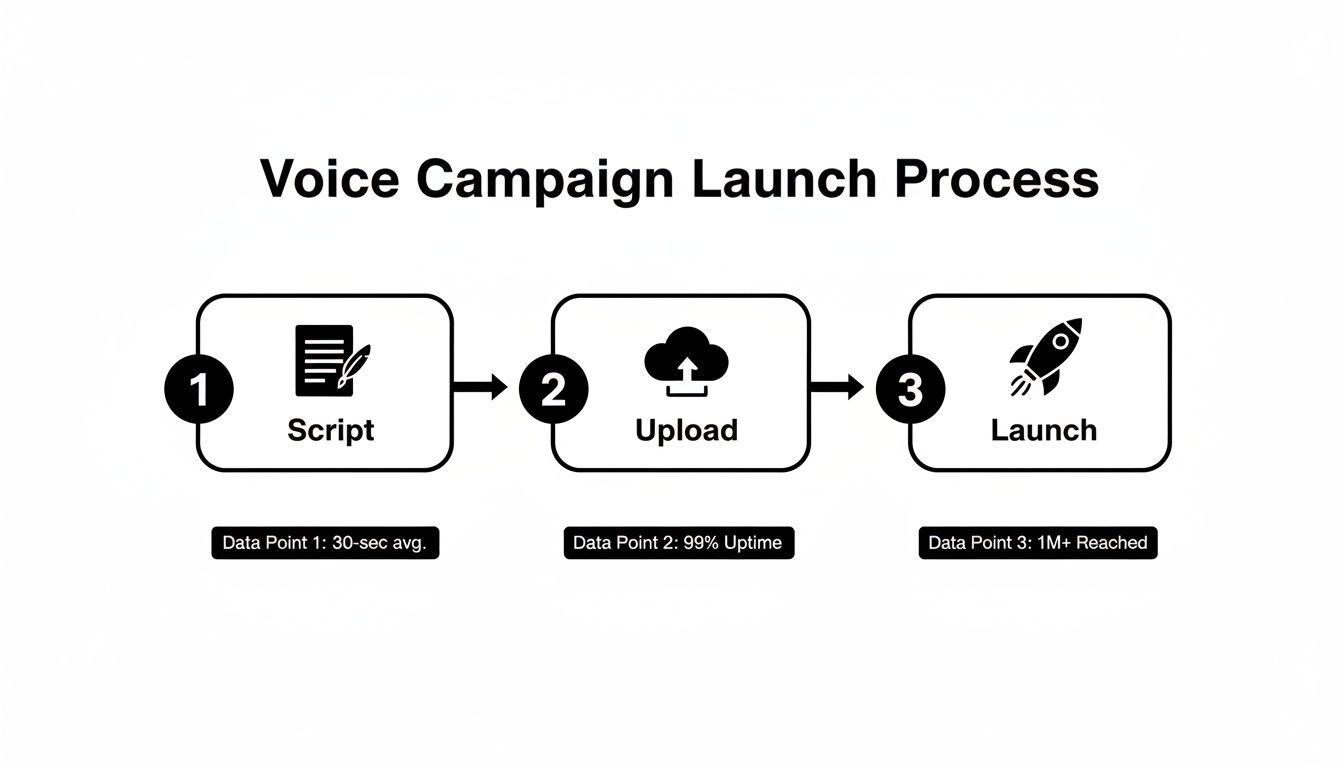
As you can see, launching your automated voice messaging campaign is a clear path: create the script, upload your contacts, and hit go.
Actionable Tips for Optimization
Once you have your baseline data, you can start making smart, targeted changes to boost your ROI. This isn’t a "set it and forget it" game; it's a cycle of testing, learning, and refining.
The goal of optimization isn't just to make more calls; it's to have more successful conversations. Even a 5% improvement in your appointment booking rate can have a massive impact on your pipeline over time.
Here are some powerful tactics you can start using right away:
- A/B Test Your Opening Lines: Create two different opening hooks and pit them against each other. Does a direct, to-the-point opener work better, or does a more conversational start get a better response? The data will tell you which one leads to a higher qualification rate.
- Adjust the AI's Vocal Tone: How your AI agent sounds can make or break a call. Try experimenting with different tones. You might find an energetic voice works great for sales outreach, while a calmer, more reassuring tone is better for appointment reminders.
- Refine Your Script Logic: Use your call outcome data to find where conversations are dropping off. If you notice lots of people are hanging up after a certain question, it’s time to rewrite that part of the script to be clearer, less confusing, or more compelling.
- Optimize Call Timing: Dig into your answer rates by time of day and day of the week. You might just find that calling your audience on a Tuesday afternoon gets you a 15% higher answer rate than on a Friday morning. That’s a free win.
By constantly watching your analytics and making these kinds of data-driven tweaks, your automated voice messaging campaigns will transform from a simple tool into a highly efficient engine for business growth.
Have Questions? We Have Answers.
As you start to explore what automated voice messaging can do, it’s only natural for questions to come up. We’ve put together some of the most common ones we hear to give you clear, straightforward answers and help you see exactly how this fits into your business.
Is This Just a Nicer Word for Robocalling?
Not at all. In fact, they’re fundamentally different things. The term "robocalling" brings to mind those old-school, one-way message blasts that are usually illegal and always annoying.
Modern automated voice messaging, on the other hand, is all about intelligent, two-way dialogues. It uses conversational AI to engage with people, not just broadcast a static recording at them. Think of it as an interactive assistant, not a pre-recorded announcement.
How Can an AI Voice Actually Sound Human?
Today’s AI voices are a world away from the robotic-sounding systems of the past. They're built with advanced machine learning models that have been trained on huge libraries of human speech.
This process allows the AI to capture the tiny, subtle variations in pitch, tone, and pacing that make a voice sound natural and engaging. The goal isn’t to trick anyone; it’s simply to create a smooth, pleasant, and easy-to-understand conversational experience.
What Keeps This Compliant and Legal?
This is a big one, and the answer is simple: compliance is built directly into professional automated voice messaging platforms from the ground up. It’s a core feature, not an afterthought.
Here’s how it works:
- Consent Management: The system is designed to ensure you only contact people who have given you prior express written consent, which is a cornerstone of TCPA rules.
- Time Zone Controls: Calls are automatically restricted to legal hours (typically 8 AM to 9 PM) based on the recipient's local time zone. No more accidental late-night calls.
- Instant Opt-Outs: The AI is specifically trained to recognize and immediately act on any opt-out request. When someone says "take me off your list," their number is added to a Do-Not-Call list in real time.
How Fast Can I Get This Up and Running?
It’s much faster than you might think. For most businesses, the entire process—from the first chat to launching your first live campaign—takes just a few weeks.
The journey involves defining your goals, working with an expert to script the conversation flow, and connecting the system to your CRM for seamless data transfer.
The most hands-on part is usually the scripting, because a well-designed conversation is the key to getting great results. Once that script is perfected and tested, launching a campaign only takes a few clicks.
With a proven process, you can start scaling your outreach and seeing real business results without a long, drawn-out setup period.
Ready to see how a dedicated AI Voice Agent can fill your calendar and grow your revenue? Voicedial.ai provides human-like AI assistants that manage calls 24/7, turning leads into qualified appointments. Learn more about Voicedial.ai.