

Forget the clunky, robotic telemarketers of the past. Today’s automated phone calls aren't just one-way announcements anymore. They use conversational AI to interact with people in a surprisingly human-like way, making them an incredibly powerful tool for businesses looking to scale their outreach.
How Automated Phone Calls Actually Work Now
Modern automated phone calls are less like a pre-recorded message and more like a highly efficient, intelligent assistant that can hold a real conversation. This massive shift is driven by a core engine of artificial intelligence that makes every single interaction feel dynamic and responsive.
Instead of just blasting a static audio file, these systems are built to listen, understand, and react in real time. The goal isn't to trick someone into thinking they're human. It's about providing a clear, professional, and productive first point of contact.
The Brains Behind the Operation
At the heart of every modern automated call is an AI "brain" that juggles three critical functions at once. This central intelligence coordinates everything from the words spoken to the interpretation of responses, creating a fluid and logical conversation. It’s what separates a simple auto-dialer from a true AI calling agent.
- Adaptive Scripting: The system follows a conversation map, not a rigid script. This means it can jump to different points in the conversation based on what the listener says, asking follow-up questions or handling objections as they come up.
- Natural Language Processing (NLP): This is the "ears" of the system. NLP allows the AI to understand the intent behind someone's spoken words. It knows that "Sure," "I guess so," and "Okay" all mean the same thing—a positive response.
- Professional Voice Synthesis: Advanced text-to-speech (TTS) technology generates a voice that is clear, professional, and natural-sounding. This ensures the delivery is smooth and easy to understand, protecting your brand's image.
This combination of technologies is fueling a massive industry shift. The call center software market, driven by these automated systems, grew to over $41.7 billion in 2025 and is projected to expand at a rapid 21.9% CAGR through 2033. The AI-powered segment alone is expected to surpass $10 billion by 2032, which shows just how essential this tech has become. You can dig into more call center industry statistics to see the full scope of this growth.
Think of it like a GPS for conversations. A basic robocall is like a single, unchangeable route. An AI-powered automated call is like a modern GPS that reroutes in real time based on traffic (the conversation's flow) to reach the destination efficiently.
Visualizing the AI Calling System
This diagram shows how these core components work together, with the AI brain coordinating each function to create a seamless call experience from start to finish.
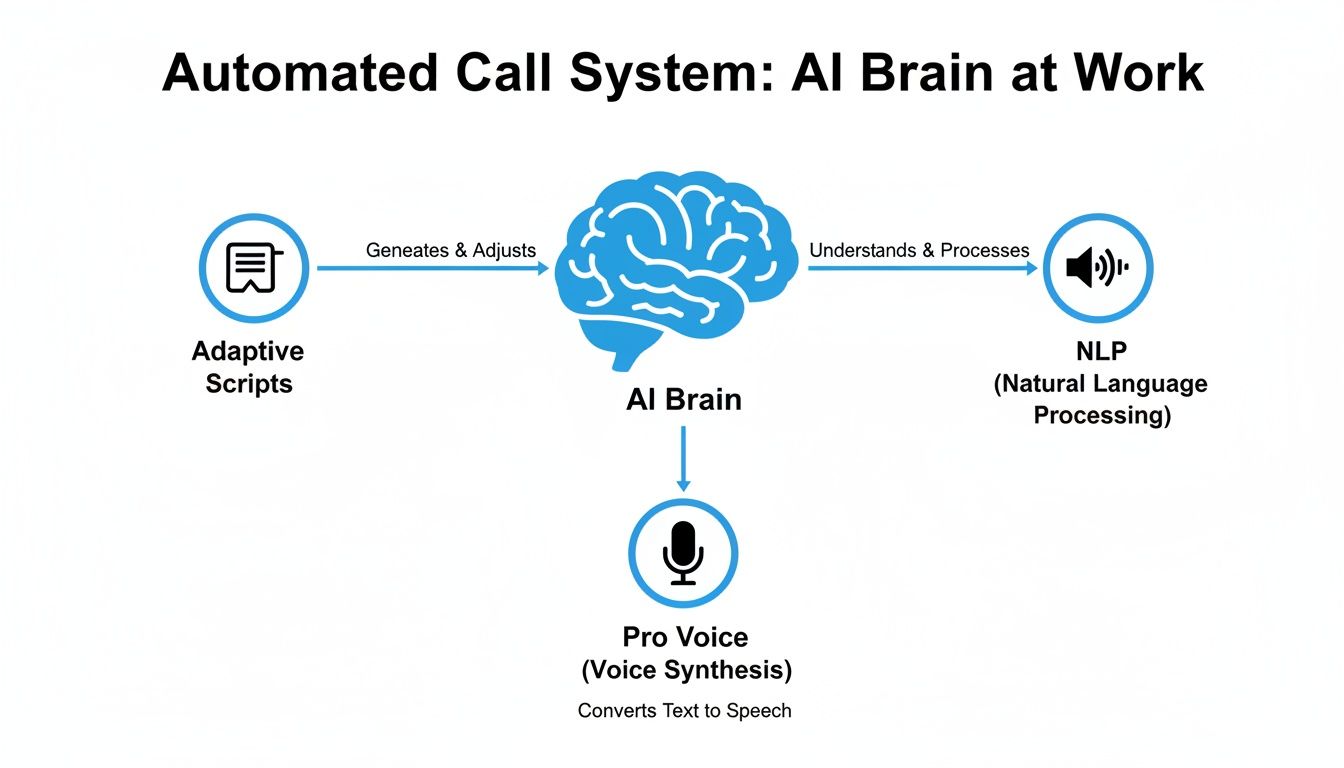
As you can see, it's the tight integration of these three technologies—scripting, understanding, and speaking—that allows the system to manage complex interactions. This is the foundation that enables businesses in insurance, home services, and legal intake to qualify hundreds of leads at the same time, with an agent that never gets tired and always follows the script perfectly.
The Real Business Impact of Call Automation
Let's move beyond theory. When you bring call automation into your business, the results are concrete, measurable, and hit your bottom line directly. The most immediate win? A massive boost in what your team can accomplish. Instead of hiring an army of agents to grind through call lists, you can have AI agents engaging thousands of contacts at the same time.
This isn't just about doing more; it’s about creating an outreach engine that's simply impossible with a human-only team. Suddenly, a small business can have the same reach as a huge enterprise, completely changing the economics of how you find and connect with customers.
Gaining Unprecedented Scale and Speed
One of the biggest shifts is the ability to operate around the clock with perfect consistency. An AI agent doesn't need breaks, never has a bad day, and can fire up a call the second a new lead hits your system. This 24/7 scalability is a total game-changer for any business where speed-to-lead is king.
Think about the real-world difference in lead response:
- Human Agent: A new lead comes in at 7 PM. They might get a call the next morning, but by then, their interest has cooled off, or worse, they've already talked to your competitor.
- AI Agent: That same lead gets an automated phone call within 60 seconds, no matter the time. The AI qualifies their interest on the spot and books a follow-up with a human expert for the next day.
That immediate connection dramatically increases your odds of conversion. Every hot prospect is contacted at the absolute peak of their interest, ensuring no opportunity is lost to a simple delay or because it's after 5 PM. The result is a fuller, more reliable pipeline of genuinely qualified leads.
"The core value of automation isn't just doing things faster; it's about creating capacity. By automating the repetitive top-of-funnel work, you free your best people to focus exclusively on high-value, revenue-generating conversations."
Ensuring Perfect Compliance and Consistency
Let’s face it, human error is an unavoidable part of any manual process. Agents can forget to read compliance disclaimers, go off-script, or log a call outcome incorrectly. These small slip-ups can snowball into major compliance risks and create inconsistent customer experiences.
Automated phone calls wipe that variable off the board. The AI agent sticks to the approved script 100% of the time. Every required disclosure is made, and every call follows your brand guidelines to the letter. This not only protects your business legally but also guarantees a uniform, professional first impression with every single prospect. Achieving that level of control with a human team alone is nearly impossible.
The data backs this up. While old-school cold calling success rates hovered around a dismal 2.3% in 2025, teams using targeted, AI-driven campaigns saw those rates jump to between 6-10%. On top of that, personalized automated calls achieved a 36% higher meeting conversion rate than generic, one-size-fits-all approaches. You can dive deeper into these call center industry trends and performance metrics.
Transforming Team Productivity and Focus
Here's the most valuable outcome: call automation completely transforms your human team's role for the better. When AI handles the soul-crushing work of dialing, navigating phone trees, and leaving voicemails, your skilled agents are finally free from the grind. They're no longer wasting their days just trying to get someone on the phone.
Instead, they walk in to a calendar full of pre-qualified, high-intent appointments. Their time is now spent exclusively on what they do best: building rapport, navigating complex objections, and closing deals. This shift elevates them from dialers to strategic closers, which does wonders for morale and skyrockets team productivity. Your best talent is laser-focused on the activities that directly grow the business.
Traditional Outreach vs AI-Powered Automated Calls
To really see the difference, it helps to put the two approaches side-by-side. The table below breaks down how an AI-augmented team stacks up against a traditional, human-only model across the metrics that truly matter.
| Metric | Traditional Human Team | AI-Augmented Team |
|---|---|---|
| Call Capacity | Limited by headcount and hours | Thousands of concurrent calls, 24/7 |
| Speed-to-Lead | Minutes to hours, dependent on availability | Under 60 seconds, instant engagement |
| Lead Qualification | Manual and variable | Automated and perfectly consistent |
| Compliance Adherence | Prone to human error | 100% script adherence guaranteed |
| Cost Per Lead | High (salaries, overhead, tools) | Significantly lower, scales efficiently |
| Agent Focus | Dialing, qualifying, appointment setting | High-value conversations and closing deals |
| Data Capture | Manual entry, risk of errors | Automatic, real-time CRM updates |
As you can see, it’s not about replacing humans. It’s about creating a smarter, more efficient system where AI handles the volume and repetition, freeing up your team to do the strategic work that only people can do.
Staying Compliant in an Automated World
Using automated phone calls can supercharge your growth, but it comes with a serious responsibility to play by the rules. The legal side can feel like a minefield, but it all boils down to one simple principle: respecting the consumer. Ignoring these regulations isn't just bad form—it can lead to eye-watering fines and permanently tarnish your brand's reputation.
The big one you absolutely have to know is the Telephone Consumer Protection Act (TCPA). This federal law is the rulebook for how businesses contact consumers by phone, and its guidelines are non-negotiable if you're using any kind of automated outreach.
Understanding Express Written Consent
The heart of TCPA compliance is what's called "prior express written consent." This is the single most important concept to master before you even think about making an automated marketing call to a cell phone. It sounds formal, but it’s actually pretty straightforward.
Simply put, you need clear, undeniable permission from someone before you dial their number with an automated marketing message. This permission has to be in writing (digital forms count) and must spell out that they agree to get automated calls from your company at the number they provided.
So, what does that look like in the real world?
- A checkbox on a web form that a user has to physically click. The text next to it needs to be crystal clear, like "I agree to receive automated marketing calls from [Your Company Name] at the number provided."
- A plain-language disclosure on a landing page where someone gives you their number to get a quote or download a guide.
- An actual signature on a physical document, maybe from an in-person event or a consultation.
It's not enough for someone to just hand over their phone number. They have to explicitly say "yes" to being contacted with automated tech. Your best defense is keeping meticulous records of this consent—who, when, and the exact language they agreed to.
Respecting the National Do Not Call Registry
Getting consent is step one. Step two is respecting the National Do Not Call (DNC) Registry. This is a list of people who have raised their hand and said, "Don't call me for marketing." Before you launch any campaign, you are required to scrub your call lists against the DNC registry and remove anyone on it.
Skipping this step can bring massive penalties. Thankfully, most reputable automated calling platforms, including Voicedial.ai, have built-in tools to help with DNC compliance, but the buck always stops with your business.
Think of compliance as the foundation of a house. You can build the most impressive sales engine on top, but without a solid, compliant foundation, the entire structure is at risk of collapsing. Getting this right from the start protects your investment and builds consumer trust.
Navigating STIR/SHAKEN and Caller ID Trust
Ever ignored a call because your phone flagged it as "Spam Likely"? That's the result of carrier-level filtering, which has gotten much more aggressive. To fight back against the flood of illegal robocalls, telecom carriers put a framework in place called STIR/SHAKEN.
This technology essentially verifies that the caller ID you're displaying is legitimate and hasn't been faked by a scammer. When your calls are properly authenticated under STIR/SHAKEN, they get "signed" as trustworthy. This dramatically lowers the chance they'll get blocked or flagged as spam by the carriers.
This is a huge deal for legitimate businesses. Unwanted robocalls are still a massive problem; in 2025, the volume of these calls only dipped by 1% from the year before. In response, major carriers like Verizon and T-Mobile now have 85% of their call traffic signed, with a whopping 93% of those calls earning the highest 'A-level' attestation of trust. If your provider isn't ensuring your calls are properly signed, you're fighting a losing battle for deliverability. You can learn more about how signed call traffic is closing the gap on illegal robocalls.
A simple compliance checklist can keep you on the straight and narrow:
- Obtain Express Written Consent: Always get clear, documented permission before making automated marketing calls to mobile numbers.
- Maintain Meticulous Records: Track who consented, when they did it, and how.
- Scrub Against the DNC List: Regularly check your lists against the National Do Not Call Registry.
- Provide a Clear Opt-Out: Every call must give the person an easy way to say "stop."
- Identify Yourself Clearly: Your business name has to be stated right at the beginning of the call.
By making these practices second nature, you can use automated calls confidently and ethically. It’s how you turn a powerful technology into a compliant and incredibly effective tool for growth.
Proven Use Cases for Automated Calling
Theory is one thing, but the real magic of automated phone calls happens when you see them solving specific, real-world business problems. Across all sorts of industries, this tech is taking over the repetitive—but absolutely critical—communication tasks and driving some serious results. This isn't just some futuristic concept; it's a practical engine for growth.
By looking at how others are already using it, you can start to picture how it might fit into your own operations. Whether you're running an insurance agency, a home service company, or a law firm, the core benefit is the same: creating scalable, consistent outreach that frees up your experts to do what they do best.
Let’s dive into how this actually works.
Insurance Agencies Supercharging Lead Qualification
In the insurance world, especially for high-volume markets like health or auto, speed is everything. Agents need a steady stream of qualified prospects, but so much of their day gets eaten up by dialing through lists of cold or lukewarm leads. A lot of those people just aren't a good fit.
This is a perfect job for an AI voice agent. The system can churn through thousands of leads, pre-qualifying them against specific criteria before a licensed agent ever has to pick up the phone.
Example Use Case: An agency specializing in Affordable Care Act (ACA) health plans needs to book appointments with qualified prospects during the chaos of open enrollment.
- Goal: Boost the number of qualified appointments for licensed agents by 30% while cutting down the time agents spend prospecting.
- Metric: Keep a close eye on the Cost-Per-Appointment to make sure the AI campaign is more efficient than just having humans dial all day.
Here’s a little snippet of what that automated call might sound like:
"Hi, this is Alex calling on a recorded line from Health Plan Connectors. We're helping folks in your area find affordable health insurance options for the new year. Do you currently have health coverage?"
If the lead says "no" or mentions they're looking for new options, the AI agent can follow up with a few more qualifying questions about their needs. From there, it can seamlessly book an appointment right on a licensed agent's calendar.
Home Service Businesses Streamlining Appointments
Home service companies—think roofers, HVAC techs, and plumbers—live and die by their booked jobs. But the admin work of scheduling inspections, confirming appointments, and chasing down old quotes can be a massive bottleneck. It pulls skilled technicians and office staff away from the work that actually makes money.
Automated calling can take over this entire workflow, keeping calendars full and drastically reducing no-show rates.
Example Use Case: A local roofing company wants to schedule free, no-obligation roof inspections after a big hailstorm just rolled through the area.
- Goal: Book 50 new inspection appointments within a two-week period.
- Metric: Measure the Appointment Set Rate—the percentage of answered calls that turn into a booked inspection.
The script for this kind of outreach can be direct and genuinely helpful:
"Hello, this is Sarah from Guardian Roofing calling on a recorded line. With the recent storm that passed through, we're offering homeowners in your neighborhood a complimentary roof inspection to check for any potential damage. Is that something you might be interested in?"
This proactive approach gets the company in front of homeowners at the exact moment their service is needed, all without tying up the core team.
Law Firms Automating Initial Client Intake
For law firms, the initial intake process is crucial for sorting out the viable cases from the ones that aren't a fit. Paralegals and intake specialists often spend hours on the phone just gathering basic information, asking the same repetitive questions over and over.
This initial screening is an ideal task to hand off to an automated calling system. It allows the legal team to focus only on cases that meet the firm’s specific criteria.
This dashboard from Voicedial.ai shows how businesses can monitor campaign performance in real-time, tracking key metrics like answer rates and outcomes. The visual breakdown of call results allows managers to quickly assess campaign health and make data-driven decisions to optimize their outreach strategy.
Example Use Case: A personal injury law firm needs to pre-screen a flood of inbound inquiries from a recent marketing campaign to filter for the highest-quality cases.
- Goal: Cut the time paralegals spend on initial intake calls by 50%.
- Metric: Track the Qualification Rate, which is the percentage of calls that meet the firm’s case criteria.
An AI agent can handle that first touchpoint with both empathy and precision:
"Thank you for contacting Miller & Associates. This call is being recorded. To connect you with the right person, I just need to ask a few quick questions. First, were you involved in a motor vehicle accident?"
Based on the responses, the system can gather all the key details and then schedule a consultation with a paralegal for the most promising cases. This makes sure the legal team's valuable time is spent on prospects who have already been vetted, dramatically improving the firm’s efficiency.
How to Launch Your First AI Calling Campaign
Ready to put automated phone calls to work for your business? A successful launch isn't about flipping a switch and blasting out thousands of calls. It's a strategic process that starts with clear objectives and a solid plan, ensuring your first campaign delivers real, measurable results right out of the gate.

Think of it like building a custom sales machine. You wouldn't just throw parts together randomly; you’d follow a blueprint. The same logic applies here. A methodical approach makes sure your AI agent acts as a true extension of your brand and actually hits its targets.
Define Your Campaign Goals
Before you write a single word of your script, you have to define what success looks like. Vague goals like "get more leads" won't cut it. You need specific, quantifiable targets that will guide your entire strategy.
A strong goal gives your campaign purpose and a benchmark for measuring performance. Without one, you're just making calls with no clear destination in mind.
Here are a few examples of clear, actionable goals:
- Increase qualified sales appointments by 30% within the first quarter.
- Reduce cost per qualified lead by 20% compared to manual cold calling.
- Re-engage at least 15% of a list of old, dormant leads.
These goals are specific, measurable, and time-bound. They give you a clear target to aim for and make it easy to see if your automated calling efforts are paying off.
Craft a Natural and Effective Script
Your script is the heart of the campaign. It needs to be more than a list of questions; it must be a conversational map that guides the AI agent through a natural-sounding interaction. The objective isn’t to trick someone into thinking they're talking to a human, but to be clear, professional, and efficient.
Ditch the robotic language and corporate jargon. Write like you speak, using simple, direct sentences. A great script anticipates common questions and objections and has a logical path for each response, ensuring the conversation flows smoothly.
A well-designed script is the difference between an AI agent that feels helpful and one that feels like an obstacle. Focus on a clear value proposition and a low-friction call to action to make the experience positive for the listener.
When building your script, be sure to include a clear and compliant opening line, direct qualifying questions, and a seamless handoff to the next step, whether that's booking a meeting or transferring the call to a live agent.
Choose Your Voice and Integrate Your Tools
The voice of your AI agent is your brand's auditory handshake. You’ll want to pick one that aligns with your company’s personality—whether that’s energetic and friendly or formal and authoritative. Most platforms, including Voicedial.ai, offer a variety of voice options to match what you're looking for.
Just as important is integrating the calling platform with your existing CRM system. This is a crucial step that ensures all call data, from outcomes to notes, flows directly into your customer records. Automated integration eliminates manual data entry, prevents leads from falling through the cracks, and gives your sales team real-time context for every follow-up.
Launch a Pilot Campaign to Test and Refine
Finally, resist the temptation to go all-in from the start. The smartest way to launch is with a small, controlled pilot campaign. This is your chance to test everything in a low-risk environment before you scale up.
Your pilot should target a small segment of your list, which allows you to gather initial data and find any areas that need improvement.
During this phase, pay close attention to key metrics:
- Answer Rate: Are people picking up? This can help you test different call times.
- Qualification Rate: Is the script actually identifying good leads?
- Appointment Set Rate: Is the call to action clear and compelling enough?
Use the insights from your pilot to refine your script, adjust call timing, and tweak your targeting. This cycle of testing, measuring, and optimizing is the secret to building a high-performing automated phone call campaign that delivers a strong and sustainable return on your investment.
Measuring Your Campaign Success and ROI
Launching an automated phone call campaign is a big step, but it’s only half the job. To really make the strategy stick, you have to prove its worth with cold, hard numbers. Measuring your campaign isn't just about checking a box to see if it "works"—it’s about dialing in on your exact return on investment (ROI) and figuring out how to make it even better.
If you don't have clear metrics, you're just flying blind. You’ll have no idea if your script is hitting the mark, if you're calling at the best times, or if the whole thing is even worth the cost. Tracking the right Key Performance Indicators (KPIs) is what turns a hopeful guess into a predictable engine for growth.
Defining Your Core Campaign Metrics
Every business has its own unique goals, but a few universal KPIs are non-negotiable for gauging the health of any automated calling campaign. These numbers tell the full story, from the first dial to a lead ready for your sales team.
Here are the critical metrics you absolutely have to track:
- Answer Rate: This is the percentage of calls that a real person actually picks up. A low answer rate can be a red flag, pointing to problems with your caller ID, your timing, or the quality of your contact list.
- Qualification Rate: Of the calls that get answered, what percentage result in the AI successfully identifying a qualified lead? This metric is a direct reflection of how effective your script and targeting are.
- Cost Per Qualified Lead (CPQL): Simply put, this is your total campaign cost divided by the number of qualified leads you generated. It's the ultimate bottom-line metric for comparing your AI callers to other marketing channels.
When you zero in on these core metrics, you stop tracking busy work (like "dials made") and start measuring what actually moves the needle. It's the difference between being active and being effective.
Calculating Your Return on Investment
The real test of any campaign is its ROI. A straightforward way to figure this out is to compare the cost of an AI agent to the fully-loaded cost of having a human do the same repetitive dialing.
A person's fully-loaded cost isn't just their salary. It includes benefits, overhead, training, and software, which can easily add up to $30-$40 per hour. An AI agent from a platform like Voicedial.ai, on the other hand, can churn through a much higher volume of calls for just a fraction of that hourly rate.
Let's play it out. Imagine an AI agent qualifies 10 leads in one hour. If your campaign cost for that hour is $10, your Cost Per Qualified Lead is a mere $1.00. Now, think about how many hours it would take a human agent to get the same result. The financial upside becomes obvious, fast.
A solid grasp of your KPIs is the foundation for understanding campaign performance. Below is a breakdown of the essential metrics you should be monitoring to measure both effectiveness and the all-important return on investment.
Essential KPIs for Automated Call Campaigns
A breakdown of the key metrics to monitor for measuring the performance and ROI of your AI voice agent campaigns.
| KPI | What It Measures | Why It's Important |
|---|---|---|
| Answer Rate | The percentage of calls answered by a live person. | Indicates the quality of your contact list and the effectiveness of your caller ID and call timing. Low rates signal a problem at the very top of the funnel. |
| Qualification Rate | The percentage of answered calls that result in a qualified lead. | This is a direct measure of your script's power to engage and persuade. It tells you if your messaging is resonating with your target audience. |
| Cost Per Qualified Lead (CPQL) | Total campaign cost divided by the number of qualified leads. | The ultimate efficiency metric. It allows you to directly compare the cost-effectiveness of your AI voice campaigns against other channels like paid ads or email. |
| Conversion Rate | The percentage of qualified leads that become customers. | This connects your calling efforts to actual revenue. A high qualification rate but low conversion rate might point to a disconnect with the sales team. |
| Call Duration | The average length of a successful (qualified) call. | Longer conversations can indicate higher engagement. Analyzing duration helps you refine script points that keep prospects on the line. |
| Opt-Out Rate | The percentage of contacts who request to be removed from the list. | A critical compliance metric. High opt-out rates can also signal that your targeting or messaging is off, irritating potential customers. |
Tracking these KPIs isn't just about generating reports; it's about gaining actionable insights. By monitoring these numbers, you can continuously refine your strategy to ensure you're getting the best possible ROI from your automated calling efforts.
Using Data to Optimize Performance
Think of your campaign dashboard as your command center. It’s where you get the real-time data you need to spot trends and find opportunities to improve. For example, if you see the Answer Rate plummets after 4 PM, you can adjust your schedule to hit those peak morning and midday hours.
You can also A/B test different script intros or offers. Run two versions and see which one delivers a higher Qualification Rate. This cycle of measuring, analyzing, and tweaking is what separates a good campaign from a great one. It ensures your automated phone calls aren't just running on autopilot—they're consistently delivering the maximum possible ROI for your business.
Frequently Asked Questions

Even after seeing the potential, diving into automated calling brings up some practical questions. It's completely normal. Let's tackle the most common concerns head-on so you can move forward with clarity.
Are Automated Phone Calls Legal for Sales Outreach?
Absolutely, as long as you follow the rules of the road—namely, the TCPA. The most critical piece is getting prior express written consent before you dial a consumer's cell phone for any marketing reason.
Reputable platforms are built with this in mind from the ground up. They have built-in tools to manage consent records and instantly honor opt-out requests, making automated calls a safe and compliant tool for legitimate businesses.
Will an AI Voice Agent Annoy My Potential Customers?
This is a huge—and valid—concern, but modern AI has come a long way from the clunky, robotic voices of the past. Today's systems use sophisticated text-to-speech and natural language processing to create a conversation that feels professional and smooth.
The goal isn't to trick anyone. It's to provide an efficient and pleasant experience that respects the lead's time and quickly determines if there's a good reason for a deeper conversation. Most people actually appreciate that.
How Quickly Can We Set Up an Automated Campaign?
It's almost always faster than people think. A realistic timeline, from mapping out your strategy to launching your first live campaign, is about three weeks.
That window gives you enough time for script development, configuring the AI agent, integrating it with your CRM, and running a final round of tests. This way, you know everything is running perfectly before you start scaling up your outreach.
Ready to see how an AI calling agent can transform your outreach and fill your pipeline with qualified appointments? Voicedial.ai delivers human-like AI voice agents that handle your calls 24/7, allowing you to scale conversations without scaling your team. Discover how it works and book a demo today.