

Imagine your sales team dialing phone numbers all day. For every great conversation they have, they’re forced to slog through countless busy signals, disconnected lines, and unanswered voicemails. Automated dialing software was built to fix this, taking over the soul-crushing task of dialing so your reps only connect when a live person is on the other end.
How Automated Dialing Multiplies Productivity
Think of manual dialing like a librarian searching for a book by walking down every single aisle, shelf by shelf. It’s a slow, painful process filled with dead ends. An automated dialer, on the other hand, is like a digital catalog that instantly finds the book's exact spot and brings it right to the front desk.
This one shift frees up your team to do what they do best: talk to real prospects and close deals. Instead of burning energy on the mind-numbing mechanics of dialing, they can invest it in building rapport, handling objections, and actually moving a conversation forward.
The Evolution from Simple Tools to Strategic Platforms
The idea isn't new, but the technology has come a long, long way. The first auto-dialers were basic tools that just churned through a list of numbers. Today, modern platforms have become sophisticated, strategic assets for any team doing outreach. This shift is why the market is growing so fast.
The global sales dialer tools market is projected to grow from an estimated $3.2 billion in 2024 to $4.5 billion by 2026. This expansion, representing a compound annual growth rate (CAGR) of 12%, highlights the increasing reliance on automated dialing technologies, especially among large enterprises with high call volumes. Discover more insights about the sales dialer market and its projected growth.
This growth isn’t just about making more calls; it’s about making smarter calls. The best systems now pack in powerful features and even artificial intelligence to manage entire outreach campaigns from start to finish.
Beyond Automation to Intelligent Conversation
The most advanced form of automated dialing software has graduated from just connecting calls. Platforms like Voicedial.ai now use AI voice agents that can handle the entire first conversation on their own. These agents can:
- Qualify leads based on your specific criteria.
- Answer common questions and give out basic info.
- Book appointments directly on a human agent's calendar.
This next-gen technology acts as a force multiplier. It handles all the top-of-funnel work, letting your human reps step in only when a prospect is already vetted, engaged, and ready for a real discussion. It's a strategic move from just automating a task to automating the whole qualification process, guaranteeing every minute of your team's time is spent on activities that actually generate revenue.
Comparing The Different Types Of Automated Dialers
Not all automated dialing software is the same. Far from it. The right system for your team comes down to your specific workflow, how much control your agents need, and what you’re trying to achieve. Understanding these differences is the first step to picking a tool that actually multiplies your efforts, rather than just making more noise.
Let's walk through the main dialer types, starting with the most basic and working our way up to the most advanced. You'll quickly see how each one operates and where it fits best.
Preview Dialers: The Personal Assistant
Imagine an assistant handing your agent a complete file on a prospect moments before they pick up the phone. That’s exactly what a preview dialer does. It serves up all the relevant contact information from your CRM—notes, purchase history, past interactions—before the agent initiates the call with a click.
This approach is all about call quality and personalization, not raw speed.
- Maximum Agent Control: Agents decide precisely when to dial, giving them time to prep a tailored opening for every single conversation.
- Ideal for Complex Sales: It's a perfect match for high-value B2B sales or detailed follow-ups where context is king and a personal touch can make or break the deal.
The trade-off, of course, is a lower call volume. Agents spend more time preparing and less time talking, which isn’t a great fit for high-volume, transactional campaigns.
Power Dialers: The Workhorse
When the main goal is just to maximize an agent's time on the phone, a power dialer is the tool for the job. This system dials one number right after the previous call ends, completely cutting out the dead time agents spend manually punching in numbers. The moment an agent becomes free, the dialer is already placing the next call.
A power dialer is a pure productivity engine. It works through a list systematically, making sure an agent is always ready for the next connection and dramatically cutting down the time between conversations.
This dialer is a huge leap from manual dialing and is a solid choice for teams that need to get through a long list quickly. It keeps a single agent as busy as possible, but it always dials sequentially, one number at a time for that one agent.
Progressive Dialers: The Smart Power Dialer
A progressive dialer is the smarter cousin of the power dialer. It works in a similar way, dialing one number at a time for an available agent, but with one crucial difference: it only starts dialing when it confirms an agent is truly available and ready.
This simple check prevents that awkward silent pause or, even worse, a dropped call that happens when a dialer connects before the agent is actually ready to speak. It improves the customer's experience while still keeping agent productivity high. Think of it as a balance between speed and quality.
Predictive Dialers: The Algorithmic Powerhouse
This is where automation gets really interesting. A predictive dialer uses algorithms to dial multiple numbers per agent at the same time. It crunches data on the fly—like your average call length, how many dials it takes to get an answer, and agent availability—to predict the exact moment an agent will finish their current call. The goal is to have a live person on the line ready to talk at that precise second.
This power is a major reason why the predictive dialer market is exploding.
The global predictive dialer software market, valued at $3.20 billion in 2024, is expected to grow at a staggering 42.3% CAGR through 2030. This growth shows just how much businesses are leaning on this tech to boost agent productivity. You can dive into the full predictive dialer market research and trends on GrandviewResearch.com.
This diagram shows how an automated dialer acts as the engine between your outreach campaign and your agents on the ground.
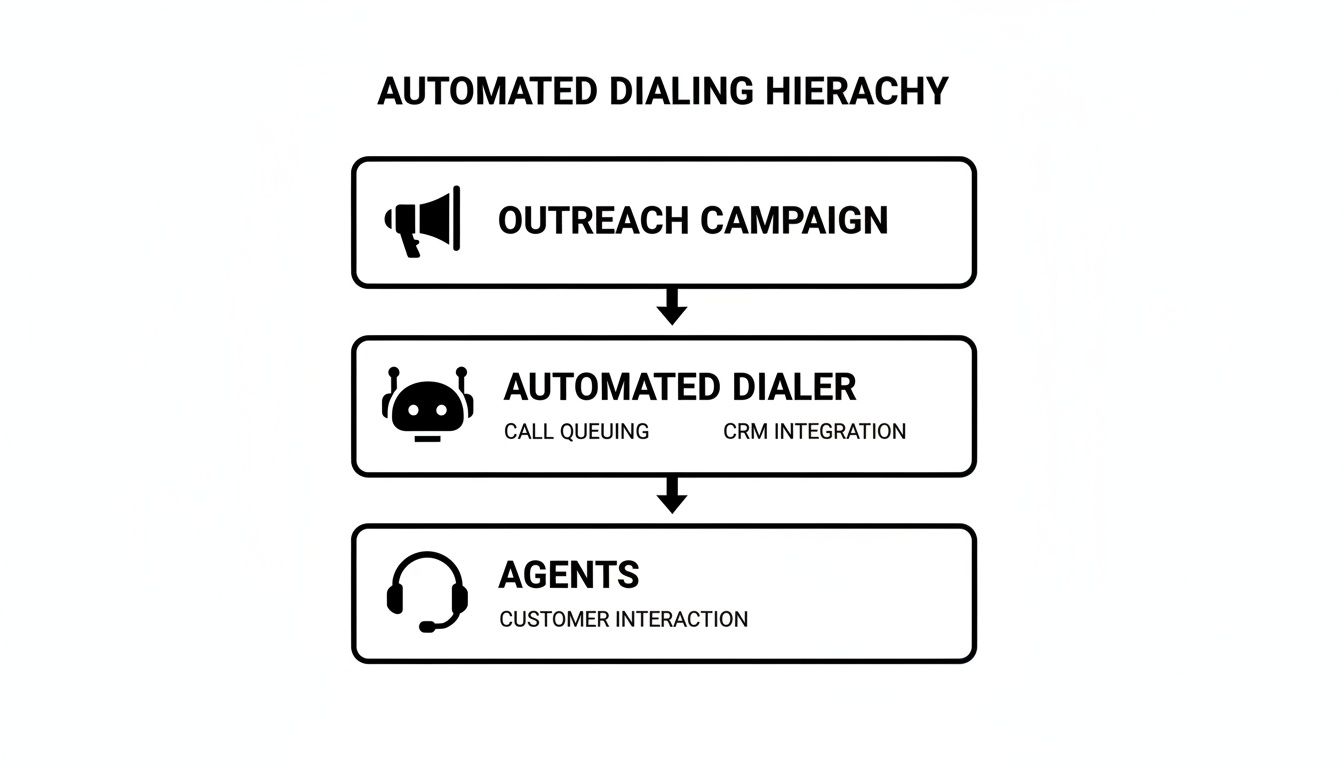
As you can see, the dialer is the central hub that turns a simple contact list into a steady stream of live conversations for your team.
To help you decide, here’s a quick comparison of how these dialer types stack up against each other.
Automated Dialer Types Comparison
| Dialer Type | Agent Control | Pacing/Efficiency | Best For |
|---|---|---|---|
| Preview | High | Low | Complex B2B sales, high-value follow-ups |
| Power | Low | Medium | High-volume outreach, keeping agents busy |
| Progressive | Low | Medium-High | Balancing speed with customer experience |
| Predictive | None | High | Large teams, maximizing talk time, efficiency |
Choosing the right one really depends on what you're trying to accomplish. If every conversation needs careful preparation, a Preview dialer is your best bet. If you just need to burn through a list, Predictive is the way to go.
AI Voice Agents: The Next Evolution
The final and most advanced tier of automation is the AI Voice Agent. Platforms like Voicedial.ai take this a giant step further. Instead of just dialing, they deploy AI agents that can handle the entire initial conversation on their own. They qualify leads, gather information, and even book appointments without any human agent getting involved until the prospect is warm and ready for a strategic discussion. This isn't just about making more calls—it's about making every call smarter.
What to Look For: Essential Features of High-Performing Dialer Software
The difference between a basic dialer and a true growth engine is all in the features. The right tools transform an automated dialing software from a simple speed dialer into the command center for your entire outreach operation.
Knowing which features actually move the needle is how you get a real return on your investment.
Centralized Data With CRM Integration
Think of CRM integration as the dialer's central nervous system. Without it, your software is just making calls in a vacuum. With it, every single call, outcome, and note is logged back to the correct contact record automatically. This creates a single source of truth for your whole team.
This seamless data flow ensures your agents have the complete customer history right in front of them before they even say hello. It kills manual data entry, cuts down on errors, and provides a 360-degree view of every interaction, making personalized follow-ups feel effortless.
Efficiency Boosters Like Voicemail Drop
Picture this: your agent finishes a great call, but the very next dial goes straight to voicemail. Instead of reciting the same message for the hundredth time that day, they just click a button. A perfect, pre-recorded message is left, and the agent is already on to the next live conversation.
That's the power of Voicemail Drop. This one feature alone can save each of your agents hours every week. It eliminates one of the most repetitive and morale-killing tasks in outbound calling, while making sure every message you leave is on-point and energetic.
Data-Driven Decision Making
A top-tier dialer does more than just connect calls—it delivers the business intelligence you need to optimize campaigns and coach your team effectively.
Real-Time Analytics & Dashboards: This is your mission control. You need to track key metrics like connection rates, average call duration, and campaign ROI as they happen. A good dashboard lets you spot trends and make data-backed adjustments on the fly, not at the end of the week when it's too late.
Call Recording & Scoring: Recording calls is table stakes. The ability to score them is what drives real improvement. Managers can review conversations, score agent performance against a defined rubric, and use those recordings as powerful, real-world training tools.
The rapid growth of the outbound call tracking software market—from $1.18 billion in 2024 to a projected $2.12 billion by 2030—is fueled by this exact demand for data. Sales teams depend on these insights to boost volume, and customer service departments use automated scoring for quality control. You can see more details about the global call tracking software market and its drivers on TheBusinessResearchCompany.com.
Built-In Compliance Safeguards
Navigating call center regulations like the TCPA isn't optional, and the fines for getting it wrong are massive. A modern automated dialing software has to be a safety net, not a liability.
Your dialer must have built-in compliance tools. These are the guardrails that protect your business by automatically managing time zone restrictions, scrubbing lists against Do Not Call registries, and controlling call frequency to prevent any hint of harassment.
Look for a platform that takes compliance seriously. Advanced systems like Voicedial.ai, for example, build these safeguards directly into the workflow. This gives you the confidence to scale your outreach without putting your business at risk. These features work together to create a powerful, efficient, and secure dialing ecosystem.
Here is the rewritten section, crafted to match the expert, natural style of the provided examples.
Navigating Compliance and Call Center Regulations
Using a powerful automated dialing software is one thing; using it responsibly is another entirely. Think of compliance as the official "rules of the road" for your outbound campaigns. Ignoring them isn't just bad form—it can lead to staggering fines that have crippled businesses. But when you get it right, compliance becomes a competitive advantage that builds trust and actually improves your connection rates.
The biggest regulation on the map in the United States is the Telephone Consumer Protection Act (TCPA). This law dictates exactly how businesses can contact consumers by phone and text. A misstep here can cost you up to $1,500 per violation. For a large-scale campaign, that number can balloon into the millions faster than you’d think.
Understanding TCPA Essentials
At its core, the TCPA was written to govern the use of automated telephone dialing systems (ATDS). While courts have gone back and forth on what technically counts as an ATDS, the smartest and safest approach is to assume your dialer falls under these rules. The most important concept you need to burn into your operational memory is "prior express written consent." This is your golden ticket for legally contacting wireless numbers for any marketing reason.
What does that mean in practice? It means you need clear, documented permission from a contact before your automated dialing software ever calls their cell phone. This isn't something you can bury in the fine print of a long terms and conditions page. The consent has to be crystal clear and unambiguous.
Other non-negotiable TCPA rules include:
- Time of Day Restrictions: You are only allowed to call residential numbers between 8 a.m. and 9 p.m., based on the recipient's local time zone.
- Do Not Call (DNC) Registry: Your system must have the built-in capability to scrub and suppress numbers on the National DNC Registry and, just as importantly, your own internal DNC list.
- Identification: Your agents must clearly state their name, the business they’re calling for, and provide a contact number or address for that business.
Failure to adhere to TCPA guidelines is a serious financial risk. A single non-compliant campaign can easily generate thousands of violations, making built-in compliance features an non-negotiable part of any modern automated dialer.
Beyond Legal Compliance to Call Deliverability
Here's a dose of reality: simply following the law isn't enough to guarantee success. You also have to make sure your calls are actually getting through. Mobile carriers have become incredibly aggressive in flagging and blocking calls they think are spam, creating a major headache for any outbound team. This is where your dialer's technical DNA becomes just as important as its legal safeguards.
Carriers use sophisticated algorithms that watch calling patterns like a hawk. If your software dials from the same number too often, or if your calls consistently have low answer rates, carriers will start flagging that number as "Spam Likely." Once a number's reputation is shot, it's almost impossible to fix, and your connection rates will plummet.
This is why high-performing dialers have Caller ID reputation management baked in. This involves smart strategies like automatically rotating through a pool of local phone numbers, a practice known as Local Presence Dialing. Showing a prospect a familiar local area code can significantly increase the chances they'll actually answer the phone.
When you’re evaluating an automated dialing software, you have to push vendors on how their platform protects you on both fronts. A system like Voicedial.ai doesn't just have compliance guardrails; it actively uses intelligent dialing strategies to make sure your calls connect. It turns a potential minefield into a well-managed and highly productive outreach channel.
How Different Industries Use Automated Dialing

The real power of automated dialing software clicks into place when you see it solving actual problems out in the wild. This isn't just a generic sales tool. It's a flexible engine that can be tuned to handle the unique headaches of almost any industry that depends on outbound calls.
Whether it’s an insurance agency trying to revive old leads or a law firm managing a massive class-action suit, the core advantage is always the same: replacing repetitive, low-value manual work with smart automation.
Let’s dig into a few real-world examples to see how this plays out.
Insurance Agencies Reviving Aged Leads
Every insurance agency has them: lists of "aged" leads. These are prospects who showed interest months, or even years, ago but never bought a policy. Calling through this kind of list manually is a soul-crushing task with a terrible return on time. It ties up licensed agents who should be spending their day closing deals, not leaving voicemails.
This is a perfect job for an AI-powered dialer.
- The Old Way: An agent spends a day manually dialing 100 aged leads. They navigate busy signals, disconnected numbers, and endless voicemails, maybe connecting with three or four people who aren't interested anyway. The entire day is a wash.
- The Automated Way: An AI voice agent from a platform like Voicedial.ai can tear through thousands of these leads in an afternoon. It works around the clock, automatically filtering out voicemails and bad numbers, and only engages with live answers to qualify their interest in a policy review.
- The Outcome: The system books 5-10 qualified appointments directly onto an agent's calendar. The agent didn't lift a finger. That "dead" list just turned into a fresh source of revenue.
Home Services Contractors Winning on Speed
In the cutthroat world of home services—roofing, HVAC, plumbing—speed is everything. When a homeowner fills out a web form for a quote, they aren't just contacting you; they're contacting three of your competitors, too. The first contractor to make contact is 78% more likely to win the business.
Waiting even five minutes to contact a new web lead can decrease your odds of connecting by 10 times. Automated dialing software eliminates this delay entirely, ensuring you are always first in line.
A contractor can't be up on a roof and instantly call a new lead the second it comes in. An automated dialer acts as their always-on assistant. The moment a lead hits the CRM, the system can trigger an immediate call from an AI agent to get an on-site estimate scheduled, beating the competition to the punch every single time.
Medical Device Sales Reaching Busy Clinics
Medical device reps have a tough gig. Their customers are incredibly busy doctors and clinic managers who are shielded by gatekeepers. Getting a few minutes of a decision-maker's time requires serious persistence and perfect timing. Manually dialing the same clinics over and over is a massive time sink.
This is where an automated dialing software streamlines the process. A sales team can upload a target list of clinics and let a power or progressive dialer do the heavy lifting. The system handles the repetitive outreach, connecting the rep only when a live person picks up. This maximizes their chances of having a real conversation about a new product or booking a demo.
Legal Intake for Mass Tort Cases
Imagine a law firm building a mass tort case. They might need to contact and qualify tens of thousands of potential claimants. Doing this manually would take an army of paralegals months of tedious work.
For the legal field, automated dialing is a complete game-changer.
- Mass Outreach: The firm uses an AI dialer to contact a massive list of potential claimants without dialing a single number by hand.
- Automated Qualification: The AI voice agent follows a pre-approved, scripted line of questioning to confirm if a person meets the specific criteria for the lawsuit.
- Seamless Handoff: Only the people who are fully qualified get transferred to a live intake specialist or paralegal for the final steps.
This automated workflow lets a firm build a huge case in a fraction of the time and at a fraction of the cost. It also frees up highly-paid legal staff to focus on work that actually requires their expertise.
How to Choose the Right Automated Dialing Software
Alright, you’re ready to invest in an automated dialer. But with a sea of options out there, how do you pick the right one? Let’s be clear: choosing poorly can torch your budget, frustrate your agents, and land you in hot water with compliance.
This isn’t just about buying another piece of software. It’s about bringing on a technology partner that will directly shape your team’s performance and your company's bottom line. To make the right call, you need to look past the flashy feature lists and ask the tough, specific questions that reveal how a platform really performs.
Your Buyer's Checklist: Essential Questions
When you’re on a demo with a potential vendor, use this checklist to drive the conversation. Their answers will tell you everything you need to know. A confident, transparent response is a great sign. Hesitation or vague answers? That’s a red flag.
1. Compliance and Security
This is where you start. A single compliance mistake can cost you far more than the software itself, so don't be shy.
- How does your platform specifically help us stay compliant with TCPA and DNC regulations?
- What tools do you have for automatically managing call frequency and time-zone restrictions?
- Can you walk me through your data security and encryption protocols for protecting our customer information?
2. Integration and Onboarding
A dialer that doesn’t sync cleanly with your other systems is just a data silo waiting to cause headaches. Smooth integration is non-negotiable.
- What level of CRM integration do you offer? Is it a native, two-way sync?
- What’s the typical timeline from signing a contract to getting our first campaign live?
- What does your onboarding process look like? What kind of training do you provide for our agents and managers?
Before committing to any automated dialing software, ask for a clear breakdown of all potential costs. A transparent vendor will have no problem explaining their pricing model, including any setup fees, per-user charges, and usage-based costs, ensuring there are no surprises down the line.
3. Performance and Scalability
Your goal is to grow, and your software has to keep up. Don't just plan for your needs today—think about where you want to be in a year.
- Can you explain your pricing model in detail and show me how it scales as our team grows?
- What is your system's uptime guarantee, and what’s the plan if there’s an outage?
- How does your platform handle call deliverability and manage caller ID reputation to avoid getting flagged as spam?
Look Beyond Dialing to Automate Conversations
As you evaluate your options, challenge yourself to think bigger than just automating the act of dialing. The real game-changer in modern outreach is automating the entire initial conversation, especially for high-volume campaigns.
This is where platforms like Voicedial.ai, which use advanced AI voice agents, come into play. These systems don't just connect calls; they run the whole top-of-funnel process. They can qualify leads, answer common questions, and book qualified appointments straight onto your agents' calendars.
This approach completely changes the game for your sales team. Instead of grinding through cold leads, they can spend 100% of their time talking to warm, pre-vetted prospects who are already interested. By arming yourself with these questions, you’ll have the confidence to pick an automated dialing software that not only solves today’s problems but also drives real, long-term growth.
Still Have Questions? Let's Talk Brass Tacks.
Switching to a new piece of technology, especially something as core to your outreach as an automated dialing software, always brings up some practical questions. Let's cut through the noise and address the common concerns we hear from teams before they take the leap. We'll cover implementation, cost, and what this all means for your reps.
How Long Does This Take to Set Up?
Nobody has time for a long, drawn-out implementation that disrupts the whole team. That’s one of the biggest fears, and thankfully, it’s mostly a thing of the past. While a totally custom, built-from-scratch system could tie you up for months, modern SaaS platforms are built for speed.
A sophisticated AI-powered dialer like Voicedial.ai, for instance, can be up and running in as little as three weeks. That timeline includes everything from scripting your AI voice agent and plugging it into your CRM to getting your team comfortable with the new workflow. The whole point is to get you from decision to dialing fast, so you can see a return on your investment almost immediately.
Wait, Will This Replace My Sales Team?
This is probably the most common myth out there. The goal of an automated dialer isn't to replace your people—it's to make them exponentially more effective.
Think about all the dead time your team sinks into right now. Manually punching in numbers, getting stuck in phone trees, leaving the same voicemail for the tenth time today. That's not what you're paying them for.
Automated dialing software is a productivity multiplier, not a replacement. It takes over the grunt work so your skilled agents can focus 100% of their energy on what actually drives revenue: having meaningful conversations with qualified people.
Instead of burning out on mind-numbing tasks, your team gets to spend their day building rapport, navigating tricky objections, and closing deals. It's a game-changer for morale and often a huge factor in reducing agent turnover.
What's the Real Cost of an Automated Dialer?
The "real cost" isn't just about the monthly subscription. It's about the total return you get back. Pricing models do vary—some vendors charge a per-user license, while others use a consumption-based model that flexes with how much you call.
Yes, there's an investment. But the ROI is where the story gets interesting. An automated dialer dramatically ramps up productivity by connecting your agents to way more live conversations every single hour. Because of that, one agent can often generate the same number of qualified appointments or sales opportunities as three or four agents dialing by hand.
When you run the numbers, the software doesn't just pay for itself; it becomes a powerful engine for growth.
Ready to see how an AI-powered dialer can transform your outreach? Voicedial.ai delivers human-like AI voice agents that handle calls 24/7, booking qualified appointments so your team can focus on closing. Discover how you can scale conversations without scaling headcount today.