
Most advice about auto insurance lead generation is pointed at the wrong problem.
Agents get told to buy more leads, launch more ads, post more content, and widen the top of the funnel. That can help. But in 2026, the bigger failure usually happens after the lead arrives. The agency doesn't answer fast enough. The form goes into a CRM queue. A producer calls back between appointments. The shopper has already spoken to two other agencies.
That operational leak is where a lot of revenue disappears.
Auto insurance shoppers don't move like they did a few years ago. They compare rates quickly, they submit forms to multiple providers, and they expect immediate contact. If your process still depends on manual callbacks, office hours, and inconsistent follow-up, you don't have a lead generation problem. You have a response system problem. Teams in other local-service categories are running into the same issue, which is why broader resources like this AI plan for real estate professionals are useful for thinking about instant response, qualification, and handoff as a system rather than a one-time campaign.
The agencies that win don't just generate leads. They build a machine that attracts the right traffic, captures intent with low friction, responds immediately, qualifies efficiently, and measures every step back to bound business.
Reframing the Lead Generation Problem
The default advice in auto insurance marketing still overvalues lead volume and undervalues lead handling. Agencies keep adding vendors, campaigns, and forms, then wonder why quote activity rises while bound premium does not.
The leak usually sits in operations.
A prospect requests a quote at 7:12 p.m. The confirmation email goes out, but no one calls, no text is sent, and the record waits until morning. By then, the shopper has already compared options and spoken with another agency that replied in minutes. In practice, that delay makes a traffic problem look bigger than it is.
That is why the lead generation conversation needs to start after the click, not before it. Teams in other local-service categories are dealing with the same shift, which is why broader resources like this AI plan for real estate professionals are useful for thinking about instant response, qualification, and handoff as an operating system rather than a campaign tactic.
More traffic magnifies a broken process
Buying more leads can raise revenue. It can also raise waste faster.
I see the same pattern across agencies that rely on manual follow-up. Leads come in unevenly. Front-desk staff is tied up on calls. Producers respond to the cleanest opportunities first. The rest sit in a queue, and the agency pays to generate demand it never really works. That is not a channel problem. It is a response-time problem, a routing problem, and often a staffing problem.
A simple rule helps here.
Practical rule: Before increasing spend, map the first five minutes after a form fill, inbound call, quote request, or missed call. If that path is slow, inconsistent, or manual, fix it first.
The failure points are usually operational and predictable:
- No instant acknowledgment: The prospect submits a form and gets silence.
- No routing logic: Every lead lands in the same inbox or generic CRM queue.
- No after-hours coverage: Evenings and weekends produce leads, but not conversations.
- No missed-call recovery: A prospect calls once, gets voicemail, and moves on.
- No qualification filter: Licensed producers spend time on shoppers the agency cannot place profitably.
None of those issues get solved by another lead source.
The real job is building a response machine
High-performing agencies treat lead generation as a connected system, not a series of isolated tactics. The ad, the landing page, the form, the call workflow, the text follow-up, and the producer handoff all affect the same outcome.
That system has five working parts:
- Targeting aligned with carrier appetite and the business you want.
- Channels that attract shoppers with real purchase intent.
- Landing and form design that captures inquiry volume without adding friction.
- Immediate follow-up through phone, SMS, and email, with clear ownership.
- Measurement tied to quotes, binds, retention, and commission economics.
Agencies that only build the intake side rarely like the math. They can increase clicks and form fills, but if response speed is inconsistent, cost per bound policy stays stubbornly high. The biggest gains usually come from tightening the handoff, automating the first touch, and making sure every legitimate inquiry gets a fast, structured response.
Defining Your Ideal and Profitable Auto Prospect
The phrase "ideal customer" gets overused. In auto insurance, it has a concrete meaning. It means the kind of prospect your agency can quote fast, place with confidence, and retain profitably.
If that sounds narrower than "drivers in my area," that's the point.
Start with carrier appetite, not audience size
A lot of wasted ad spend starts with broad targeting and optimistic thinking. Agencies launch campaigns around "cheap car insurance" or "best auto rates" without first checking whether their appointed carriers fit the traffic they'll attract.
Bluefire puts the issue plainly: strong marketing is wasted when carrier access is too narrow for the leads being generated. The same guidance argues that agencies should focus on leads that match underwriting appetite, and notes that AI-driven predictive lead scoring can use behavior signals like website activity and quote completion to identify higher-converting prospects, while AI voice agents can pre-screen and qualify prospects before a human spends time on them, as outlined in Bluefire's guidance on auto insurance lead generation.
That means your prospect definition should begin with questions like these:
- What risks can we place well right now?
- Which policies produce healthy commission and retention?
- Which segments eat staff time and still don't bind?
- Where are we operationally strong?
- Which product gaps cause producer frustration?
If you write standard preferred auto very well but have weak options for lapse business or difficult driving histories, your campaigns should reflect that reality. If you have strong markets for SR-22, multilingual service, non-owner policies, or multi-vehicle households, those niches deserve their own positioning.
Build a usable avatar, not a marketing poster
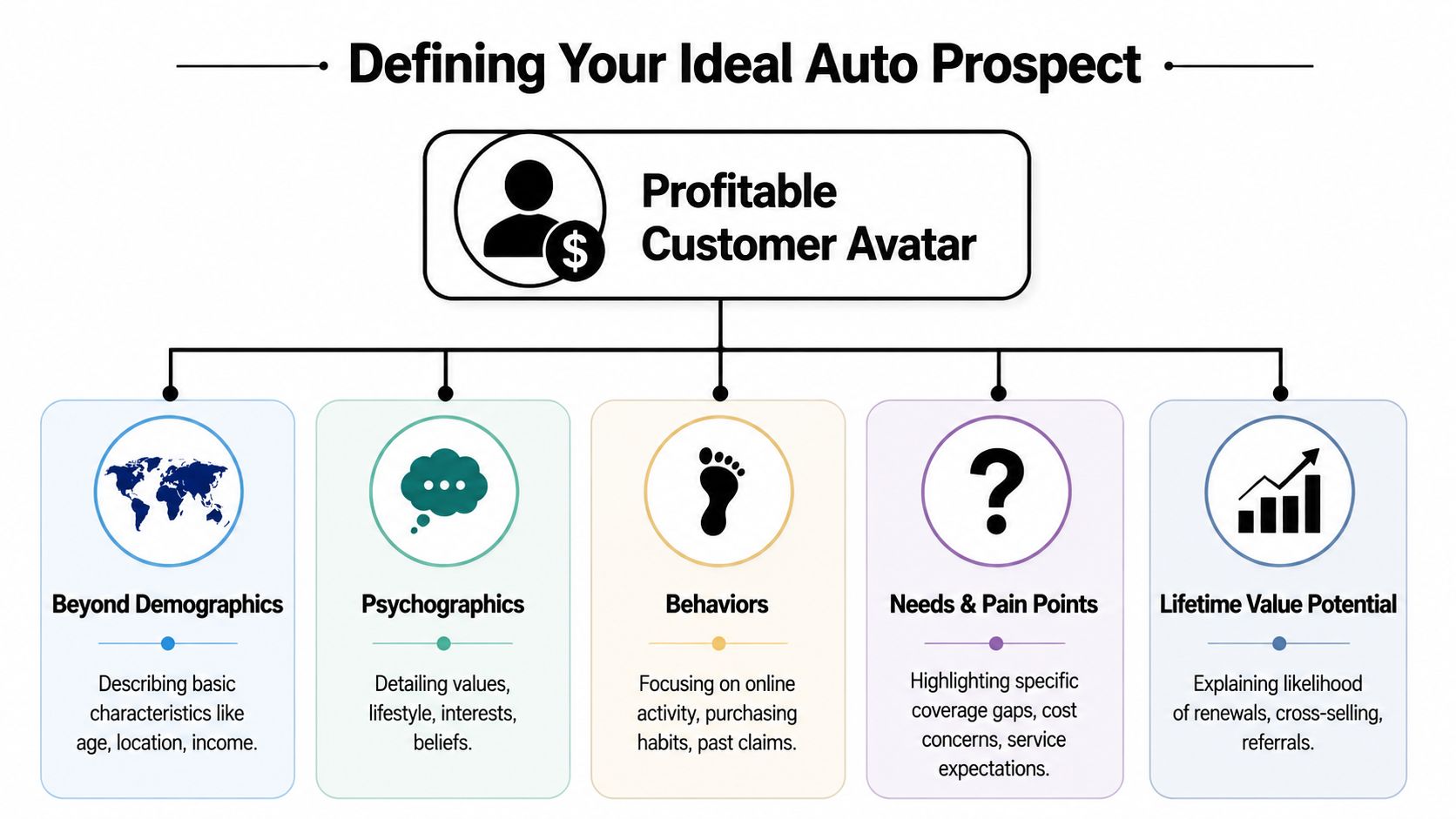
A profitable auto prospect profile should include more than age and ZIP code. Use a practical worksheet.
- Placement fit: Which carrier or program would likely take this risk?
- Urgency trigger: Why is this shopper looking now? Renewal shock, adding a teen driver, recent move, reinstatement need, financing requirement.
- Reachability: Do they answer calls, reply to text, finish forms, or prefer digital-only contact?
- Service load: Will this account need heavy handholding or straightforward processing?
- Lifetime value potential: Is this likely to stay mono-line, or can it expand into renters, home, umbrella, or referral activity?
One useful way to sharpen this is by segmenting leads by business model and vertical logic rather than treating all inquiries as interchangeable. This piece on improving lead scoring with verticals is helpful because it pushes you to define qualification criteria around specific market realities rather than generic interest.
A lead isn't "good" because it asked for a quote. It's good because your agency can realistically turn it into a policy.
Examples of profitable specificity
Broad messaging gets broad problems. Specific targeting gives your team a cleaner sales conversation.
Consider the difference:
| Prospect type | Why it can work | Common trap |
|---|---|---|
| Families adding a teen driver | Clear trigger, high urgency, bundling opportunity | Generic quote pages that don't address premium shock |
| Drivers needing SR-22 | Immediate need, strong intent | Campaigns routed to staff who can't qualify fast |
| Lapse or reinstatement shoppers | Short buying window, strong motivation | Weak appetite match with appointed carriers |
| Multi-car households | Higher account value potential | Slow quoting process kills momentum |
| Local preferred-risk drivers | Easier placement and service | Overly broad ads attract mismatched traffic |
Most agencies don't need more personas. They need fewer, tighter, more placeable ones.
Choosing Your Lead Generation Channels
More channels do not fix a weak pipeline. Agencies usually lose more revenue from slow follow-up, bad routing, and low-contact rates than from a shortage of lead sources. Channel strategy matters, but only if the source fits the way your team sells.
The right question is simple. Which channels produce prospects your staff can contact fast, quote accurately, and close at a profit?
That standard rules out a lot of attractive noise.
Organic channels
Organic search is a strong fit for agencies with a narrow offer, a defined service area, and the patience to build pages around real buying intent. Local coverage pages, Google Business Profile work, and scenario-specific content can produce leads with better context because the shopper has already seen how you position the offer.
It also takes time and upkeep. Agencies that publish a handful of generic blog posts and stop rarely see meaningful quote volume. Organic works best as an owned channel that compounds over time, not as a fix for this month's production gap.
Paid channels
Paid acquisition buys speed. Search ads capture active shoppers. Paid social is better for remarketing, audience building, and specific local offers than for broad quote traffic. Third-party lead vendors can fill the calendar fast, but they expose every weakness in your operation.
That trade-off gets expensive quickly. If your team takes ten minutes to respond to a form lead, your media buying skill matters less than your handoff process. Speed-to-lead decides whether paid channels print profit or waste budget.
This is also where form design matters more than many agencies expect. A long quote form can improve lead detail and still crush conversion. A short form can raise submission volume and flood the team with weak inquiries. Good channel economics depend on matching the form to buyer intent, then automating the first response. This overview of lead form best practices is useful if you're tightening that balance.
Purchased leads
Purchased leads deserve a harder look than they usually get.
Shared leads can work for agencies with disciplined call handling, extended coverage hours, and immediate automation. Without that setup, you are paying to enter a race you are structurally built to lose. Exclusive leads reduce competition, but they still fail if the source sends poor-fit shoppers or your producers cannot connect on the first attempt.
I have seen agencies blame lead quality when the problem was response time, weak scripts, or no retry cadence. Before adding a vendor, confirm who gets the lead, how fast they act, how many contact attempts happen in the first hour, and what percentage turns into quoted opportunities.
Relational channels
Referrals, dealer relationships, mortgage and real-estate partners, and local business alliances still produce some of the cleanest opportunities in personal lines. Trust transfers. The conversation starts warmer. Cross-sell potential is usually better.
They are slower to build and harder to forecast. A referral channel is only dependable if you ask consistently, track the source, and follow up well enough that partners keep sending people.
Auto Insurance Lead Channel Comparison
| Channel | Cost Pattern | Lead Quality/Intent | Scalability | Best Fit |
|---|---|---|---|---|
| Organic SEO and content | Upfront time and content investment, then lower marginal cost | Often strong when pages match local and scenario-specific intent | Moderate over time | Agencies building a long-term local pipeline |
| Google PPC | Can become expensive fast without tight keyword control and fast follow-up | High when search intent is clear | High with budget and operational discipline | Capturing active shoppers now |
| Paid social | Usually less direct-buying intent than search | Mixed. Better for remarketing and niche audience targeting | High | Agencies with defined offers and strong follow-up automation |
| Exclusive purchased leads | Higher cost, lower competition | Can be solid if source quality and routing are controlled | Moderate | Teams that call fast and qualify well |
| Shared purchased leads | Lower cost, high competition | Volatile because several agencies may contact the same shopper | High volume, lower control | Agencies built for instant outreach |
| Referrals and partnerships | Low media cost, high relationship effort | Often high trust and better account potential | Lower and relationship-dependent | Agencies with strong service reputation and a repeatable referral process |
What usually works in practice
A balanced mix beats channel hopping.
For most agencies, the strongest setup is one fast-demand source, one owned source, and one relationship source. Search or purchased leads create volume now. Organic content and local visibility reduce dependence on paid traffic over time. Referrals and partnerships improve close rates and account quality.
The catch is operational, not theoretical. Do not add a channel until your team can respond immediately, route leads cleanly, and track quote-to-bind performance by source. In 2026, the agencies that win do not just generate more leads. They waste fewer of the leads they already paid for.
Designing Your High-Conversion Campaign Funnel
More traffic rarely fixes a weak funnel.
Auto insurance campaigns usually lose money after the click, not before it. The ad got the shopper's attention. Then the landing page drifted off-message, the form asked for too much, and the handoff into the CRM left the buyer guessing about what would happen next. Agencies often blame lead quality at that point. In practice, funnel design is the first leak to fix.
Match the page to the shopper's reason for clicking
Intent match does a lot of the conversion work.
A shopper searching for SR-22 help should land on an SR-22 page. A parent looking for teen driver coverage should not hit a generic agency homepage with broad copy about saving money on auto insurance. That mismatch creates hesitation, and hesitation kills form completion rates.
Each landing page should answer four questions within a few seconds:
- Am I in the right place?
- Do you handle my situation?
- How much work is this quote request?
- What happens after I submit?
That means specific headlines, short supporting copy, and trust cues that can be verified. Use service area details, real carrier access language, office hours, and honest response expectations. Skip vague promises your team cannot support operationally.
Cut form friction without wrecking lead quality
This is a trade-off, not a slogan.
Shorter forms usually convert better because they preserve momentum. Longer forms can improve lead quality, but only if your traffic source already carries strong intent and your team effectively uses the extra information. If producers ignore half the fields on the first call, those fields are hurting conversion with no return.
A practical starting point is simple. Collect enough to route and start the conversation:
- Contact details: Name, phone, email
- Location detail: ZIP code or service area
- One qualifier: Current insured, renewal window, lapse status, or driver type
- Consent language: Clear permission and follow-up expectations
If you want a practical checklist, these lead form best practices are useful because they focus on reducing friction, clarifying expectations, and improving completion quality.
The first form should start the sales process, not complete underwriting.
Write copy around real shopping triggers
Insurance pages often fail because the copy sounds generic and interchangeable. Shoppers respond better when the page reflects the problem they are trying to solve right now.
Use language tied to actual triggers:
- Need coverage after a lapse
- Adding a teen driver
- Shopping after a renewal increase
- Need an SR-22 filing
- Comparing rates before renewal
That style of copy lowers cognitive load and improves self-qualification. It also gives your follow-up team cleaner context once the lead hits the CRM.
Keep the funnel architecture tight
Complex funnels are not the goal. Clear funnels win more often because they are easier to measure, troubleshoot, and route correctly.
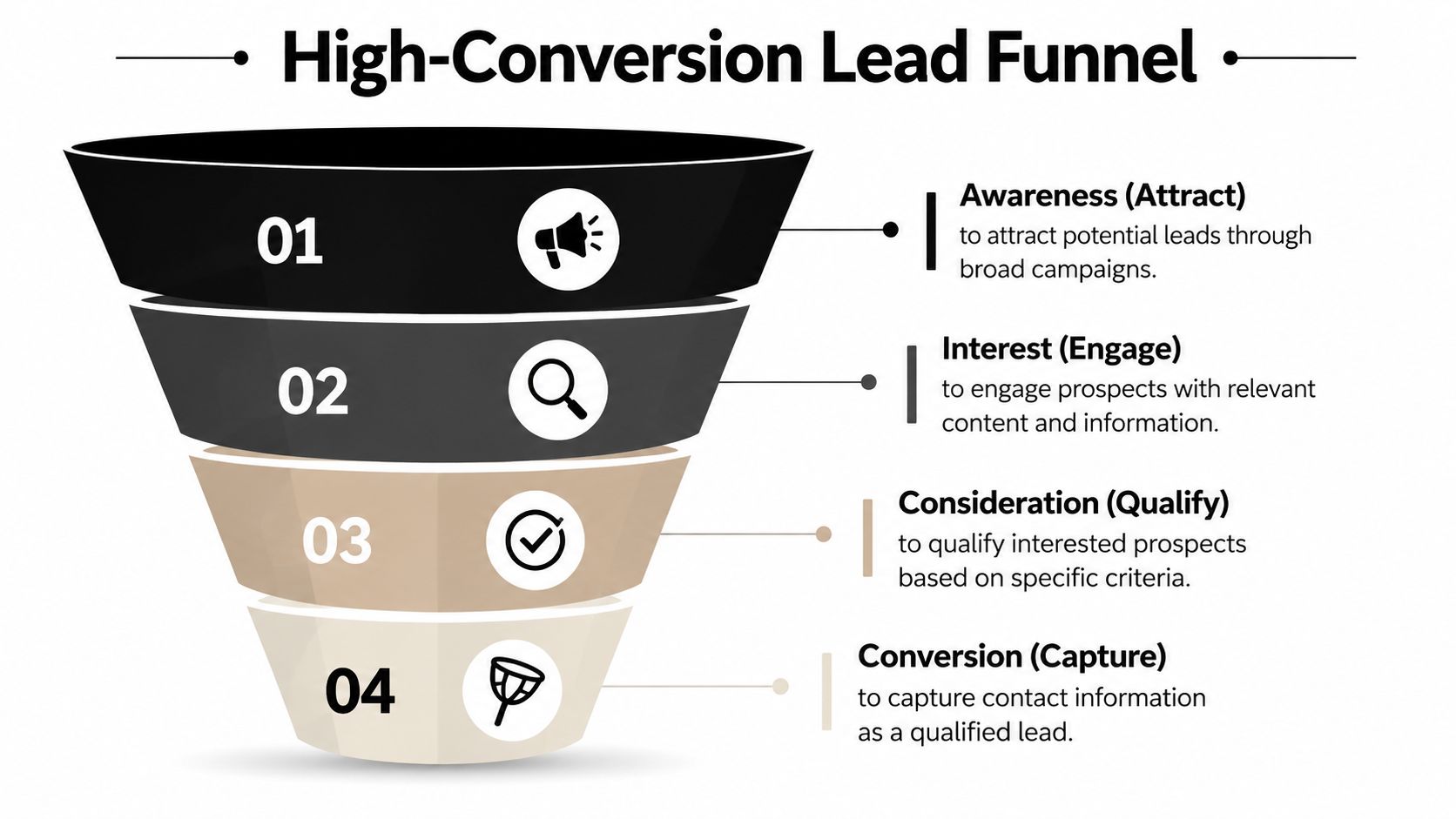
A workable auto insurance funnel usually looks like this:
| Funnel stage | What to build |
|---|---|
| Ad or search entry | Tight match between keyword or audience and offer |
| Landing page | One scenario, one audience, one primary CTA |
| Form | Minimal fields, clear reason to submit |
| Confirmation page | Set expectations for response method and timing |
| CRM handoff | Immediate routing by source, coverage type, and geography |
The confirmation step gets overlooked. It matters because it reduces drop-off between submission and contact. Tell the shopper exactly what happens next, whether that is a call, text, or quote review request. Agencies that win speed-to-lead consistently do this well before the first rep ever picks up the phone.
Underperforming funnels usually do not need more software. They need tighter message match, fewer unnecessary fields, and a cleaner path from click to conversation.
Mastering Instant Follow-Up and Qualification
More lead volume usually is not the main constraint. Follow-up failure is.
Agencies lose good auto prospects in the first few minutes after the handoff. The form gets submitted after hours. An inbound call hits the office while everyone is tied up. A producer plans to call back after finishing a quote and never gets to it. By the time someone responds, the shopper has already talked to two other agents.
Fast follow-up changes the economics of lead generation because it protects spend you have already made. If you buy traffic, pay for clicks, or invest staff time into referrals and local search, slow response turns that investment into leakage. Agencies that respond first usually get the first real conversation. In personal lines, that advantage matters because many shoppers are requesting quotes from several places at once.
The first five minutes need structure
Speed alone is not enough. A rushed call with no qualification path creates busywork and low-quality handoffs.
The first contact should do four jobs. Confirm the inquiry is real. Find out why the shopper is looking now. Check whether the risk fits your appetite. Move the lead to a clear next step.
That process should be prebuilt, not left to individual rep habits.
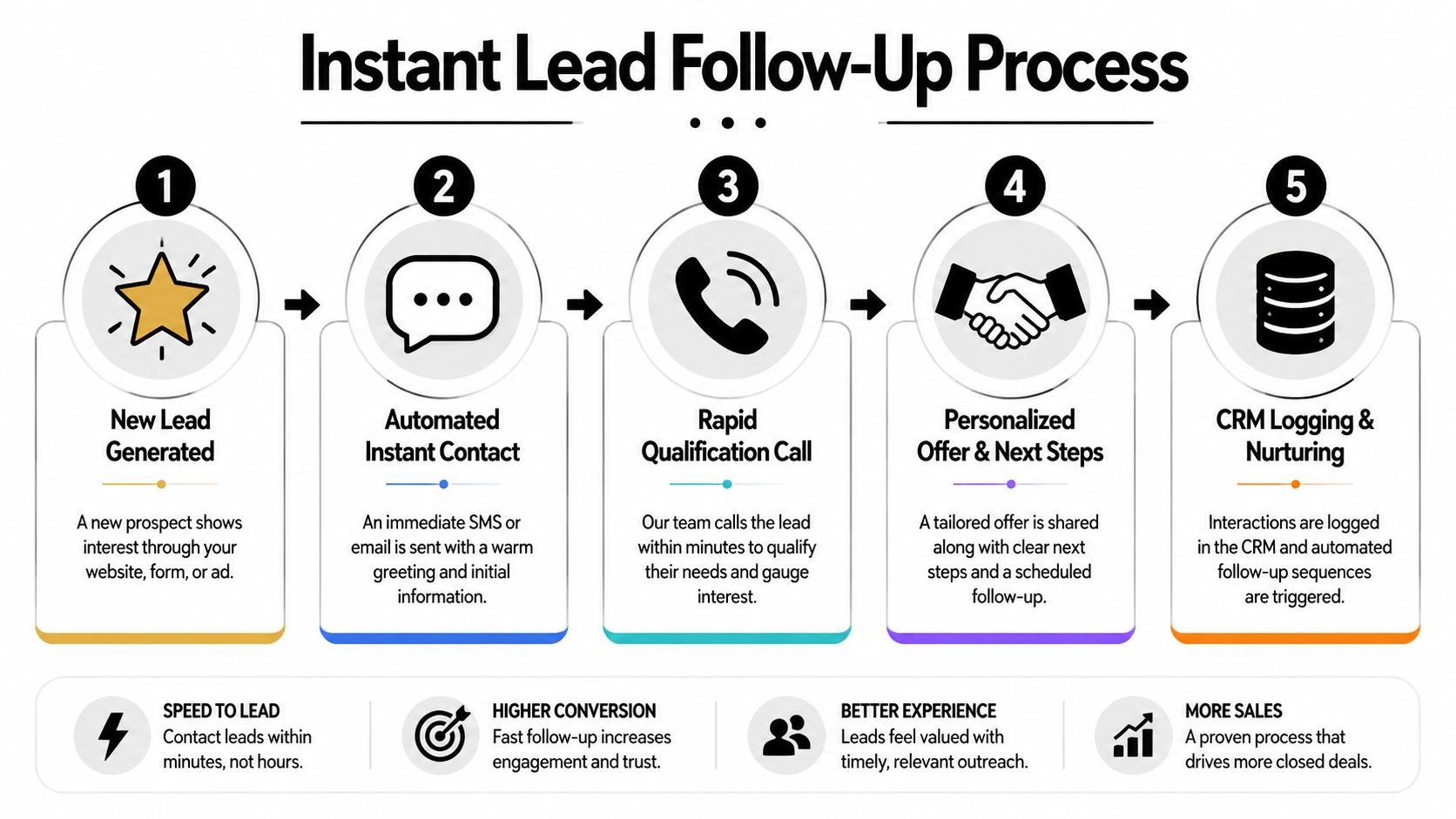
A practical workflow usually includes:
- Instant acknowledgment: Text or email confirms the request and sets response expectations
- Immediate first attempt: Call or text starts automatically based on channel and time of day
- Basic qualification: Identify trigger, timeline, vehicle count, prior coverage status, and any special handling such as SR-22
- Routing logic: Send standard personal auto to the right queue and flag edge cases for experienced staff
- Persistent follow-up: If there is no answer, continue on a timed sequence instead of waiting for someone to remember
The script matters as much as the speed. "Just following up on your request" is weak. A better opening ties back to the shopper's likely trigger, such as a renewal increase, a lapse, adding a driver, or needing proof filed quickly. That gets to intent faster and gives your team better information before a quote is started.
Missed calls are lead loss, not a phone issue
A missed inbound call is usually a paid lead you failed to catch.
Agencies often separate "lead gen" from "phone handling" as if they are different systems. They are the same revenue system. If your ads, SEO, or referral partners drive calls and nobody answers, the marketing did its job and operations failed. I see this constantly in audits. Teams keep looking for a new source while existing demand is leaking through unanswered calls, slow callbacks, and weak after-hours coverage.
That is why missed-call text back, after-hours response, and callback queues deserve the same attention as ad targeting and landing page conversion.
Here's a short demo that illustrates the operational side of fast AI-driven calling workflows:
Speed-to-lead isn't a sales tactic. It's a service standard for buyers who are actively shopping.
Where AI voice automation fits
AI voice automation helps when lead volume is uneven, staffing is thin, or response gaps happen outside business hours. It can place the first call within seconds, ask a short set of qualifying questions, capture intent, and hand the conversation to a licensed agent when the lead is ready for a real quote discussion.
That makes sense for agencies with enough inbound volume to justify process automation. It makes less sense if the underlying routing is messy, scripts are vague, or nobody owns the handoff. Automation does not fix weak operations. It exposes them.
Used well, the workflow looks like this:
| Step | Action |
|---|---|
| Lead enters CRM | Trigger immediate outreach |
| First touch | Automated text or call confirms inquiry |
| Qualification | System asks basic fit and timing questions |
| Routing | Hot lead goes to licensed agent or scheduled callback |
| Nurture | Unreached or not-yet-ready lead enters follow-up sequence |
One option in this category is Voicedial.ai, which provides AI voice agents for inbound and outbound follow-up, qualification, and appointment booking. The primary implication is operational. Agencies that want to win speed-to-lead without matching every new lead source with more headcount need automation, clear routing rules, and defined takeover points for human agents.
The goal is not to automate everything. The goal is to get to the right human conversation faster, with enough context to quote efficiently and without wasting producer time on leads your system should have filtered earlier.
Tracking Optimizing and Measuring True ROI
Most agencies still judge auto insurance lead generation by cost per lead. That's too shallow to run a profitable system.
A cheap lead source can be a bad investment if it produces weak contact rates, poor fit, and low close quality. A more expensive source can be excellent if it reaches placeable shoppers your team can bind efficiently.
Measure the full maturation window
A high-performing workflow tracks KPIs such as contact rate, quote rate, and closing rate over the full lead maturation window, which can be three months or more, and best-practice follow-up combines calls with welcome emails and SMS because shoppers prefer different communication channels, according to Digital Media Solutions' workflow guidance for auto insurance prospects.
That means your dashboard should not stop at form fills.

Track the funnel in layers:
- Top of funnel: lead volume by channel, page, audience, and offer
- Contact layer: response speed, first-contact success, missed-call recovery
- Sales layer: quote rate, appointment rate, closing rate
- Economics layer: cost per quoted prospect, cost per bound policy, item count
- Retention layer: renewal behavior, cross-sell potential, referral activity
Use metrics to make operating decisions
Measurement only matters if it changes behavior.
If one source sends lots of leads but poor contact rates, that may be a timing issue, not a traffic issue. If one landing page converts but quote rates are weak, the promise may be attracting the wrong shopper. If one script produces a lot of conversations but few handoffs, your qualification standard may be loose.
A simple review rhythm helps:
- Weekly: response speed, contact outcomes, source-level quality trends
- Monthly: quote and bind performance by channel and campaign
- Quarterly: retention quality, appetite alignment, and budget reallocation
The healthiest agencies don't ask which channel generated the most leads. They ask which system generated the most profitable policies with the least operational drag.
This is what turns marketing from a gamble into a manageable machine. The channels matter. The pages matter. The scripts matter. But the greatest impact arises from connecting acquisition, follow-up, qualification, and measurement into one operating system.
If your agency is generating inquiries but losing momentum in follow-up, Voicedial.ai is worth evaluating as part of that operating system. Its AI voice agents handle inbound and outbound calls around the clock, qualify prospects, answer common questions, and book appointments automatically, which fits the exact gap many auto insurance teams struggle with: instant response without adding more manual calling capacity.