

An AI sales agent is an autonomous system built to handle sales conversations from start to finish. It works around the clock to qualify leads, book appointments, and follow up with prospects. Think of it as a tireless, perfectly consistent member of your sales team—one that scales your outreach efforts without increasing your headcount.
What Is an AI Sales Agent and Why Does It Matter Now?

At its core, an AI sales agent is a specialized form of artificial intelligence designed to automate the high-volume, repetitive tasks that eat up a sales team’s day. This isn't just another chatbot or a simple auto-dialer. It's an intelligent system that can understand natural human language, navigate complex conversations, and make decisions based on the logic you give it.
Imagine a pipeline clogged with thousands of old leads your team never had time to circle back to. An AI sales agent can systematically call every single one, identify anyone with renewed interest, and place a qualified, ready-to-talk prospect directly on your calendar. This technology is the bridge between those missed opportunities and closed deals.
The Shift From Manual Effort to Automated Intelligence
For decades, sales development has been a numbers game—one defined by manual grunt work. A human Sales Development Representative (SDR) might make 50-100 calls a day, grinding through rejections, voicemails, and sheer fatigue. That model has always had hard limits on scale and consistency.
An AI sales agent completely rewrites that equation. It can manage hundreds or even thousands of conversations at the same time, ensuring every lead is contacted promptly and professionally. This leap in efficiency solves several huge business challenges:
- Scaling Outreach: Instantly ramp up call volume without the cost and time of hiring and training new reps.
- Reducing Costs: Lower your cost-per-lead by automating top-of-funnel activities, freeing up your human reps for high-value work.
- Improving Conversion: Capitalize on lead interest with immediate follow-up, day or night.
The growing demand for this kind of efficiency is undeniable. The AI SDR market is on track to hit $15.01 billion by 2030, signaling a massive industry shift. In fact, 22% of sales teams have already replaced human SDRs with AI to manage high lead volumes in sectors like insurance and home services. You can discover more insights on the state of AI sales prospecting and see how other businesses are adapting.
This isn’t about replacing skilled salespeople. It's about augmenting them. An AI agent handles the repetitive grind of prospecting, so your expert closers can focus on what they do best: building relationships and sealing deals.
This technology matters now more than ever because it provides a direct, measurable solution to rising customer acquisition costs and the need for greater operational speed. For any business in a competitive market—from legal intake to medical device sales—the ability to engage every potential customer instantly is a massive advantage.
Comparing a Human Sales Rep to an AI Sales Agent
To really grasp the difference, it helps to see a side-by-side comparison. While a human SDR brings creativity and emotional intelligence, an AI agent delivers unmatched scale, consistency, and efficiency for top-of-funnel tasks.
| Feature | Traditional Human Sales Rep | AI Sales Agent |
|---|---|---|
| Operating Hours | 8-10 hours/day, 5 days a week | 24/7/365, including holidays |
| Call Capacity | 1 call at a time, ~50-100 calls/day | Hundreds of concurrent calls, thousands/day |
| Response Time | Varies; can be minutes or hours | Instant, engages leads in seconds |
| Consistency | Performance varies (mood, fatigue) | 100% consistent, follows script perfectly |
| Cost | $70k+ per year (salary, benefits, overhead) | A fraction of the cost, scales affordably |
| Data Entry | Manual CRM updates, prone to error | Fully automated, real-time CRM sync |
| Training Time | Weeks or months to ramp up | Hours to configure and deploy |
Ultimately, the goal is to combine the strengths of both. Let the AI handle the high-volume, repetitive work of prospecting, and let your human team focus on the nuanced, relationship-driven work of closing deals.
How AI Sales Agents Understand and Converse

The ability of an AI agent to hold a genuinely human-like conversation isn’t magic. It's the result of several powerful technologies working together in perfect sync. The real engine behind these interactions is Natural Language Processing (NLP), the field of AI that gives machines the ability to read, understand, and interpret human language.
Think of NLP as the AI’s “ears and brain.” When a prospect says something, NLP immediately gets to work, breaking down their sentences to figure out what they really mean. It identifies keywords, grasps intent, and can even pick up on sentiment. This is how the AI knows the difference between what someone is saying and why they're saying it.
This understanding is then supercharged by machine learning (ML), which acts as the agent's memory and learning center. With every single call, the system gathers new data, recognizes patterns, and refines its approach. If one way of handling an objection consistently leads to more booked demos, the ML model learns and adapts, making the agent smarter and more effective over time.
The Brains of the Operation: NLP and Machine Learning
These two technologies create a powerful feedback loop. NLP processes the live conversation happening right now, while machine learning uses the data from thousands of past calls to steer the AI toward the best possible response. This cycle of continuous improvement is what separates a true AI sales agent from a basic robocaller.
Here’s a look at how it works in a real conversation:
- Speech-to-Text Conversion: First, the AI instantly transcribes the prospect's spoken words into text. This happens in a fraction of a second.
- Intent Recognition: NLP jumps in to analyze the text and figure out the customer's goal. Are they asking a question ("What are your prices?"), raising an objection ("I'm not interested right now"), or showing interest ("Tell me more about that")?
- Intelligent Response Generation: Based on that intent, the AI selects the best conversational path from its script. Machine learning helps ensure this choice is optimized based on what has worked in the past.
- Text-to-Speech Synthesis: Finally, the system converts its chosen text response back into natural-sounding speech, continuing the conversation without ever missing a beat.
This entire process happens in milliseconds, creating a seamless, real-time conversation. The quality of the AI's voice and its ability to mimic human intonation are what really build rapport and keep prospects on the line.
Inbound vs. Outbound: The Two Faces of an AI Agent
While the core technology is the same, AI sales agents are usually put to work in two very different roles, each designed for a specific part of the sales funnel. Getting this distinction right is key to making them work for you.
An inbound AI sales agent is like a digital receptionist, ready 24/7 to engage leads the moment they show interest. When someone fills out a form on your site or calls your business after hours, the inbound agent is there to respond instantly. It qualifies them, answers their first few questions, and gets a follow-up booked with a human sales rep.
The main job of an inbound agent is all about speed-to-lead. It makes sure no marketing-generated interest goes cold by making contact within seconds of the lead coming in.
On the other hand, an outbound AI sales agent is a proactive prospecting machine. It tirelessly works through lists of cold or old leads, making hundreds of calls an hour to dig for potential opportunities. Its purpose is to handle the massive volume of initial outreach needed to find those few interested prospects buried in a large database, filtering out all the noise so your sales team doesn't have to.
From Script to Conversation
A great AI sales agent is built on a meticulously crafted script that anticipates the flow of a real sales call. These aren't the rigid, linear scripts of the past; they are dynamic conversation trees with multiple branches for every possible customer response.
The process of building one looks like this:
- Define the Goal: What's the main objective? Is it to book a demo, qualify for a quote, or transfer the call to a live person?
- Map Scenarios: Think through all the common questions, objections, and conversational detours that might come up.
- Craft Responses: Write human-like replies that sound natural and empathetic, not like a robot reading from a screen.
- Set Triggers: Define the exact criteria for when the AI should push for a meeting versus when it should hand the call off to a human closer.
For example, if a prospect says, "I need to talk to my partner first," the AI doesn't just give up. It navigates to a specific "spousal objection" branch in its script, maybe responding with, "That makes perfect sense. Would it be helpful to schedule a brief call for a time when you are both available?" This ability to navigate objections intelligently is what turns an AI agent into a genuine sales tool.
The Real Business Impact of an AI Sales Agent
The technology is cool, no doubt. But what really matters is the bottom-line impact an AI sales agent brings to the table. We're not just talking about theory here; this is about real, measurable gains in revenue, efficiency, and your ability to grow. Businesses putting these systems to work aren't just tweaking a process—they're rewriting their entire growth story.
The effect is immediate and powerful, especially for companies swimming in leads. Think about an insurance brokerage. They can set an AI agent loose on a list of thousands of aged leads, instantly finding the ones who are still interested and booking calls. Or a home services business can keep its calendar packed with qualified appointments, killing the downtime that eats into profits.
This isn't just about making more calls. It's about building a sales engine that's more efficient, more profitable, and operates at a scale you could only dream of before. The result is a direct and undeniable boost to your revenue.
Drastically Reduce Operational Costs
Hiring, training, and keeping a team of human Sales Development Representatives (SDRs) is a huge expense for any sales department. You've got salaries, benefits, commissions, not to mention the overhead for software and office space. An AI sales agent offers a compelling alternative that slashes this cost per lead.
Instead of paying a full salary for one rep who might make 100 calls a day, you can deploy an AI agent that makes thousands for a fraction of the cost. This frees up your budget to hire expert human closers who can focus their energy on high-stakes, final-stage negotiations.
An AI sales agent isn’t a replacement for your best salespeople; it's a force multiplier. It handles the monotonous, top-of-funnel grind so your skilled team can focus on building relationships and closing deals.
This cost-efficiency means you can suddenly go after leads you might have written off. That old database of prospects from two years ago? It just became a goldmine, ready to be explored for new opportunities without burning expensive human hours.
Scale Your Outreach Instantly
Picture this: you need to triple your sales outreach tomorrow. With a human team, you'd be looking at a long, expensive cycle of recruiting, hiring, and training. With an AI sales agent, scaling is as simple as turning a dial in the software.
This on-demand scalability is a game-changer for businesses reacting to market shifts or seasonal demand.
- Launch New Campaigns: Instantly hit thousands of prospects the day you launch a new product or service.
- Respond to Market Trends: Quickly ramp up outreach the moment demand in your industry spikes.
- Maximize Lead Lists: Buy a massive lead list and have your AI agent contact every single person within hours, not weeks.
This kind of immediate scalability ensures you never miss an opportunity due to a lack of manpower. Your outreach capacity is no longer tied to headcount; it’s driven purely by your strategic goals.
Achieve Higher Conversion Rates
In sales, speed is everything. The chance of converting a lead plummets after just five minutes. An AI agent completely erases this delay, engaging with new leads the second they show interest—whether that's 2 PM on a Tuesday or 2 AM on a Sunday.
This immediate, consistent follow-up catches prospects at their peak moment of interest, dramatically boosting the odds of booking that critical first meeting. On top of that, AI agents deliver a perfect, consistent pitch every single time, giving you total quality and compliance control on every call.
The market data backs this up. The wider AI in sales market is set to explode from USD 8.8 billion in 2025 to USD 63.5 billion by 2032. Companies are jumping on this because it flat-out works. Today, 81% of sales teams have already implemented AI, and they are 1.3x more likely to see revenue growth. You can explore more AI sales agent statistics to see just how big this shift really is.
Real-World Scenarios and Industry Use Cases
The real power of an AI sales agent snaps into focus when you see it solve actual, everyday business problems. Talking about "efficiency" and "scalability" is one thing, but watching this technology break a real-world bottleneck is what really matters. From waking up old, dead leads to making sure no new opportunity is ever missed, the applications are as practical as they are powerful.
Let’s look at some concrete examples of how businesses are putting these agents to work. These aren't theoretical concepts; they show how the technology becomes a core part of a company’s growth engine and delivers results you can actually measure.
Home Services Full Calendars with Automated Follow-Up
Picture a roofing company sitting on a database of 5,000 leads from the last three years. These are all homeowners who got a quote but never pulled the trigger. The sales team is way too busy chasing new, hot inquiries to even think about manually calling a list that massive.
- The Problem: A goldmine of old leads is just collecting dust, representing thousands in potential revenue. Calling them all by hand is far too slow and expensive, especially for leads with a low chance of converting.
- The AI Agent Solution: An outbound AI sales agent gets to work, methodically calling all 5,000 contacts. It uses a friendly, low-pressure script to re-engage them, asking if a roof replacement is still on their mind and offering a fresh, no-obligation inspection.
- The Measurable Outcome: The agent is a workhorse, making thousands of calls in just a few days. It pinpoints dozens of homeowners who are now ready to talk, booking 30% more qualified quote appointments and filling the sales team’s calendar with opportunities that would have been lost forever.
Legal Intake Qualifying Cases Around the Clock
A personal injury law firm invests heavily in marketing that brings in calls 24/7, including late nights and weekends. When their small intake team is off the clock, every call goes straight to voicemail. By Monday morning, many of those high-value potential clients have already dialed a competitor.
- The Problem: The firm is bleeding valuable cases because they can’t offer immediate, live intake for every single caller. Each missed call could be a six-figure case walking out the door.
- The AI Agent Solution: An inbound AI sales agent is set up to answer every call that comes in after hours. It follows a precise script to handle the initial qualification, asking the right questions about the incident, injuries, and other critical details.
- The Measurable Outcome: The AI agent makes sure every call is answered and pre-qualified instantly. It captures all the essential info and schedules a follow-up with a paralegal for qualified callers, stopping lead leakage in its tracks and massively boosting the firm's case sign-up rate from its marketing efforts.
This isn't about replacing legal professionals. It’s about creating a perfect handoff. The AI handles the initial, repetitive data gathering so that the human team can dedicate their expertise to high-value client consultations from the very first minute.
Insurance Brokerages Re-Engaging Old Prospects
An independent insurance broker specializing in Medicare plans has a familiar problem. Every year, they have a long list of prospects who showed interest but never enrolled during the last Annual Enrollment Period (AEP). For busy agents focused on new leads, manually calling that list is always the lowest priority.
- The Problem: Agents just don’t have the bandwidth to nurture and re-engage a large database of past prospects. Because of this, a predictable source of seasonal business is completely untapped.
- The AI Agent Solution: The brokerage deploys an AI agent to contact the entire list of last year's prospects a few weeks before the next AEP kicks off. The agent's script is conversational and helpful, reminding them of their past interest and asking if they’d like to schedule a time to review the new plans for the year.
- The Measurable Outcome: The AI campaign successfully warms up the cold list, flagging individuals who are ready to look at their options again. It books dozens of pre-scheduled appointments directly into the agents' calendars, giving them a huge head start on their busiest season and driving a significant increase in total policy sales.
Each of these scenarios shows off a core strength of an AI sales agent: its ability to handle high-volume, consistent, and immediate outreach that human teams simply can't match at scale. It turns forgotten lead lists into active sales pipelines and makes sure no new opportunity is ever wasted because of bad timing or a lack of resources.
To see just how versatile this is, let's look at the projected performance gains across a few different sectors.
Projected Performance Gains by Industry
The table below gives you a clearer picture of how an AI sales agent can directly impact key business metrics in various industries. While results vary, the pattern of improvement is consistent.
| Industry | Key Metric Improved | Potential Improvement Rate |
|---|---|---|
| Real Estate | Qualified Showing Requests | 35-50% |
| Financial Services | Initial Consultation Bookings | 25-40% |
| Healthcare | New Patient Appointments | 30-45% |
| B2B SaaS | Demo-Qualified Leads | 20-35% |
| Home Services | In-Home Estimate Bookings | 40-60% |
| Insurance | Policy Review Appointments | 30-50% |
What this data really shows is that the impact isn't marginal. By automating the top of the funnel—the initial contact, qualification, and scheduling—businesses are seeing substantial lifts in the exact activities that lead to revenue. It’s a direct line from automated outreach to a healthier bottom line.
A Practical Plan for Implementing Your AI Agent
Bringing an AI sales agent onto your team might sound like a huge technical lift, but it’s actually a pretty straightforward process when you break it down. Think of it less like flipping a switch overnight and more like building a new, valuable asset for your sales floor. Like any good asset, it needs a solid foundation to deliver the best results.
The first step is the most important: getting crystal clear on exactly what you want this agent to accomplish. This initial strategy phase will guide every single decision you make, from which vendor you partner with to how you write the very first line of your script.
Stage 1: Discovery and Vendor Selection
Before you can build anything, you need to find the right partner and platform. This isn’t just a tech decision; it’s about finding a provider who gets your world, whether that’s the compliance maze of insurance or the rapid-fire appointment setting of home services. A great partnership starts with asking the right questions.
Here’s what you should be looking for:
- Voice Quality: Does the AI actually sound human? Ask for live call samples so you can hear it in action.
- Script Customization: Can the platform handle complex conversation paths with multiple branches, or is it just a simple Q&A bot?
- CRM Integration: How well does it play with your existing CRM? You need it to log calls and update lead statuses without any manual work.
- Analytics and Reporting: What kind of dashboard will you get? You need clear visibility into KPIs like answer rates and how many appointments are actually being booked.
This whole process is about mapping a provider's capabilities directly to your business goals. Taking the time to properly vet vendors ensures you pick a platform that not only works for you today but can grow with you tomorrow.
Stage 2: Scripting and Compliance
Once you’ve got a partner, the focus shifts to crafting the conversation itself. This is where your deep industry knowledge meets the AI’s technical power. A great script is more than a list of things to say; it’s a strategic map designed to guide a prospect toward a specific outcome, like booking that demo.
You’ll need to anticipate the common questions and objections and script responses that are natural and empathetic. For anyone in regulated industries like insurance or finance, this is also the stage where you embed compliance right into the dialogue, making sure every interaction ticks the legal boxes.
Think of your script as the AI's playbook. A well-designed script allows the agent to navigate conversations with the same nuance and objective-driven focus as your best human sales rep.
Stage 3: Integration and Testing
The last phase before you go live is all about plugging the AI agent into your current workflow. This usually means integrating it with your CRM, dialer, and calendar systems to make sure qualified leads are handed off to your human team smoothly and automatically. A solid integration is what keeps hot leads from falling through the cracks.
This flow chart gives a good visual of how it works, turning an old, cold lead into a freshly booked appointment.
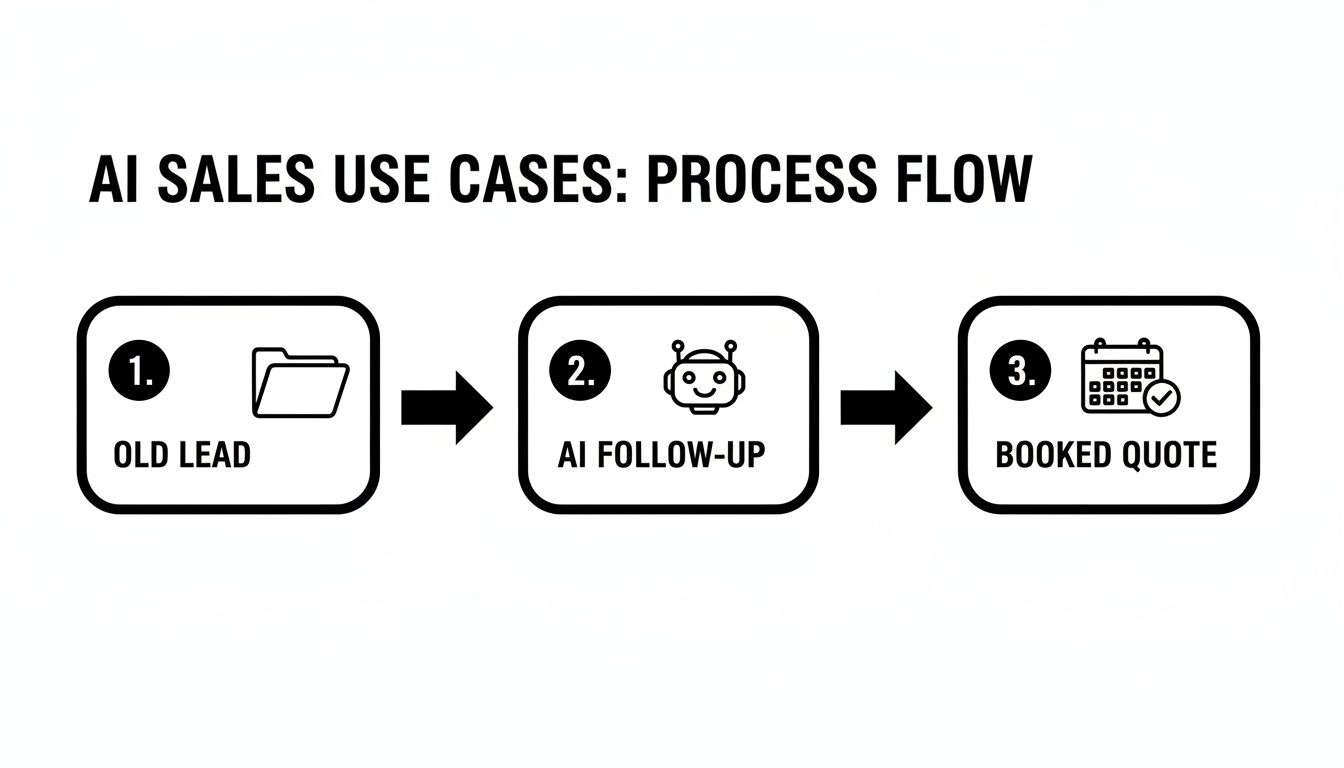
As you can see, the AI can take a lead that’s been sitting dormant and turn it into a confirmed meeting, automating that entire re-engagement process.
After integration, you'll want to run a pilot. Test the agent on a small, controlled list of leads to see how it performs, iron out any kinks in the script, and make sure all the data is flowing into your CRM correctly before you unleash it at full scale.
This structured approach—from picking a vendor to final testing—sets your AI agent up for success right out of the gate. In fact, many single-agent systems can be fully up and running in just a few weeks. The market is definitely moving toward these specialized AI agents, with growth projected at a staggering 62.7% CAGR in niches like legal intake and credit repair. You can read the full research about AI agent market growth to get a better sense of where things are headed.
How to Choose the Right AI Sales Agent Partner
Picking the right AI sales agent partner is probably the most important decision you'll make. This isn't just about buying software; it’s a strategic choice that will directly shape your success. Not all platforms are created equal, and the last thing you want is an AI that sounds robotic and frustrates your prospects.
Think of it like hiring a new sales director. You wouldn't just glance at a resume. You'd dig in, check references, and make sure they're a perfect fit for your team and your goals. Apply that same level of diligence here. A great vendor is more than a technology provider—they’re a partner who gets your industry and is invested in your growth.
Evaluating Core Technical Capabilities
First things first, you need to get under the hood and look at the tech. A slick sales pitch doesn't mean much if the platform can't deliver a genuinely human-like conversation. The goal is to find an AI sales agent that becomes a seamless extension of your brand, not a clunky robot that turns people off.
Here’s what to zero in on:
- AI Voice Quality: This is non-negotiable. Ask for live or recorded call samples. Does the voice have natural pacing, tone, and inflection? If it sounds like a GPS from 2005, keep looking. A high-quality voice is crucial for building rapport.
- Scripting Flexibility: Real sales conversations are messy and unpredictable. The platform has to handle that. It needs to support dynamic, multi-path scripts that can navigate objections, answer tough questions, and adapt on the fly.
- CRM and Systems Integration: Automation only works if it's seamless. The agent must be able to log calls, update lead statuses, and book meetings directly into your CRM and calendar without anyone on your team lifting a finger.
A platform's real value is its ability to plug into your existing sales workflow without creating more work. If your team has to manually clean up data because of poor integration, the whole point of automation is lost.
Focusing on Partnership and Industry Expertise
Beyond the tech, you need a partner who actually understands your business. A script that works wonders for a home remodeling company will be a complete disaster in a highly regulated field like insurance or finance. You want a provider who has already walked this road in your industry.
When you're talking to potential vendors, ask them some direct questions:
- Can you show me case studies from companies in my industry? This proves they've delivered real results for businesses like yours, not just in theory.
- How do you handle industry-specific compliance and regulations? This is critical for anyone in finance, legal, or healthcare. Don't let them give you a vague answer.
- What does support look like after we launch? You're looking for a partner who will help you optimize scripts and campaigns over time, not someone who just hands you the keys and disappears.
Choosing the right AI sales agent is an investment in your company's future. By digging into both the technical nuts and bolts and their real-world industry experience, you can make a smart decision that fills your pipeline and drives growth for years to come.
Got Questions About AI Sales Agents? We've Got Answers.
When you're looking at new technology, it’s natural to have questions. For something like an AI sales agent, decision-makers want to get past the buzzwords and understand how it really works on a practical level before they commit. Here are the straight answers to the most common questions we hear.
How Human-Like Do These AI Agents Actually Sound?
Let’s be honest, we’ve all been frustrated by robotic, monotone phone menus. Modern AI voice technology is a world away from that. Today’s best AI sales agents are built on advanced text-to-speech engines that don’t just read words—they mimic human intonation, natural pauses, and conversational pacing.
The result is a voice that is often indistinguishable from a live caller, especially within the flow of a typical sales call. This isn't just for show; that human-like quality is absolutely critical for building enough rapport to keep a prospect on the line and gauge their interest. The goal is a smooth, natural conversation, not another automated dead end.
What Kind of Setup Is Required From My Team?
This is where people are often pleasantly surprised. The setup process isn't about heavy technical lifting on your end. It’s more about a strategic brain dump—your team provides the subject matter expertise, and the vendor builds it into the AI.
Typically, you'll be involved in:
- Defining the Goal: What’s the win? Booking a demo? Qualifying a lead? We need to know the destination before we build the map.
- Script Collaboration: You’ll work with the vendor’s team to outline the ideal conversation, including how to handle common questions and pushback.
- CRM Connection: Just provide the access credentials, and the AI agent will link up with your CRM to log every call and update records automatically.
Most of the complex technical work is handled by the vendor. Your team’s real job is to pour your industry knowledge into the system so the AI sounds like a genuine expert from your company.
How Does an AI Agent Handle Complex or Angry Customers?
An AI sales agent is designed to work within a defined conversational playbook. It’s a master at navigating the standard questions and objections because it has a pre-scripted path for each one.
But what happens when a call goes completely off the rails, or a customer gets heated? The AI is programmed with a clear exit strategy. It’s trained to recognize emotional cues like anger or extreme frustration and execute a seamless handoff. For example, it might say, "I completely understand. Let me get you over to my manager who can sort this out for you," before instantly routing the call to a human on your team.
Is My Customer Data Secure with an AI Platform?
Data security isn’t just a feature; it’s the foundation. Any reputable AI sales agent provider builds their platform with serious security protocols to protect your customers' sensitive information. This should include things like end-to-end encryption for all call data and strict adherence to privacy regulations like GDPR or HIPAA, if applicable.
When you're evaluating a vendor, don't be shy. Ask them directly about their security measures, data handling policies, and any compliance certifications they hold. A partner worth their salt will be completely transparent about how they keep your data safe, giving both you and your customers total peace of mind.
Ready to see how a tireless, perfectly consistent AI sales agent can fill your sales pipeline? Voicedial.ai provides human-like voice agents that book qualified appointments 24/7. Schedule your free discovery call today.