

Imagine your best sales development representative (SDR). Now, imagine they could make thousands of perfectly scripted calls in a single day, never get tired, and work around the clock to make sure no lead is ever missed. That’s the core idea behind AI outbound sales calls.
What Are AI Outbound Sales Calls
These systems aren’t the clunky robocallers of the past that just play a recorded message. We're talking about sophisticated conversational AI that uses natural language processing (NLP) to have dynamic, two-way conversations.
The AI agent can actually understand what a prospect is saying, answer their questions, handle common objections, and make smart decisions based on how the dialogue unfolds.

Think of it as deploying an entire automated sales development team. This team takes on the most repetitive, time-sucking parts of the sales process:
- Initial Outreach: Making that first contact with thousands of leads from a list.
- Lead Qualification: Asking the right questions to figure out if a prospect is a good fit.
- Appointment Setting: Booking qualified meetings directly onto a human closer's calendar.
The Shift from Human Effort to AI Execution
Outbound sales has always been a brutal numbers game. Reps would burn hours every day just dialing, facing rejection, and leaving voicemails, all for a handful of real conversations. It's inefficient, tough to scale, and frankly, demoralizing for even the best teams.
AI outbound calls completely flip this model. Instead of people grinding through low-value, repetitive work, the AI handles the entire top-of-funnel slog. This frees up your expert salespeople to do what they do best: focus on high-intent, pre-qualified conversations where their skills actually matter.
This technology transforms outbound from a manual chore into a scalable, data-driven system. The AI's job is to sift through the noise and deliver qualified appointments; the human's job is to turn those appointments into revenue.
How It’s Changing Outbound Sales
This isn’t some far-off concept—it’s a reality that's rapidly taking over modern sales floors. The sheer complexity of today's outbound funnel, with its mix of timing, compliance, and intent signals, has just become too much for a person to manage alone.
It’s no surprise that AI is projected to direct a staggering 70% of outbound activity by 2026. Data from Salesforce shows that 81% of sales teams are already using or at least experimenting with AI. The goal is to get reps out of the chaotic world of dialing for dollars and into strategic conversations that build a solid pipeline. You can find more insights on these outbound sales trends from Koncert.
Ultimately, AI-powered calling represents a fundamental change in how businesses grow. It lets companies have more meaningful conversations at a scale that was once impossible, turning a cold list of names into a predictable source of revenue.
AI Calling vs Human Calling At A Glance
To put it all in perspective, it’s helpful to see a direct comparison. While both AI and human agents have their place, they excel in very different areas of the sales process.
This table breaks down the key operational differences.
| Aspect | AI Outbound Calls | Traditional Human Calls |
|---|---|---|
| Scalability | Can make thousands of concurrent calls | Limited to one call at a time per rep |
| Consistency | 100% script adherence, no deviation | Performance varies based on mood, energy, and skill |
| Operating Hours | 24/7/365, no breaks or holidays | Standard business hours, requires breaks |
| Cost Per Call | Cents on the dollar, scales cheaply | High cost per interaction (salary, benefits, overhead) |
| Core Task | Top-of-funnel: outreach and qualification | Mid/bottom-of-funnel: relationship building, closing |
| Data Capture | Automatic, real-time logging of every detail | Manual and often inconsistent data entry |
| Emotional Factor | None; immune to rejection and fatigue | Susceptible to burnout and emotional drain |
As you can see, AI isn't here to replace skilled salespeople. It's here to handle the high-volume, repetitive work they shouldn't be doing in the first place, allowing them to focus on closing the deals the AI has teed up.
The Core Business Benefits Of Using AI Sales Agents
Thinking about AI for outbound calls as just another operational tweak is missing the point entirely. It’s a fundamental strategic shift that rewrites the economics of your sales process. The real advantage isn’t just making more calls; it’s about building a predictable, scalable engine for generating pipeline.

Just picture trying to scale a traditional sales development team. The sheer effort of hiring, training, and managing enough reps to dial thousands of leads daily is a massive drain on time, money, and focus. AI sales agents completely remove that barrier.
A single AI system can run thousands of calls at the same time, hitting a volume that is physically impossible for a human team. This isn't just about raw speed. It's about achieving massive scalability without the ballooning overhead. You can reach an entire lead list in an afternoon, not a whole quarter.
Slash Costs and Boost Efficiency
The financial upside of automating the top of your funnel is immediate and powerful. When you deploy AI outbound sales calls, you’re automating the most repetitive, time-consuming, and expensive part of sales: the initial outreach and qualification grind.
This allows you to slash your cost-per-lead and cost-per-appointment. Instead of a salaried SDR burning hours dialing a list full of unqualified leads, the AI does the heavy lifting for pennies on the dollar. It only hands off warm, conversation-ready prospects to your human closers.
By automating top-of-funnel qualification, you're not just saving money—you're reallocating your most valuable resource, your sales team's time, to revenue-generating conversations.
This newfound efficiency has other perks, too. AI agents deliver 100% lead follow-up, making sure no prospect ever falls through the cracks because of human error or a rep being overloaded. They can work 24/7, engaging leads the second they show interest—a critical factor for conversion.
Drive Higher Conversions with Perfect Consistency
One of the biggest headaches with a human sales team is inconsistency. Reps have good days and bad days. They get tired, go off-script, or suffer from burnout. AI agents, on the other hand, operate with perfect, machine-like consistency.
Every single call follows the proven script. Every objection is handled according to your best practices. And every lead gets the exact same high-quality experience. This consistency doesn't just create predictability; it drives superior results. The numbers back this up: AI automation has been shown to deliver 451% more qualified leads and 50% more sales-ready leads at a 33% lower cost. Sales teams using AI also report 78% shorter deal cycles and 76% higher win rates thanks to this incredibly consistent and efficient approach. You can dig into more of these powerful cold calling statistics on Trellus.ai.
Finally, every AI-powered call is a data-gathering opportunity. This constant feedback loop gives you incredible insight into what’s resonating with your market and what’s falling flat. You can quickly analyze:
- Which opening lines get the best responses.
- What time of day produces the highest answer rates.
- The most common objections your prospects raise.
This data is a goldmine. It lets you continuously refine your scripts, understand your market on a much deeper level, and build a truly data-driven sales pipeline that you can actually count on.
Real-World Use Cases For AI Outbound Sales
Theory is one thing, but seeing how AI outbound sales calls actually drive results is where the rubber meets the road. These AI agents aren't just a concept; they're actively booking appointments, reviving dead lead lists, and scaling outreach for businesses across dozens of industries. Let's dig into how companies are using this technology to solve very specific problems and win more business.

The applications are incredibly diverse and go far beyond simple appointment reminders. From high-volume lead qualification to targeted customer reactivation, AI callers are a flexible and powerful tool for growth.
Insurance Agency Lead Qualification
Picture an insurance agency that specializes in ACA and Medicare plans. They’re spending a hefty marketing budget to get thousands of online quote requests. The catch? Speed-to-lead is everything. A human team can only dial so fast, and hot leads turn ice-cold in just a few minutes.
Problem: An inability to instantly contact and qualify every single new web lead, leading directly to missed opportunities and wasted ad spend.
AI Solution: An AI calling agent is hooked directly into the lead generation forms. The second a prospect hits "submit," the AI is on the phone. It's programmed to ask key qualifying questions like, "Are you looking for coverage for yourself or your family?" and "Are you currently receiving any government assistance for healthcare?"
Results: The AI agent makes contact with 100% of new leads within 60 seconds of their inquiry. It filters out anyone who isn't a good fit and books appointments with eligible individuals right onto the calendars of licensed agents. This instant, perfect follow-up dramatically boosts conversion rates from lead to consultation.
Home Services Customer Reactivation
A successful home services company, like an HVAC business, is often sitting on a goldmine: its past customer list. A database of 10,000 previous clients who haven't booked in over a year is a huge asset, but calling them all for seasonal maintenance is a monumental task for a small office team.
Problem: A massive list of dormant customers that is simply too large for the internal team to contact efficiently for seasonal tune-ups, leaving predictable revenue on the table.
AI Solution: The company unleashes an AI caller to work through the entire list of 10,000 past customers. The AI’s script is friendly and familiar, referencing their previous service and offering a special discount for a seasonal HVAC tune-up. It can handle basic questions and navigate straight to scheduling.
By automating this reactivation campaign, the business can engage its entire past customer base in just a few days—a task that would have taken a human team months to complete. The AI caller breathes new life into a stagnant list, turning it into a powerful source of new appointments.
Results: The campaign successfully books hundreds of high-margin maintenance appointments without pulling a single technician or office staffer away from their main jobs. The ROI is immediate and substantial, proving the value of systematically re-engaging past clients.
Medical Device Distributor Outreach
For a medical device firm launching a new product, just getting the attention of busy distributors is a huge hurdle. The outreach has to be professional, informative, and—most importantly—compliant with strict industry regulations. The goal isn't a hard sell; it's to gauge interest and qualify potential partners.
Problem: The need to contact hundreds of potential distributors to introduce a new device, a time-consuming process that demands careful, compliant communication every single time.
AI Solution: An AI agent is scripted with precise, pre-approved language to introduce the new medical device. It calls a curated list of distributors, qualifies their interest, and determines if they meet the criteria to become a partner. For anyone interested, the AI schedules a follow-up call with a senior product specialist.
Results: The firm efficiently gauges market interest across the country in record time. The AI ensures every call is perfectly compliant, and the sales team only spends its valuable time with pre-vetted, interested distributors. This seriously accelerates the go-to-market timeline.
Legal Intake and Case Screening
Law firms get a constant stream of inquiries, but not every case is viable or a good fit. Manually screening each potential client eats up valuable paralegal and attorney time that could be spent on billable work. It’s a classic bottleneck.
Problem: The initial client intake process consumes huge amounts of staff time to screen a high volume of inquiries, many of which don't even meet the firm's basic criteria.
AI Solution: The firm sets up an AI caller as the first point of contact for all new inquiries. The AI asks a series of non-legal, fact-finding questions to determine the basic viability of a case, like "When did the incident occur?" or "Were there any injuries?"
Results: The AI effectively filters all incoming inquiries. It flags promising cases for immediate follow-up by the legal team and politely directs non-fitting inquiries to other resources. This frees up staff to focus only on high-potential clients, improving both efficiency and the firm's bottom line.
How To Design High-Converting AI Call Scripts
An AI agent is only as good as the conversation you teach it to have. When you sit down to script an AI call, you have to throw out the old playbook of writing a rigid monologue. Think of yourself less as a scriptwriter and more as a conversational designer. Your job is to build intelligent pathways that guide prospects toward a clear, specific goal.
The first few seconds of any call make or break the entire interaction. Your AI’s opener absolutely must be a pattern interrupt—something that shatters the prospect’s automatic “no” reflex. Ditch the generic, "Hi, is this John?" Instead, try something more direct and transparent that immediately gives them context.
A stronger opener might sound like this: "Hi, this is an AI assistant from Voicedial.ai calling about your recent inquiry. Can I take 27 seconds to explain why I’m calling?" It’s unexpected, it's specific, and it hands control back to the prospect, dramatically increasing the odds they’ll actually listen.
Start With The End Goal In Mind
Before you write a single word, you need to know exactly what you want the call to accomplish. Is the goal to book a demo? Qualify a lead for a specific service? Reactivate a past customer? Every single branch of the conversation has to lead back to this one objective.
Remember, the purpose of most AI outbound sales calls isn't to close a sale on the spot. It's to expertly qualify the lead and book the next step with a human.
This means your script needs to be laser-focused on gathering key pieces of information. For an insurance AI, this could be verifying household size or an income range. For a home services AI, it might be confirming the age of an HVAC system.
Build Smart Conversational Pathways
A great AI script feels like a "Choose Your Own Adventure" book. It needs to anticipate what a prospect might say and have a pre-planned route for every common response. This involves mapping out the most likely questions, objections, and even diversions.
- Anticipate Objections: What happens when the AI hears "I'm busy," "Not interested," or "Just email me"? Don't just program it to give up. Design respectful but persistent responses, like, "I understand. Would tomorrow at 10 AM be better for a quick chat?"
- Use Simple Language: Stay away from jargon, marketing fluff, and complicated sentences. The AI should sound like a helpful assistant, not a walking advertisement. The language must be clear, simple, and direct.
- Create Question Loops: The best way to guide a conversation is by asking questions. After the AI delivers a piece of information, it should always end with a question to prompt a response, like, "Does that sound like it could help your team?"
The key is to design a conversation, not a speech. Your AI script should be a series of questions and branching logic that allows the prospect to guide the interaction while your AI gently steers it toward the desired outcome.
Optimize Through Continuous A/B Testing
Let's be clear: your first script will never be your best one. The real magic of using AI for sales calls is the ability to test, measure, and optimize at a scale humans could only dream of. Once your campaign is live, you should be constantly A/B testing different elements to improve performance.
What can you test?
- Openers: Test different opening lines to see which one gets the highest engagement rate.
- Value Propositions: Try framing the benefits in different ways to see what resonates most.
- Tones of Voice: Experiment with different AI voices—male, female, high-energy, or more measured—to find what connects with your audience.
- Calls-to-Action: Test different ways of asking for the meeting to see which one produces the highest booking rate.
By digging into the data from these tests, you can methodically refine your script, turning a good conversation into a high-converting one. This data-driven approach is what separates a basic AI dialer from a strategic sales tool that consistently delivers qualified appointments to your team.
Navigating Compliance In AI Outbound Calling
In the high-stakes world of outbound sales, compliance isn't just a box to check—it's the foundation of a sustainable strategy. When you use AI outbound sales calls, you amplify your reach, but you also amplify your responsibility to play by the rules. Getting this wrong can lead to crippling fines, a damaged brand, and a total loss of customer trust.
The legal landscape is dominated by a few key regulations, with the Telephone Consumer Protection Act (TCPA) being the big one in the United States. The TCPA sets strict rules for how businesses can contact consumers, especially on their cell phones. At its core is the requirement for “express written consent” before you can use an automated system to call or text a mobile number.
This isn't a simple checkbox buried in your terms and conditions. It has to be a clear, unambiguous agreement from the prospect, letting them know they will receive marketing calls from you. Modern AI platforms like Voicedial.ai are built to manage this, ensuring you only dial leads who have explicitly given you the green light.
Staying On The Right Side Of The Law
Beyond the TCPA, your compliance strategy needs to cover a few other critical areas. If you let these slide, even the best AI campaign can get shut down fast.
- Do Not Call (DNC) Lists: You are legally required to scrub your calling lists against both the National DNC Registry and your own internal DNC list. This is non-negotiable. If someone tells your AI agent, "Don't call me again," your system must automatically add them to your internal list and never contact them again.
- AI Disclosure: Transparency is everything. In many states, you are legally required to disclose that the prospect is talking to an AI or a recording. A simple, upfront statement like, "Hi, this is a recorded line," or "I'm an AI assistant," is usually all you need.
- Time-of-Day Restrictions: You can't just call whenever you want. Regulations dictate when you can call residential numbers, generally banning calls before 8 a.m. or after 9 p.m. in the recipient's local time zone. A compliant AI system automatically respects these calling windows without you having to think about it.
Protecting Your Caller ID Reputation
One of the biggest operational risks in high-volume calling is having your numbers flagged as "Spam Likely" by phone carriers. This will kill your connect rates almost overnight. Some reports show that spam-labeled calls can tank connect rates by a staggering 40-70%, making your campaigns practically worthless.
Modern AI platforms proactively manage caller ID health. They do this by rotating numbers and constantly monitoring their reputation to keep them from getting flagged. This is a critical, often-overlooked feature of a good AI calling system that has a direct impact on your ROI.
This focus on a clean, positive calling experience also happens to be what customers want. A recent study found that 32% of customers actually prefer interacting with AI for its speed and to avoid repeating themselves. It just goes to show how important a smooth, compliant, and efficient system really is. For more on this, you can dig into these sales automation statistics and insights from Utmost Agency.
Ultimately, a compliant approach isn't about limiting your campaigns; it's about making them work for the long haul. By using an AI platform built with these legal guardrails from the ground up, you get the confidence to scale your AI outbound sales calls responsibly, protecting your business while building a predictable, healthy pipeline.
Measuring Success With Key AI Calling Metrics
To really get a handle on what AI outbound sales calls can do, you have to look past vanity metrics like "dials made." Sure, the sheer volume is impressive, but it’s meaningless without results. Success isn't about how busy your AI is; it's about the real, tangible business outcomes it generates. You can't improve what you don't measure, and tracking the right Key Performance Indicators (KPIs) is what separates a guessing game from a data-driven sales strategy.
This is where the real-time analytics from platforms like Voicedial.ai become so critical. They give you a live dashboard with a clear, unfiltered view of your campaign’s health. This lets you spot trends, make smart decisions, and see the direct financial impact of your AI agent in real time.
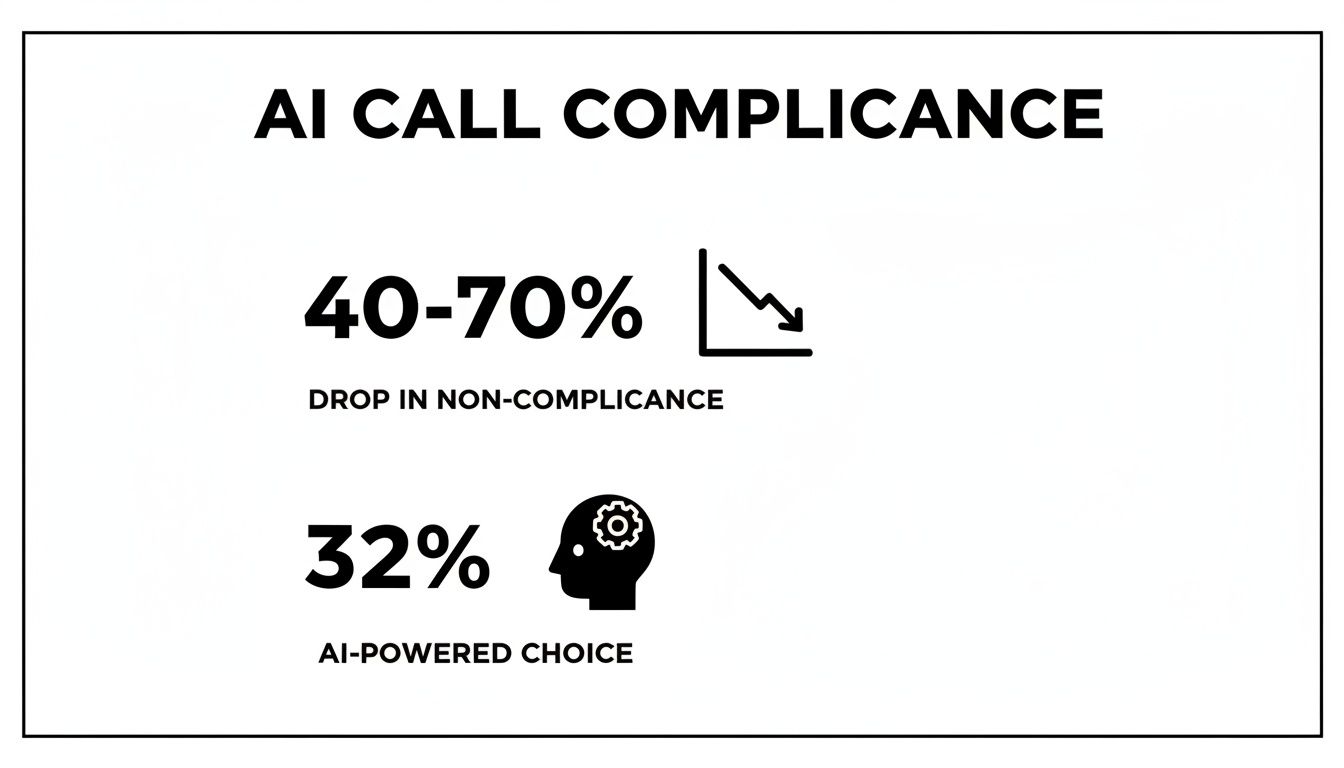
The data here is telling. A well-managed AI system doesn't just drive better results—it also aligns with what customers increasingly prefer: efficiency and clarity. A 40-70% drop in compliance issues isn't just a number; it's a massive reduction in business risk.
Core Metrics That Drive ROI
To get a true picture of performance, you need to focus on metrics that track the entire journey, from the initial connection all the way to a booked meeting. These are the numbers that tell a story about your script's effectiveness, the quality of your list, and the overall efficiency of your campaign.
Here are the numbers that actually matter:
- Answer Rate: What percentage of your calls are actually answered by a real person? This metric tells you a lot about your list quality and your caller ID reputation. If it’s low, your numbers might be getting flagged as spam.
- Qualification Rate: Of the calls that get answered, how many prospects are identified as qualified leads? This is a direct reflection of how well your script and targeting are working together.
- Appointment Booking Rate: What percentage of those qualified leads turn into a booked meeting on the calendar? This is the ultimate test of your AI's ability to execute its main job.
The Most Important KPI: Cost Per Appointment
While the rates above are crucial for diagnosing how your campaign is doing, the single most important metric for measuring ROI is Cost Per Appointment (CPA). This KPI boils everything down to one simple dollar figure: How much did it cost you to get one qualified, sales-ready meeting on the calendar?
Cost Per Appointment is your north star metric. It cuts through all the noise and gives you a clear, undeniable measure of your campaign's financial efficiency and its direct contribution to your sales pipeline.
By tracking your CPA, you can directly compare your AI agent's performance against other lead generation channels or even the cost of a human SDR. When you see a low and stable CPA, you know your AI outbound sales calls are doing more than just dialing—they're creating predictable, cost-effective growth for your business.
This data-driven approach takes all the guesswork out of the equation. You can confidently tweak your scripts, test new lists, and scale your campaigns, all while knowing exactly what it costs to generate each new opportunity.
Essential KPIs For AI Outbound Sales Campaigns
To truly master your AI calling strategy, you need a clear view of what’s working and what isn’t. This table breaks down the essential KPIs that every team should track. Think of it as the control panel for your outbound engine.
| Metric (KPI) | What It Measures | Why It's Important |
|---|---|---|
| Cost Per Appointment (CPA) | The total campaign cost divided by the number of appointments booked. | This is your primary ROI metric. It tells you the direct cost to acquire a sales-ready meeting. |
| Answer Rate | The percentage of dialed calls that are answered by a person. | Indicates list quality and caller ID health. A low rate may signal spam flagging. |
| Qualification Rate | The percentage of answered calls where the prospect is deemed qualified. | Measures the effectiveness of your script, targeting, and the AI's conversational ability. |
| Appointment Booking Rate | The percentage of qualified prospects that agree to book a meeting. | The ultimate conversion metric. It shows how well the AI closes for the appointment. |
| Average Conversation Length | The average time the AI spends talking to a prospect on answered calls. | Can indicate engagement levels. Very short calls may point to script issues. |
| No-Show Rate | The percentage of booked appointments where the prospect does not attend. | Helps evaluate the quality of the appointments being set and the effectiveness of reminders. |
Tracking these metrics gives you the insights needed to make informed adjustments. A low qualification rate might mean your script needs work, while a high no-show rate could signal that the AI is booking appointments with low-intent prospects. It’s all about using data to steer the ship.
Still Have Questions? Let's Clear Things Up.
It’s smart to have questions when you’re looking at bringing new technology into your business. When that technology touches something as important as sales outreach, you need clear, straightforward answers.
We get it. Even after seeing the benefits and real-world results, you probably have a few things you’re wondering about. Let’s tackle the most common questions we hear so you can see exactly how this works and where it fits.
Will AI Actually Replace My Sales Team?
The short answer? No. AI sales agents are here to empower your sales team, not to make them obsolete.
Think of the AI as your most dedicated Sales Development Representative (SDR). It’s a digital team member that tirelessly handles the most repetitive, high-volume, top-of-funnel work—all the prospecting that burns out your best people. This frees up your human closers to do what they do best: build relationships, navigate complex deals, and win business with pre-qualified, high-intent leads.
The AI's job is to fill the pipeline. Your team's job is to close the deals that drive revenue. It makes them more effective, not redundant.
How Do The AI Voices Actually Sound?
Forget the clunky, robotic voices of old automated systems. Today’s conversational AI is a world apart, using advanced deep learning and text-to-speech tech to generate stunningly human-like voices. They have natural tones, human-like inflections, and the kind of realistic pauses that make a conversation feel comfortable, not forced.
The point isn't to trick anyone. It’s to create a smooth, pleasant interaction that doesn't feel jarring or obviously automated. Many platforms even let you clone the voice of your best-performing agent, ensuring your brand’s tone—one you already know works—is consistent on every call.
This focus on quality ensures the very first touchpoint a prospect has with your brand is a positive and professional one.
How Quickly Can I Get An AI Calling Campaign Running?
The whole process is surprisingly fast. With a focused platform like Voicedial.ai, a business can move from strategy to a live campaign in as little as three weeks.
This timeline breaks down into a few clear stages:
- Discovery Call: We'll dig into your specific goals, who you’re targeting, and what makes a lead qualified for your team.
- Script Development: We map out the conversation flows and how the AI will handle common objections, all based on your business rules.
- Voice Asset Creation: You'll select or create the AI voice that perfectly represents your brand.
- List Integration and Testing: We connect your lead list and run final checks to make sure everything is running flawlessly.
The whole process is managed for you, so you get a fully customized and effective AI agent dialing for your business without a months-long, complicated setup.
What Happens When A Prospect Says They’re Not Interested?
This is where thoughtful conversational design is crucial. A well-built AI agent is programmed to handle disinterest and objections gracefully. Using natural language understanding, it recognizes common rejections like, "I'm not interested," "I'm busy," or "This isn't a good time."
Instead of awkwardly pushing forward, the AI is scripted to respond politely and respectfully based on rules you define. You can configure it to:
- Politely end the call right away.
- Ask if there’s a better time to connect in the future.
- Mark the lead for removal from the current campaign.
This ensures every single interaction, even one that doesn't lead to an appointment, protects your brand's reputation. The AI never gets frustrated or argumentative, which is a win on every call.
Ready to see how a dedicated AI calling agent can transform your outreach and fill your sales pipeline with qualified appointments? At Voicedial.ai, we build, deploy, and manage human-like AI agents that handle your sales calls 24/7. Schedule a demo with Voicedial.ai today and discover the power of scalable conversations.