

An AI appointment setter is a piece of intelligent software that takes over the entire process of scheduling meetings with your leads and customers. Think of it as a tireless digital assistant—one that works 24/7 to engage prospects, qualify them, and book them directly into your team's calendar without any human getting involved.
What Is an AI Appointment Setter
Imagine cloning your top-performing sales assistant—the one who is always on, never takes a break, and can somehow juggle thousands of conversations at once. That's what an AI appointment setter brings to the table. It’s not just another chatbot that pops up on a website; this is a proactive tool designed to drive real business growth.
This technology goes way beyond basic scheduling links. It actually starts and manages two-way conversations over phone calls, SMS, or web chat. It feels a lot like a human receptionist or a sales development rep (SDR), but it's supercharged with artificial intelligence.
An AI setter’s primary job is to turn a list of potential leads into a calendar full of qualified appointments. This frees up your sales team to focus on what they do best: closing deals, not chasing down prospects.
How the Technology Works
At its core, an AI appointment setter is a blend of several key technologies working together. This combination is what lets it understand human language, make smart decisions, and get tasks done automatically.
Here are the main ingredients:
- Natural Language Processing (NLP): This is the magic that allows the AI to understand and interpret what people say or type, including all the nuances, intent, and context. It’s why a lead can say, "I'm swamped tomorrow, how about next week?" and the AI knows exactly how to respond.
- Calendar Integration: The system plugs directly into your team’s calendars, like Google Calendar or Outlook. This gives it real-time access to everyone's availability, preventing double-bookings and finding the perfect slot for both the lead and your sales rep.
- Custom Scripting: You're in the driver's seat. The AI follows a carefully designed script to ask qualifying questions, handle common objections ("I need to think about it"), and guide the prospect smoothly toward a confirmed meeting.
In the world of sales outreach, these systems are proving to be a serious advantage. According to recent appointment setting research, businesses using AI-powered booking systems see 3.2 times higher conversion rates compared to old-school manual methods. The tech also leads to a 47% reduction in booking abandonment, as the AI conversationally guides prospects and removes the friction of filling out forms or waiting for someone to call back.
AI Setter vs Human Setter A Quick Comparison
While the human touch will always be valuable, an AI appointment setter offers some powerful advantages when it comes to efficiency and scale. It's not about replacing people, but about augmenting their efforts.
Here’s a quick look at how the two approaches stack up.
| Feature | Human Appointment Setter | AI Appointment Setter |
|---|---|---|
| Availability | Standard business hours | 24/7, including holidays |
| Capacity | One call at a time | Thousands of calls simultaneously |
| Cost | Salary, benefits, training | Monthly subscription fee |
| Consistency | Varies with mood and energy | Perfectly consistent every time |
| Data Tracking | Manual entry, often inconsistent | Automatic, real-time analytics |
Ultimately, the choice depends on your goals. An AI handles the high-volume, repetitive work flawlessly, letting your human team focus on building relationships and navigating complex sales cycles where their expertise truly shines.
The Business Benefits of AI Appointment Setting

So you understand what an AI appointment setter is. That opens the door to the real question: why should you care? The answer comes down to tangible, measurable results that hit your bottom line. Bringing this tech into your workflow isn't just about looking modern; it's about driving core business outcomes.
The advantages go way beyond simple convenience. From slashing operational costs to making sure no lead ever gets left behind, an AI agent can act as a powerful growth engine for your business. Let’s break down the specific benefits that make this tool a game-changer.
Drastically Reduce Operational Costs
Hiring, training, and managing an in-house team of appointment setters is a major investment. You’re on the hook for salaries, benefits, office space, and equipment—all of which add up fast. An AI appointment setter swaps those heavy overheads for a predictable, scalable subscription fee.
This shift frees up a ton of financial resources. The money you save on headcount can be poured back into other growth drivers, like marketing campaigns or product development. You get the output of a full team without the price tag.
Achieve Instant and Limitless Scalability
Imagine your real estate agency gets a list of 5,000 new leads on a Friday afternoon. For a human team, contacting everyone would take weeks, maybe even months. An AI appointment setter can start reaching out to all 5,000 leads at the same time over the weekend, engaging and qualifying them while your team is off the clock.
This is what true scalability looks like. Your business is no longer bottled-necked by how many calls one person can make in a day. Whether you have ten leads or ten thousand, the AI handles the volume without any drop in performance, making sure every opportunity is chased down with speed.
For businesses like credit repair firms and law practices that often get swamped with inquiries, this kind of scalability is a massive edge. In fact, analysis shows small to mid-sized businesses using AI see a 50-70% drop in missed calls and achieve 2-3x faster response times. This pushes booking rates as high as 15-52%—a number that manual follow-ups just can't touch. You can dive deeper into these findings in the full analysis of AI appointment setters from Hyperbound.ai.
Operate Around the Clock
Your leads don't operate on a 9-to-5 schedule. Interest can pop up at any time—late at night, first thing in the morning, or over a weekend. If a prospect is ready to talk but has to wait for your office to open, that initial spark of interest can die out fast.
An AI appointment setter works 24/7/365, capturing and engaging leads the moment they show interest. This constant availability means you’re always ready to book a qualified meeting, maximizing your chances of turning a curious browser into a serious sales opportunity. Your pipeline keeps filling up even when you're sound asleep.
Improve Lead Conversion and Follow-Up Speed
The first few minutes after a lead shows interest are absolutely critical. The faster you respond, the higher your odds of converting them. A delay of just five minutes can cause lead qualification rates to plummet. Human teams, often juggling multiple tasks, simply can't guarantee that instant follow-up.
An AI agent, on the other hand, can engage a new lead within seconds. This immediate, persistent, and perfectly scripted follow-up dramatically boosts conversion rates. On top of that, the AI automatically handles all the necessary reminders and rescheduling requests, which is proven to slash no-show rates and keep your sales calendar packed with genuinely interested prospects.
How Different Industries Use AI Appointment Setters

The true power of an AI appointment setter snaps into focus when you see it solving real-world business problems. While the basic function is always scheduling, its impact looks wildly different from one industry to the next—whether it's taming a flood of insurance calls or streamlining client intake for a busy law firm.
This isn't a blunt, one-size-fits-all tool. Think of it as a flexible technology that adapts to fix very specific operational headaches. Let’s look at how different sectors are putting AI to work, turning their scheduling chaos into tangible growth.
Insurance for ACA and Medicare
Insurance agencies, particularly those in the ACA and Medicare space, know the chaos of open enrollment all too well. It’s a seasonal tidal wave of calls that overwhelms agents, leaves leads waiting on hold for ages, and loses potential clients to busy signals.
The central challenge is managing these massive peaks in demand without the expense and hassle of hiring a temporary army of call center reps. An AI appointment setter is the perfect answer, acting as an infinitely scalable front line.
- 24/7 Lead Capture: The AI works around the clock, engaging prospects who are comparison shopping for plans late at night or on weekends.
- Instant Qualification: It immediately asks critical screening questions (like, "Are you currently enrolled in Medicare Part A and B?") to make sure agents only talk to people they can actually help.
- Automated Booking: Qualified leads get booked directly onto an agent's calendar, filling their pipeline with appointments that are ready to close.
This approach turns a frantic, high-anxiety period into a smooth, predictable machine, helping agents sell more policies while keeping operational costs firmly in check.
Home Services
For home service businesses—think plumbing, HVAC, or roofing—a single missed call often means a lost job. When a pipe bursts or an air conditioner dies, customers need help now and will simply dial the next company on their list if they can't get through. Disorganized scheduling and spotty follow-up are direct leaks in your revenue stream.
An AI appointment setter steps in as the ultimate 24/7 dispatcher, making sure no opportunity ever falls through the cracks.
The problem for home service pros isn't a lack of demand—it's the operational grind of capturing and managing that demand. An AI agent solves this by answering every single call, qualifying the job, and booking a service visit on the spot, even if it's 2 AM on a Sunday.
This system transforms your phone line from a point of failure into a reliable revenue engine. The AI can handle hundreds of calls at once, book non-urgent maintenance jobs for the future, and instantly escalate emergency calls to a human technician.
Medical and Dental Practices
Medical and dental offices are in a constant tug-of-war between patient care and administrative overload. Front desk staff are often swamped with in-person check-ins and insurance paperwork, forcing incoming calls to go straight to voicemail. Every missed call is a lost appointment and a hole in the schedule, which can easily cost a practice $200–$300 per unfilled slot.
An AI appointment setter designed for healthcare can manage this call volume with both precision and total compliance.
- HIPAA-Compliant: It's built to handle sensitive patient information securely, adhering to the strictest privacy rules.
- EHR Integration: The AI syncs directly with Electronic Health Records (EHRs) to see real-time calendar availability and book appointments without any manual data entry.
- Intelligent Routing: It answers common questions and schedules routine check-ups automatically, while knowing exactly when to transfer complex clinical questions or emergencies to the right staff member.
Research suggests that up to 70% of scheduling calls can be handled from start to finish without any human help, freeing up your team to focus on the patients standing right in front of them.
Legal and Financial Services
Law firms and financial advisors build their businesses on a steady flow of qualified consultations. The problem is, their highly-paid paralegals and advisors waste huge chunks of their day on screening calls with people who aren't a good fit. This flood of unqualified inquiries creates a massive bottleneck that slows down growth.
The core challenge is separating the signal from the noise. An AI appointment setter is a master at this, acting as a tireless intake specialist that never gets distracted.
It can be programmed with a script to ask the make-or-break qualifying questions right away:
- For a Law Firm: "Are you looking for help with a personal injury, family law, or business matter?"
- For a Financial Advisor: "Are you interested in retirement planning, investment management, or advice on debt consolidation?"
Based on the answers, the AI weeds out the tire-kickers and books consultations only with high-potential clients. This simple change ensures the firm’s experts spend their valuable time exclusively on activities that generate revenue, dramatically improving efficiency and the cost of acquiring a new client.
How to Get Your First AI Appointment Setter Up and Running
Bringing an AI appointment setter on board might feel like a major technical lift, but modern platforms have made it surprisingly straightforward. Think of it less like launching a software project and more like onboarding a new, highly efficient team member. This is a no-nonsense roadmap for business owners, not engineers, breaking the process down into simple, manageable steps.
The whole point is to get your AI agent ready for success, making sure it understands your business inside and out so it can have real, productive conversations with your leads. Let’s walk through the key phases to get your automated system live.
Phase 1: Define What "Winning" Looks Like
Before you even think about scripts, you need to be crystal clear on what you want this AI to actually do. This first step is the foundation for everything that follows. Is the main goal to cram your calendar with as many demos as possible? Or is it to carefully screen leads for a high-touch, enterprise sales process?
Get specific by asking these questions:
- What's the one action we want? Are you booking initial consults, follow-up meetings, or service calls?
- Who are we calling? Is the AI contacting ice-cold leads, warm marketing-qualified leads (MQLs), or existing customers?
- What's a successful outcome? A "win" could be a booked meeting, a fully qualified lead handed off to sales, or even just routing an urgent call to the right human.
Having a precise objective, like "book qualified demos for our enterprise software with marketing VPs," gives you a North Star for the entire project.
Phase 2: Design the Conversation
With your goals locked in, it’s time to design the actual conversation. This is where you give your AI appointment setter the smarts it needs to sound natural and, more importantly, get results. A great script isn’t a rigid monologue; it’s a flexible conversation flow.
Start by outlining the key moments in a typical call:
- The Opener: How will the AI introduce itself and build a little rapport in the first few seconds?
- The Qualification: What are the must-ask questions to figure out if a lead is a good fit?
- Handling Pushback: How should it respond to the classics like "I'm busy" or "Just send me an email"?
- The Ask: How will it smoothly pivot to booking the actual appointment?
The biggest mistake people make here is writing a robotic, one-way script. Don't. Think like a conversation designer. Map out the different ways a real person might reply and build paths for each scenario. You want the interaction to feel helpful and human, not automated and annoying.
Phase 3: Connect It to Your Tech Stack
For your AI to really make an impact, it can't live on an island. It has to plug right into the tools you already use to run your business. This integration step is what makes the whole system feel like magic, killing off manual data entry and preventing embarrassing scheduling mistakes.
There are two non-negotiable integrations:
- Your CRM: Connecting the AI to your Customer Relationship Management system (like Salesforce or HubSpot) is critical. It ensures all call notes, outcomes, and dispositions are automatically logged against the lead's record. This gives your sales team the full story for every meeting that lands on their calendar.
- Your Calendars: Syncing with your team's Google Calendar or Outlook is a must. This lets the AI see real-time availability and book appointments directly into open slots, stopping the dreaded double-booking before it ever happens.
Modern platforms like Voicedial.ai make this easy with simple, click-to-connect integrations, turning a technical headache into a few minutes of setup.
Phase 4: Run a Small-Scale Pilot
Never, ever unleash a new system on your entire database at once. The last step before you go big is to run a small, controlled pilot program. This is your chance to test everything in a live environment and smooth out the wrinkles without putting a huge chunk of your leads at risk.
Pick a small, representative group of contacts—maybe 50 to 100 leads—and turn your AI agent loose. During this test, you need to be obsessed with the results. Listen to the call recordings. Are there spots in the script where the AI sounds clunky or gets stuck? Are leads consistently hanging up at a certain point?
This feedback is gold. It gives you the real-world insights you need to tweak your script and settings before you hit the "go" button for everyone.
Creating AI Scripts That Actually Convert
An AI appointment setter is only as smart as the script you give it. Think of it this way: a weak script leads to robotic, frustrating conversations and a calendar full of empty slots. But a powerful script? That turns your AI into a persuasive booking machine that drives real results.
Crafting a script that actually converts is an art. It’s not about writing rigid, one-way commands. It’s about designing a conversation. Your goal is to create a natural, two-way dialogue that builds rapport, uncovers needs, and smoothly guides the prospect toward a confirmed meeting.
Designing a Natural Opening
You have about ten seconds to make an impression. The opening of any call is absolutely critical. Your AI’s first words need to be warm, clear, and disarming enough to build instant trust. A robotic, salesy opener will trigger immediate hang-ups.
Instead of a stiff, "This is an automated call," try a more human-sounding approach. Something like, "Hi, I'm calling from [Your Company]. I saw you were looking into our services, and I just wanted to see if I could help." This simple shift establishes context and frames the call as helpful, not intrusive.
This three-step flow shows how the whole process comes together, starting with your goals and leading directly into creating the script itself.
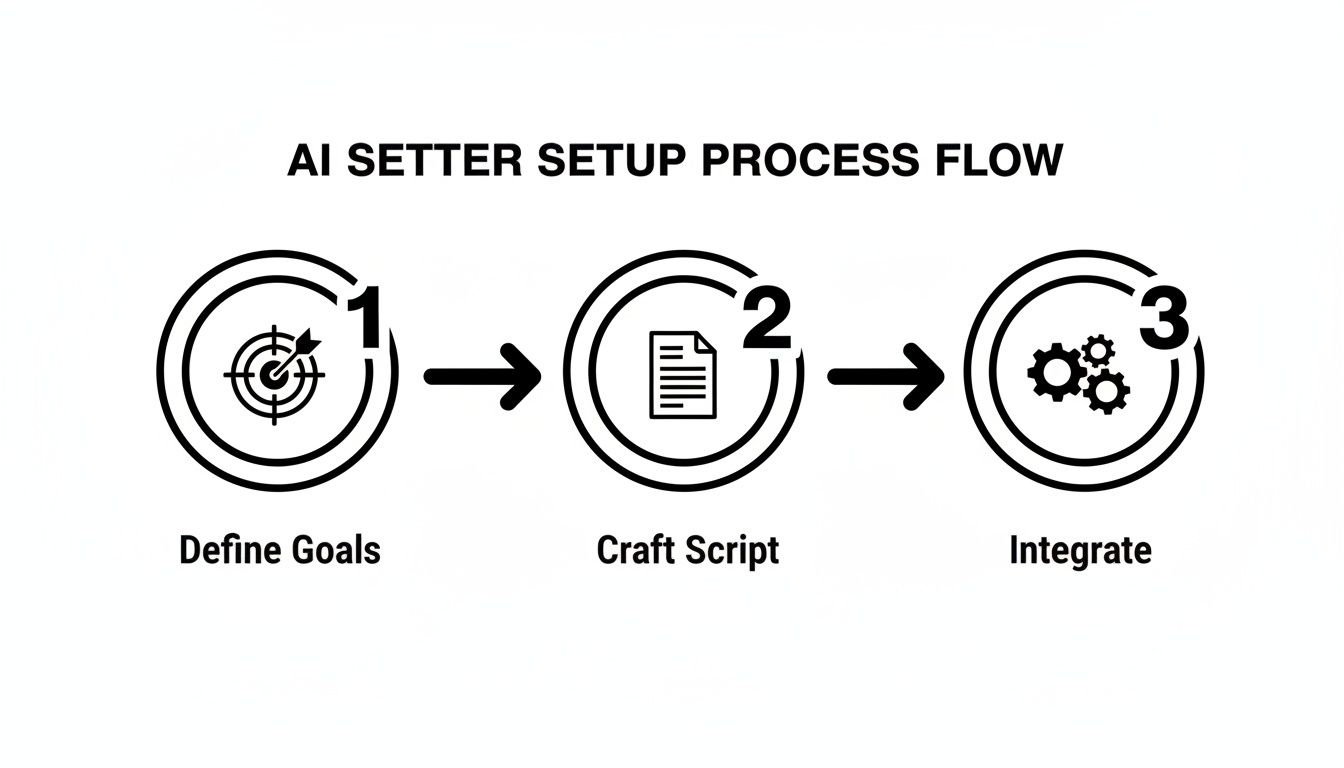
As you can see, a well-crafted script isn't just a document; it's the direct result of clearly defined goals and the bridge to a successful system integration.
Qualifying Leads with Smart Questions
Once you have their attention, it’s time to qualify. This shouldn’t feel like an interrogation—it's a discovery process. The key is to use open-ended questions that get prospects to share information freely.
- Weak Question: "Are you interested?" (This is a dead-end yes/no question).
- Strong Question: "What prompted you to look for a solution for [problem] right now?"
This approach gets them talking about their specific pain points. That gives your AI the context it needs to position a meeting as the obvious, logical next step.
Remember, the AI is your digital detective. Program it to listen for specific keywords and phrases that signal high intent. When a lead mentions "budget," "timeline," or a specific competitor, the AI should recognize these as buying signals and adjust its conversational path accordingly.
Handling Objections with Intelligence
Let’s be real: every sales conversation faces some pushback. Your AI appointment setter has to be ready to handle common objections gracefully, without sounding flustered or giving up too easily.
Pre-program intelligent responses for the objections you hear all the time:
- "I'm busy right now." A great response is, "I understand completely. This will only take a minute. Would now be better, or perhaps later this afternoon?" This respects their time while still trying to secure a moment.
- "Just send me an email." A smart reply is, "I'd be happy to. To make sure I send the most relevant information, could I just ask you two quick questions?" This turns a dismissal into a chance to continue the qualifying conversation.
Creating a Clear Call to Action
The final—and most crucial—part of the script is the call to action (CTA). This is where you actually ask for the meeting. Vague, passive CTAs will absolutely kill your conversion rates.
- Bad CTA: "When are you free to chat?" This puts all the work on the prospect.
- Good CTA: "It sounds like a brief demo would be really helpful. I have openings on Tuesday at 10 AM or Thursday at 2 PM. Does either of those work for you?"
This technique is known as the "alternative choice" close. By offering specific, limited options, you make it incredibly easy for the prospect to just say "yes." It removes decision fatigue and moves the conversation directly to a booked appointment, significantly boosting the success of your AI appointment setter.
Measuring the Success of Your AI Agent
Dropping an AI appointment setter into your workflow isn’t a “set it and forget it” move. Its real power comes from turning what used to feel like a murky business expense into a crystal-clear, revenue-generating machine. Unlike the old days of manual calling where data was scattered and often just a gut feeling, every single interaction your AI agent has is logged, analyzed, and ready for you to inspect.
This opens the door to proving your return on investment (ROI) with cold, hard numbers. You’re no longer guessing if your outreach is working; you know. By keeping a close eye on a few key performance indicators (KPIs), you can get an undeniable picture of what’s clicking, what’s not, and exactly how to tune the engine for even better results.
Core KPIs for Your AI Agent
To really understand your AI's performance, you have to look beyond just the number of calls it makes. The right metrics tell the whole story, from the first "hello" all the way to a prospect actually sitting down for their meeting. Think of these KPIs as the vital signs of your automated outreach.
Your dashboard should give you a clean, simple view of these core metrics:
- Call Connection Rate: What percentage of your calls actually result in a live conversation? A low number here might mean it's time to scrub your contact list or rethink when you're calling.
- Lead Qualification Rate: Of the people your AI speaks to, how many are identified as a good lead? This number is a direct reflection of how well your script resonates and identifies real pain points.
- Appointments Booked: This is the bottom line. It’s the raw count of qualified meetings your AI successfully puts on your team's calendar.
- Cost Per Appointment (CPA): Simply divide your total campaign cost by the number of appointments booked. This metric screams ROI. A low CPA means your AI is a hyper-efficient booking machine.
- Meeting Show-Up Rate: What percentage of those booked appointments actually happen? A strong show-up rate tells you the AI is setting solid expectations and that your automated reminders are doing their job.
A low show-up rate isn't just a scheduling headache—it's a revenue leak. Each no-show can represent hundreds or even thousands of dollars in lost opportunity. Tracking this KPI helps you find and fix issues in the handoff or reminder sequence, letting you make small tweaks that deliver a big financial punch.
How Do Your Numbers Stack Up?
Knowing your metrics is step one. Step two is putting them into context. Is your AI agent just average, or is it a top performer? While results will always shift based on your industry, offer, and lead source, having industry benchmarks gives you a solid goal to shoot for.
The table below breaks down the essential metrics you need to track to really understand your AI agent's performance and ROI. These are the numbers that matter.
Key Performance Indicators for Your AI Agent
A breakdown of the essential metrics to track the performance and ROI of your AI agent, along with industry benchmarks.
| KPI | What It Measures | Why It Matters | Industry Benchmark |
|---|---|---|---|
| Lead Qualification Rate | % of conversations that identify a good lead | Shows if your script is targeting the right pain points | 10% – 25% |
| Cost Per Appointment | The total cost to secure one booked meeting | Directly proves the financial efficiency of the system | $50 – $150 |
| Meeting Show-Up Rate | % of booked meetings that are attended | Indicates lead quality and effectiveness of reminders | 75% – 90% |
When you consistently watch these numbers, you stop thinking about appointment setting as just another operational task. It becomes a strategic growth lever you can pull, continuously optimizing to fill your calendar with genuinely qualified, high-value meetings.
Have Questions About AI Appointment Setters? We’ve Got Answers.
Adopting any new technology brings up good questions. When it comes to an AI appointment setter, most business owners have the same gut-check concerns: customer experience, system limits, and the technical lift.
Let’s get straight to the point and tackle the most common ones.
Will the AI Sound Robotic and Turn Off Customers?
This is the number one concern, and it’s a fair one. We’ve all been trapped in a robotic phone menu, and it's awful. But modern AI has come a long, long way.
Today’s systems use advanced voice synthesis to create natural, human-like conversations. They understand different accents, vary their tone, and even use conversational fillers (like "um" or "let me see") to make the interaction feel completely normal.
Most customers have no idea they’re speaking with an AI. The goal isn’t to trick anyone, but to deliver a helpful and efficient experience that feels personal, not clunky.
What Happens if the AI Gets Stumped?
Even the smartest AI will hit a question it can’t answer. The best platforms are built for this reality and have a seamless human handoff protocol.
If the AI detects a complex problem, an urgent request, or even a hint of frustration in the caller's voice, it’s programmed to instantly transfer the call to a human agent. The system gives your team member a full summary of the conversation, so the customer never has to repeat themselves.
This ensures every caller gets the right support without hitting a dead end. It’s a safety net that protects the customer experience.
Is This Going to Be a Headache to Integrate with My Software?
Not at all. Modern platforms are built for real-world businesses, not just developers. A good AI appointment setter should plug right into the tools you already use every day.
Top-tier providers offer simple, click-to-connect integrations with popular CRMs and calendars like Salesforce, HubSpot, Google Calendar, and Outlook. The setup usually takes just a few minutes and requires zero technical skill, making it surprisingly straightforward to get started.
Ready to see how an AI appointment setter can fill your calendar without adding to your payroll? Voicedial.ai delivers human-like AI agents that work 24/7 to qualify leads and book meetings, all while integrating seamlessly with your existing tools. Start your pilot with Voicedial.ai and transform your outreach today.