

In a large-scale study of 828,000 conversations, top-performing accounts qualified 31.78% of engaged leads, while the bottom quartile qualified only 0.67%. That gap isn't a model benchmark. It's an operating-system benchmark, and it shows why AI powered lead qualification succeeds or fails on response design, rule quality, routing, escalation, and feedback discipline, not on the model alone. (SetSmart's 2026 analysis of AI lead qualification)
The same dataset shows qualification rates of about 1% after 1–4 messages, roughly 7% after 5–10 messages, and around 18% after 11–20 messages. The implication is practical: an AI agent creates value not only by answering quickly, but by sustaining a structured conversation long enough to collect the information a static form or one-touch follow-up misses. (SetSmart's conversation analysis)
What AI Powered Lead Qualification Does
AI powered lead qualification is a closed-loop operating system that converts an inbound signal into a decision, an assignment, and measurable feedback. It captures the lead, enriches available information, starts a voice or chat exchange, adapts questions to earlier answers, evaluates fit and intent, writes the result to the CRM, and routes the contact to a person, queue, or nurture path.
A scoring model ranks records after capture, often from company size, territory, or form selections. Full qualification has a wider job: collect missing inputs, apply disqualifiers, handle uncertainty, request consent where required, and trigger the next operational step. The distinction matters because a high score without verified need, authority, timing, or eligibility can still produce a poor sales handoff.
The gap between top and bottom performers makes the operating-system view concrete. Top accounts qualified 31.78% of engaged leads, compared with 0.67% for the bottom quartile in the SetSmart dataset. (SetSmart's engagement-response findings) Those figures do not establish a universal target. They show how response design, decision rules, routing, and feedback discipline can determine whether a model's output becomes usable pipeline.
The qualification loop
A production workflow usually runs through six linked actions:
- Capture: Accept form submissions, calls, chats, and campaign responses.
- Engage: Begin a conversation promptly rather than wait for manual review.
- Extract: Convert answers into CRM fields for need, timing, location, authority, and consent status.
- Decide: Return a qualification outcome and a prioritization score.
- Route: Send the lead to the appropriate seller, specialist, nurture sequence, or review queue.
- Learn: Feed opportunity outcomes into threshold changes and model evaluation.
The conversation has a specific operational role. The SetSmart analysis found qualification increasing from about 1% after 1–4 messages to around 18% after 11–20 messages, supporting persistent, logically sequenced follow-up rather than one automated prompt. (SetSmart's engagement-response findings)
Operational rule: Treat every inbound signal as the start of a qualification attempt, not merely as a record to score.
Infrastructure reviews should separate a score endpoint from a system that enriches, decides, and dispatches. A resource such as Fetchin's real-time lead routing API belongs in that comparison because routing turns a model result into an operational assignment.
| Quartile | Qualification Rate | Median Time-to-First-Response | Notes |
|---|---|---|---|
| Top-performing accounts | 31.78% | Not reported in the verified dataset | Indicates strong execution across engagement and qualification |
| Median | Not reported | Not reported | A universal median isn't available in the verified data |
| Bottom quartile | 0.67% | Not reported in the verified dataset | Indicates substantial workflow or implementation weakness |
The table also marks a measurement boundary. The available study reports qualification rates, message depth, and conversation volume, but not median response times. Operators should measure latency in their own system and interpret it alongside qualification quality, rather than fill the gap with an unsupported benchmark.
The Architecture Behind Modern Qualification Systems
Top-performing accounts qualify 31.78% of leads, compared with 0.67% in the bottom quartile. That gap points to an operating-system problem, not just a model-quality problem. A modern qualification stack must capture evidence, apply controls, route decisions, and return outcomes to the next evaluation cycle.
Four components, one data path
The conversational front end manages voice or chat. It opens with an approved introduction, asks the next relevant question, detects interruptions or uncertainty, and records the prospect's answers. It should reuse information already provided in a form and stop when a lead opts out.
The CRM remains the system of record. It should retain the source campaign, contact identity, transcript, structured answers, consent flags, qualification result, score, disqualification reason, owner, and later opportunity outcome. Keeping the interaction outside the CRM leaves sales representatives with a polished exchange but no durable context for review, compliance, or model improvement.
The routing layer converts the decision into an action. A qualified insurance lead can go to a licensed representative for the relevant line of business. A lead outside the service territory can enter a clear disqualification path, while an ambiguous answer can trigger human review rather than an unsafe automated decision. A resource such as Fetchin's real-time lead routing API illustrates why assignment belongs in the architecture, not in a later manual step.
The scoring engine should produce separate fit, intent, and rule outcomes. A machine-learning model can identify patterns in historical won and lost deals, while deterministic controls enforce boundaries that the model must not override. A systematic review published in Information Systems Frontiers found predictive scoring more effective and efficient than traditional approaches because it detects patterns people often miss. (Systematic review of predictive lead scoring)
The end-to-end flow
An inbound webhook or form event creates a staging record. The conversational agent collects missing information, extracts structured values, and writes them to the CRM. Scoring then evaluates fit, behavior, and intent, while the rules layer checks disqualifiers and compliance conditions.
The routing service receives the decision, score, confidence, transcript, and metadata. It assigns the lead to an SDR queue, books a meeting, starts nurture, or escalates to a specialist. Closed-won and closed-lost outcomes complete the loop, giving RevOps evidence for testing whether the original decision produced useful pipeline.
Follow-up depth also affects architecture. Qualification agents need stateful sequences that continue from prior answers, rather than restarting the interview at every interaction. The earlier conversation-depth observation supports this design: persistence matters, but only when each question advances qualification.
The largest lift failures usually sit outside the model. Missing routing rules, inconsistent CRM fields, weak disqualification logic, and absent outcome feedback can erase the value of accurate predictions.
Designing Qualification Rules That Hold Up at Volume
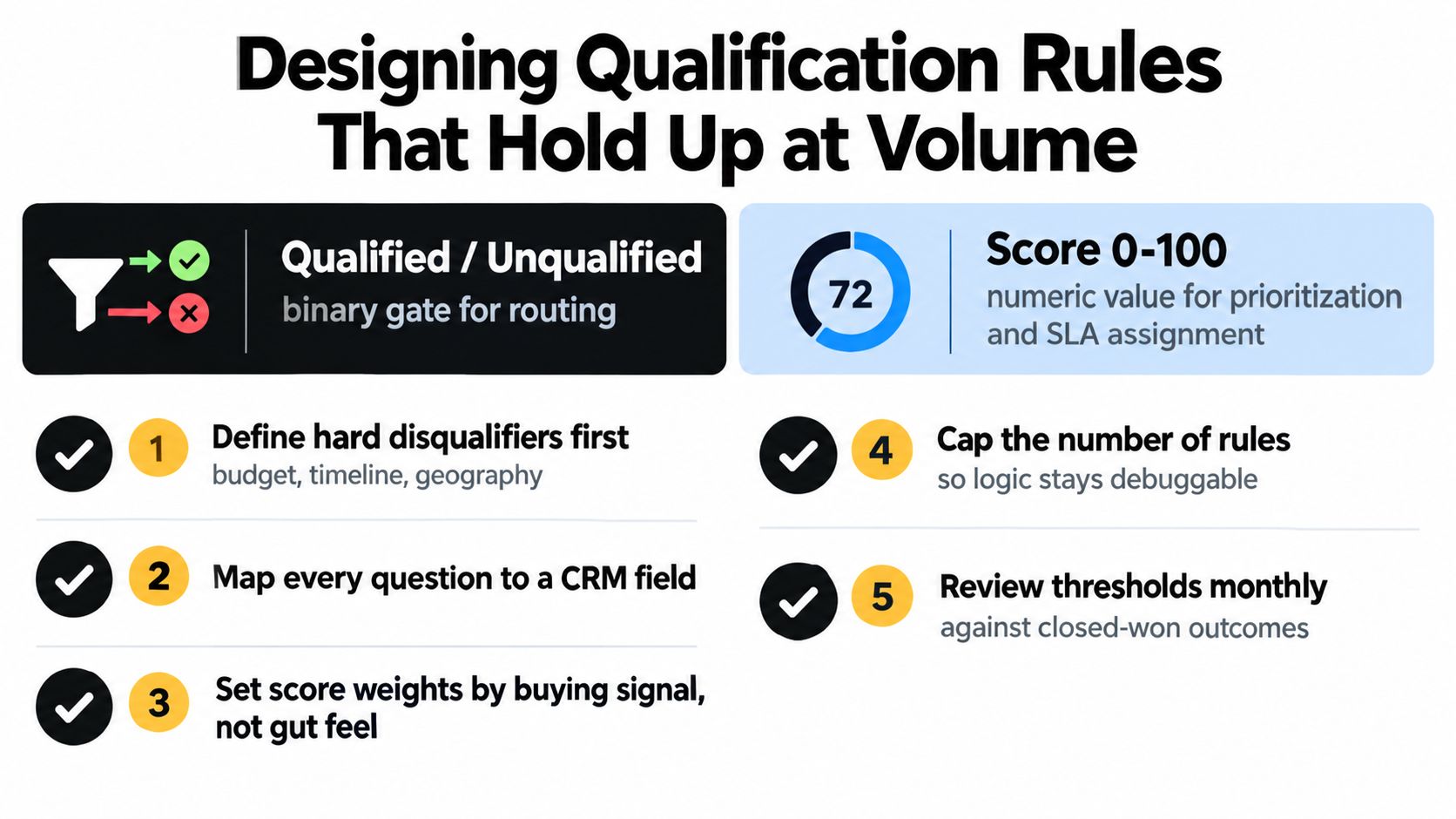
Qualification should function as a binary gate, while scoring prioritizes leads that have already passed that gate. The gate asks whether a lead may enter the sales path. The score determines which eligible lead receives attention first and what service level applies. A high score cannot compensate for a mandatory failure involving geography, consent, licensing eligibility, or serviceability.
Build the rules in layers
Start with hard disqualifiers. These are gates, not negative weights:
- Territory: Is the prospect within the supported geography?
- Eligibility: Does the request match the product, service, or regulated use case?
- Commercial fit: Does the need meet the minimum engagement conditions?
- Permission: May the business lawfully contact the person through the selected channel?
- Conflict or safety: Does the request require specialist review before automation continues?
Then define scoring inputs. Use company characteristics, stated need, behavioral intent, urgency, and conversation quality. The ZoomInfo guidance on automated lead qualification describes a closed-loop process that combines enrichment, real-time scoring, immediate routing, and feedback from closed-won outcomes. Score inputs should support a disposition, while the gate determines whether that disposition is permissible.
Add context boosters only after the core rules work. Referral source, recent engagement, product interest, and responses to a campaign can improve prioritization. None should override a hard disqualifier or conceal missing critical information.
Set thresholds around capacity
Use three operational bands:
- Auto-route: The lead satisfies every mandatory condition and provides enough evidence for immediate assignment.
- Human review: The lead may fit, but an answer is ambiguous, a field is missing, or model confidence conflicts with a rule.
- Nurture or disqualify: The lead lacks current fit, permission, urgency, or serviceability.
Set cutoffs against outcomes and seller capacity, not because a round number looks tidy. Compare each band with closed-won and closed-lost results, then adjust the thresholds to match the queue's ability to respond. An auto-route band that generates more conversations than representatives can handle is producing backlog, not useful qualification.
The two-o'clock test: A stranger should receive the same safe, explainable disposition outside business hours as during a staffed shift.
Test interruptions, incomplete answers, contradictory information, opt-out language, unsupported requests, and unusual field combinations. These cases expose whether the rules operate as a closed loop: the system should preserve evidence, make a defensible decision, route it appropriately, and learn from the eventual outcome. A high-volume design is ready when edge-case behavior is as deliberate as the happy path.
Integration and Automation From Capture to Closed-Won
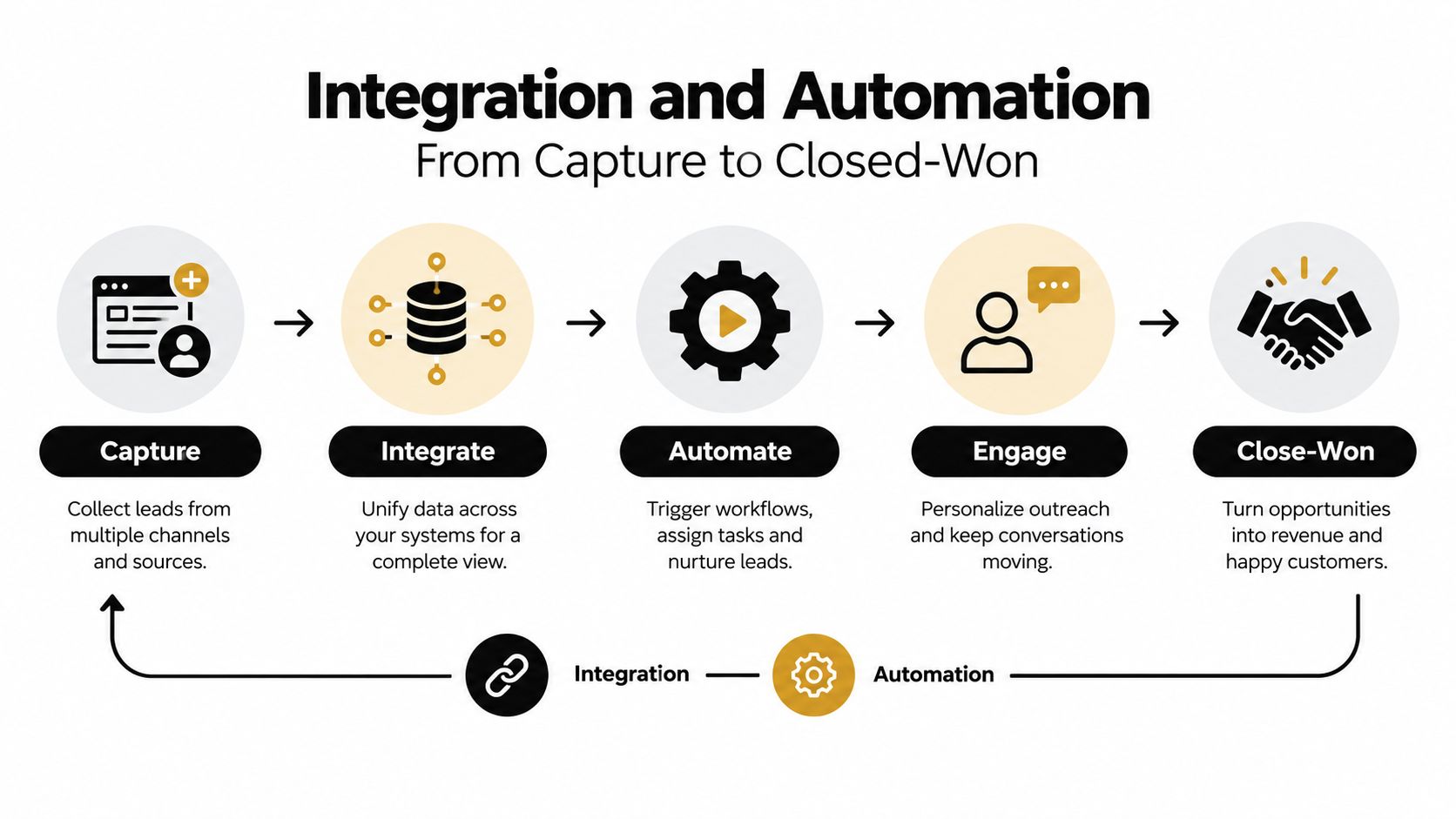
Integration should preserve the existing lead journey while adding decisions at the points where delay or ambiguity costs pipeline. Start with a staging object rather than writing unvalidated conversational output directly into final CRM fields.
A controlled handoff sequence
Capture forms, web chat, inbound calls, and campaign events through webhooks. Store the original payload, source, timestamp, consent signal, and deduplication key. This gives RevOps an audit trail when a lead appears in multiple form variants or channels.
Enrich the record with firmographic, contact, and intent information. Keep sourced values separate from AI-inferred values so a representative can see what the prospect provided.
Qualify through the voice or chat agent. The agent should write structured fields, not only a summary. Store the transcript or call reference, question-level answers, confidence indicators, disqualification reason, and escalation status.
Route and book only after the gate has passed. The receiving queue should get the transcript, score breakdown, consent flags, source campaign, and next action. A handoff without context forces the representative to repeat the conversation, which weakens trust and wastes the speed advantage.
Close the loop without corrupting it
When an opportunity changes stage, record the outcome against the original qualification event. Closed-won and closed-lost outcomes should be connected to the score, rule path, source campaign, handoff type, and time between qualification and seller contact.
Disqualification reasons should flow back to marketing. If a campaign generates many contacts outside the service area, the problem may be targeting rather than sales execution. If leads meet the gate but stall after handoff, the routing threshold or seller queue may need review.
Common integration failures are mundane but expensive:
- Timezone handling: A local-time rule can send calls at an inappropriate hour or delay an urgent request.
- Duplicate detection: The same person can enter through several forms and create competing assignments.
- CRM rate limits: Peak inbound periods can cause missing updates or delayed routing.
- Partial writes: A route can trigger before consent or mandatory fields are stored.
- Calendar mismatch: A booking action can succeed while the CRM fails to record the appointment.
A weekly feedback process is more valuable than a one-time model launch. The system has to reflect current product definitions, territories, campaigns, and sales outcomes, not just the historical data used during setup.
KPIs That Predict Real Pipeline Lift
A qualification dashboard should answer one question: Does the system create more sales-ready conversations that sellers can work effectively? Answer rate matters, but it is not revenue. Qualification rate can also mislead when the system sends poor-fit contacts to a full sales queue.
Track five measures together:
- Answer rate: The share of attempted calls answered by a person within the defined response window. Separate live conversations from voicemail, wrong numbers, abandoned calls, and explicit opt-outs.
- Qualification rate: The share of engaged leads marked sales-ready. Compare results by source, product, operator configuration, geography, and rule version.
- MQL-to-SQL conversion: The proportion of marketing-qualified leads that become sales-qualified under agreed definitions. This tests whether an AI label survives seller review.
- Time-to-first-contact: The time from the inbound event to the first human or AI interaction. Report the average and distribution, since delayed leads can disappear inside an average.
- Cost per qualified lead: Total acquisition and qualification cost divided by leads that pass the sales-ready gate. It is more useful than cost per lead when channels produce uneven fit.
Read the spread, not just the average
The verified operator dataset reports 31.78% for top-performing accounts and 0.67% for the bottom quartile. (SetSmart's operator performance data) That gap is the operating-system problem: qualification performance depends on signals, rules, routing, seller acceptance, and feedback, not scoring alone. The dataset does not report a universal median, answer-rate benchmark, cost benchmark, or time-to-first-contact standard. Establish those measures from your own baseline.
| KPI | Top Quartile | Median | Bottom Quartile | Why It Matters |
|---|---|---|---|---|
| Qualification rate | 31.78% | Not reported | 0.67% | Shows the gap between effective and weak execution |
| Answer rate | Not reported | Not reported | Not reported | Shows whether the conversation begins at all |
| MQL-to-SQL conversion | Not reported | Not reported | Not reported | Tests whether marketing qualification survives sales review |
| Time-to-first-contact | Not reported | Not reported | Not reported | Exposes delay before engagement |
| Cost per qualified lead | Not reported | Not reported | Not reported | Connects acquisition and qualification spend to usable pipeline |
Review answer rate, qualification rate, and response latency weekly. Review cost per qualified lead, source quality, closed-won outcomes, and threshold drift monthly. Attribute a multi-touch lead to the qualification event that created the accepted handoff, while retaining campaign history for channel analysis.
The main warning signal is divergence. If qualification rises while MQL-to-SQL conversion falls, the system is likely overscoring. If answer rate remains healthy but qualified leads rarely become opportunities, inspect question design, disqualifiers, and routing. A closed-loop KPI set exposes where lift is lost, from initial engagement through seller acceptance and revenue.
Industry-Specific Qualification Patterns
A generic qualification script fails because each regulated or service-heavy market has different definitions of fit. The agent needs a shared operating pattern, but the questions, gates, and escalation triggers must reflect the consequences of a wrong handoff.
| Industry | Key Qualification Fields | Top Disqualifier | Human Handoff Trigger |
|---|---|---|---|
| Insurance | Consent, coverage area, line of business, policy need | Unsupported geography or missing permission | Ambiguous coverage need, licensing concern, or sensitive case |
| Home services | Service ZIP, job scope, property status, urgency | Service outside territory or unsupported job type | Emergency language, unclear scope, or safety concern |
| Medical devices | Physician role, diagnosis context, product fit, authorization status | No clinical or commercial pathway for the device | Clinical uncertainty, authorization question, or specialist request |
| Credit repair | Credit situation, debt type, state residency, consent | Unsupported state or incompatible debt profile | Regulatory ambiguity or request for individualized advice |
| Legal intake | Case type, jurisdiction, timing, conflict indicators | Outside practice area or jurisdiction | Limitation concern, conflict signal, or complex factual dispute |
Insurance and home services
Insurance qualification should verify permission and geography before it optimizes sales priority. A person expressing strong interest isn't automatically routable if the representative can't serve the location or the interaction lacks the required consent signal.
Home services need a different sequence. Service ZIP and job scope establish serviceability, while urgency can change the route immediately. An emergency phrase shouldn't wait for a leisurely score calculation, but it also shouldn't trigger an unapproved promise or unsafe instruction. The handoff should carry the exact urgency language and the information already collected.
Medical devices and financial intake
Medical-device conversations require a strict boundary between commercial qualification and clinical judgment. The agent can collect the relevant role, use case, diagnosis context, and authorization status, then escalate uncertainty to an appropriately trained human. It shouldn't improvise clinical conclusions.
Credit-repair intake has a similar governance challenge. State residency and debt type can determine whether a request belongs in the supported workflow, while a human should review ambiguous situations rather than letting a numerical score override regulatory logic. The Prospeo discussion of AI lead qualification is useful here because it distinguishes scoring from qualification, including the need for missing-input collection, disqualifiers, edge-case escalation, and next actions.
Legal intake
Legal systems should screen for practice area, jurisdiction, timing, and conflicts before attorney assignment. The human handoff trigger is not merely a high score. It may be a limitation concern, a potential conflict, or a fact pattern that needs legal judgment.
Across all five verticals, the highest-value routing field is the one that determines who can safely act next. A detailed transcript can't compensate for a missing territory, jurisdiction, authorization, consent, or serviceability field.
Common Failures and a 30-Day Validation Checklist
Weak AI qualification systems fail in repeatable ways. A CRM report, call review, or routing audit can usually isolate the failure before the team blames the model.
| Failure Mode | Diagnostic Signal | Operational Fix |
|---|---|---|
| Silent voice agent | Calls connect but conversations do not progress | Review turn-taking, interruptions, fallback prompts, and transfers |
| Overscoring cold lists | High scores produce few accepted opportunities | Reweight intent and fit against closed-lost records |
| No CRM feedback loop | Scores remain unchanged as outcomes shift | Sync closed-won and closed-lost results to each qualification record |
| Brittle routing rules | Leads reach the wrong queue or stall | Add territories, ownership fallbacks, and human-review paths |
| Missing opt-out compliance | Suppressed contacts remain active | Make consent and suppression states routing gates |
| Stale model training | New campaigns differ from historical performance | Review thresholds and segment results against current outcomes |
A generic script also fails when its first questions test the wrong constraint. A home-service company that asks about budget before confirming service territory can reject a qualified lead and frustrate the prospect. Qualification must collect the facts that determine fit and the next safe action.
The verified operator gap provides a demanding reference point, 31.78% versus 0.67%, but it is not a performance promise. (SetSmart's performance-gap analysis) Use the contrast to test whether your closed-loop workflow behaves more like a top or bottom operator, then verify the causes in your own records.
A practical 30-day sequence
Week one: Connect scoring to held-out opportunities. Confirm that every input exists at decision time and that the binary gate and numeric score produce separate, auditable outputs.
Week two: Audit routes against closed-lost records. Check territory errors, missing consent, incorrect product assignment, and leads that should have entered human review.
Week three: Stress-test escalation with simulated spikes, incomplete answers, duplicate records, and unusual conversations. Failure states should create visible queues rather than silent drops.
Week four: Compare qualification rate, MQL-to-SQL conversion, answer rate, response latency, and cost per qualified lead with the baseline. Scale only when decisions remain explainable and receiving teams can act on them.
Implementation quality creates the gap. A governed workflow with clear gates, reliable routing, and closed-won feedback can outperform a more advanced model attached to a broken process.
Voicedial.ai provides customizable AI voice agents for inbound and outbound follow-up, real-time qualification, common-question handling, and appointment booking. Its dashboard reports call outcomes and performance trends. Visit Voicedial.ai to review the platform and assess voice qualification against your CRM and routing workflow.